By early 2026, the global AI in marketing market has matured into a $45.83 billion powerhouse, as reported by MarketsandMarkets. We have moved past the era of "cool demos" and into the era of industrial orchestration. Today, 88% of enterprise marketing teams are using AI to automate core functions, but a new challenge has emerged: the Sea of Sameness. When every brand uses the same base models, creative output starts to look dangerously identical. To break through, the world’s most successful brands are leveraging a combination of Midjourney for raw aesthetic power and Adobe Firefly for enterprise-grade safety. This playbook outlines how to scale hyper-individualized creative that captures attention without sacrificing legal compliance or brand soul.
Bypassing the Uncanny Valley: Midjourney for Rapid Storyboarding
In 2026, the most sought-after marketing role is the Marketing Engineer—the person who can chain prompts and APIs together to build automated workflows. For these professionals, Midjourney for marketing 2026 is the gold standard for high-fidelity asset generation. While legacy tools struggled with the "uncanny valley," Midjourney’s latest iterations produce cinematic-quality visuals that are indistinguishable from professional photography.
Brands are primarily using Midjourney for two specific phases of the creative cycle: rapid storyboarding and social creative experimentation. Instead of waiting weeks for a design agency to return with concepts, teams use Midjourney to generate hundreds of mood boards in minutes. This allows for a "fail fast" approach where only the most resonant visual directions move into production.
"AI isn't replacing the marketing team; it’s replacing the 'marketing factory.' The boring parts—the logistics, the resizing, the versioning—those are gone. The strategy and the soul remain human." — Scott Brinker, Chiefmartec
However, pure Midjourney workflows often hit a wall in the enterprise: commercial safety. Because Midjourney is trained on broad internet data, its output can occasionally stray into murky copyright waters. This is where a multi-tool stack becomes essential for modern brands.
Adobe Firefly: Solving the 2026 Copyright and Legal Liability Issues
As AI adoption reached 88% in the Salesforce State of Marketing 10th Edition, legal departments became the primary bottleneck. For high-stakes campaigns, Adobe Firefly for business has become the mandatory standard. Unlike other models, Firefly is trained exclusively on licensed images from Adobe Stock and public domain content, providing brands with commercial indemnity.
In 2026, many brands are using a "Bake and Shield" workflow:
- Bake: Use Midjourney to explore "weird" and "original" creative concepts that stand out.
- Shield: Use Adobe Firefly to recreate those concepts using commercially safe training sets, ensuring the final assets can be trademarked and used in global TV or OOH campaigns.
This approach addresses the AI Fatigue reported by the Retail Tech Innovation Hub, where 44% of consumers express cynicism toward brands using generic AI-generated imagery. By using Firefly’s Structure Reference and Style Reference features, brands can maintain a unique "Brand DNA" while remaining legally bulletproof.
Hyper-Individualization: The Nutella and Coca-Cola Model
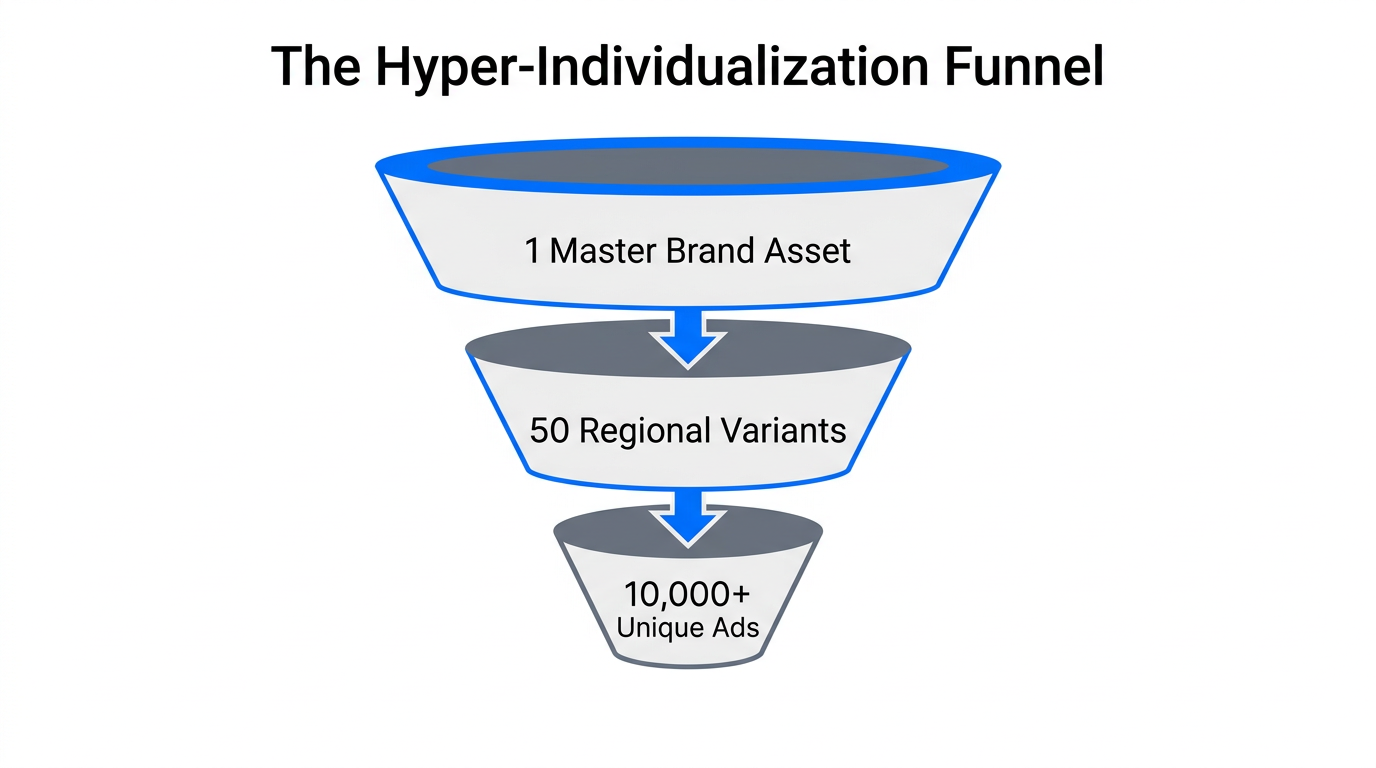
The true power of hyper-individualization marketing isn't just making one good image; it’s making seven million of them. Nutella (Ferrero) pioneered this by using AI to design 7 million unique labels for jars in Italy. The result? All 7 million jars sold out within a month. This level of scale is humanly impossible for even the largest design agencies.
Similarly, Coca-Cola launched the "Create Real Magic" platform, which turned fans into creators. This generated over 120,000 unique submissions in weeks. In 2026, the most successful brands don't just broadcast a single message; they provide a generative framework that allows the brand to adapt to every individual consumer's preference.
| Feature | AI-First Team (2026) | Traditional Agency | Minutes to Hours | Weeks to Months | Fixed Software Subscription | High Retainer ($$$) | Infinite | Limited by Headcount | Model-driven (Stable) | Human-driven (Variable) |
|---|
To implement this, brands are shifting away from manual asset creation to Agentic AI workflows. As noted by Zigment, organizations using agentic AI—where the AI takes action on data rather than just generating text—have seen a 32% reduction in CAC and a 41% increase in revenue.
Synthetic Personas: Testing Resonance Before the Spend
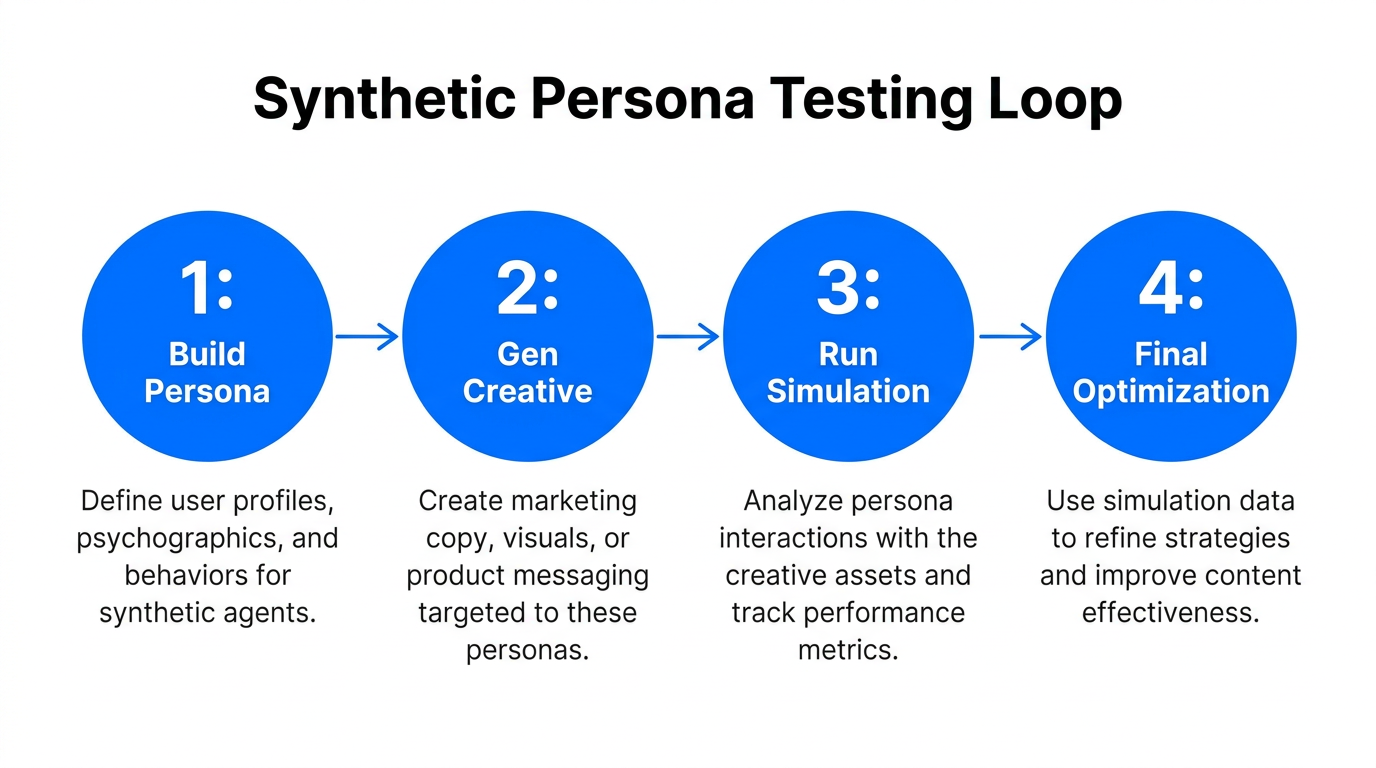
One of the biggest shifts in 2026 is the move from "A/B testing" to Synthetic Testing. Instead of spending thousands of dollars on Meta Ads to see which creative works, brands are using synthetic customer personas. These are AI digital twins of a brand's actual customer base, built from proprietary data and first-party research.
By running a Midjourney-generated ad through a panel of synthetic personas, a brand can get an instant "vibe check" on emotional resonance. This is critical because, as the Spaghetti Agency notes, some AI campaigns have been slammed as "soulless." Synthetic testing allows you to catch that lack of soul before it hits the public.
For example, you might use Stormy AI's audience analysis tools to determine which customer segments are most likely to respond to a specific visual style, then identify the perfect real-world creators who can add that essential "human touch" to your AI-generated concepts.
"The 2026 marketing playbook is about using AI to collapse the production layer so that humans can focus entirely on the vision."
The 80/20 Rule: Mastering AI Creative Automation
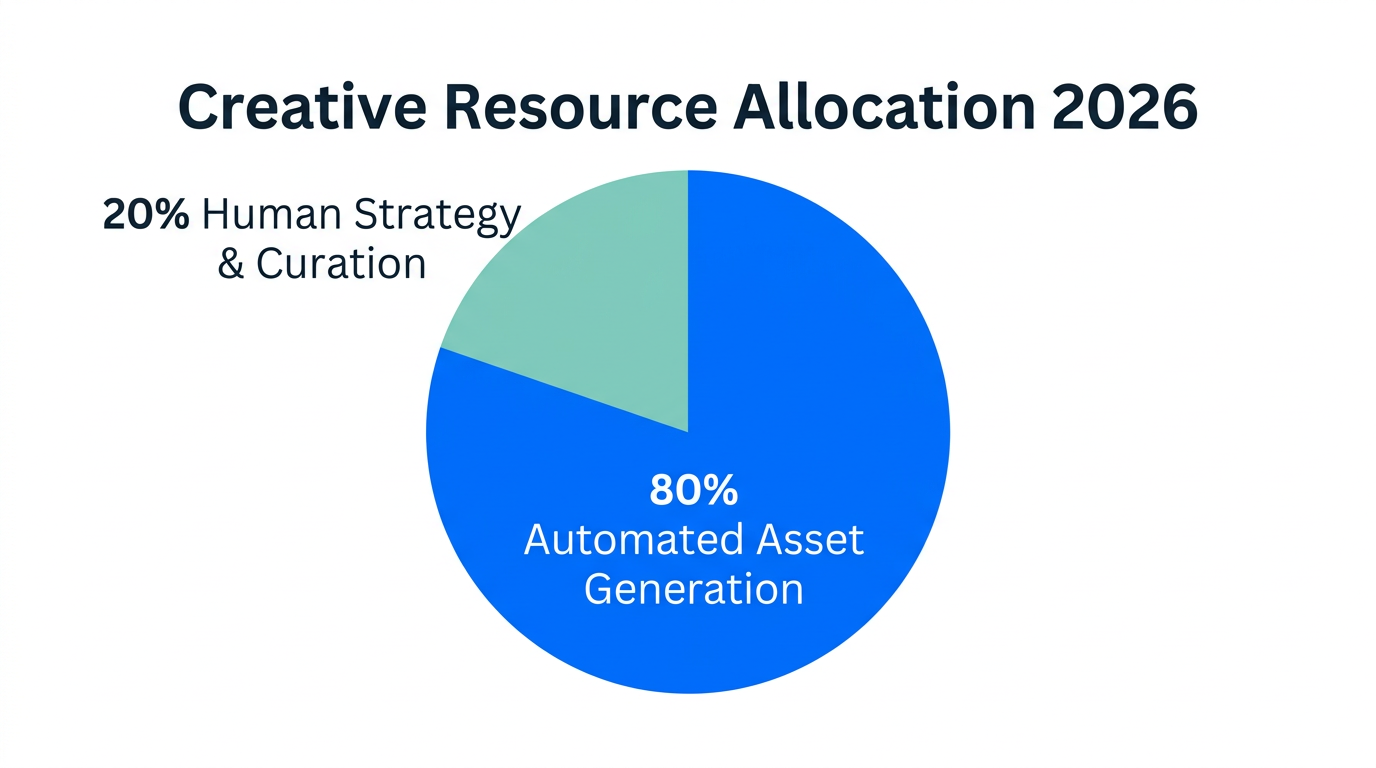
To scale effectively without losing quality, top brands follow the 80/20 Rule: Automate 80% of the production (the "boring" logistics) and focus human creativity on the 20% that provides the "soul." According to Gartner Marketing Practice, 64% of marketing tasks being automated today are administrative or clerical, such as resizing, tagging, and versioning.
Step 1: Audit the "Boring"
Identify every repeatable task that takes more than two hours. If you are manually turning a hero video into 15 different aspect ratios for TikTok and Instagram, you are losing money. Use orchestration tools like Make.com to automate these pipelines.
Step 2: Build a Content "Loom"
Create a centralized workflow where a single creative concept is automatically remixed. A "Marketing Engineer" might use Airtable as the brain, triggering Midjourney for images, Claude for copy, and Brandfolder for storage.
Step 3: Establish a Brand Bible PDF
To ensure AI creative automation doesn't drift, upload your Brand Bible to your AI’s knowledge base. This ensures that every asset generated by Midjourney or Firefly adheres to your specific hex codes, tonal guidelines, and stylistic taboos.
Conclusion: The Boring Truth of 2026 Marketing
The "boring truth" of 2026, as discussed in Medium/Naresh Khadka, is that AI has not fired the marketing team; it has simply changed the job description. The production layer has collapsed. A team that once required ten specialists now requires three Full-Stack Marketers acting as architects of an AI-powered system.
By leveraging Midjourney for marketing 2026 and Adobe Firefly for business, brands can achieve the kind of hyper-individualization that was once reserved for tech giants with infinite budgets. Whether you are scaling to 7 million labels or just trying to find the right UGC creators on Stormy AI to amplify your brand voice, the goal remains the same: use the machine for the scale, and the human for the soul.
As we move further into 2026, the winners won't be the ones with the best prompts, but the ones who build the most robust systems for AI creative automation. It’s time to stop generating and start orchestrating.