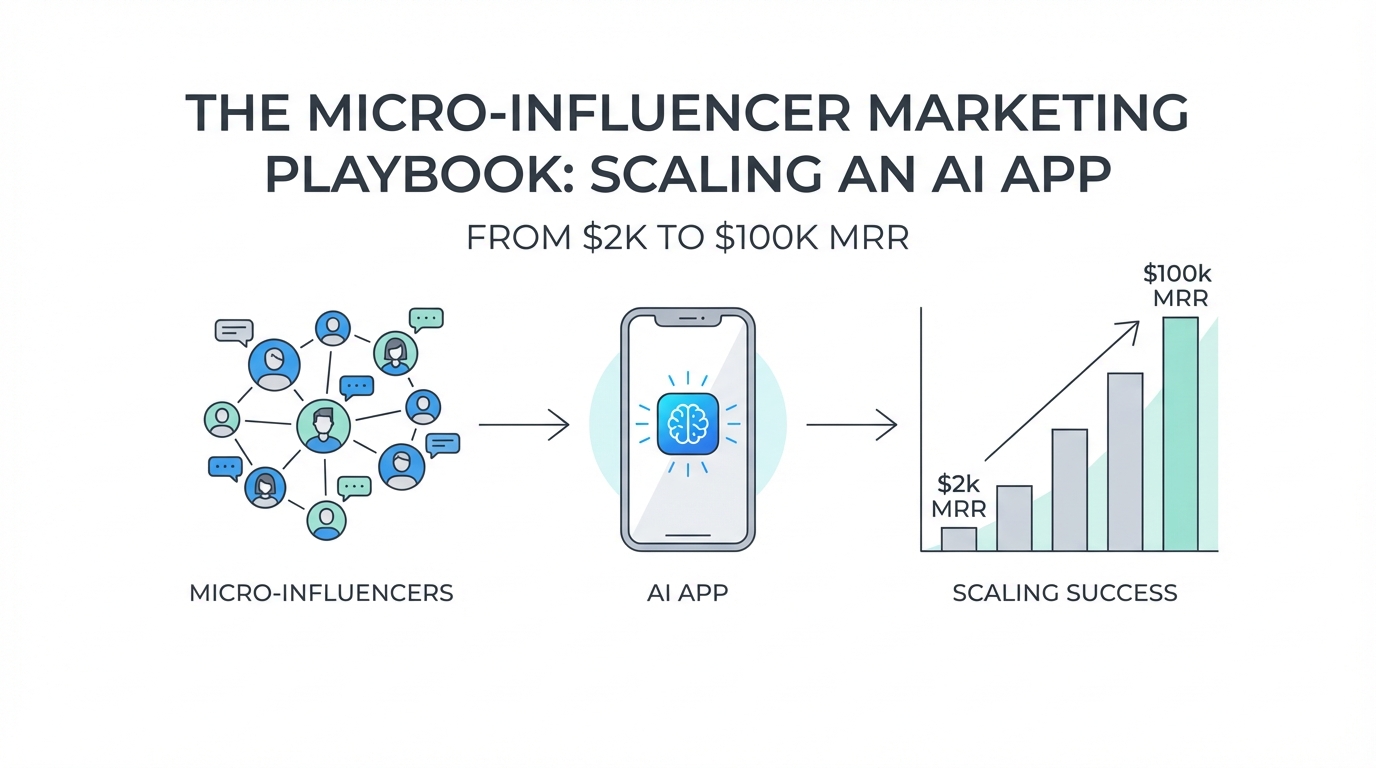
Scaling a consumer app from a handful of users to a six-figure monthly recurring revenue (MRR) is rarely a linear journey. Most founders find themselves trapped in a cycle of product obsession, tweaking features while ignoring the engine that actually drives growth: distribution. Julian Alvarez, the founder of Jungle (an AI-powered study platform), broke this mold by shifting his focus entirely to distribution for weeks at a time. The result was a meteoric rise from $2,000 MRR to $15,000 MRR in just 14 days, eventually stabilizing at a massive $80,000 to $100,000 MRR. This wasn't achieved through massive ad spend on Google Ads or complex algorithmic manipulation; it was the result of a highly tactical, repeatable micro-influencer marketing strategy.
Why Micro-Influencers Offer Better ROI for Mobile Apps
When most app developers think of influencer marketing, they envision celebrity shoutouts or creators with millions of followers. However, Jungle’s success proves that the real growth engine lies in the "sweet spot" of creators with 5,000 to 100,000 followers. In the influencer marketing for apps space, these micro-influencers offer significantly better CPMs (Cost Per Mille) and a much higher influencer ROI compared to their macro counterparts. Large influencers often command five-figure fees for a single post that may or may not resonate with their broad audience. In contrast, micro-influencers typically have a highly engaged, niche-specific following that views the creator as a peer rather than a distant celebrity.
By targeting students in specific disciplines—such as medical students on TikTok—Jungle was able to tap into existing communities where the product's value proposition (AI-generated flashcards) felt like a life-saving "alpha" tip rather than a cold advertisement. One medical student creator, Agogo, produced content so authentic and compelling that it generated over 150 million total views across several videos. This level of reach from a micro-influencer is a force multiplier for startup budgets, allowing founders to diversify their risk across dozens of creators rather than betting the farm on one big name.
The Multi-Video Deal: Maximizing Frequency and Lowering Costs

A common mistake in influencer marketing for apps is the "one-and-done" post. Brands pay for a single video, and if it doesn't go viral immediately, they abandon the creator. Jungle’s playbook suggests a more sophisticated approach: the multi-video deal. By contracting a creator for three or more videos upfront, you can negotiate a lower cost per video while simultaneously increasing brand frequency. This is a tactic often managed through Stormy AI, which is an AI-powered search engine for creator discovery that helps brands identify creators who are already seeing traction in their specific niche using natural-language prompts.
Julian found that success often came in waves. A creator might post one video that does reasonably well, but the second or third video—honing in on a specific pain point like "prepping for finals in 24 hours"—is the one that actually goes 10x viral. By locking in multiple videos, you give the creator space to experiment with different viral hooks and formats without the pressure of a single-post performance. This strategy also helps mitigate the high cost of acquisition typically found on Meta Ads Manager, where cold traffic often requires multiple touchpoints before converting into an app install.
How to Build a Brief: Viral Hooks vs. Creative Freedom

The core of a successful micro-influencer marketing strategy is the brief. If you give a creator too much freedom, they might miss the product's core value proposition. If you give them too little, the content feels staged and inauthentic. To scale Jungle, the team developed a briefing process that focused on content intuition. They didn't just tell creators what to say; they provided examples of hooks that had already worked in the niche while encouraging the creator to adapt the narrative to their own voice.
Step 1: Identify the Pain Point
The brief should always start with the problem. For Jungle, the problem wasn't just "studying"; it was the motivation to show up every day and the tediousness of creating study materials. By focusing on how the AI generates practice questions from a simple PDF upload, the creators could speak to a universal student frustration: time management.
Step 2: Provide Tested Hooks
Give creators 3-5 potential opening lines. Examples include "Stop wasting time making flashcards" or "How I passed my med school exams using this one tool." These hooks are designed to stop the scroll on Twitter or TikTok, where the first two seconds determine the video's fate. Using Stormy AI to analyze audience demographics and engagement can help you find which hooks are currently trending among competitors or similar apps.
Step 3: Allow Creative Expression
Once the hook and the product demo (the "magic moment") are defined, the rest of the video should be up to the creator. Whether they prefer a "day in the life" style or a direct-to-camera tutorial, their audience will respond best to the format they are already known for. User-generated content (UGC) works because it feels native to the platform; over-producing it is the fastest way to kill your conversion rate.
Minimum View Clauses: Protecting Your Marketing Budget

One of the hardest lessons learned during Jungle's growth was that not every creator—even those with great past performance—will deliver a hit. Influencer marketing can feel like a lottery. To mitigate this, savvy app marketers are now implementing minimum view clauses in their contracts. This ensures that if a video significantly underperforms, the creator is obligated to produce additional content or provide a partial refund.
While this might seem aggressive, it is a necessary step when moving from how to find influencers in your niche to running a professional marketing operation. It shifts the relationship from a simple transaction to a performance-based partnership. If you are investing thousands of dollars, you need a guarantee of eyeballs. Additionally, vetting creators through Stormy AI to get an AI-powered quality report—which automatically detects fake followers and engagement fraud—is essential to avoid accounts with inflated follower counts but zero engagement.
Transitioning from Organic Hits to a Repeatable UGC Strategy
As Jungle grew, they realized that relying on a few viral hits was not a long-term plan. They transitioned to a massive UGC content engine, employing 30 to 40 creators to post 400 videos per week across various brand-owned accounts. This high-volume approach aims for a "saturation effect." The goal is to make the app appear ubiquitous within the target community. At this scale, the team achieved $2 CPMs, which is incredibly efficient compared to traditional digital advertising.
However, Julian warns of the "saturation problem." When every third video on a student's feed is a thinly veiled ad for the same study tool, authenticity begins to erode. This is why finding UGC creators for mobile app ads requires a constant influx of new faces and perspectives. You cannot simply run the same three creators for a year; you must continuously discover new talent to keep the brand feeling fresh and "discovered" rather than forced.
Retention: Why Distribution Only Works if the Product Sticks

You can have the best influencer roi in the world, but if your app’s retention is poor, you are simply pouring water into a leaky bucket. Jungle’s strategy involved a heavy emphasis on "time to magic." They optimized their onboarding so that a user could upload a document directly from the landing page and see AI-generated questions immediately—before even signing up. This interactive demo significantly lowered the barrier to entry.
Moreover, they incorporated gamification elements, like a growing tree that responds to study progress, which increased engagement by 70%. This visual component served a dual purpose: it kept users coming back (retention) and acted as an organic growth loop. When a student uses the app in a library and others see a tree growing on their screen, it sparks a conversation. This physical-world virality contributes to the 30-40% of new users who come via word-of-mouth. To manage these complex user journeys and paywalls, tools like Superwall are often used to test which onboarding flows result in the highest long-term retention.
Conclusion: The Playbook for Future Growth
The journey from $2k to $100k MRR is not about finding a single "growth hack" and riding it forever. It is about a relentless cycle of experimentation. Julian’s story with Jungle highlights that while micro-influencer marketing strategy can provide the initial spark, building a sustainable business requires transitioning those insights into a repeatable system. Founders must develop their own content intuition, vet their creators rigorously, and ensure the product delivers on the viral promise within seconds of the first download.
If you are currently struggling to find traction, take the advice Julian received: Don't touch your product for two weeks. Focus purely on distribution. Use Stormy AI to set up an autonomous AI agent that discovers, outreaches, and follows up with creators on a daily schedule, set up multi-video deals, and start testing hooks. If you can get 30 to 100 new users in the door every week through these methods, you will finally have the data you need to build a product that people actually care about. Growth is a skill—and like any skill, it requires getting your hands dirty, failing frequently, and eventually hitting that one home run that changes everything.