Scaling with Meta Advantage+ Shopping Campaigns: The 2026 Guide to AI-Driven Growth
Master Meta Advantage+ Shopping Campaigns in 2026. Learn how AI-driven customer acquisition is delivering 22% higher ROAS and why manual targeting is obsolete.
In 2026, the era of the "manual media buyer" has officially ended. If you are still meticulously selecting interests like "Yoga" or "Organic Food" in your Meta Ads Manager, you aren't just behind the curve—you are actively losing money. Today, Meta Advantage+ Shopping Campaigns represent the pinnacle of AI-driven customer acquisition, moving away from granular human inputs and toward a system where the algorithm finds your customers for you. Recent data from Coinis indicates that advertisers embracing these automated environments are seeing an average 22% higher return on ad spend (ROAS) compared to traditional setups.
This guide provides a strategic transition plan for brands looking to scale their Facebook automated ads strategy. We will explore why manual targeting is a relic of the past, how to implement the 10-30% testing rule, and how to fuel Meta's AI with high-quality creative to achieve sustainable growth in 2026.
Why Manual Interest-Based Targeting is Obsolete in 2026
The shift toward scaling Facebook ads in 2026 is driven by one core reality: Meta's AI is smarter than your best media buyer. When you apply narrow interest filters, you are essentially putting blinders on an algorithm that can see billions of data points. By restricting the audience, you prevent the AI from finding "lookalike" behaviors that don't fit into a pre-defined category but exhibit high purchase intent.
"Automation is not a replacement for strategy; it is an accelerator that requires the right data fuel to succeed."
Industry benchmarks for 2026 show that 67% of companies have already shifted their primary budgets toward AI-first tools. According to NoFluff, the projected click-through rate (CTR) for AI-optimized campaigns has risen to 1.8%, up from 1.51% just two years ago. This efficiency gain isn't just about targeting; it's about relevance. The AI understands which creative resonates with which user in real-time.
| Metric | Manual Campaigns | Advantage+ Shopping |
|---|---|---|
| Avg. ROAS Improvement | Baseline | +15% to +22% |
| Conversion Rate | ~8.2% | 9.0%+ |
| Management Time Redux | 0% | 60% |
| Targeting Method | Interests/Behaviors | Broad/AI-Driven |
Step-by-Step Implementation of Advantage+ Shopping Campaigns
For e-commerce brands using platforms like Shopify, the Meta Advantage+ Shopping (ASC) tool is the most powerful growth lever available. Unlike standard campaigns, ASC consolidates your testing and scaling into a single, high-volume environment.
Step 1: Account Consolidation
AI performs best when data is consolidated. Move away from hundreds of micro-targeted ad sets. In 2026, the "Power 5" philosophy has evolved into total simplification. Identify your top-performing products and group them into a single ASC campaign to give the AI the 50 conversions per week it needs to exit the learning phase.
Step 2: Creative Diversification
Since the AI handles the targeting, your only job is the creative. You must provide a mix of formats: static images (which still account for 60-70% of conversions), Reels-ready short-form video, and dynamic carousels. Use tools like Motion to analyze which visual hooks are stopping the scroll.
Step 3: Setting Spending Guardrails
A common mistake in Facebook automated ads strategy is "setting and forgetting." AI can be aggressive; on a high-intent day, it may overspend by up to 75% if limits aren't set. Use Bïrch (formerly Revealbot) to set automated rules that pause underperforming creative or cap daily spend based on ROAS fluctuations.
The 10-30% Rule: Transitioning from Manual to AI

Experts like Tara Zirker from the Successful Ads Club recommend a phased approach. Do not switch 100% of your budget to Advantage+ overnight. Instead, allocate 10-30% of your total budget to an Advantage+ Shopping test campaign while keeping your "control" manual campaigns running.
Monitor the performance over a 14-day window. If the ASC campaign achieves a lower Cost Per Acquisition (CPA), gradually shift budget from the manual campaigns to the automated ones. This "scientific method" approach prevents revenue dips while allowing the AI to gather the first-party data it needs to optimize.
"The top performers in 2026 achieve a median CPC of $0.30–$0.40 by letting the AI handle the bidding auctions that humans are too slow to manage."
Using Advantage+ Leads to Reduce CPL
While e-commerce gets most of the spotlight, service-based businesses are seeing massive gains with Advantage+ Leads. By allowing Meta's AI to automatically reallocate budget toward high-intent "Instant Forms" and automated chat sequences, brands are slashing their lead costs.
A 2026 case study on a fitness lead gen brand showed a 12% reduction in Cost Per Lead (CPL) after moving to an automated leads setup. The AI was able to identify which users were likely to complete a form versus those who were just "window shopping." This level of predictive analytics is impossible to replicate with manual targeting.
Maintaining Brand Voice in the Age of Generative AI
Meta now offers native generative AI tools for background expansion and dynamic copy rewriting. While these tools are incredible for scaling Facebook ads 2026, they come with a risk: genericism. Akvile DeFazio of AKvertise notes that while AI automates the testing of 150+ variations, it doesn't inherently understand your unique brand voice.
To succeed, you must provide the AI with strict messaging guidelines. Combine your internal brand standards with AI's speed. For instance, using UGC (User-Generated Content) is essential for maintaining authenticity. To find the right creators to fuel your automated campaigns, platforms like Stormy AI streamline the process of sourcing, vetting, and managing influencers who can produce the high-volume creative that Advantage+ requires.
The 2026 AI Facebook Ads Audit Framework
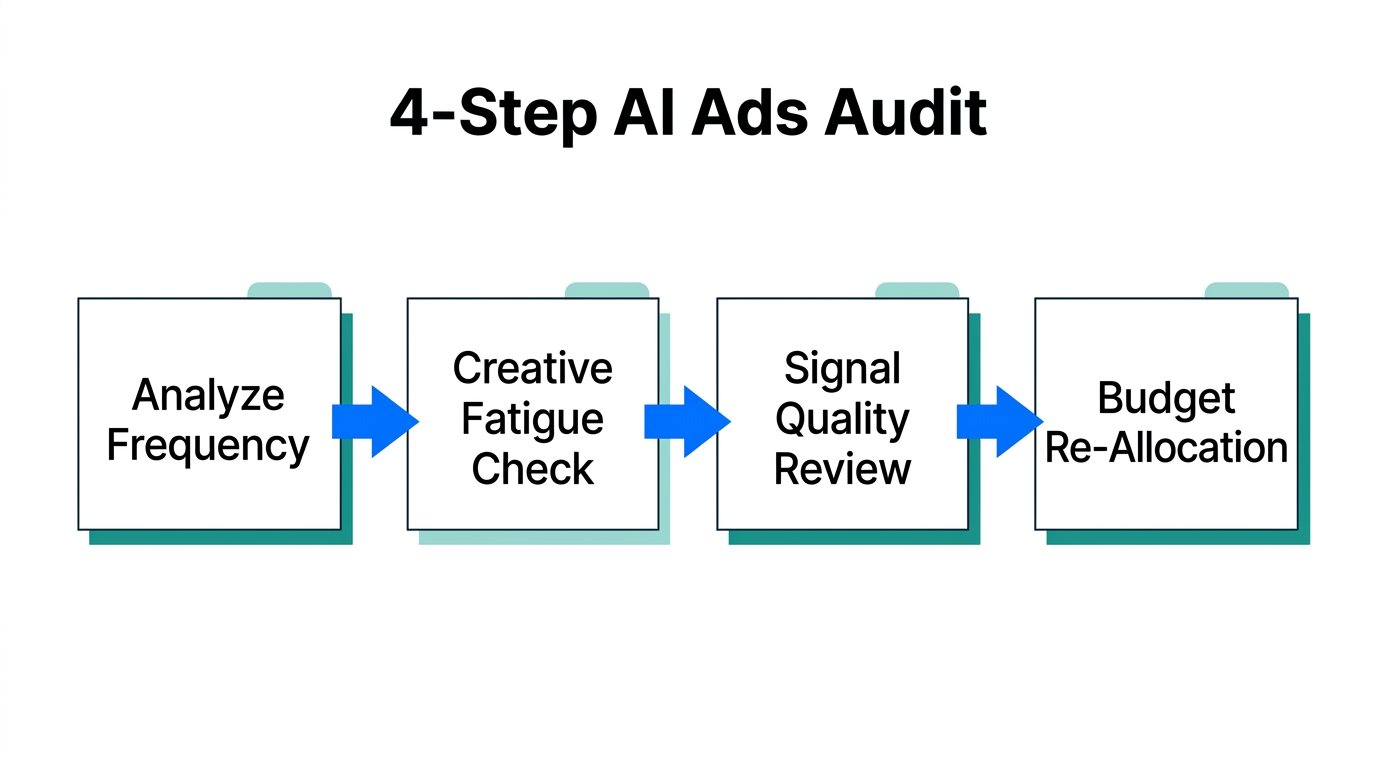
To ensure your AI-driven customer acquisition is actually working, you must perform regular audits. Use this four-pillar framework to check your performance:
1. The Technical Audit (Data Purity)
- Check your Event Match Quality (EMQ) Score in Meta Events Manager. Aim for a score of 7/10 or higher.
- Ensure Signal Deduplication is active so you aren't double-counting sales between the Pixel and CAPI.
2. The Structural Audit (Logic)
- Check for Audience Overlap. If it's above 20%, your campaigns are competing against each other, driving up your own costs.
- Verify that your objective is "Sales" or "Leads." Using "Traffic" for sales goals is a classic mistake that feeds the AI low-intent users.
3. The Creative Audit (The Engine)
- Analyze Frequency Scores. If your frequency is above 5–7 and ROAS is dropping, the AI has exhausted that specific creative.
- Ensure Creative Diversification. Use design tools like Canva or Figma to iterate quickly. You should have at least 3-5 different creative concepts running at all times.
4. The Budget Audit (The Fuel)
- Identify ad sets "Stuck in Learning." This usually means your budget is too low for the AI to find the required 50 conversions per week. According to Markifact, data fragmentation is the #1 killer of ROAS in 2026.
"In 2026, your job is no longer to 'find' the audience; it is to 'engineer' the creative that calls out to them."
Conclusion: Embracing the AI-First Future
Scaling with Meta Advantage+ Shopping Campaigns is no longer optional for brands that want to remain competitive. By shifting your focus from manual button-clicking to strategic creative direction and data purity, you can unlock the full potential of Meta's machine learning. Remember to maintain a 10-30% testing budget, prioritize your Conversions API setup, and never stop refreshing your creative assets.
As you scale, the bottleneck will inevitably become content production. To keep your AI engine running, consider using Stormy AI to discover and collaborate with UGC creators who can provide the authentic, high-converting video content that Advantage+ thrives on. The future of growth is automated—make sure you're the one steering the machine.