For years, the hallmark of a great media buyer was the ability to navigate complex audience interests, granular exclusions, and meticulous manual bidding. However, as we head into 2025, the era of micromanaging Facebook ads is officially over. Meta has pivoted toward a "Black Box" approach where the algorithm—not the human—dictates who sees an ad and when. This shift is not just a trend; it is a performance powerhouse. Data from Meta's internal studies shows that Meta Advantage+ campaigns now deliver up to 22% higher ROAS compared to traditional manual campaign management. For brands looking to scale, the choice is no longer between manual and automated—it is about how effectively you can feed the AI engine.
Why the 'Black Box' Era of Meta Advantage+ is Outperforming Manual Lists
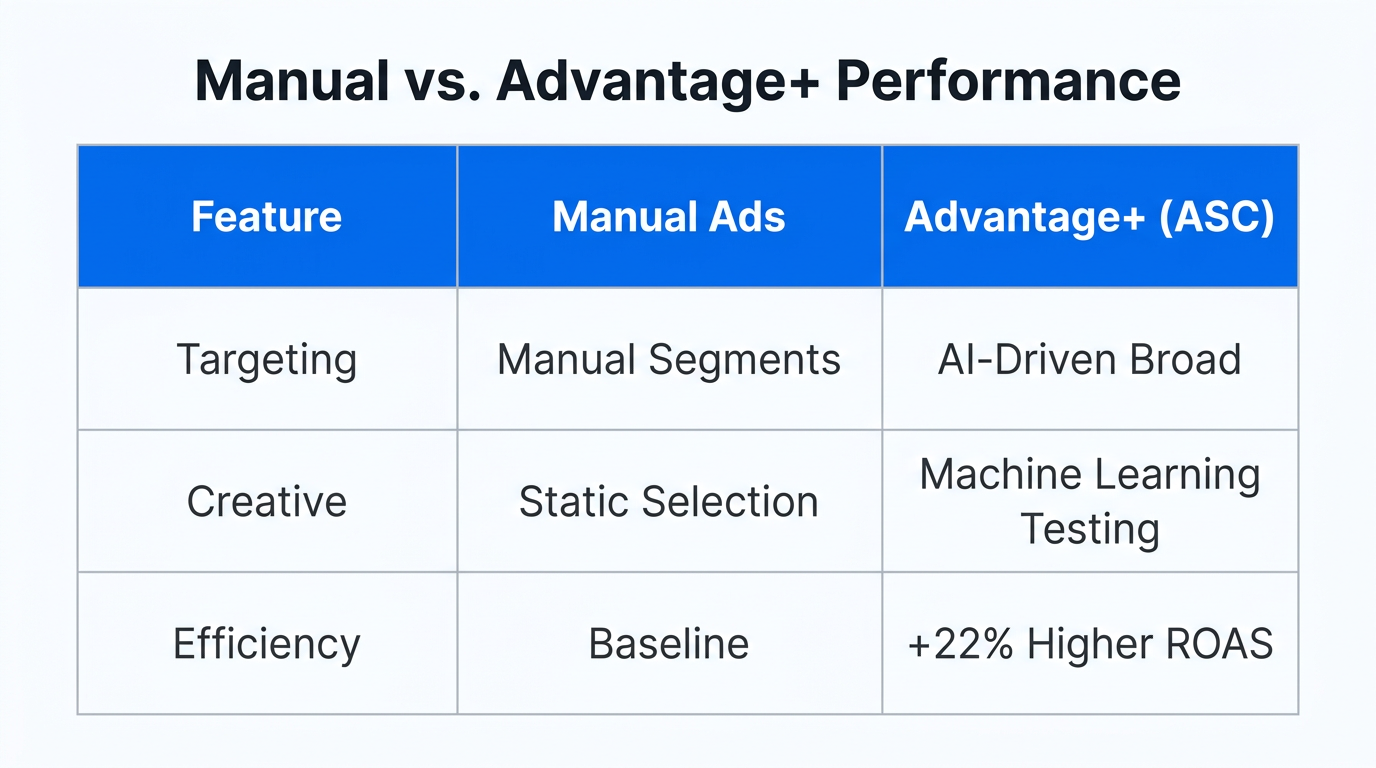
The transition to Meta Advantage+ represents a fundamental change in social media advertising trends. Historically, advertisers relied on "lookalike" audiences and specific interest groups. Today, Meta’s AI uses millions of data points to identify intent in real-time. This algorithmic approach is significantly more efficient; internal benchmarks shared by Social Media Today indicate that Advantage+ generates $4.52 for every $1 spent, whereas manual campaigns average just $3.70.
The "Black Box" works because it removes human bias. While a marketer might assume their best customer is a 30-year-old fitness enthusiast, the AI might find a more profitable segment among 50-year-old retirees that the human buyer would have excluded. This expansion of the top-of-funnel is why 85% of digital advertisers have now migrated to AI-powered bidding strategies, according to research from eMarketer. By letting go of granular targeting, brands are seeing an 18% reduction in CPA and a 10% drop in the cost per qualified lead.
"AI is redefining the category of advertising by moving toward a world where no manual demographics are needed." — Mark Zuckerberg
| Feature | Manual Campaigns | Advantage+ Shopping (ASC) |
|---|---|---|
| Targeting | Interest & Lookalikes | Algorithmic (Broad) |
| Placements | Manual Selection | Dynamic Ubiquity |
| ROAS Benchmark | $3.70 | $4.52 |
| Efficiency | Time-Intensive | Automated & Scalable |
The Advantage+ Shopping Campaign (ASC) Playbook for 22% Higher ROAS
To hit the 22% ROAS benchmark, you cannot simply click "automate" and walk away. Successful Advantage+ shopping campaigns require a specific structural setup that allows the machine to learn without interference. Follow these steps to build a high-performance ASC structure:
Step 1: Consolidate Your Account Structure
The AI needs volume. Stop splitting your budget across dozens of small ad sets. Instead, consolidate your budget into a single Advantage+ Shopping Campaign. This allows the algorithm to reach the "learning phase" faster and prevents audience fragmentation.
Step 2: Optimize for Value, Not Just Conversions
Instead of telling Meta to find "any purchase," use Value Optimization. This signals the AI to find high-spending customers. Case studies from brands like Centrepoint show that shifting to AI-driven Value Optimization can result in a 24% lower cost per purchase and a 59% increase in total revenue.
Step 3: Manage Existing Customer Caps
One of the unique features of ASC is the ability to set a "budget cap" for existing customers. To maximize ROAS from new acquisitions, keep your existing customer spend cap between 10% and 20%. This ensures the AI is primarily hunting for new growth rather than just retargeting people who would have bought anyway.
Feeding the Algorithm: The 50 Conversions Rule
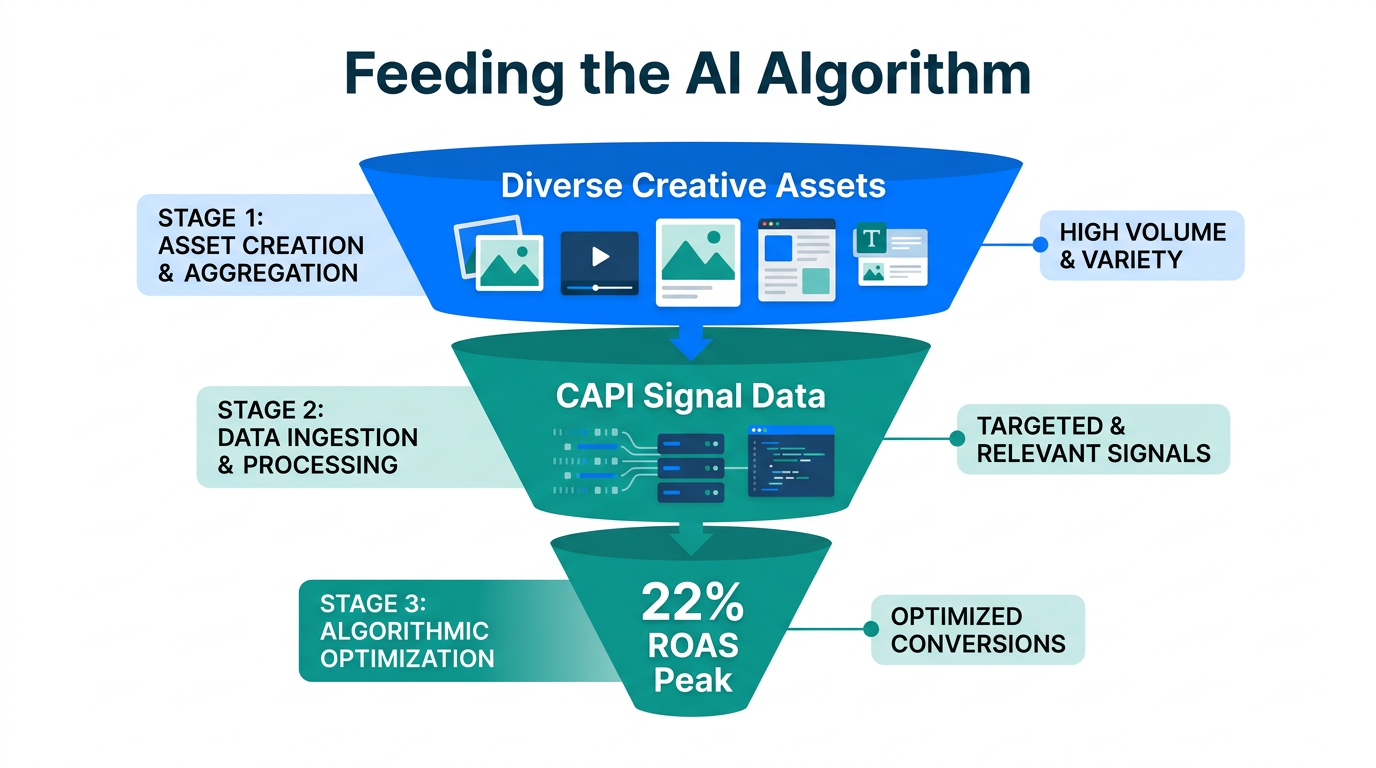
The biggest mistake marketers make with Facebook ads automation is "starving" the algorithm. For the AI to stabilize and move out of the volatile learning phase, an ad set must record at least 50 conversions per week. If your budget is too low (e.g., $10/day), the AI will never gather enough data to optimize effectively.
To maintain this momentum, automation tools like Revealbot or Madgicx can be used to set "if-then" logic that protects your budget. For instance, you can set a rule to automatically increase spend by 15% if the ROAS remains above your target, ensuring the AI always has the "fuel" it needs to stay in the optimized zone.
Strengthening AI Signals with Conversions API (CAPI)
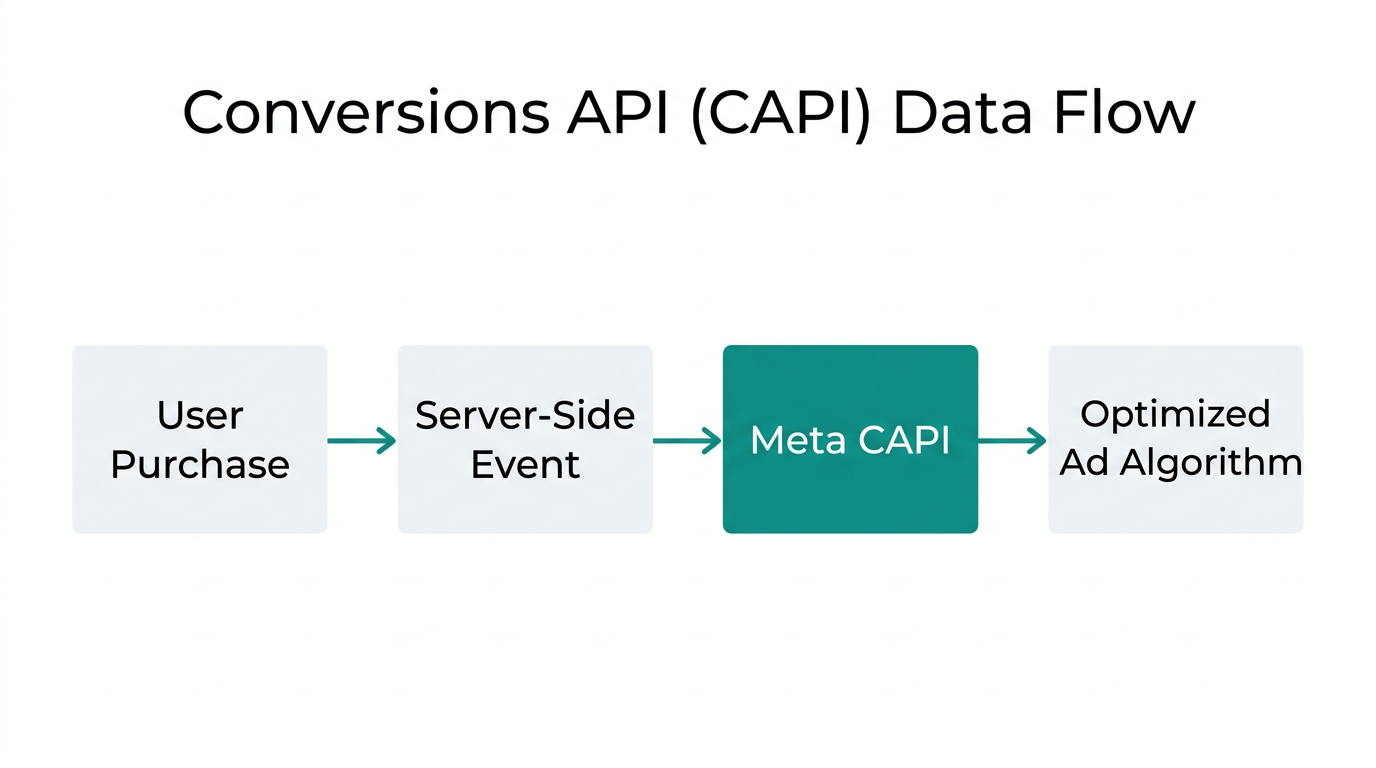
In a post-cookie landscape, the quality of the data you feed the AI is just as important as the budget. Relying solely on the Meta Pixel is no longer sufficient. To achieve ROAS optimization, you must implement the Meta Conversions API (CAPI). This creates a direct link between your server (Shopify, Stripe, or CRM) and Meta.
CAPI helps the AI bypass browser limitations and ad blockers, ensuring that every purchase, lead, and high-value action is tracked. Platforms like LeadsBridge allow for seamless CRM integrations that feed first-party data back into the AI. Without these high-quality signals, the AI is essentially flying blind, which often leads to the "broken data pipeline" error where ads are optimized for the wrong user actions.
"Advantage+ campaigns deliver $4.52 per $1 spent, outperforming manual campaign benchmarks by nearly 25%."
The 3-6 Creative Rule: Fueling the AI Engine
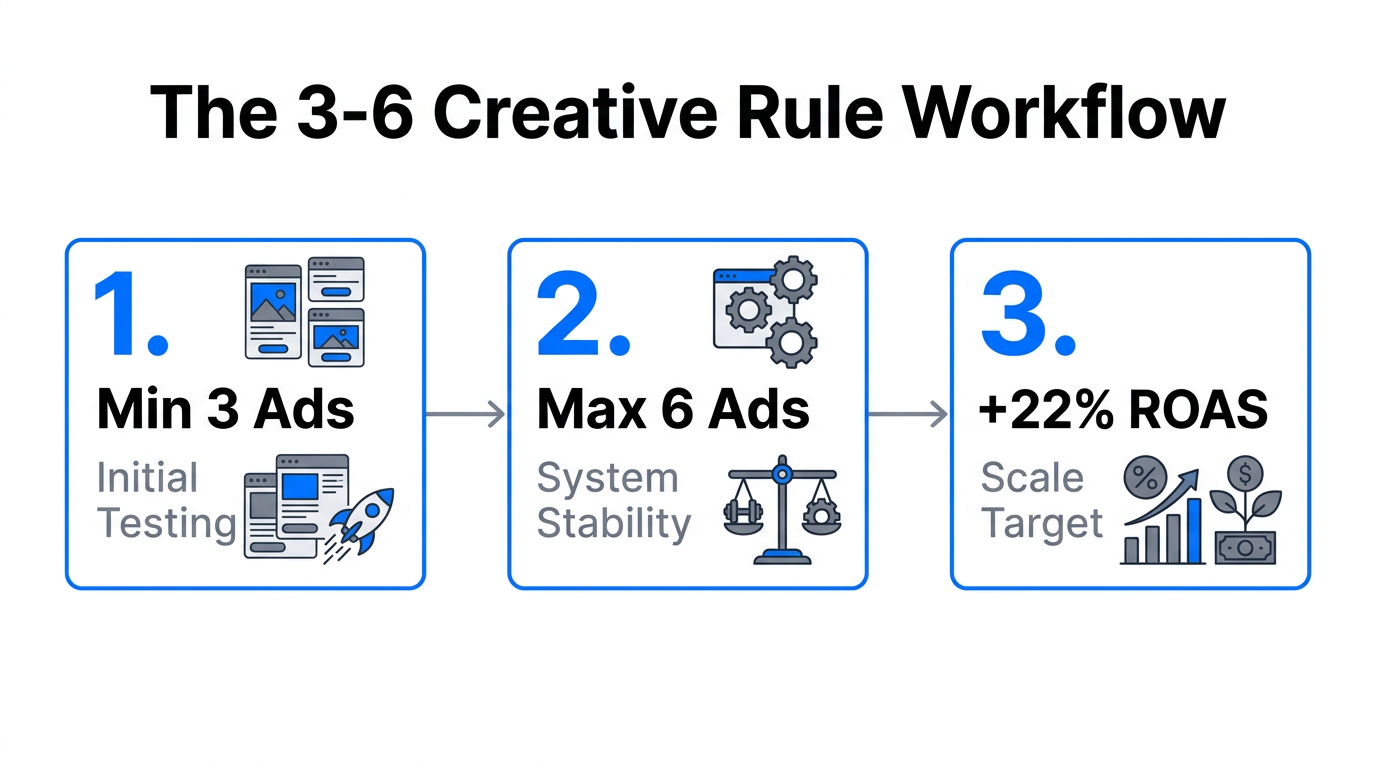
In the world of automated advertising, creative is the new targeting. Since you are no longer manually selecting interests, your ad creative must do the heavy lifting of attracting the right audience. Experts recommend the "3-6 Rule": providing the algorithm with 3 to 6 distinct creative variations per ad set.
This does not mean six versions of the same image with different headlines. It means six fundamentally different concepts:
- UGC (User-Generated Content): Raw, authentic testimonial videos.
- Product-Focused: High-production shots highlighting features.
- Educational/Listicle: "Top 5 reasons why..." graphics.
- Comparison: "Us vs. Them" charts.
Managing this volume of creative can be overwhelming, which is why platforms like Stormy AI are becoming essential for performance teams. By using Stormy AI to streamline creator sourcing and outreach, brands can maintain a constant stream of fresh UGC content. This prevents "creative fatigue," a common issue where the AI stops showing your ads because the engagement rates have plummeted. Tools like Smartly.io can then take these assets and handle creative automation at scale, generating thousands of variations from a single template.
Common Mistakes: Why Some AI Campaigns Fail
While the potential for social media advertising trends 2025 is massive, AI can also amplify inefficiency. If your product-market fit is weak or your offer is unappealing, automation will only help you lose money faster. Here are three critical errors to avoid:
- The "Set and Forget" Fallacy: AI requires monitoring. Even with automation, you must audit your Advantage+ shopping campaigns weekly to ensure the AI isn't drifting away from your brand voice or colors.
- Neglecting Brand Consistency: Automated creative generators can sometimes produce "uncanny" or off-brand visuals. As seen with recent discussions on Marketing Brew regarding AI in advertising, human oversight is still required to ensure emotional resonance.
- Budget Undershooting: Marketing automation saves an average of 52 hours per month, but that time should be spent on strategy and creative, not spent worrying about a $5/day budget that the algorithm cannot learn from.
Conclusion: Embracing the Algorithmic Future
Achieving a 22% higher ROAS with Meta Advantage+ is not about finding a "secret button" in the Ads Manager. It is about shifting your mindset from manager to architect. By consolidating your structure, implementing CAPI for perfect data signals, and following the 3-6 creative rule, you provide the AI with the foundation it needs to succeed.
The brands that will dominate in 2025 are those that leverage Facebook ads automation to handle the heavy lifting of distribution while they focus on high-level strategy and high-impact creative. Whether you are scaling an e-commerce store or an app, trusting the algorithm is no longer optional—it is the most efficient path to growth. Start by testing a single ASC alongside your manual campaigns and let the data prove the Meta Advantage+ advantage.