The era of the manual media buyer is officially over. In 2026, the competitive landscape of digital advertising has shifted from those who can "push buttons" to those who can "conduct the orchestra." As over 4 million advertisers now leverage generative AI tools for creative production, according to the Meta Newsroom, the real edge lies in operational automation. We are moving beyond simple generative AI into the realm of Agentic AI—where tools like Claude Code don't just write your copy, they execute your entire Meta Ads performance audit and management workflow via the command line.
The Rise of the Agentic Media Buyer in 2026
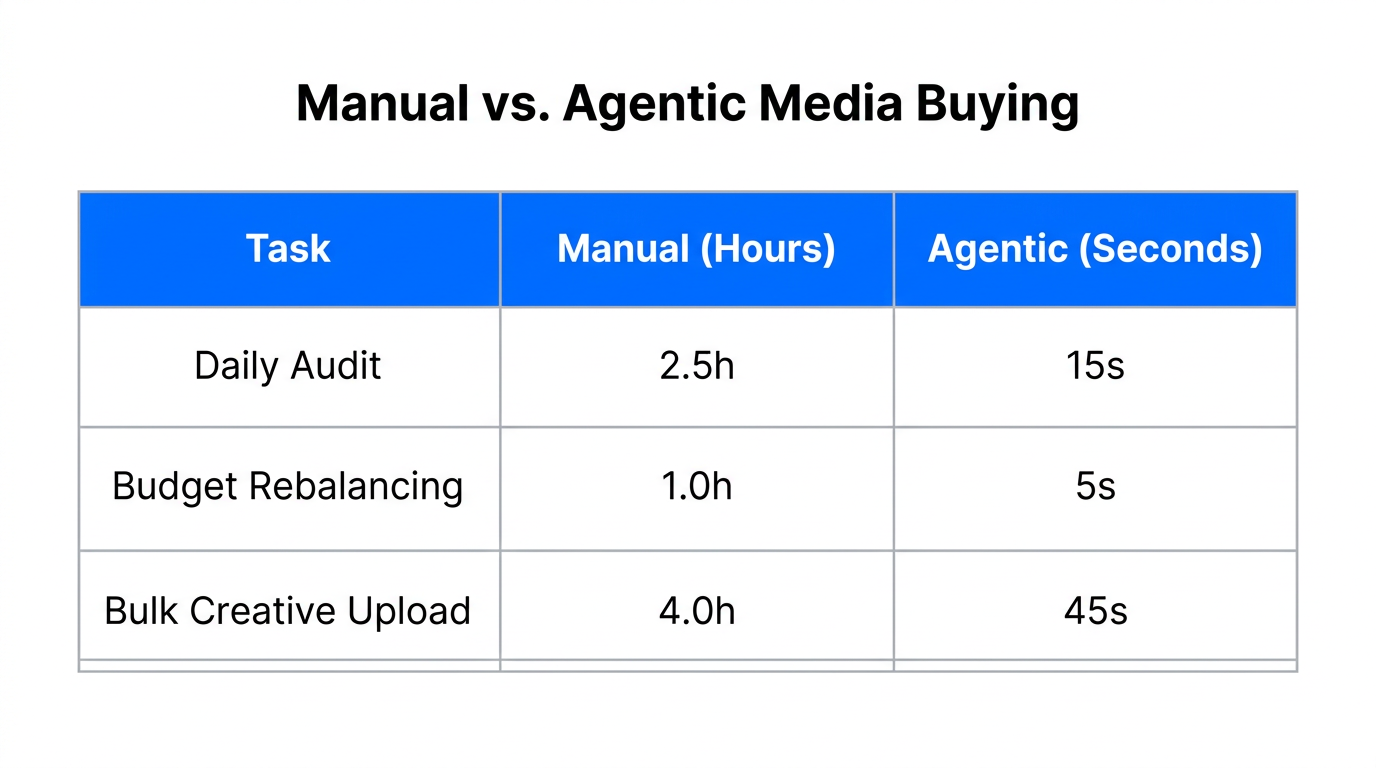
For growth teams and agencies, the bottleneck is no longer creative ideation; it is the friction of the Ads Manager UI. Navigating hundreds of campaigns, manually checking ROAS, and adjusting budgets is a recipe for burnout and human error. Today’s top-tier marketers are embracing automated media buying by moving from the browser to the Command Line Interface (CLI).
By using Claude Code, media buyers can execute complex bulk changes and deep-data queries using natural language. This shift, often called "Vibe Querying," allows you to ask your terminal: "Which of my ads had a 20% CPM spike yesterday?" and receive an instant answer—or better yet, have the AI automatically pause the offending ad sets. This level of scaling Meta Ads accounts was previously reserved for enterprise-level teams with dedicated data science departments. In 2026, it is the standard for any agile agency.
"The role of the media buyer has evolved from playing the instruments to conducting the orchestra. You are no longer clicking buttons; you are managing AI agents that execute your strategy at scale."
Building an Automated Performance Audit Script
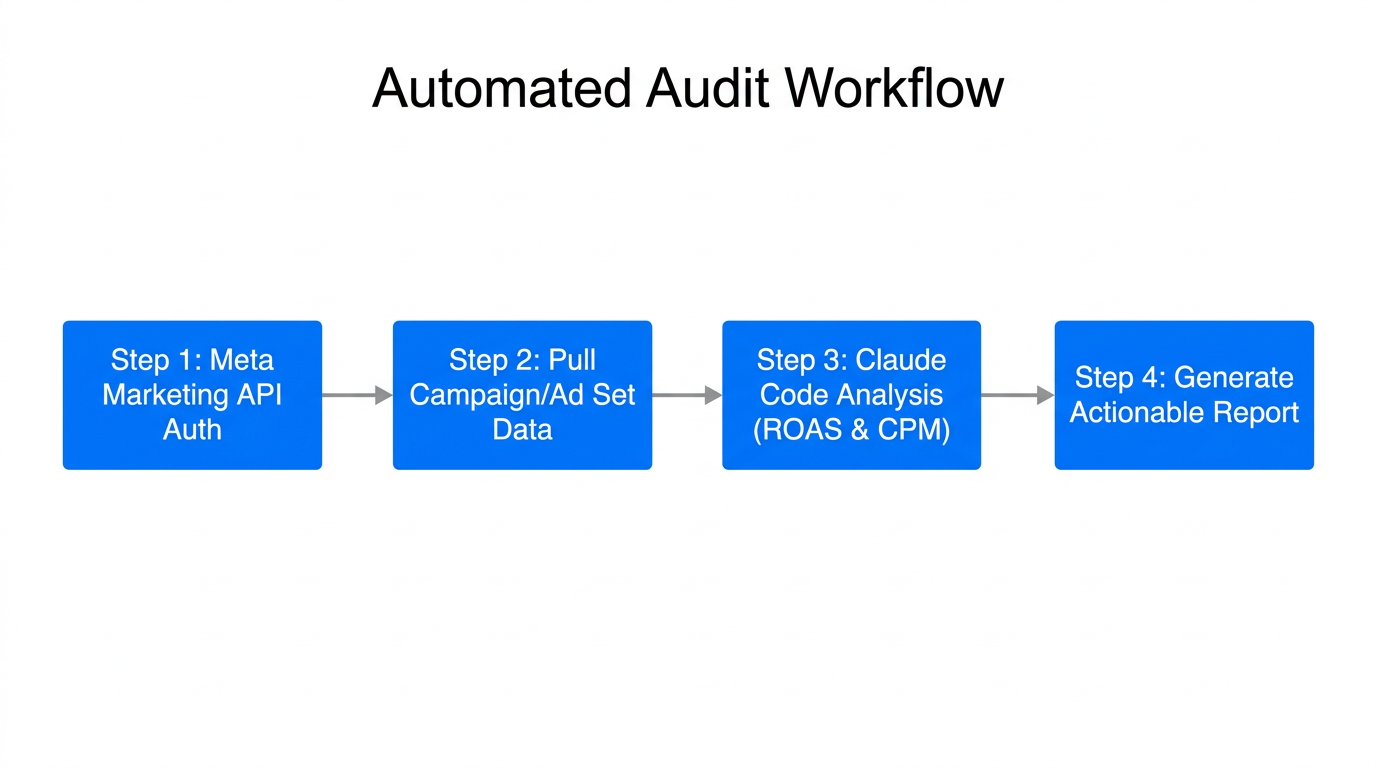
One of the most powerful Claude Code workflows is the creation of a private "Performance Sentinel." Instead of a human checking the dashboard every morning, you can deploy a Node.js or Python script that interacts directly with the Meta Marketing API.
The 15% ROAS Threshold Rule
A common friction point in Meta Ads performance audits is deciding when to kill an underperforming ad set. By leveraging Claude Code, you can write a script that calculates the account-wide average ROAS and automatically pauses any ad set that falls 15% below that average over a 72-hour window. This ensures that your budget is always flowing toward winners without the emotional hesitation of a human buyer.
To set this up, you can prompt Claude Code to: "Write a script using the Meta Marketing API that fetches yesterday's ROAS for all active ad sets, compares them to the 7-day account average, and pauses any set that is 15% underperforming." Users often pair this with tools like VS Code to maintain and version-control their private automation library.
| Feature | Manual Media Buying | Automated AI Workflow (2026) |
|---|---|---|
| Audit Frequency | Once daily (at best) | Real-time or Hourly |
| Decision Logic | Emotional / Subjective | Data-driven / Programmatic |
| Scaling Speed | Linear (Requires more staff) | Exponential (Requires more compute) |
| Error Rate | High (Fatigue/Mistakes) | Near-Zero |
The Agency Audit Automation Playbook: From 8 Hours to 2
For agencies, the weekly or monthly account audit is a significant time sink. Traditionally, a comprehensive audit involving creative analysis, audience overlap checks, and technical tracking verification took roughly 8 hours per client. With the Model Context Protocol (MCP), Claude can now securely "read" and "write" to your Meta Ads account in real-time using servers like the Meta Ads MCP Server.
By running 190+ parallel checks across Meta, Google, and LinkedIn simultaneously, agencies can reduce audit time from 8 hours to under 2 hours. This isn't just about speed; it's about depth. An AI agent can spot a subtle increase in audience fatigue by tracking frequency spikes across 50 different ad sets—something a human eyes would likely miss while scrolling through the UI.
"Agencies aren't just saving time; they are increasing the surface area of their success by testing 10x more variables than they ever could manually."
When you find a winning creative angle through your automated audits, you need a steady stream of new UGC to keep the momentum. This is where Stormy AI becomes essential. While your automated "Ad Machine" handles the media buying, you can use Stormy AI to discover high-performing UGC creators and influencers to fuel your creative pipeline with fresh content that prevents creative decay.
Setting up a Bulk Upload Pipeline for Creative Testing
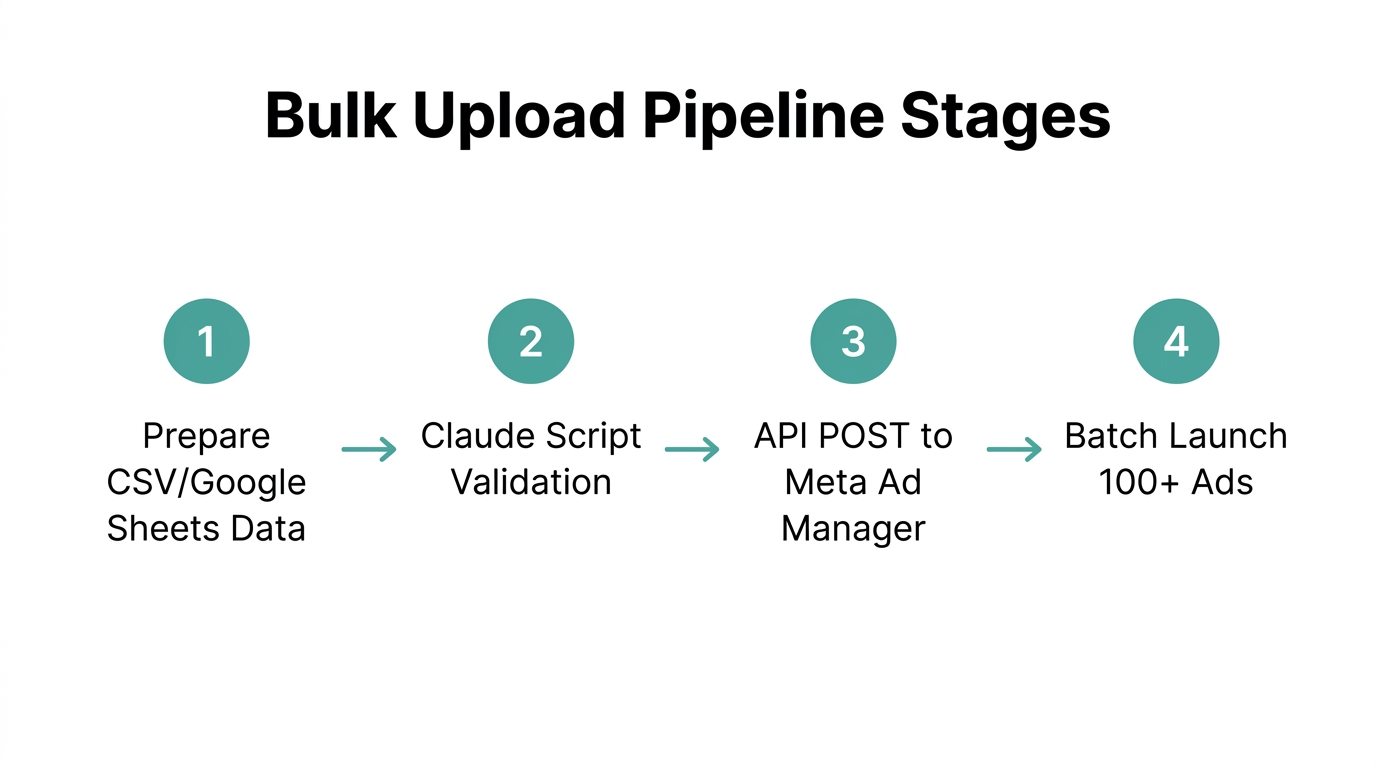
In 2026, scaling Meta Ads accounts requires a massive volume of creative testing. Advertisers using Meta Advantage+ campaigns have already seen a 22% higher ROAS by letting AI handle placements, but the bottleneck remains the manual upload of assets.
The Bulk Upload Pipeline strategy involves using Claude Code to generate a Node.js script that takes a CSV of creative assets—hooks, body copy, and image URLs—and pushes them programmatically to the Meta Ads Manager. This allows you to:
- Upload hundreds of image variations in seconds.
- Automatically apply UTM parameters to every variation without typos.
- Test 50+ unique ad angles (persona-specific hooks) generated from a Brand DNA file.
Solving Signal Loss with CAPI and Claude Code
Precision in automated media buying is only as good as the data feeding the machine. Signal loss due to privacy regulations remains a hurdle. To combat this, growth teams must ensure a robust setup of the Meta Conversions API (CAPI).
Setting up CAPI can be technically daunting for marketers, but Claude Code simplifies the process. You can use Claude to write the server-side code necessary to send events directly from your backend (using platforms like Stripe or Shopify) to Meta. Referencing the Meta Conversions API Documentation, Claude can help you build a bridge that bypasses browser limitations, ensuring your "Ad Machine" has the high-quality data it needs to optimize ROAS.
Without CAPI, your automated scripts might optimize for the wrong KPIs—like high CTR but zero actual purchases—leading to what experts call the "Set and Forget Fallacy." Always maintain a human-in-the-loop review to ensure the AI's goals align with actual business revenue.
Monitoring 'Audience Fatigue' via the CLI
When you scale volume using AI, audience fatigue becomes your primary enemy. High-volume automated campaigns can quickly exhaust small audiences, leading to a spike in Frequency and a subsequent drop in CTR.
Using the CLI, you can monitor these spikes more efficiently than through the UI. A simple script can pull the "Frequency" metric for all active campaigns and flag any that have increased by more than 20% week-over-week. This allows you to proactively rotate creatives before performance craters.
"Automation isn't about ignoring your ads; it's about building a better dashboard that tells you exactly where to look, exactly when it matters."
To keep your creative rotation fresh, integrating a discovery platform is key. Stormy AI allows you to search for creators across TikTok, YouTube, and Instagram using natural language, making it easy to find new faces and styles to combat the very fatigue your automated system identifies.
Common Mistakes in Meta Ads Automation
While the potential for automated media buying is massive, there are several pitfalls that can drain your budget if you aren't careful:
- Generic Prompting: Asking an AI to "write a Facebook ad" leads to "AI slop." You must provide a Brand Voice Guide or data from Perplexity API to ensure the copy resonates with real humans.
- Neglecting Data Privacy: Ensure all automated scripts are compliant with GDPR and CCPA. Never hardcode API keys; use environment variables.
- Over-Automation: Do not automate budget increases without a ceiling. An AI might see a temporary performance blip and skyrocket spending on an unproven ad set.
The Bottom Line: Your Ad Machine is Waiting
In 2026, the distinction between a "marketer" and a "developer" is blurring. By leveraging Claude Code workflows and the Meta Marketing API, you can transform your agency from a manual service provider into a high-octane automated media buying powerhouse.
Start small: automate your Meta Ads performance audit first. Once you've reclaimed those 6 hours a week, move on to a Bulk Upload Pipeline. The goal isn't just to work faster; it's to build a system that achieves a 22% higher ROAS through relentless, programmatic optimization. The tools are here—it's time to build your machine.