By 2026, the era of the "manual media buyer" has officially ended. We are no longer in a world where clicking buttons in the Meta Ads Manager UI is a competitive advantage. Today, high-performance growth is driven by agentic media buying—a paradigm shift where marketers use autonomous AI agents to audit, manage, and optimize campaigns in real-time. Leading the charge is Claude Code, an agentic interface from Anthropic that has transformed from a simple copy generator into a full-scale media buying assistant.
As Meta moves toward a "Goal-Only" ad system where the algorithm handles everything from bidding to creative generation, the marketer's role has evolved into that of an orchestrator. Advertisers leveraging these modern AI-powered workflows are seeing a 22% higher Return on Ad Spend (ROAS) compared to standard manual campaigns, according to Meta Internal Studies. This playbook outlines exactly how to transition your workflow from manual execution to agentic automation.
The Rise of Agentic Media Buying: Why Manual is Dead
In 2026, the volume of data generated by the Meta Marketing API is too vast for human eyes to process daily. Agentic media buying involves using Claude Code to perform deep-dive audits across hundreds of ad sets simultaneously. Instead of building manual pivot tables, performance marketers now use "vibe querying"—asking Claude natural language questions like, "Which of my creatives had a 20% CPM spike yesterday?"
The efficiency gains are staggering. Agencies that have integrated Claude directly into their ad stacks via API report a 90% reduction in manual operational work, including reporting and mundane campaign auditing, based on recent Advolve case studies. This shift allows teams to focus on creative strategy rather than logistics.
"The shift to agentic media buying isn't just about speed; it's about the ability to catch performance decay 48 hours before a human would notice the trend in a dashboard."Setting Up a 'Performance Sentinel' for 24/7 Auditing
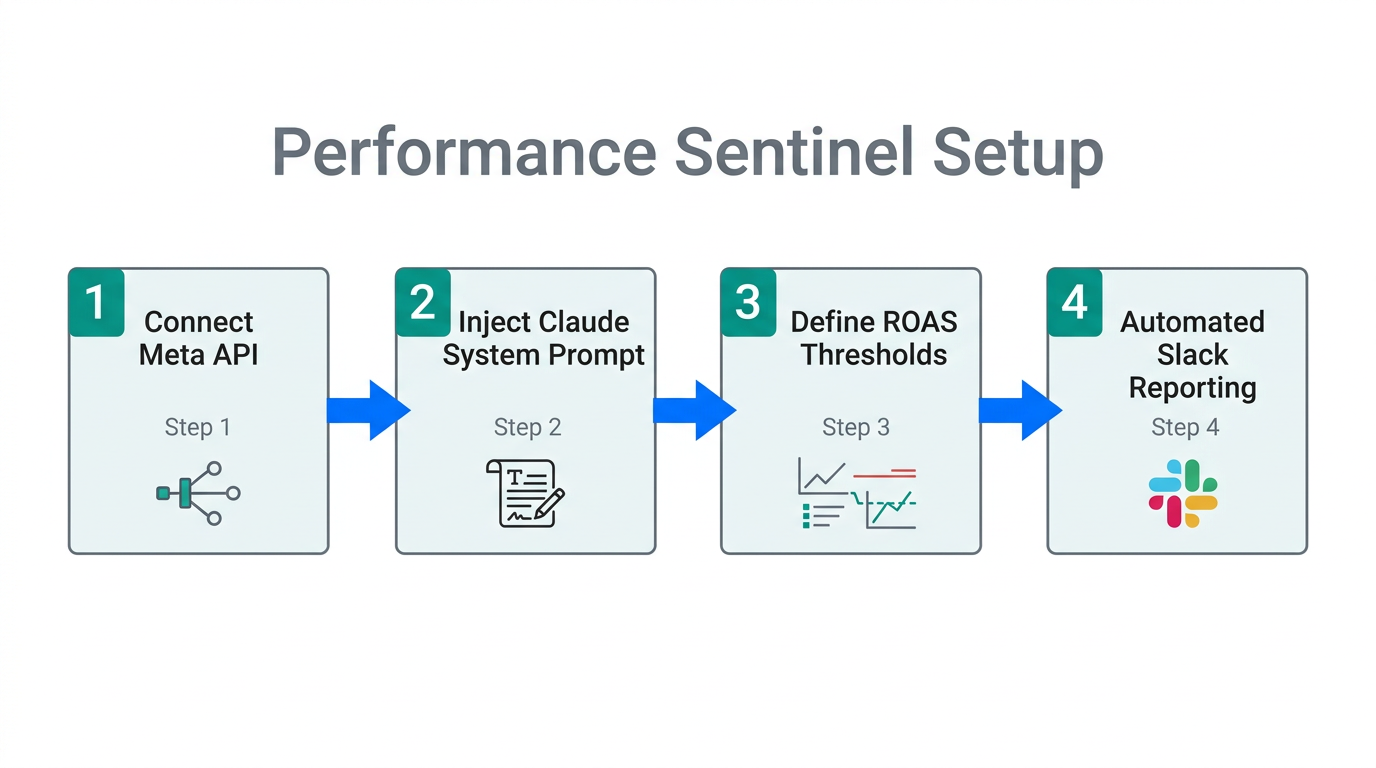
The first step in modern Meta ads automation is building what we call a Performance Sentinel. This is a custom script—written by Claude—that monitors your ad account every hour. Instead of you logging into Ads Manager, the Sentinel pings you via Slack or email only when something is wrong.
Step 1: Connecting to the Meta Marketing API
Use Claude Code to generate a Node.js or Python script that authenticates with your Meta Business account. You can instruct the AI to fetch core metrics like ROAS, CPC, and frequency. This allows the agent to "see" your data without you having to open a browser.
Step 2: Defining Performance Deviations
Rather than simple rules (e.g., "if CPC > $2, pause"), an agentic sentinel looks for anomalies. You can ask Claude to "alert me if any ad set's conversion rate drops by 2 standard deviations from its 7-day mean." This prevents the AI from making rash decisions based on small data fluctuations.
Step 3: Automated Creative Fatigue Alerts
Creative fatigue is the silent killer of ROAS. By using tools like Flyweel or Adzviser to stream live data into Claude, you can identify when an ad’s frequency is rising while its ROAS is dipping. This was recently demonstrated in an MCP Playground case study, where a SaaS provider saved 15% of their monthly spend by catching fatigue on day 6 instead of day 8.
Model Context Protocol (MCP): The Bridge to Live Data
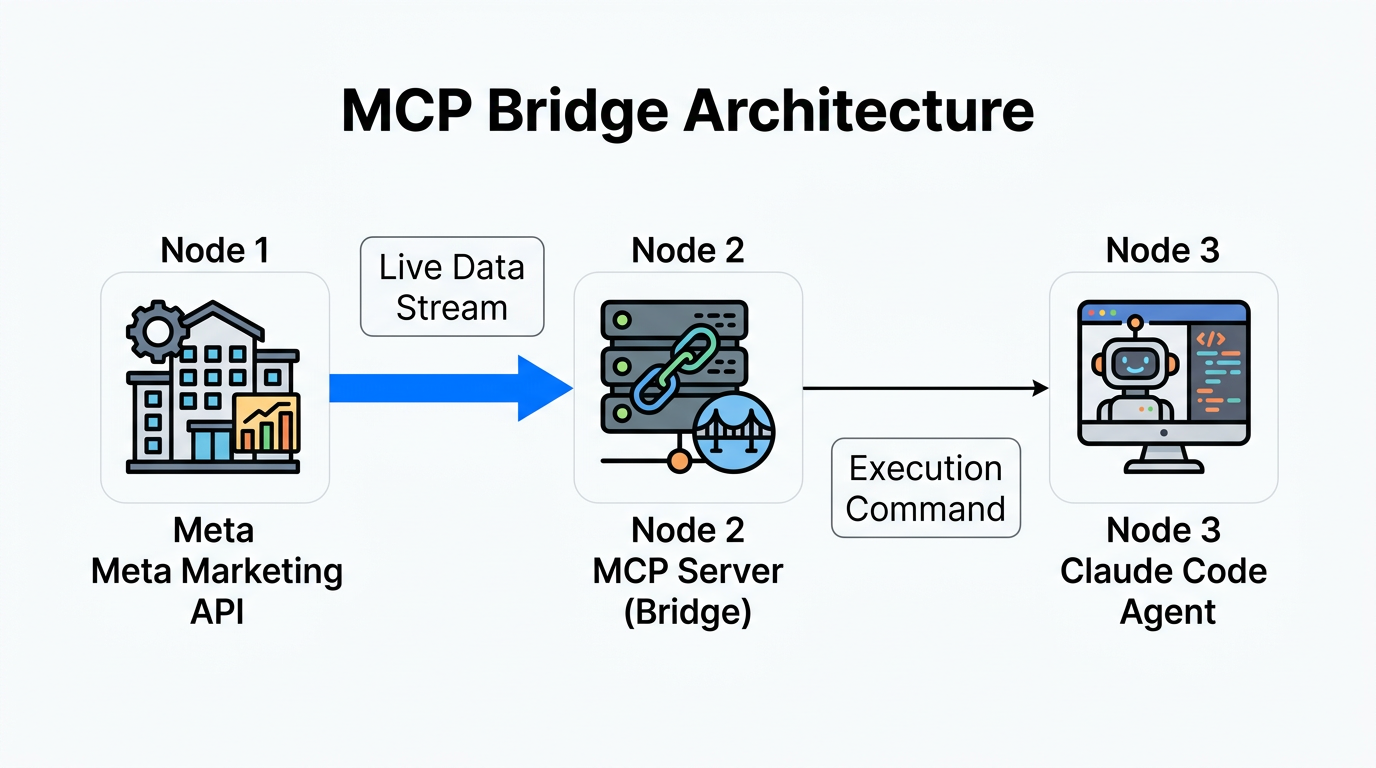
In 2026, the biggest technical hurdle is no longer the AI's intelligence, but its context. This is where the Model Context Protocol (MCP) comes in. MCP allows Claude to securely "read" and "write" to your Meta Ads account in real-time. It effectively gives the AI eyes and hands on your dashboard.
By using an MCP connector like Pipeboard, you can give Claude temporary access to your live campaign data. This enables advanced workflows such as:
- Real-time ROAS auditing: "Claude, check all campaigns and tell me which ones are underperforming our target $3.50 ROAS."
- Budget redistribution: "Shift $500 from the low-performing 'Top of Funnel' campaign to the 'Advantage+ Shopping' campaign that has the highest conversion volume today."
- Cross-platform analysis: Using Windsor.ai to pull Google and Meta data into a single Claude session for holistic scaling.
"MCP is the 'connective tissue' of 2026. Without it, your AI is just a copywriter; with it, your AI is a junior media buyer with a photographic memory of your entire account history."Meta Advantage+ Native Automation vs. Custom Agentic Workflows
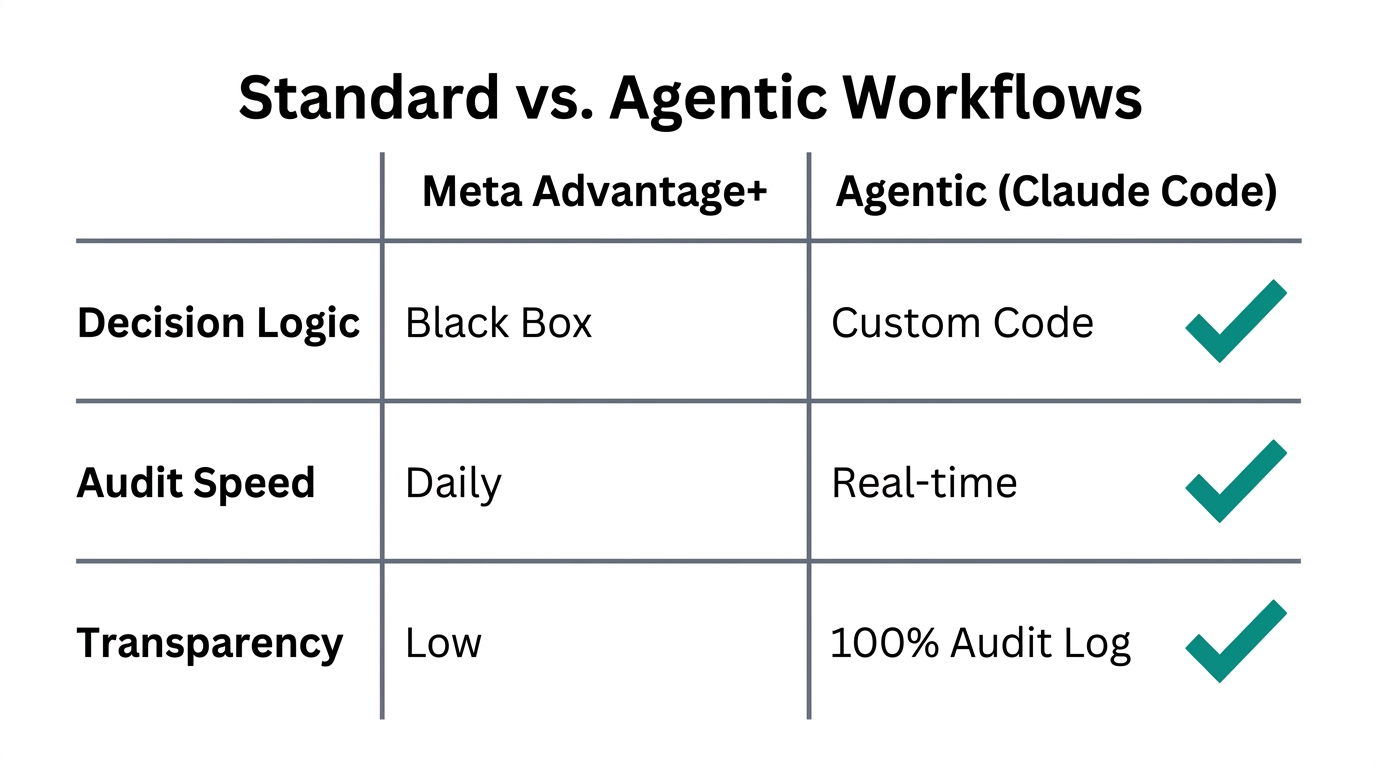
While Meta provides powerful native tools like Meta Advantage+, top-tier marketers are finding that a hybrid approach—combining Meta's black-box AI with Claude's white-box logic—yields the best results.
| Feature | Meta Advantage+ (Native) | Agentic Workflow (Claude + API) |
|---|---|---|
| Optimization Logic | Algorithmic "Black Box" | Transparent & Customizable |
| Creative Testing | Automatic variations | Strategic 'Creative Matrix' testing |
| Human Control | Limited (set and forget) | High (Human-in-the-loop) |
| Data Sources | Meta internal only | Multi-channel (Meta + CRM + Google) |
| Best For | Rapid scaling for SMBs | Performance scaling for Agencies/DTC |
While Advantage+ is excellent for finding broad audiences, it can often over-optimize for "cheap clicks" if not monitored. This is where custom agentic media buying thrives. For example, fashion retailer TABA Digital used a combination of Advantage+ and AI-driven creative oversight to reduce their CPC from $0.35 to $0.01 while scaling volume by 300% (Source: TABA Digital).
The 'Human-in-the-loop' Mandate for 2026
One of the most dangerous mistakes in 2026 is the "Set and Forget" fallacy. While AI can handle 80% of the heavy lifting, unfiltered automation is a recipe for budget waste. Senior media buyers now advocate for Hybrid LLM Stacks. In this model, Claude acts as the "Creative Director" (finding psychological hooks and brand voice), while tools like Adspirer handle the conversational management of ad sets.
A critical part of this loop is sourcing high-quality, authentic content. This is where platforms like Stormy AI become essential. While Claude can write the script, you still need real creators to produce the UGC that feeds the algorithm. Smart marketers use Stormy AI to find creators who fit their niche and then use Claude to analyze which creator's style correlates with the highest ROAS.
Avoiding the Pitfalls: Signal Loss and Creative Fatigue
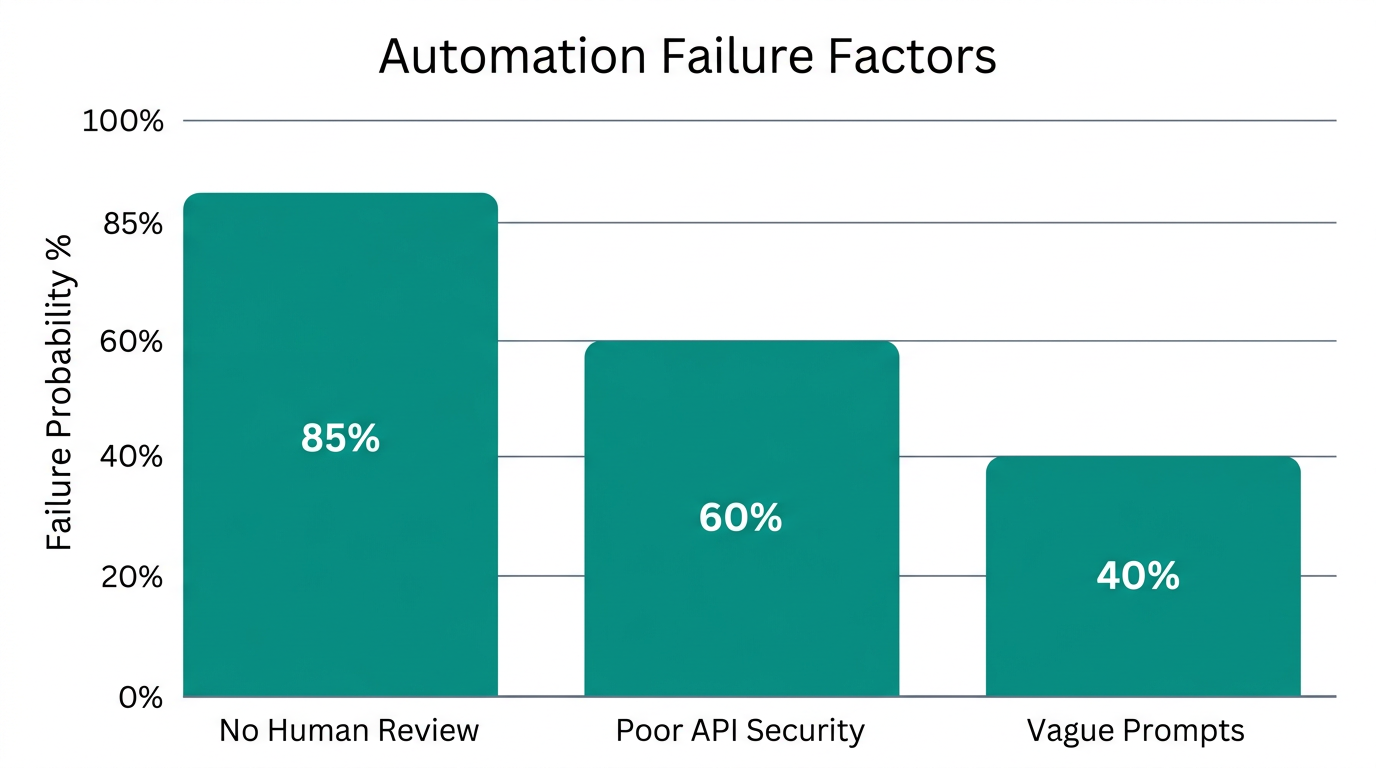
Scaling Meta ads automation in 2026 requires more than just good prompts. You must avoid these three common traps:
1. Signal Loss (Lack of CAPI)
Running automation without the Meta Conversions API (CAPI) is like flying a plane with a broken altimeter. AI needs high-quality server-side data to optimize properly. If you rely only on browser pixels, your ROAS numbers will likely be "hallucinated" due to cookie blocking (Source: AnyTrack).
2. Creative Slop Overload
Just because Claude can generate 500 headlines in 10 seconds doesn't mean you should use all of them. Meta’s algorithm works best with a few high-quality "anchor" creatives. Pumping too many variations into one campaign leads to creative fatigue overload and high CPMs.
3. The Wrong Optimization Goal
Never automate for "Clicks" when your goal is "Sales." Agentic media buyers use Claude to verify that the API is actually optimizing for Purchase events rather than ViewContent or LinkClicks, which often attract "click-happy" bots rather than buyers.
"The most expensive ad you'll ever run is the one that is perfectly automated for the wrong goal."Conclusion: Your 2026 Media Buying Stack
To win in 2026, you must stop being a "button pusher" and start being a developer of systems. By combining the natural language intelligence of Claude with the power of the Meta Marketing API, you can build a 24/7 media buying machine that scales while you sleep.
Remember to keep a human-in-the-loop for creative direction and use specialized tools like Stormy AI to ensure your creative pipeline remains stocked with authentic content. The future of ROAS isn't just about spending more—it's about automating smarter. Start by setting up your first Performance Sentinel today and let Claude Code take the wheel of your campaign auditing.