How to Measure Luck: A 2026 Growth Framework using HubSpot
Learn how to treat serendipity as a measurable KPI in 2026. This framework shows you how to use HubSpot CRM automation to track 100 lucky breaks and scale to $1M+.
In the high-velocity business landscape of 2026, the difference between a struggling startup and a million-dollar business hit often comes down to a single variable that most founders leave to chance: serendipity. While traditional business growth strategies 2026 focus on linear funnels and predictable ad spend, the most successful operators have moved toward a more radical approach. They are treating luck not as a mystical force, but as a measurable, manageable, and scalable business KPI. By leveraging HubSpot CRM automation to track 'lucky breaks' and outbound goodwill, you can transition from transactional networking to a serendipity-led growth model that generates exponential returns.
The 'Irrational Believer' and the TMJ Factor
Discover the irrational believer factor and how it fuels successful business partnerships.
Every successful venture in our portfolio—from e-commerce brands to high-growth SaaS—started with a single ingredient: the irrational believer. Before you have product-market fit, and certainly before you have a million-dollar balance sheet, you need someone who believes in your vision when there is zero logical proof to support it. In the world of elite entrepreneurship, we call this having TMJ (Too Much Juice). It is that undeniable energy and competence that makes someone like Twitter (X) power users or top-tier founders take a blind bet on your potential.
"The first believer is more important than the first check. You need a coach who puts you on the floor for those first two minutes of the game when no one else knows your name."
Consider the story of Michael Birch, who named a 23-year-old as CEO of his company despite a lack of traditional qualifications. That was an irrational move that paid off because of the 'juice' detected early on. In 2026, finding these believers is easier if you use platforms like Stormy AI to identify high-leverage creators and mentors who align with your brand's energy. When you find someone with TMJ, you don't keep that belief private; you buy their 'stock' early by offering value before asking for anything in return.
The Luck Spreadsheet: Tracking 100 Lucky Breaks
Learn how tracking lucky breaks transforms random networking into a measurable growth engine.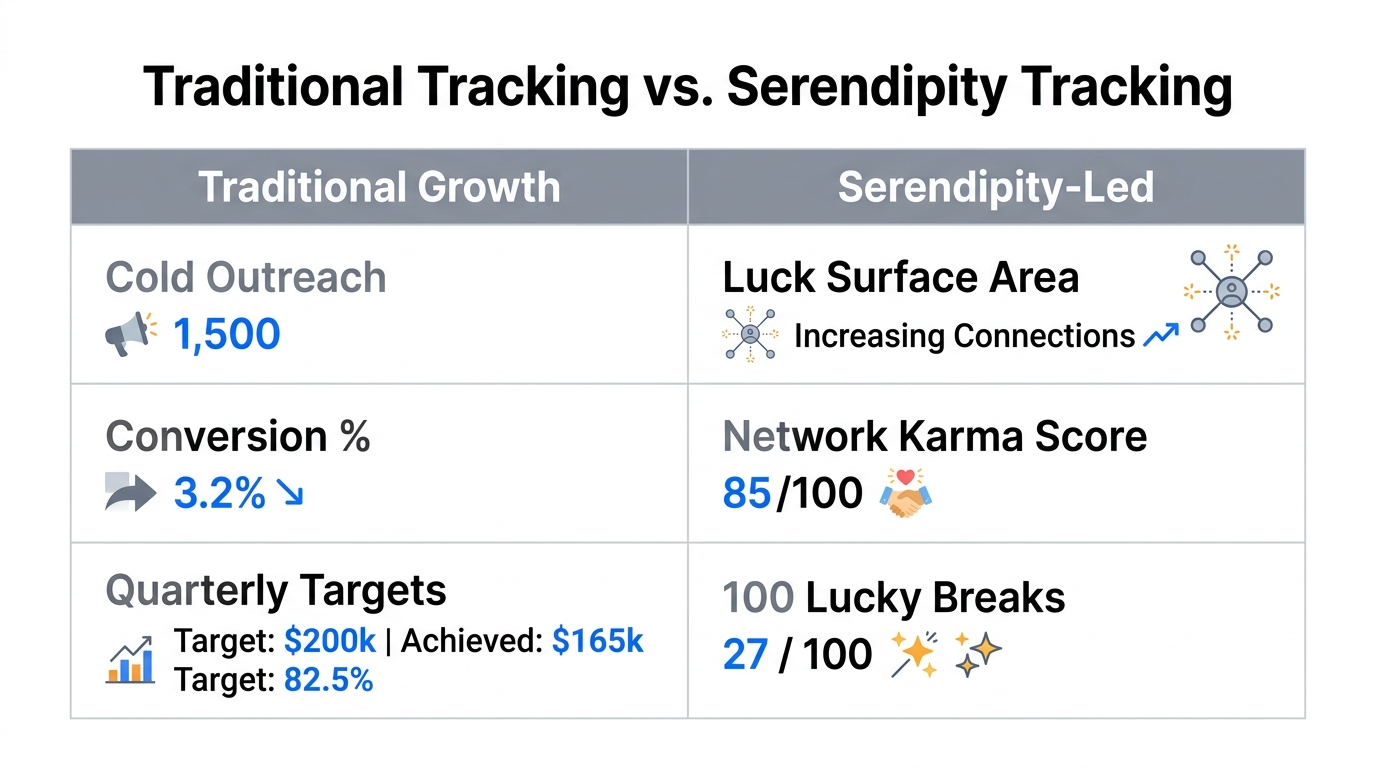
If you aren't measuring your luck, you can't manage it. Peter Drucker famously said, "What gets measured gets managed," and this applies to serendipity as much as it does to revenue. To scale a million dollar business, we implemented a 'Luck Spreadsheet.' The goal is simple: track 100 lucky breaks per year. A lucky break is defined as any positive outcome that you didn't directly 'buy' through a transaction—a random intro that led to a hire, a tweet that went viral, or a guest appearance on a major podcast like YouTube-based shows.
How to Categorize Your Luck
- Content Serendipity: A post on LinkedIn that catches the eye of a future partner.
- Network Karma: A referral you gave six months ago that unexpectedly returns as a major client.
- In-Person Hits: Insights gained from high-level events like the K Academy or private mastermind groups.
By recording these breaks, you begin to see the patterns. You realize that for every 100 lucky breaks, you need to perform roughly 500 to 700 'interesting activities'—sending cakes to celebrate a peer's milestone, buying 100 copies of a mentor's book, or proactively hunting down a referral for someone in your network without being asked. This is the foundation of entrepreneurial networking tactics in the modern era.
"Luck is a skill. You can actually influence how much of it you have in your life by increasing the volume of your high-leverage interactions."
Setting up HubSpot to Manage Business Karma
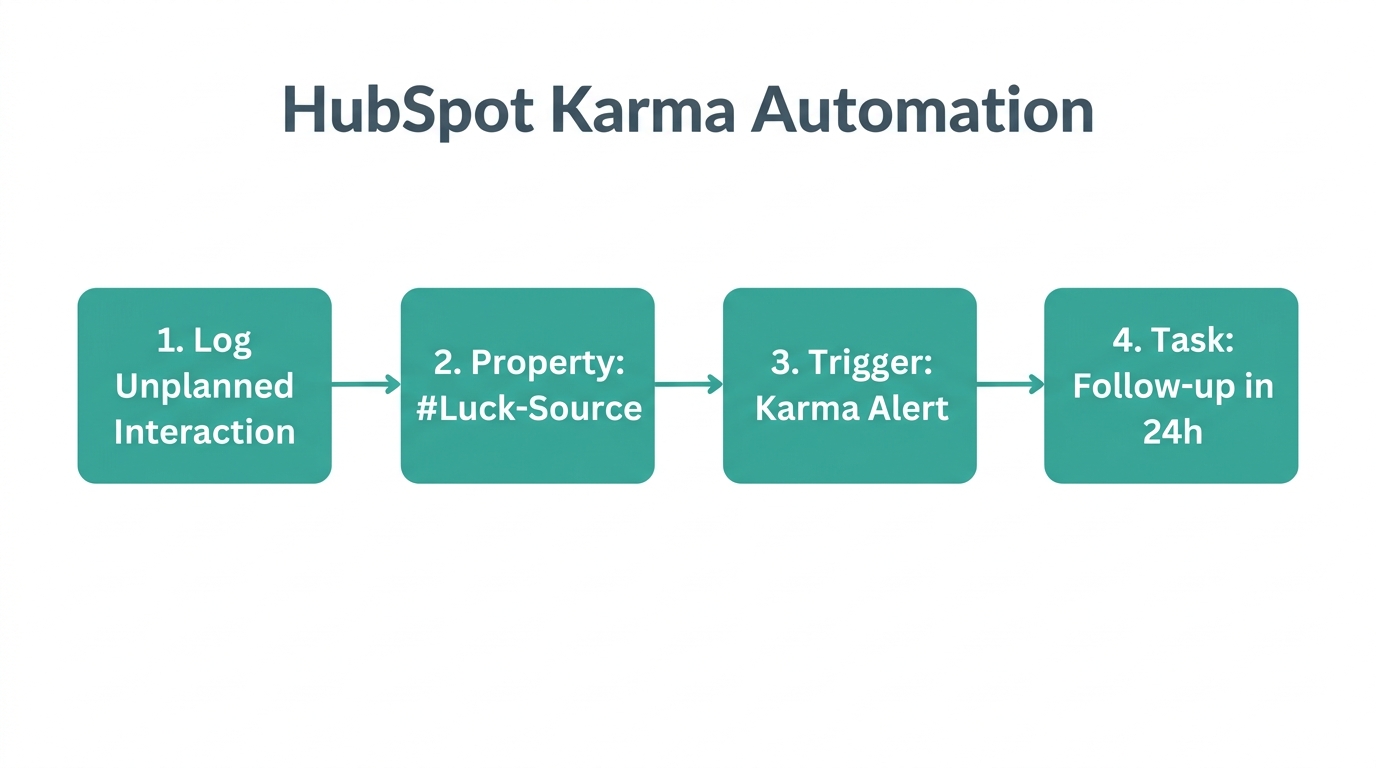
Most people use their CRM for sales. We use HubSpot CRM automation to manage business karma. By treating relationships as long-term assets rather than short-term transactions, you create a 'magnet' for opportunity. To do this, you must move beyond the standard lead-tracking fields and create custom properties that track your 'Goodwill Quotient.'
| HubSpot Custom Property | Description | Growth Impact |
|---|---|---|
| Last Goodwill Activity | Tracks the last time you helped this contact without an agenda. | Builds a high-trust network that responds to your calls. |
| TMJ Score (1-10) | A subjective measure of the contact's energy and influence. | Ensures you are spending time with 'juice-heavy' individuals. |
| Serendipity Source | Where the lucky break originated (e.g., Stormy AI, Twitter, Event). | Identifies which marketing channels generate the most luck. |
Using Klaviyo or Beehiiv alongside HubSpot allows you to automate the 'low-touch' side of the relationship. For example, you can set an automation to ping you when a contact in your CRM has a birthday or hits a revenue milestone, prompting you to send a personalized gift via Shopify. This ensures you are constantly 'replying' to the universe, as the most successful networkers are the ones who simply never stop responding and checking in.
The Barbell Strategy: Lightweight Texts vs. Deep Hangs
Explore the barbell framework for balancing digital outreach with high-impact in-person connections.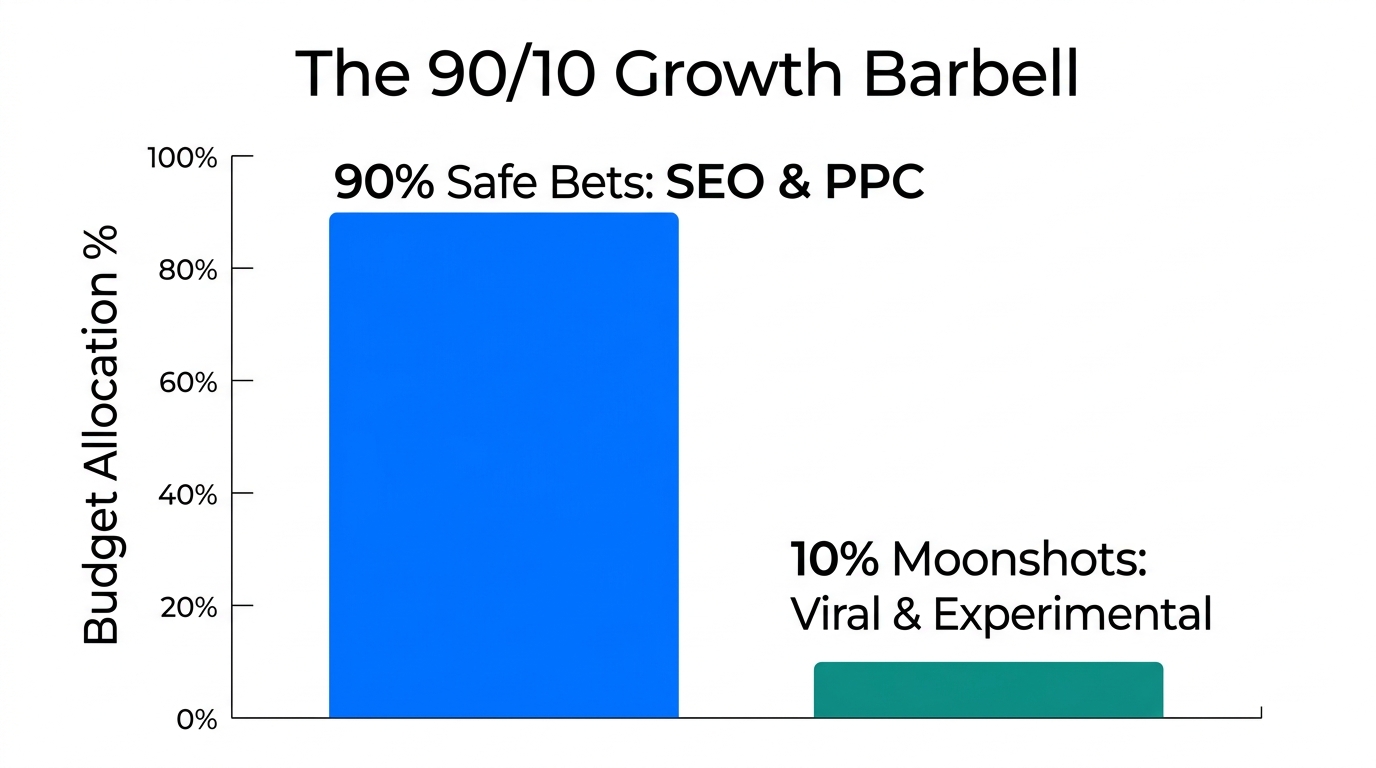
In 2026, the 'middle zone' of networking is death. This is the zone of the 40-minute Zoom call—it's too long to be efficient and too short to build a real bond. To master scaling a million dollar business, you must adopt the Barbell Strategy. On one end of the barbell, you have ultra-lightweight communication: 70+ texts a day, sharing memes, congratulating peers on TikTok, and staying top-of-mind with 10-second interactions. On the other end, you have 'Deep Hangs.'
The Chris Sacca Model
Legendary investor Chris Sacca famously moved to Truckee, near Lake Tahoe, to escape the noise of San Francisco. Instead of coffee meetings, he invited founders for 48-hour stays in his guest cabin. They skied, cooked, and spent hours in the hot tub. This 'deep hang' allowed him to understand the founder's true character in a way a Zoom call never could. It was during these deep hangs that he solidified his positions in Uber and Instagram.
When you combine this strategy with tools like Stormy AI, you can find the right people to invite to these deep hangs. Stormy allows you to filter through thousands of creators to find those with the most authentic engagement and audience quality, ensuring that your 48-hour investment is spent with someone who actually has the 'juice' to move the needle for your business.
"A five-hour walk is worth 200 Zoom calls. You can't connect the dots looking forward, but you can certainly place more dots on the map."
Step-by-Step: Transitioning to Serendipity-Led Growth
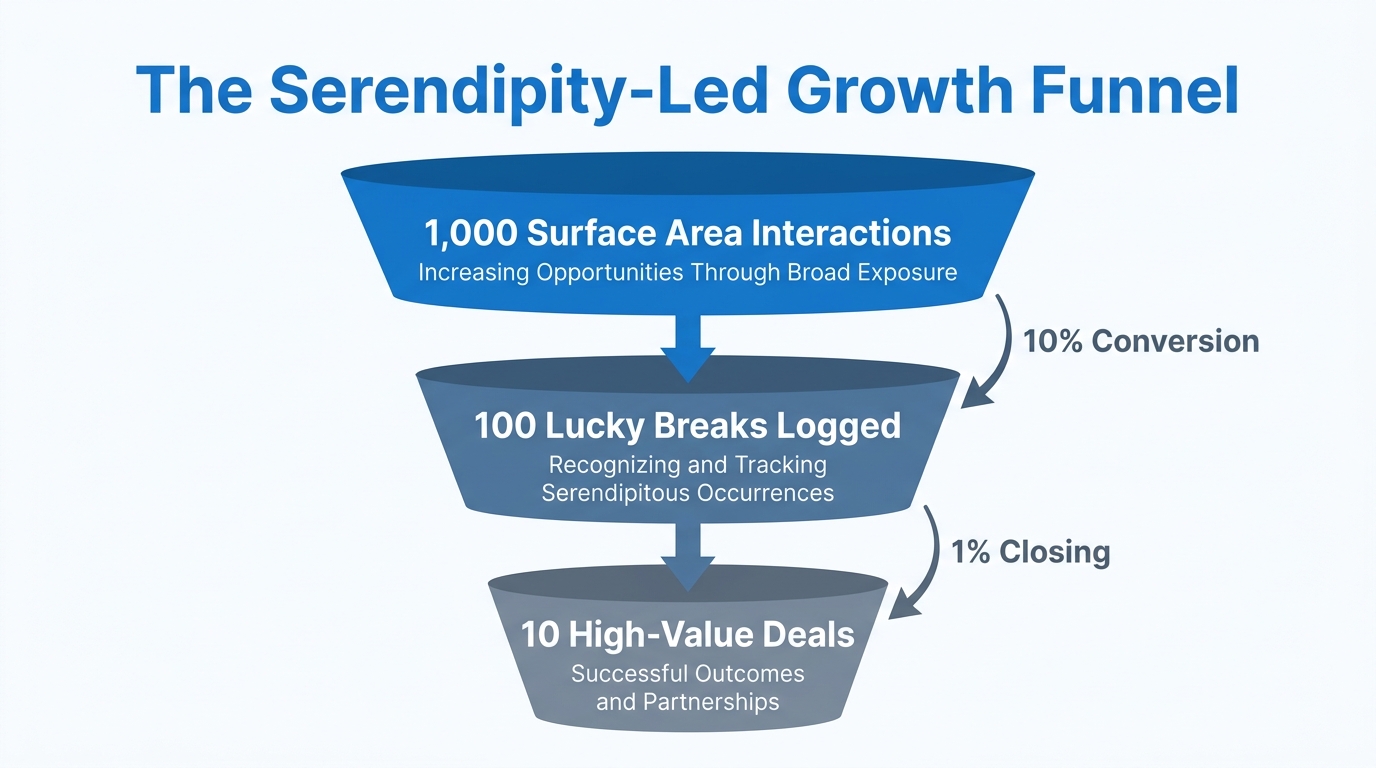
Transitioning your business from a transactional model to a serendipity-led growth model requires a shift in mindset and tooling. Follow this playbook to start measuring and manufacturing luck in your own organization:
Step 1: Audit Your 'Juice'
Identify the top 1% of your network—the people who are 'post-economic' or have extreme influence in your niche. Use Stormy AI to vet their audience quality and ensure they aren't just 'status signals' but actual value-adders. If they have high engagement and authentic followings, they belong in your 'Inner Circle' in HubSpot.
Step 2: Automate the Goodwill
Set up workflows in HubSpot to trigger 'Karma Tasks.' If a contact hasn't been reached in 90 days, your CRM should prompt you to send a helpful resource, a referral, or a simple 'thinking of you' text. Pair this with Instantly or Lemlist for personalized outreach that doesn't feel like a template.
Step 3: Track the Hits
Every time something good happens that you didn't pay for, log it in your Luck Spreadsheet. Analyze the source. Did it come from a TikTok Ads campaign, or was it a byproduct of a podcast guest you referred to a friend? This data will tell you where to double down on your 'unproductive' activities.
Step 4: Pursue Moments
Adopt the Coach K mantra: "We pursue moments." Whether it's a high-stakes sales call or a team offsite, look for the 'shock value' that creates a lasting memory. Use custom motivational content, unique gifts, or face-to-face deep hangs to differentiate yourself from the sea of transactional entrepreneurs.
The Bottom Line on Luck in 2026
As we move through 2026, the most successful business growth strategies will be those that embrace the irrational. By using HubSpot CRM to track your serendipity and Stormy AI to discover high-leverage partners, you can turn 'lucky breaks' into a predictable revenue stream. Stop waiting for the world to give you a break and start engineering the conditions for luck to strike. Scaling a million dollar business isn't just about the math; it's about the karma you build along the way.