In the early days of 2024, if a growth lead wanted to pull real-time lead data from Salesforce into a custom AI dashboard, they had two choices: beg the engineering team for a two-week sprint or mess around with fragile Zapier connections. Fast forward to 2026, and that entire paradigm has shifted. The Model Context Protocol (MCP) has become the 'Plaid for marketing data,' a universal language that allows AI agents to navigate your CRM, project management tools, and calendars with zero custom code.
The era of 'bespoke plumbing' is ending. As we move deeper into this year, marketers are no longer logging into ten different SaaS platforms to check stats; they are conversing with their data. This shift isn't just about convenience—it's about the speed of execution. When an AI tool can instantly understand the context of your Notion strategy docs while simultaneously pulling live conversion data from Google Ads, the distance between 'idea' and 'execution' shrinks to near zero.
What is MCP (Model Context Protocol)? The 'Plaid' for Your Marketing Data
 24:49
24:49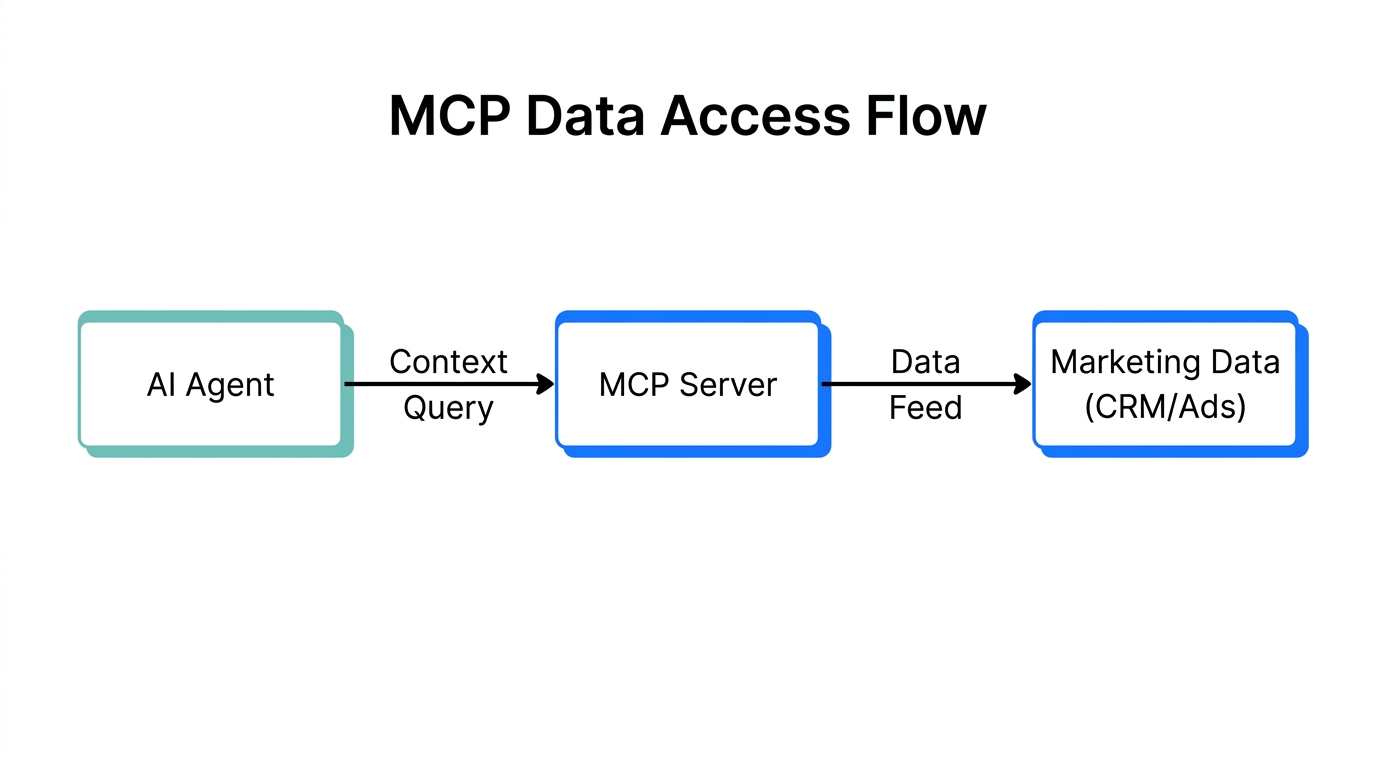
At its core, the Model Context Protocol (MCP) is an open standard that enables AI models—like those from Anthropic or OpenAI—to securely access data and 'tools' within other applications. Think of it as a universal translator. Previously, an AI couldn't 'see' inside your Linear workspace unless an engineer built a specific bridge using a bespoke API. Now, if an app supports MCP, any AI tool can interact with it natively.
This is particularly revolutionary for no-code marketing integration 2026. Growth teams can now build autonomous workflows where a ChatGPT instance identifies a drop in campaign performance, cross-references it with your Shopify inventory, and automatically drafts an update for the team in Slack. This isn't just automation; it's AI agent data access that understands the 'why' behind the numbers.
"The interfaces we've spent a decade learning are dying. In 2026, you don't 'use' a CRM; you talk to it via a protocol that understands your business intent."
Why Traditional APIs Feel Like 'Plumbing' in 2026
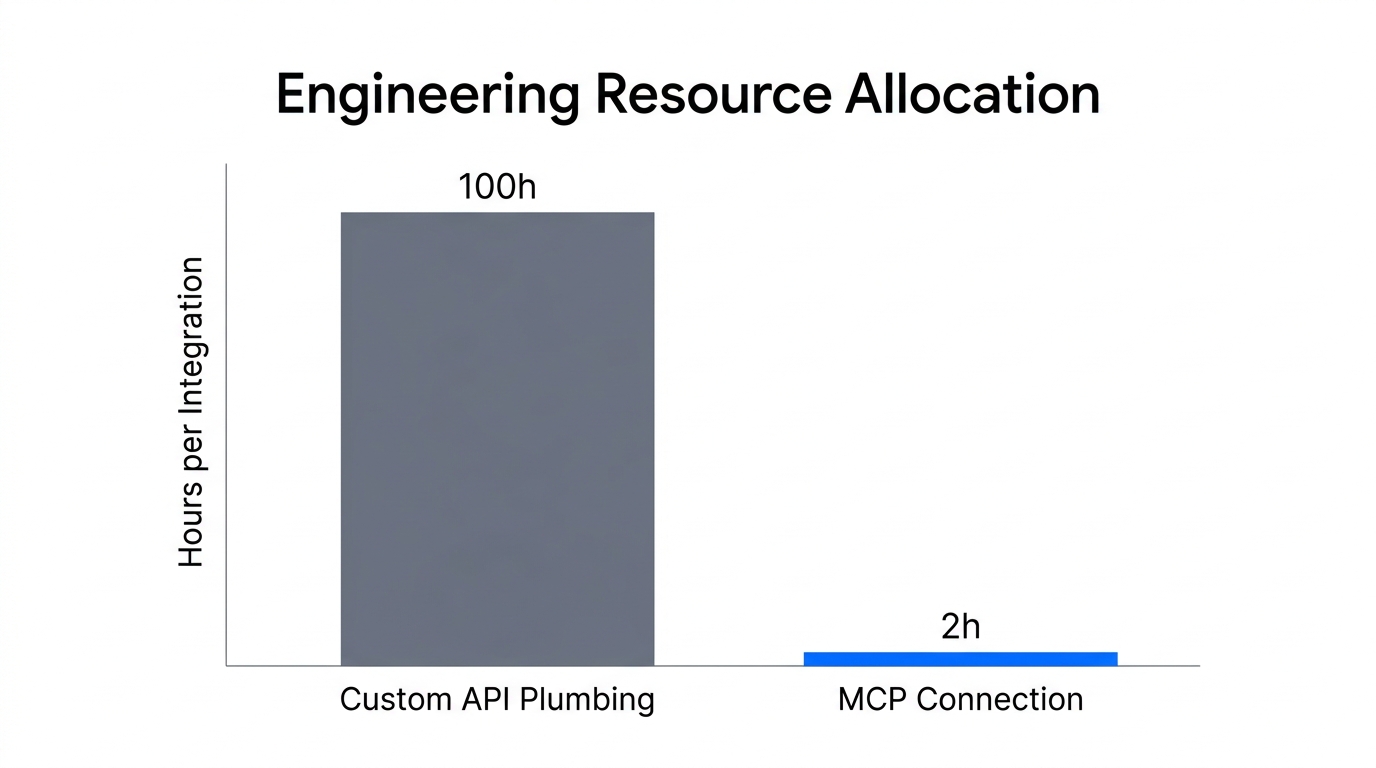
In the past, APIs were the gold standard. But as Saastr founder Jason Lemkin has noted, the problem with traditional APIs is that they are bespoke. Every tool has its own nuances, its own 'language,' and its own security hurdles. For a growth lead, managing these was like being a full-time plumber, constantly fixing leaks in the data pipeline. MCP changes the game by standardizing the way AI 'reads' an application's capabilities.
| Feature | Traditional APIs | Model Context Protocol (MCP) |
|---|---|---|
| Setup Time | Weeks (Engineering required) | Seconds (O-Auth style) |
| Flexibility | Rigid endpoints | Dynamic context discovery |
| Maintenance | High (APIs break/change) | Low (Protocol handles updates) |
| User Input | Structured queries/Code | Natural Language |
When you use an all-in-one platform like Stormy AI, you're already seeing the benefits of this streamlined connectivity. Stormy’s AI discovery engine doesn't just search a static database; it uses advanced data protocols to vet creators, analyze audience quality, and manage outreach sequences in real-time across TikTok and Instagram. This type of marketing technology trend 2026 is what separates high-growth startups from the laggards who are still manually exporting CSV files.
The End of Bespoke Integrations: Instant CRM Access
26:56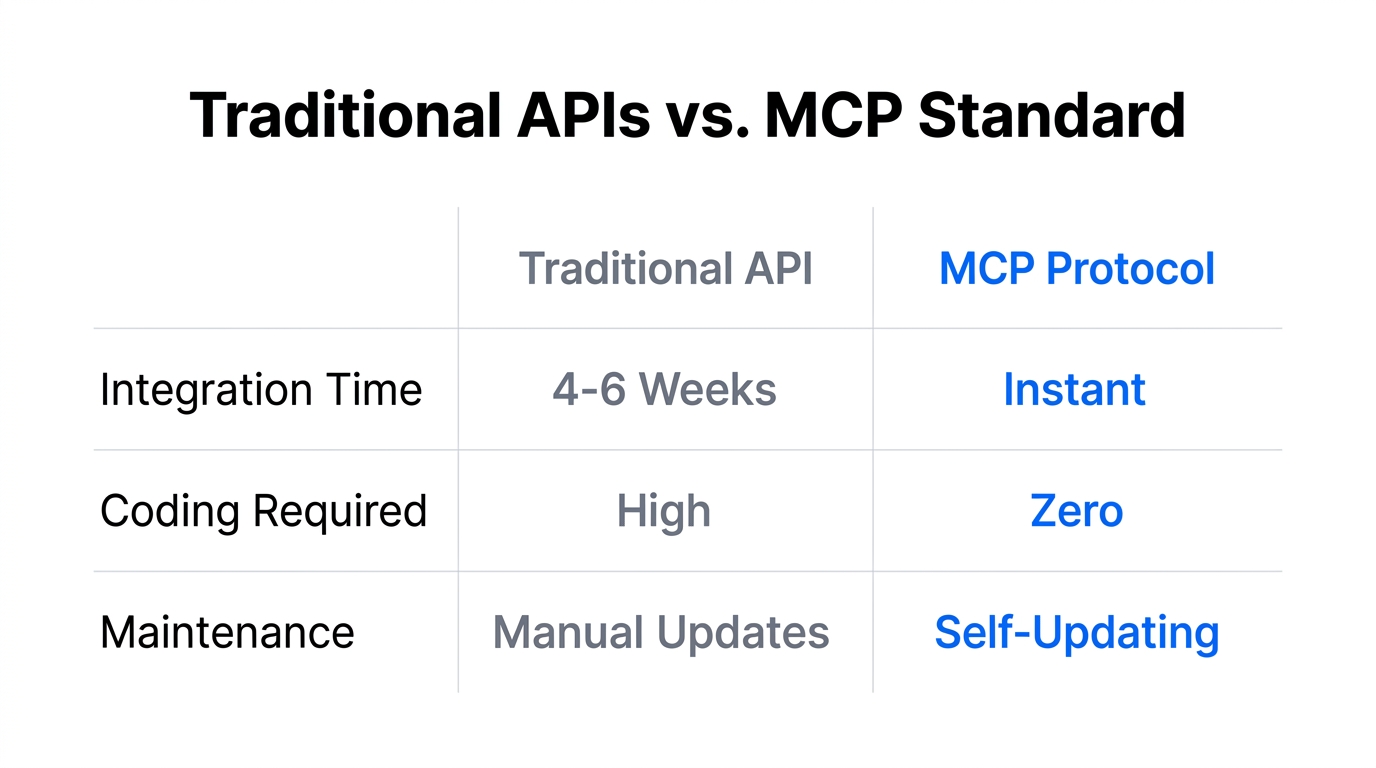
The most significant impact of Model Context Protocol for marketers is the democratization of data. You no longer need a 'Data Operations' title to build a complex ecosystem. If you're using a modern CRM, the MCP-enabled AI can 'understand' your deal stages, revenue forecasts, and customer touchpoints without you having to define them in a middleware tool like Zapier or Make.com.
Consider the 'digital body double' experiment discussed in recent tech circles. By ingesting 20 million words of content—including YouTube transcripts, blog posts, and emails—AI can now act as a high-level advisor. With MCP, that advisor can also act. It doesn't just suggest a sales strategy; it logs into your Salesforce via MCP and re-prioritizes your leads for the day based on the latest competitive intelligence.
"20 million words is about 200 books' worth of context. In 2026, your AI doesn't just know your data; it knows your 'brain' and how you want to use it."
Case Study: Updating Google Calendars and Notion via Natural Language
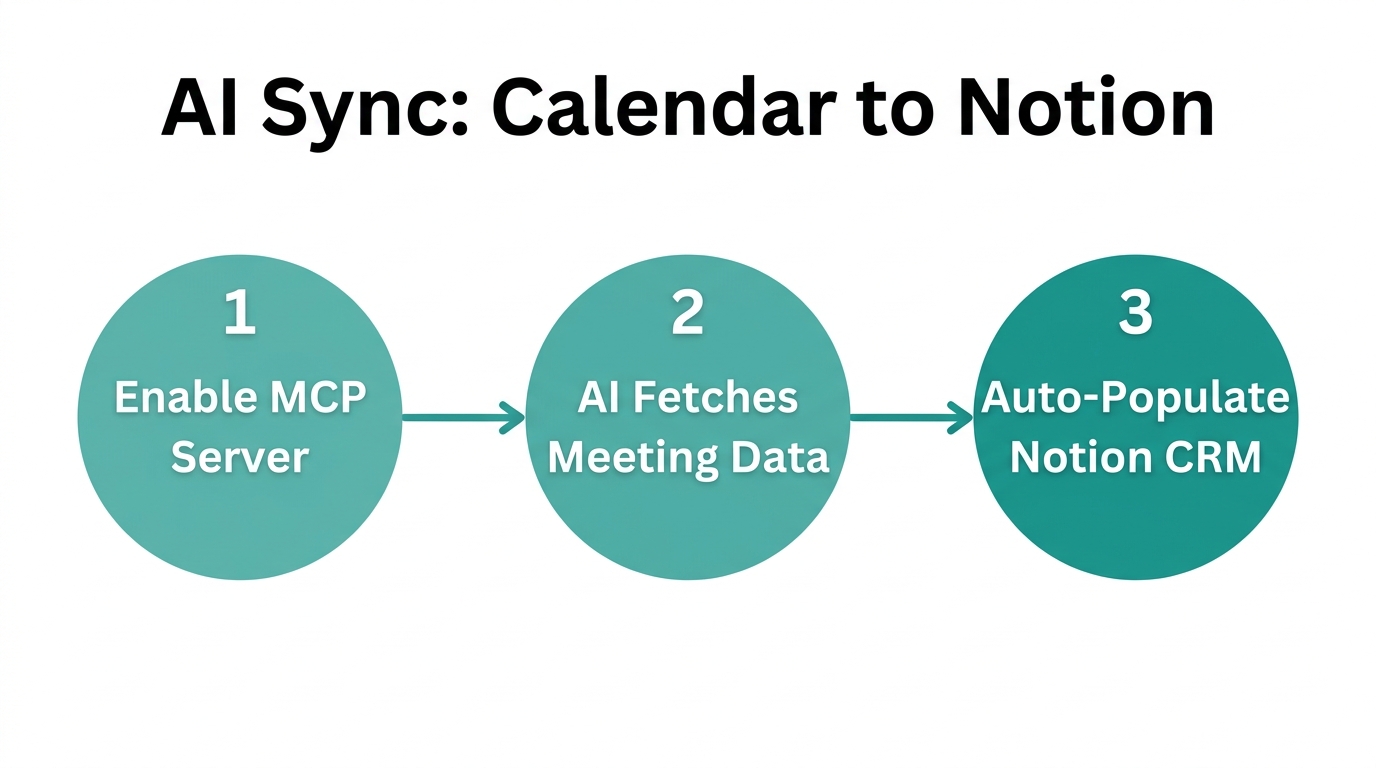
Let's look at a practical application that is common in 2026 growth operations. Imagine you are running a UGC (user-generated content) campaign for a mobile app. Your creators are sending in videos, and your deadlines are shifting. Traditionally, you'd spend hours updating Google Calendar and syncing those dates with a Notion content tracker.
Step 1: Connect Your Sources
Using an MCP-enabled interface (like the one found in Claude or ChatGPT), you grant the AI access to your calendar and Notion workspace. This is a one-time 'handshake'—no API keys or code required.
Step 2: Give the Command
Instead of manual entry, you simply type: 'The three UGC videos from the LA fitness creators are delayed by 48 hours. Update my content calendar in Notion and move the corresponding review meetings on my Google Calendar.'
Step 3: Verification
The AI uses the MCP to 'read' the current states of both apps, identifies the specific records, and performs the updates. It then confirms: 'Notion database updated. Meetings for Wednesday moved to Friday at 2:00 PM.'
Transitioning from UI-Based Marketing to Chat-Based Growth Operations
63:39The shift to chat-based growth operations is the defining marketing technology trend 2026. We are moving away from 'logging into apps' and toward 'directing agents.' When you can pull a full report on your TikTok Ads Manager performance simply by asking, the utility of a complex dashboard diminishes. This is why incumbents are racing to become 'plumbing' for AI agents rather than just standalone destinations.
- Increased Efficiency: One person can now manage the workload of a five-person content team.
- Real-Time Auditing: Use AI to audit ElevenLabs voice clones or CapCut edits for brand consistency automatically.
- Seamless Outreach: Solutions like Stormy AI utilize these protocols to ensure your influencer outreach is hyper-personalized, drawing from the latest social data without manual research.
As the 'push' of 2024 (pushing for growth, pushing for data) turns into the 'pull' of 2026 (the market pulling AI-driven results toward it), the tools that win will be the ones that play nicely with others. MCP is the glue that makes this possible.
"If your AI can talk to any app you use and take the data out, you no longer care about the UI. The UI is for the AI, not for you."
The Future of the 'Marketing Stack' in an AI-Agent World
In the next 24 months, the concept of a 'Marketing Stack' will be replaced by the 'Agentic Ecosystem.' Instead of choosing a stack based on which tools integrate with Mailchimp, you'll choose tools based on their MCP compliance. If a tool doesn't allow your AI agent to navigate its data, it will be discarded in favor of one that does.
We are already seeing this in the UGC for mobile app marketing space. App developers are using AI to discover creators, script videos using brand-voice-trained models, and then using MCP to push those creative assets directly into Meta Ads Manager. This 'full-stack' AI automation is only possible because of standardized communication protocols.
Conclusion: How to Master MCP Today
To stay ahead in 2026, you don't need to learn to code; you need to learn to orchestrate. Start by auditing your current marketing tools. Do they support the MCP Model Context Protocol? If not, ask their support teams for a roadmap. Begin experimenting with tools like Stormy AI that leverage the power of AI to simplify complex manual tasks like creator vetting and personalized outreach.
The goal is to move from 22 minutes of AI usage per day to 24 hours of autonomous AI operations. By embracing no-code marketing integration 2026, you aren't just saving time—you're building a scalable growth engine that works while you sleep. The 'Model Context Protocol for marketers' isn't just a technical update; it's the keys to the kingdom for the next generation of growth leaders.