For modern CMOs and marketing directors, the challenge is no longer a lack of data; it is the latency between insight and action. In the time it takes for an analyst to identify a cost-per-click (CPC) spike on TikTok and report it to the media buying team, thousands of dollars in budget may have already been inefficiently deployed. As the AI social media market prepares to balloon from $2.12 billion in 2024 to $7.87 billion by 2029, according to AdMove, the industry is pivoting toward marketing ROI automation. The goal is no longer just 'assisted' marketing, but truly autonomous performance loops. This is where Claude Code and agentic architectures are redefining the Go-To-Market (GTM) strategy.
The Shift to Agentic Social Media ROI
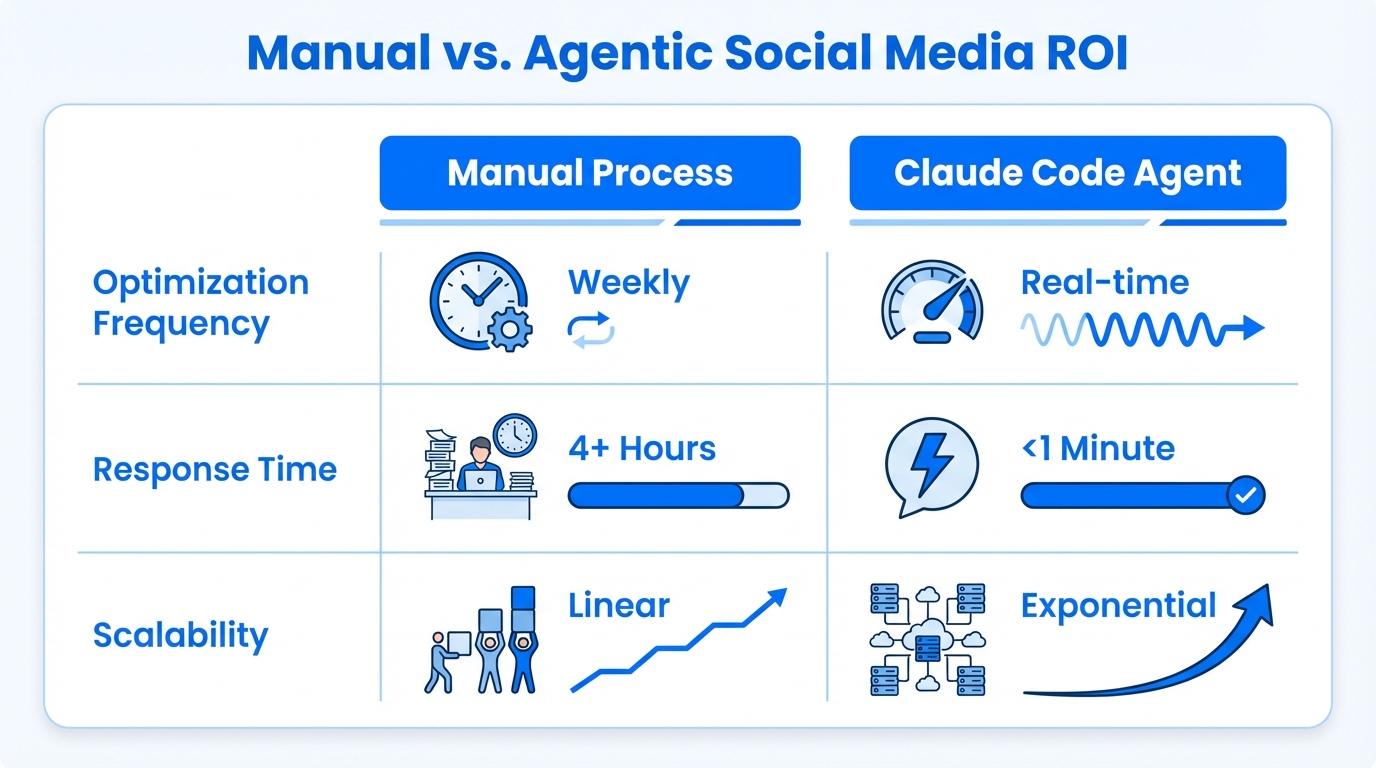
The traditional marketing stack is fragmented. You have analytics tools, creative suites, and ad managers, all requiring human intervention to sync. However, 88% of executives now plan to increase AI spending specifically for agentic capabilities, as noted by the Digital Marketing Institute. An AI agent, unlike a chatbot, doesn't just suggest a course of action—it executes it. For performance marketing, this means autonomous social media analytics automation where the 'agent' monitors live streams of data and adjusts bids, pauses underperforming creatives, or scales winning sets in real-time.
"The move from 'AI-assisted' to 'AI-agentic' is the single biggest shift in marketing efficiency we will see this decade, potentially reducing content creation time by 30% while lifting engagement by up to 20%."By leveraging tools like Claude Code, teams are building systems that bridge the gap between high-level strategy and terminal-level execution. This isn't just about saving hours; it’s about capturing revenue that would otherwise be lost to manual delay. 79% of companies have already reported adopting AI agents in 2025, with two-thirds seeing immediate, measurable ROI according to Gmelius.
Case Study: How AdMove AI Automates Performance Responses
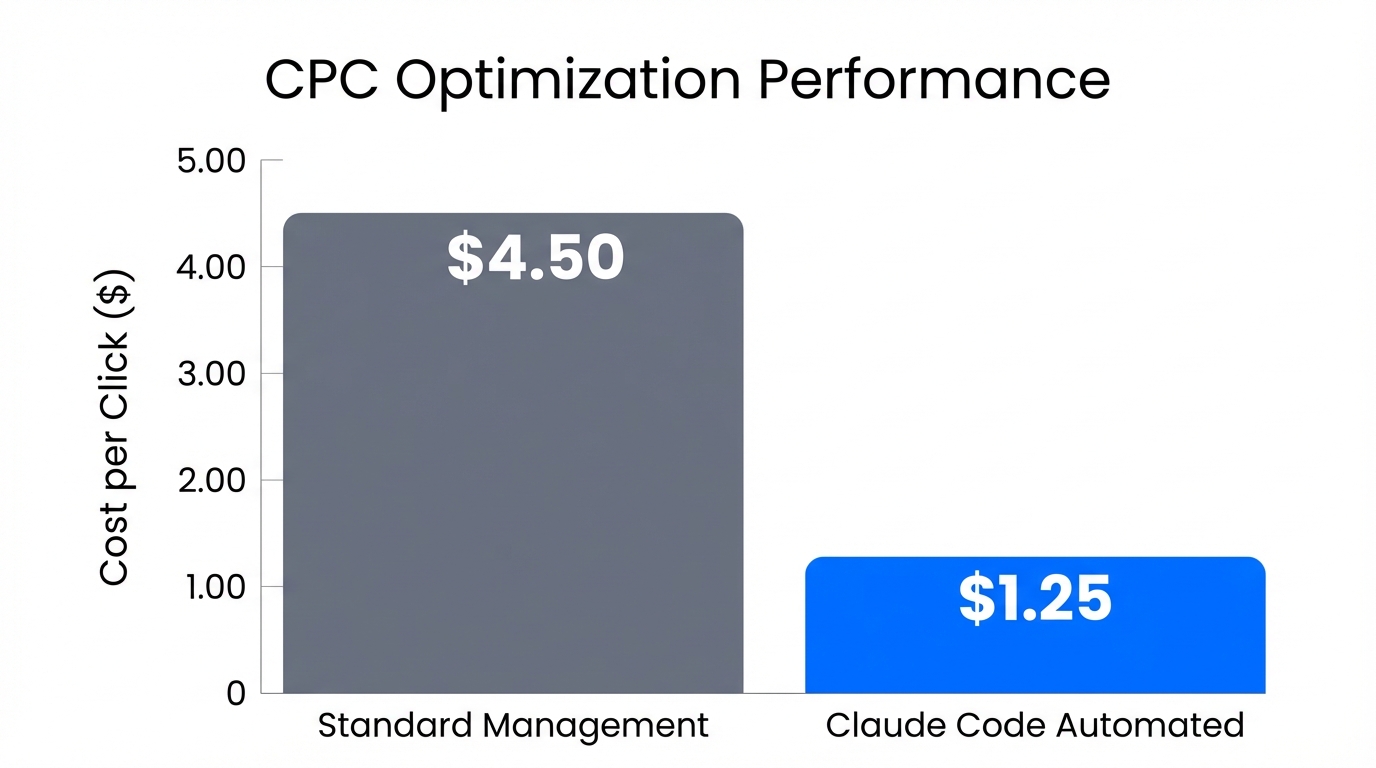
Consider the real-world application of AdMove AI, which utilizes autonomous agents to manage high-stakes ad spend. In a typical scenario, a mobile app install campaign might experience a sudden surge in CPC at 11:00 PM on a Friday. A human manager wouldn't see this until Monday morning. An agentic system built on Claude’s architecture monitors these metrics continuously.
Instead of merely sending an alert or pausing the campaign, the agent analyzes the context. Is the spike due to a competitor outbidding? Is it a specific geographic region? The agent then autonomously adjusts mobile bids or redistributes the budget to higher-performing segments. This level of AI agent GTM strategy ensures that your capital is always working at peak efficiency, regardless of human office hours.
The 'Brain-Tool-Action' Architecture for Performance Teams
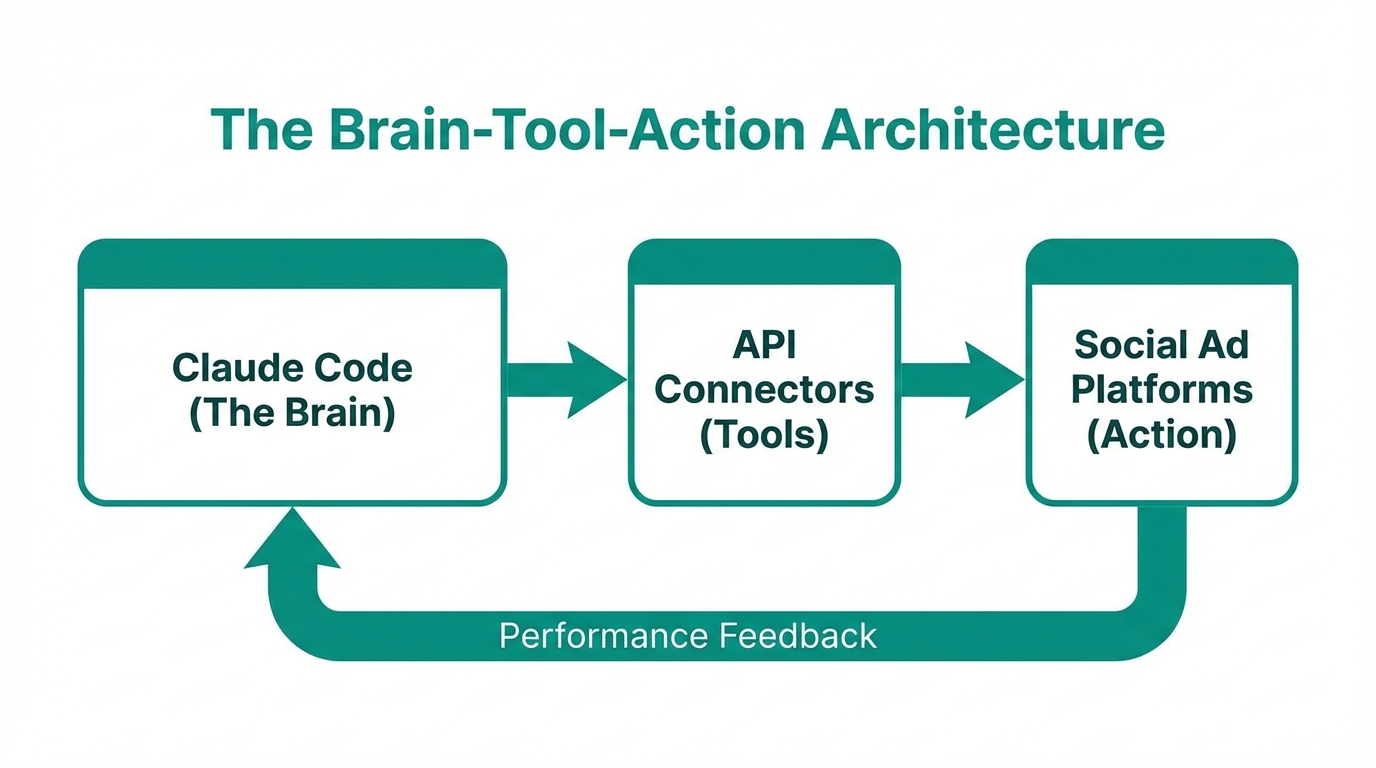
To implement Claude Code for performance marketing, CMOs need to understand the underlying framework: the 'Brain-Tool-Action' architecture. This modular approach allows for a secure, scalable, and highly intelligent marketing engine.
- The Brain: This is Claude 3.7 Sonnet. It provides the reasoning, brand voice adherence, and strategic decision-making capabilities.
- The Tool: This is the Model Context Protocol (MCP). MCP acts as the 'USB-C for AI,' allowing the agent to connect directly to social APIs like the LinkedIn Developer Portal or Meta’s Ads Manager without custom, fragile middleware.
- The Action: This is the execution layer where Claude Code interacts with your codebase or marketing scripts to push changes live.
| Feature | Manual Workflow | Agentic Workflow (Claude Code) |
|---|---|---|
| Response Time | Hours to Days | Seconds to Minutes |
| Data Processing | Sampling/Top-level | Granular/Comprehensive |
| Creative Iteration | Weekly Sprints | Real-time testing |
| Error Rate | High (Human Fatigue) | Low (Rule-based constraints) |
Bridging the Gap: Between Analytics Data and Creative Execution
One of the greatest points of friction in performance marketing is the disconnect between what the data says and what the creative team produces. Often, data suggests a specific hook is working, but it takes days to produce a variation. By using the Claude Agent SDK, marketers can build agents that not only analyze which YouTube comments or TikTok trends are driving engagement but also automatically draft new briefs or scripts for creators.
For example, a Community Poll Bot can analyze YouTube engagement data and autonomously generate polls to keep the algorithm favoring your channel. This creates a feedback loop where the data directly informs the next piece of content without manual translation. In the world of influencer marketing, platforms like Stormy AI can help source the very creators who will execute these AI-informed briefs, ensuring that your UGC strategy is backed by hard performance data.
"Data without immediate creative execution is just a history lesson. Agentic systems turn history into a real-time roadmap for growth."Cost-Benefit Analysis: 'Thinking Mode' vs. Manual Labor
A common concern for marketing directors is the cost of running advanced AI models. Claude 3.7 Sonnet’s 'Thinking Mode' is a powerful tool for high-stakes strategy, such as crisis management or complex campaign planning. While 'Thinking Mode' consumes more tokens, the cost is negligible compared to the manual labor it replaces. According to data from Templated, teams report a 30% reduction in content creation time when using these automated flows.
When you factor in the 20-30% lift in engagement seen by automated teams, the ROI becomes clear. You are trading expensive human hours for high-speed, high-accuracy machine cycles. To further streamline the funnel, integrating your agent with platforms like Stormy AI allows for autonomous creator outreach and vetting, removing yet another manual bottleneck in the performance marketing chain.
Future-Proofing Your GTM strategy with Agentic Capabilities
To stay competitive, marketing teams must move beyond simple scheduling. Future-proofing your GTM strategy involves building a 'Strategic Memory' for your agents. By using a CLAUDE.md file within your project environment, you can store your brand voice, negative constraints (e.g., 'never use these emojis'), and compliance rules that the agent references during every session.
Furthermore, developers should utilize the MCP Server Marketplace to find pre-built connectors for X (Twitter), LinkedIn, and other social platforms. This modularity means that as social platforms update their APIs, your agentic infrastructure remains resilient. By sandboxing these agents in Docker containers and implementing strict maxIterations limits, brands can deploy autonomous marketing power without the risk of 'infinite loops' or compliance breaches.
Conclusion: The New Standard for ROI
The era of manual performance marketing is drawing to a close. As the complexity of social platforms increases, the human ability to monitor and respond in real-time is being outpaced. By adopting Claude Code and an agentic approach, CMOs can ensure their marketing ROI automation is not just a buzzword, but a core competitive advantage. Start by identifying your highest-latency marketing process—whether it's ad bid adjustments or creator sourcing—and apply an agentic loop. The results will manifest in higher engagement, lower costs, and a significantly more agile GTM strategy.