The era of manually refreshing ad dashboards every sixty minutes to check for budget spikes is officially over. In 2024 and 2025, the digital marketing industry underwent a tectonic shift: moving from "AI as a tool" (simple chatbots and copy generators) to "AI as a workforce" (autonomous agents). Leading this charge is OpenClaw, an open-source framework that has reached over 214,000 GitHub stars by early 2026—surpassing the initial growth rates of industry titans like Docker and React. For performance marketers, the promise of OpenClaw isn't just efficiency; it's the ability to achieve real-time ROAS optimization that a human team simply cannot match.
The Rise of Agentic Marketing: Why Manual Management is a Liability
Data indicates that manual ad management is rapidly becoming a competitive liability. According to research from Deloitte, 37% of global companies have already replaced or automated significant portions of human marketing workflows with AI agents as of late 2025. This shift is driven by the sheer volume of data generated by modern programmatic ecosystems. By 2026, programmatic display spending in the US alone is expected to exceed $203 billion, and AI agents are becoming the standard for managing the real-time bidding and optimization required to stay profitable.
"The marketer’s role is shifting from a creator to a conductor. You set the tempo; the agents play the instruments." — Jon Hyman, CTO at Braze
Early adopters of agentic GTM (Go-To-Market) platforms are already seeing massive returns. Research from Landbase highlights that companies utilizing OpenClaw ROAS optimization report an average of 55% higher operational efficiency and, perhaps more importantly, 35% lower marketing costs. These agents function as a 24/7 "Jarvis" for your ad accounts, executing complex commands across Google, Meta, and TikTok through natural language interfaces like Slack or Discord.
Automated Performance Auditing: Setting ROAS Guardrails
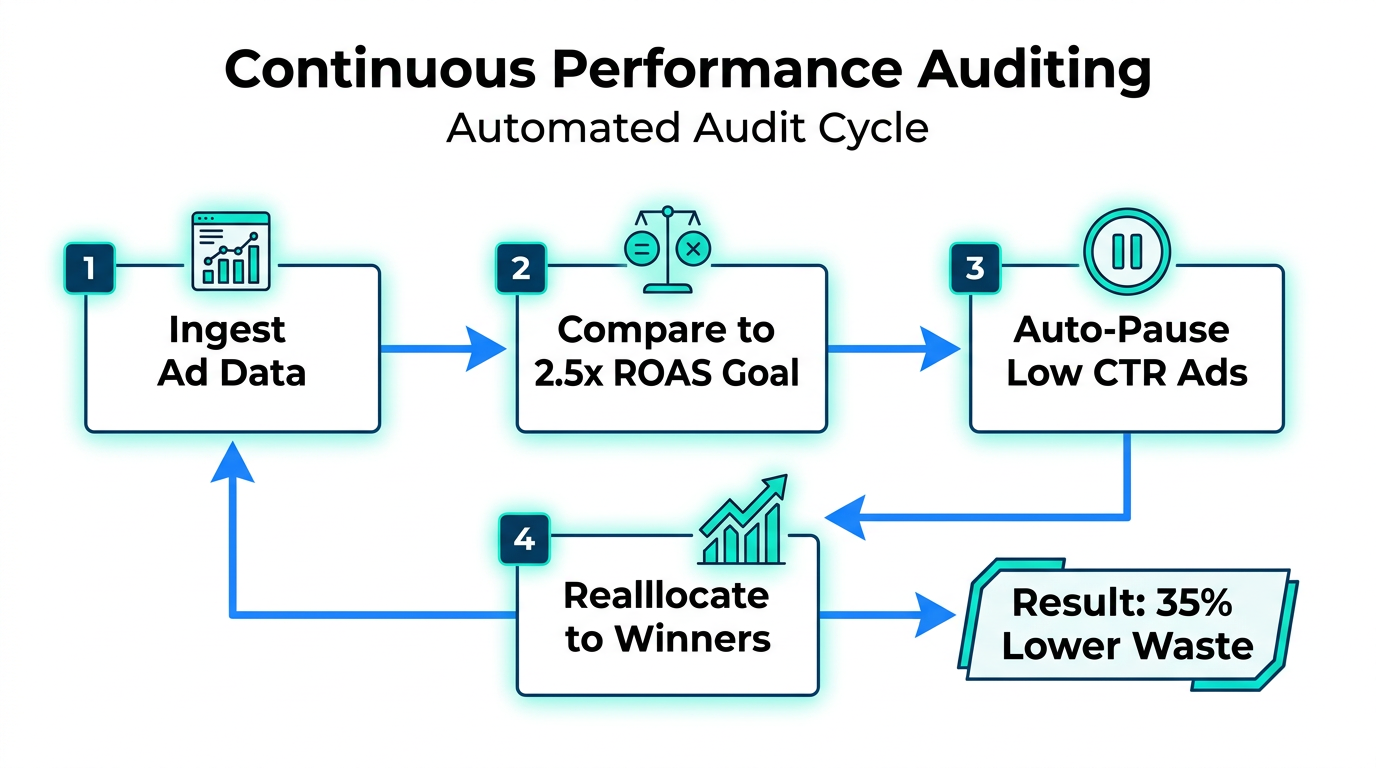
One of the most immediate ways to lower marketing costs with AI is through automated ad performance auditing. Traditionally, an account manager might check a campaign’s Return on Ad Spend (ROAS) twice a day. If a campaign tanks at 10:00 AM, it might continue to bleed budget until the afternoon check-in. OpenClaw agents eliminate this latency by monitoring accounts every few minutes.
Using specialized "Skills" from the ClawHub registry, marketers can set strict performance thresholds. For example, you can program an agent to proactively alert you: "ROAS fell below 2.0 on the 'Spring Sale' campaign. Should I pause it?" This real-time intervention prevents wasted spend and ensures that only winning creatives receive the lion's share of the budget. Beyond simple pausing, these agents perform Creative Analysis, identifying "creative fatigue" by monitoring CTR decay and automatically suggesting new assets before performance falls off a cliff.
Browser Automation vs. API Mode: Solving the Developer Token Headache
For many small teams and startups, accessing official ad APIs can be a nightmare of developer tokens, security reviews, and technical overhead. OpenClaw solves this by offering two distinct execution modes:
| Feature | API Mode | Browser Automation Mode |
|---|---|---|
| Speed | High-speed, bulk operations | Simulates human speed |
| Setup Difficulty | Complex (requires developer tokens) | Easy (no API access needed) |
| Reliability | Highest; follows official protocols | High; uses Playwright to click dashboards |
| Best For | Enterprise-scale management | SMBs and small marketing teams |
The Browser Automation Mode is particularly revolutionary. It uses Playwright to simulate human clicks within the ad dashboard itself. This allows an agent to log in to your Meta Ads Manager, navigate to a specific campaign, and adjust a budget or swap a creative exactly as a human would—without ever needing an official API integration. This democratizes high-level automation for brands that don't have a dedicated engineering team.
AI Agent Budget Pacing: Eliminating the Month-End Overspend
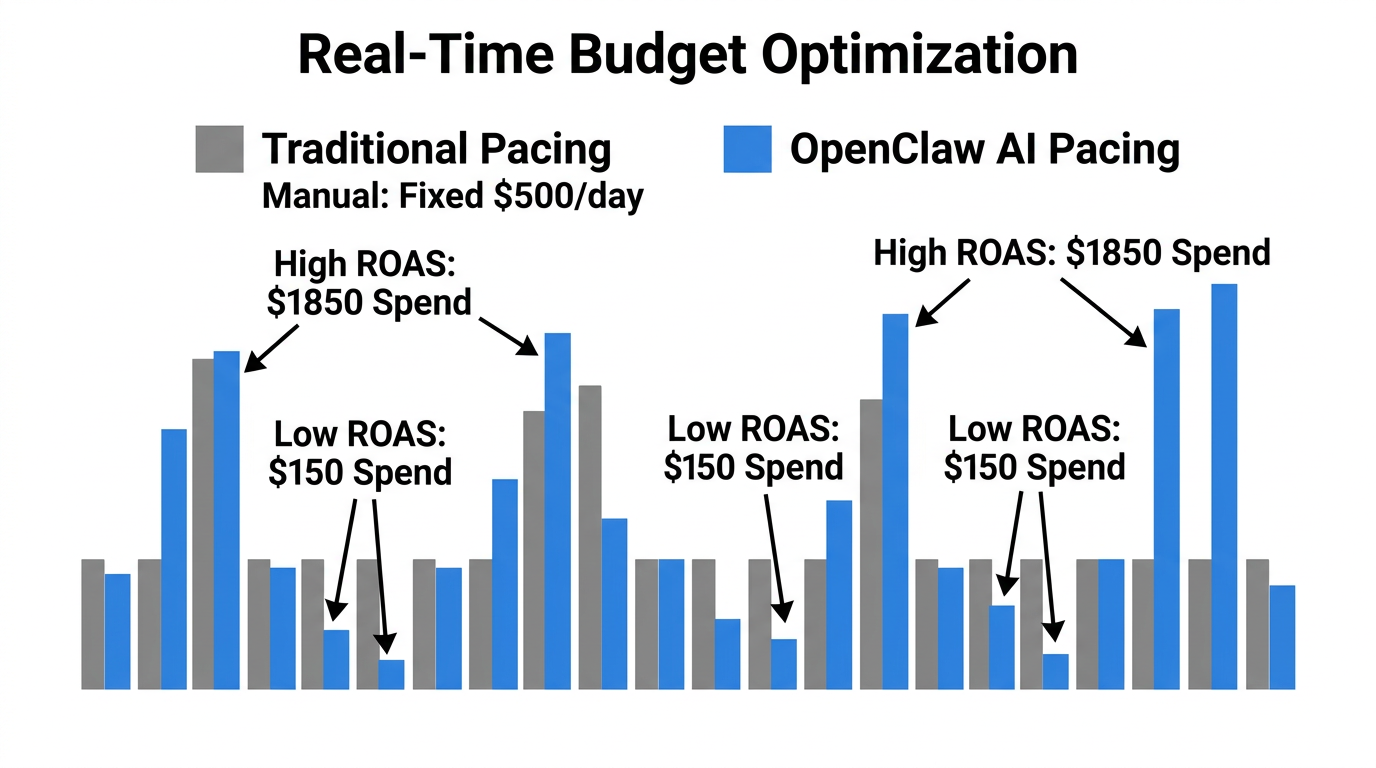
Every performance marketer has experienced the "pacing panic"—realizing on the 25th of the month that 90% of the budget is gone, or conversely, that you're 40% underspent. AI agent budget pacing solves this by implementing dynamic adjustments based on real-time performance and remaining calendar days. Instead of a flat daily limit, the agent calculates the optimal daily spend based on historical winning hours and current market liquidity.
If the agent detects that CPMs are unusually high on a Tuesday morning, it might throttle spend and wait for the more profitable Tuesday evening window. This real-time ad bidding agent behavior ensures that your budget is allocated to the highest-intent moments. Platforms like Adspirer act as bridges, allowing OpenClaw to connect to Google Ads, Meta, TikTok, and LinkedIn Ads without writing a single line of custom code, making dynamic pacing accessible to non-technical users.
"In 2025, AI moved from the side of the tech stack to the center, taking responsibility for entire workflows like building and routing campaigns." — Saul Marquez, CEO of Outcomes Rocket
The 'Garbage In, Garbage Out' Rule: The Importance of Data Quality
While the autonomy of OpenClaw is powerful, it is not infallible. The "Garbage In, Garbage Out" (GIGO) rule is the most critical factor in agentic optimization. If you feed an agent dirty data—such as duplicate leads, outdated tracking pixels, or broken conversion events—the agent will optimize for the wrong goals with terrifying efficiency.
To ensure your OpenClaw ROAS optimization works correctly, you must audit your data infrastructure. This includes:
- Ensuring Meta Conversions API and Google Tag Manager are firing correctly.
- Cleaning CRM data in platforms like Shopify or Salesforce to prevent agents from optimizing toward spam leads.
- Providing Brand Voice files so agents don't generate generic, "robotic" creative suggestions.
Transitioning to AdAmigo and AdStellar for Meta Mastery
While OpenClaw is a versatile open-source framework, some marketers prefer specialized tools that are pre-configured for specific platforms. For those focusing heavily on Meta (Facebook/Instagram), tools like AdAmigo.ai and AdStellar provide a more "turnkey" experience.
AdStellar, for instance, uses 7 specialized agents—including a Director, Copywriter, and Budget Allocator—to build and launch complete Meta campaigns in under 60 seconds using voice commands. Similarly, AdAmigo is designed for hands-off management, allowing you to scale budgets or swap headlines via simple text prompts in a mobile-friendly interface.
For brands looking to fuel these ads with authentic content, incorporating UGC (User-Generated Content) is essential. Platforms like Stormy AI streamline this process by using AI agents to autonomously find, outreach to, and negotiate with creators on TikTok and YouTube. By pairing Stormy AI for creator sourcing with an optimization agent like OpenClaw, brands can create a fully automated pipeline from content creation to ad optimization.
Playbook: Implementing Your First OpenClaw Optimization Agent
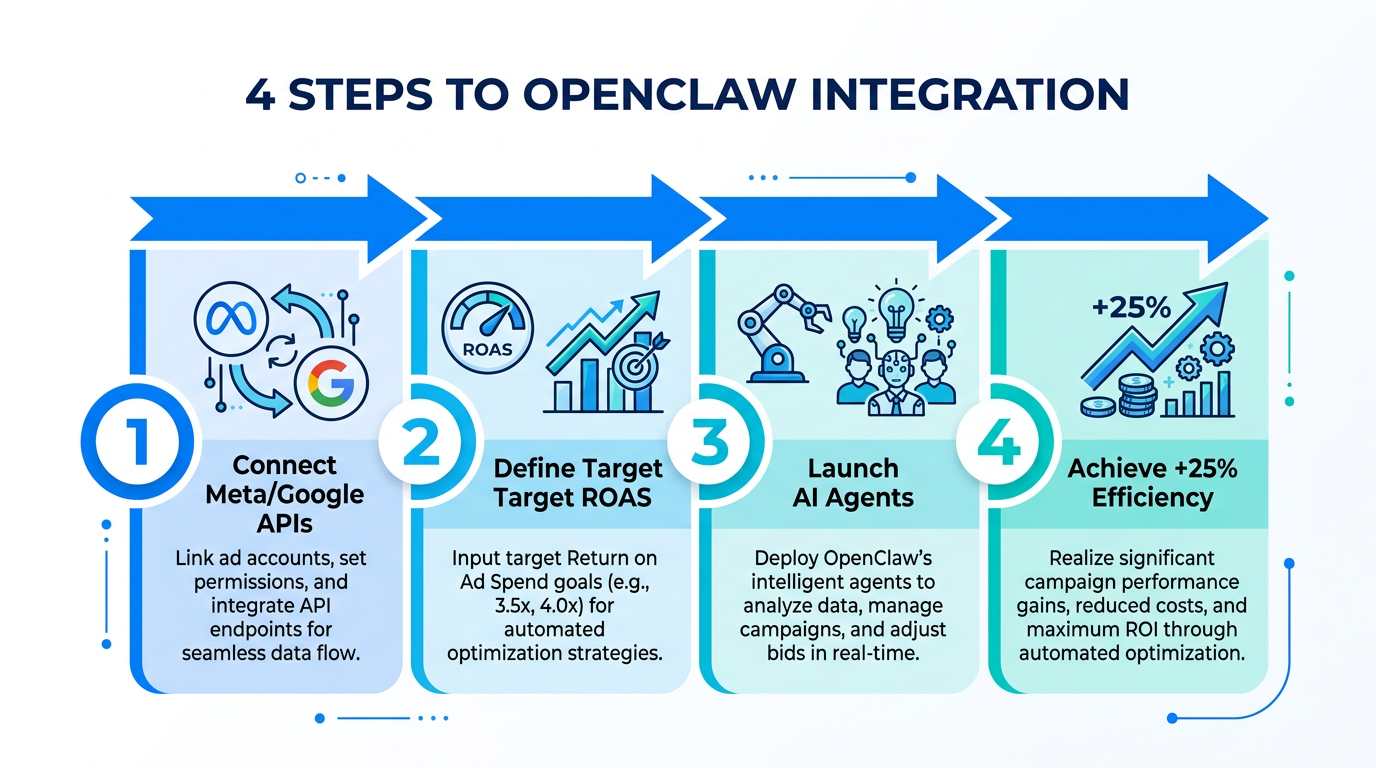
- Step 1: Deployment: Run OpenClaw locally or on a private server using the instructions on the official GitHub repository.
- Step 2: Connect Your Accounts: Use Adspirer or official SDKs to link your Google and Meta Ads accounts.
- Step 3: Install Skills: Visit ClawHub and install the AdWhiz Skill for auditing and optimizing Google Ads.
- Step 4: Set the SOUL.md Protocol: Program your agent to require a "Thumbs Up" emoji in Slack before any budget change over $500 goes live. This ensures you maintain control over major shifts.
- Step 5: Monitor and Iterate: Use a project management tool like Linear or Asana to track the agent’s performance improvements over time.
"The key to maximizing ROAS isn't spending more; it's spending smarter. AI agents don't get tired, they don't miss trends, and they don't forget to pause a failing ad at 3:00 AM."
Conclusion: The Future is Agentic
The transition to agent-led marketing is no longer a futuristic concept—it is a current reality. By leveraging OpenClaw ROAS optimization, brands can significantly lower marketing costs with AI while freeing up human talent to focus on high-level strategy and brand narrative. Whether you are using Browser Automation Mode to bypass API hurdles or deploying specialized tools like AdStellar for Meta mastery, the goal remains the same: maximize efficiency through intelligent automation.
As Gartner predicts, by 2026, 40% of enterprise applications will include task-specific AI agents as a default feature. Now is the time to build your agentic workforce, audit your data quality, and stop the manual daily monitoring that is holding your ROAS back. For those looking to automate the "top of the funnel" content creation, consider starting your journey by learning how to discover creators on Stormy AI to ensure your agents always have fresh, high-performing UGC to optimize.