The transition from generative AI that simply writes copy to agentic AI that executes strategy is the defining shift of 2026. For growth teams, this evolution is embodied in Claude Code, a terminal-based orchestrator that doesn't just suggest marketing plans—it builds and manages them. As we navigate a landscape where the Marketing Automation Mesh has replaced the rigid stacks of the past, understanding the economics of these autonomous systems is no longer a luxury; it is a survival requirement for maximizing marketing AI ROI.
By the first quarter of 2026, the AI agent market has surged to $12.06 billion, according to data from Research and Markets. This isn't just hype; it is a fundamental restructuring of how work gets done. With 79% of companies adopting AI agents this year, the focus has shifted from "can it write?" to "can it execute?" Tools like Claude Code are leading the charge, reaching a $2.5 billion annualized run-rate and serving over 300,000 business customers who are looking for more than just a chatbot. They are looking for a tireless, technical team member capable of managing the complexity of a modern growth engine.
The 2026 MarTech Economy: The $12B Agentic Shift
The total MarTech market has reached a staggering $222.53 billion in 2026, as reported by Fortune Business Insights. Within this massive ecosystem, the fastest-growing segment is "Action AI." Marketing teams are no longer satisfied with dashboards that show what happened; they want agents that can fix what’s broken. This has led to the rise of the Composable Canvas, a concept pioneered by Scott Brinker, where a unified data foundation allows agents to roam freely between tools to find information and execute tasks.
Efficiency metrics suggest that this shift is paying off. Teams utilizing agentic tools, such as Stormy AI for creator discovery, report a 75% reduction in time spent on repetitive strategic analysis. This allows humans to move from being "doers" to "orchestrators." As Christopher S. Penn notes, the "Technical Marketer 2.0" doesn't write code; they orchestrate agents to handle the heavy lifting of data routing and API calls.
Comparing the Costs: Claude Code API Spend vs. Traditional Agencies
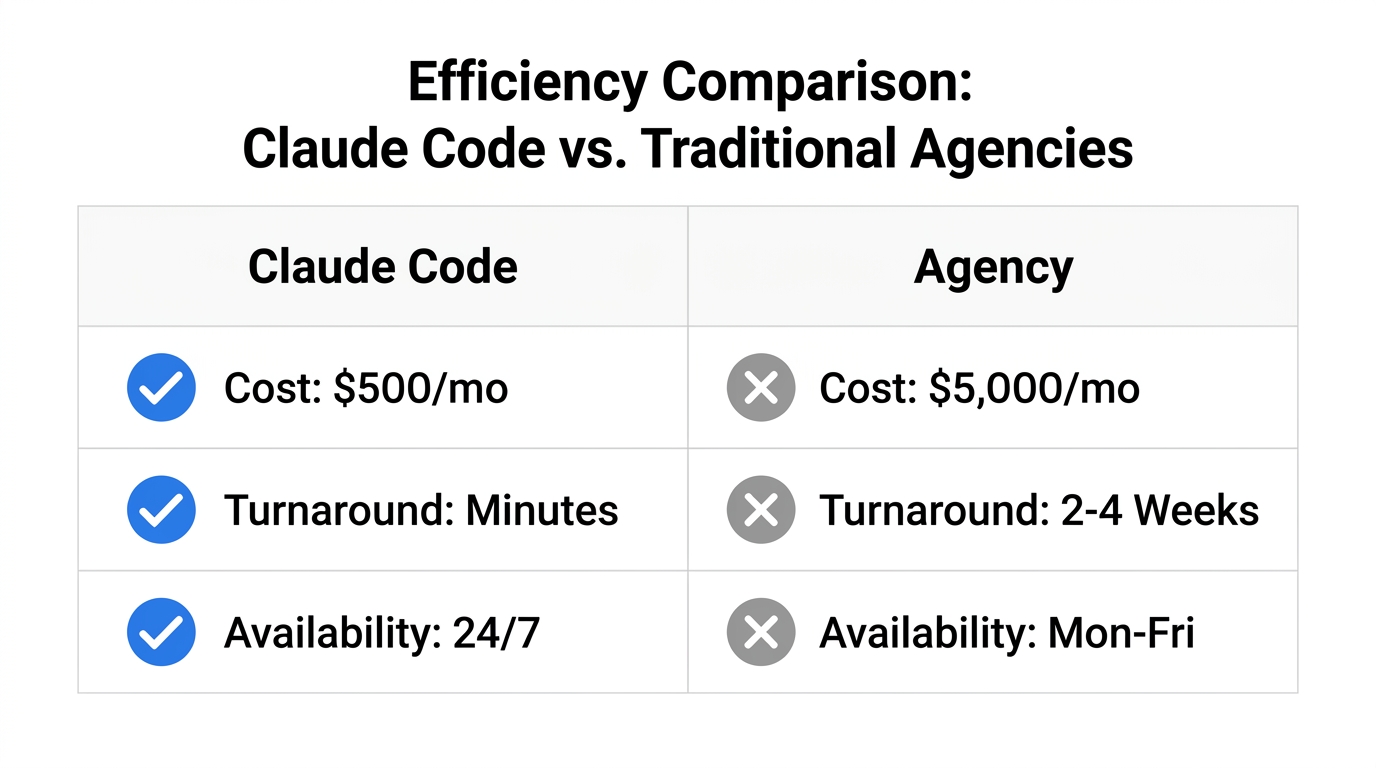
The economic argument for Claude Code is overwhelming. Traditional marketing agencies often charge high retainers for work that is increasingly becoming automated. In contrast, the cost of running Claude Code is tied directly to usage and tokens. For most high-growth teams, the average API cost sits at a mere $6 to $12 per developer/day. Even power users on the "Max" tiers rarely exceed a few hundred dollars a month while producing the output of a multi-person department.
"The move from 'Chat AI' to 'Agentic Mesh' is delivering 544% ROI, effectively ending the era of the high-retainer, low-output agency model."
| Pricing Tier (2026) | Monthly Cost | Capabilities | Best For |
|---|---|---|---|
| Pro | $20/mo | 44k tokens / 5-hour window | Solopreneurs & Startups |
| Max 5x | $100/mo | 88k tokens / 5-hour window | Growth Teams |
| Max 20x | $200/mo | 350k tokens / 5-hour window | Enterprise Orchestration |
| Team | $150/seat | Centralized MCP & Auditing | Large Agencies |
When you compare a $200/month subscription to a $10,000/month agency retainer, the math becomes clear. Companies like Nike have already demonstrated the power of this model, achieving an 836% ROI by using agents to dynamically adjust messaging across 12+ channels based on live behavioral data. This level of omnichannel personalization was previously impossible without a massive headcount, but with a tool like Claude Code, a single technical marketer can manage the entire flow.
Introduction to AgentOps: Monitoring the Fleet
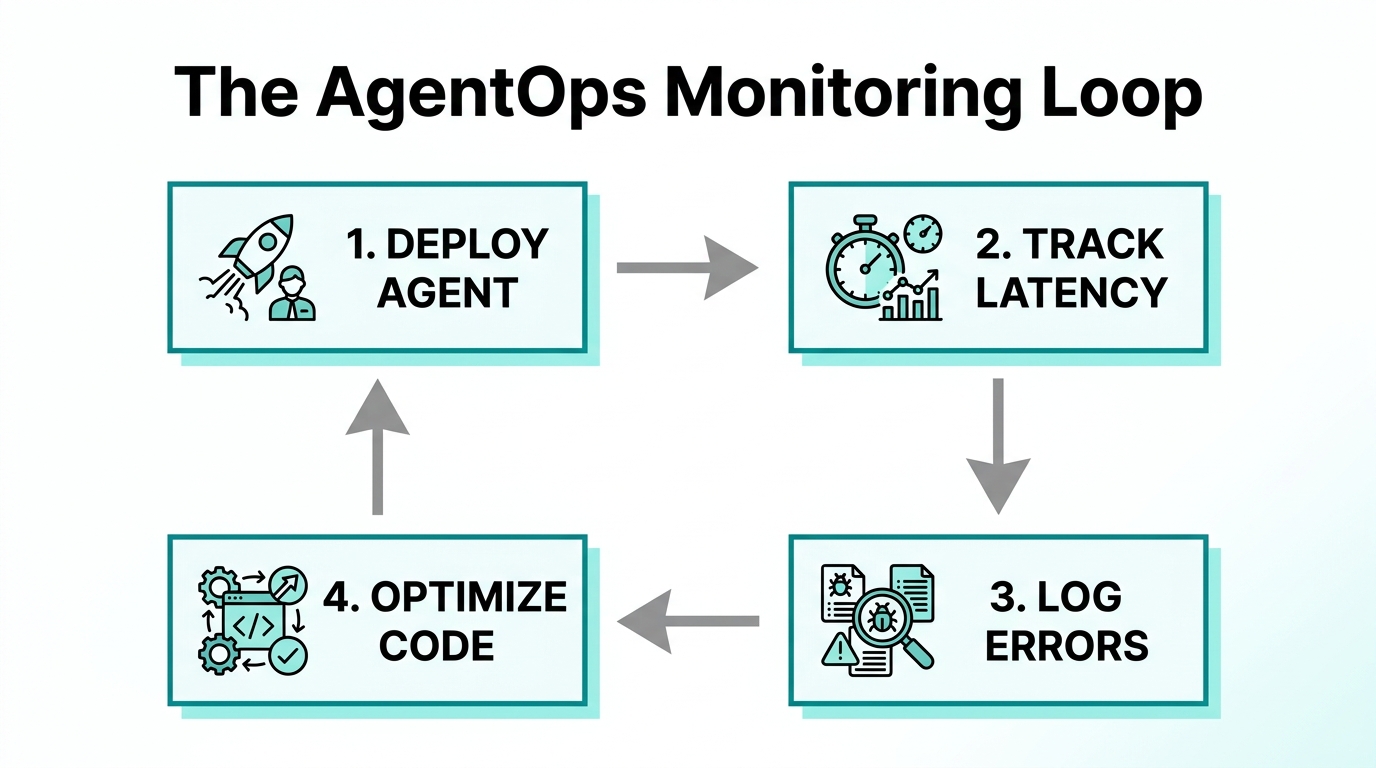
As marketing teams move from managing people to managing fleets of agents, a new discipline has emerged: AgentOps. Just as DevOps reshaped software deployment, AgentOps focuses on the reliability, cost, and brand compliance of AI agents. According to Joao Moura, CEO of CrewAI, AgentOps is the essential bridge between experimental AI and production-ready growth systems.
Key components of a robust AgentOps strategy in 2026 include:
- Token Cost Monitoring: Preventing budget overruns during complex multi-step tasks.
- Reliability Audits: Tracking "overeager" agents that might attempt to delete production branches or misinterpret brand guidelines.
- MCP Management: Ensuring the Model Context Protocol (MCP) servers—the connectors between Claude and your stack—are secure and functional.
- Human-in-the-Loop (HITL): Establishing checkpoints for high-risk actions like adjusting live ad budgets.
Analyzing the 40% Failure Rate: How to Avoid 'Agent Washing'
Despite the high ROI potential, many companies are struggling. A staggering 42% of organizations scrapped AI initiatives in late 2025 due to data issues and "spaghetti" integration failures, according to Flowlyn. The primary culprit is often "Agent Washing"—a trend where legacy software vendors slap an "AI Agent" label on a simple, non-adaptive chatbot. These tools lack the reasoning capabilities of a true orchestrator like Claude Code and fail when faced with non-linear marketing problems.
Furthermore, the Data Trust Gap remains a major hurdle. Only 16% of RevOps professionals fully trust their data accuracy. Without a warehouse-native foundation like RudderStack to route clean event data, an AI agent is essentially flying blind. For an agent to execute "Write" actions—like changing a lead status in HubSpot or pausing a campaign in Meta Ads Manager—the underlying data must be impeccable.
"AI agents are only as smart as the data mesh they inhabit. If your data is spaghetti, your agent will just make a mess faster."
Benchmarking ROI: Agentic SEO vs. Manual Research
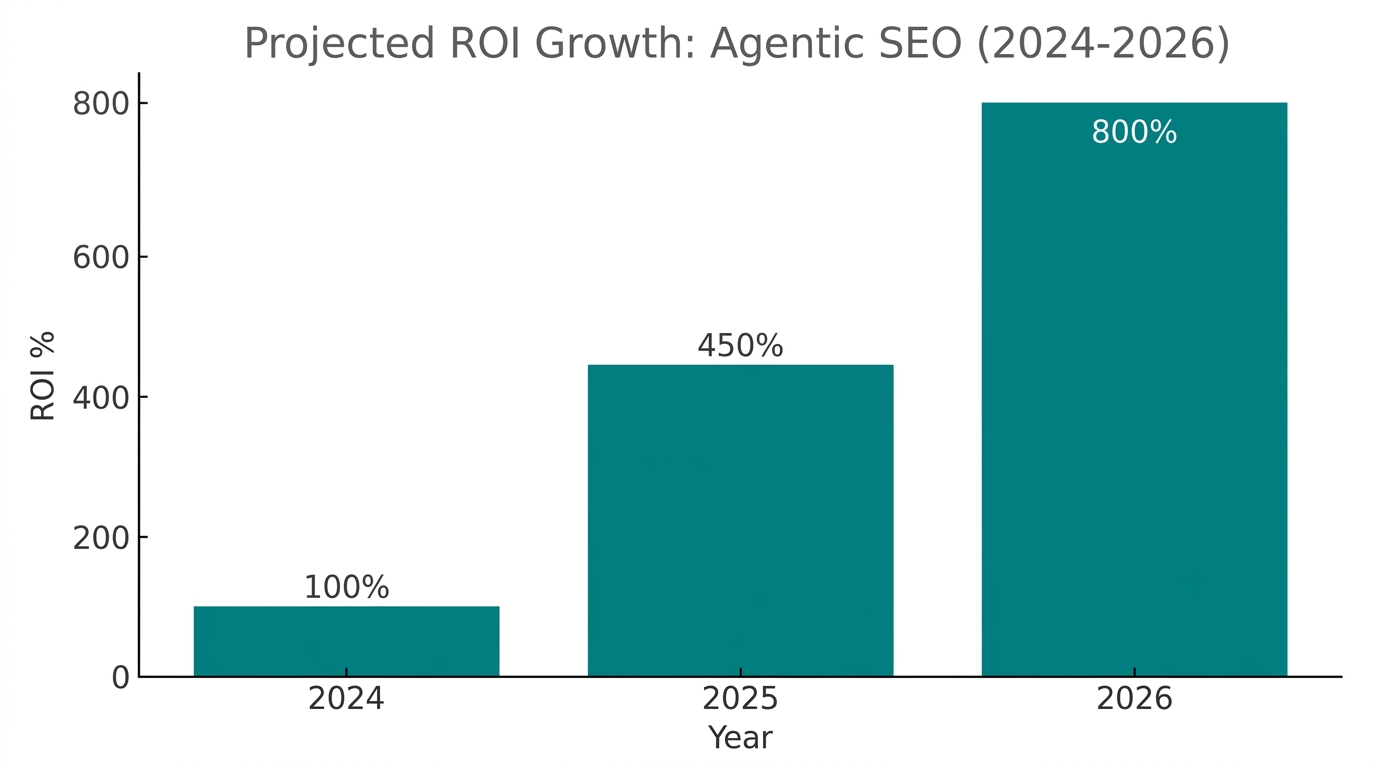
One of the most immediate wins for marketing AI ROI is in the realm of search. Agentic SEO tools are now generating 451% more qualified leads compared to traditional manual keyword research. This is because agents can perform real-time SERP analysis, competitor audits, and content mapping in parallel, rather than sequentially.
In 2026, we are also seeing the rise of GEO (Generative Engine Optimization). As users move away from traditional search engines toward AI answer engines, marketers must optimize their content to be "machine-readable." Using Claude Code to manage your schema and API feeds ensures that your brand becomes the cited source for LLMs. Platforms like Stormy AI are already helping brands identify the right influencers to fuel this generative visibility, creating a loop where UGC provides the social proof that AI agents then prioritize for end-users.
The 5-Step Marketing Mesh Playbook
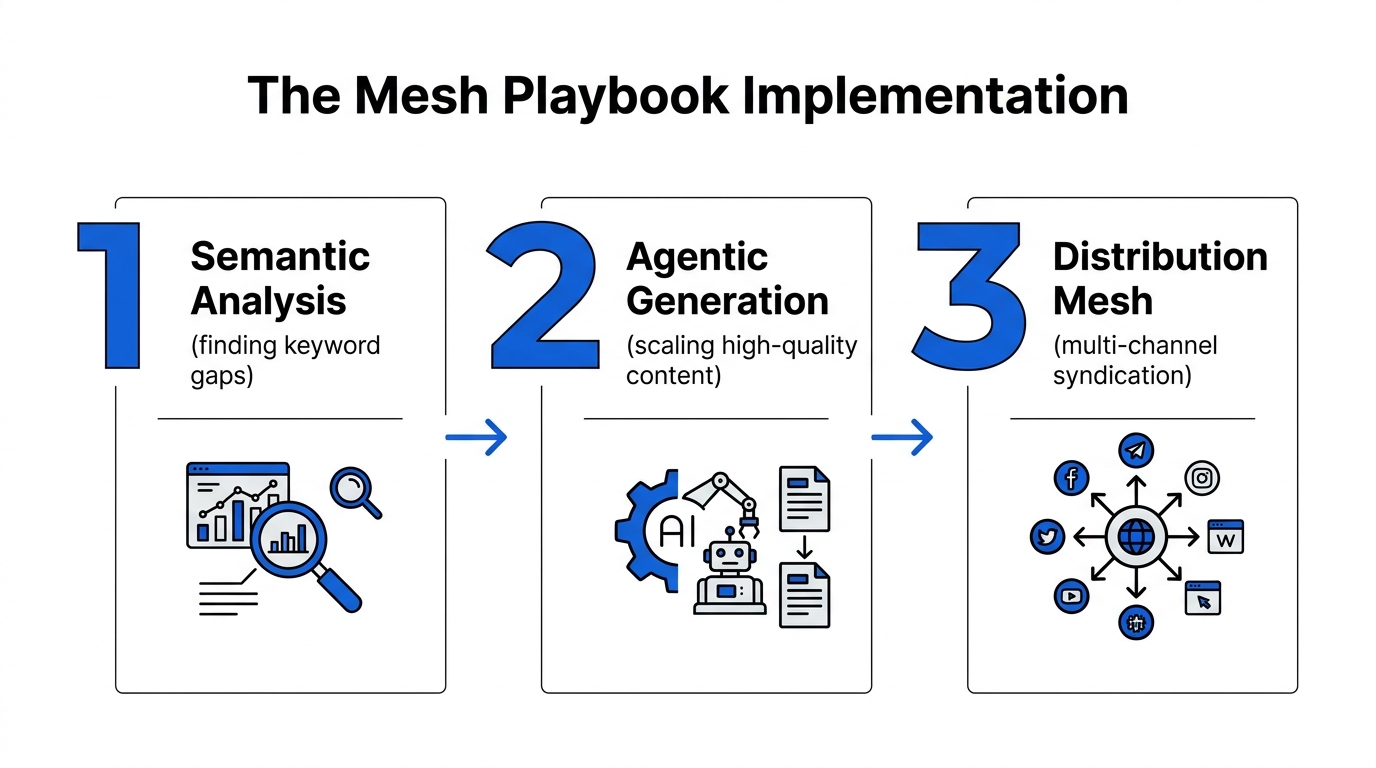
Ready to move beyond basic prompts? Follow this playbook to build an autonomous marketing mesh with Claude Code.
Step 1: Initialize Context (CLAUDE.md)
Create a CLAUDE.md file in your root directory. This acts as the agent's "permanent memory," containing your brand voice, ICP data, and target personas. This ensures consistency across every terminal session, as noted in recent technical guides on Medium.
Step 2: Connect the Mesh (MCP)
Install Model Context Protocol servers for your primary tools. Use claude mcp add google-drive for content briefs and claude mcp add slack for approval loops. For deeper integration, use specialized servers like AdLoop to connect to Google Ads.
Step 3: Deploy Specialized Subagents
Don't ask one agent to do everything. Create specialized subagents in your directory—one for UTM generation, one for PPC monitoring, and one for content repurposing. This multi-agent approach is used by 57% of leading organizations to improve accuracy and speed.
Step 4: Execute via Slash Commands
Build custom slash commands to trigger workflows. For example, a /market-audit [URL] command can trigger parallel subagents to scan SEO, copy quality, and competitor positioning simultaneously, delivering a comprehensive report in seconds.
Step 5: Implement Agentic Reporting
Use a final "Reporting Agent" to pull data from GA4, format it into a Markdown report, and automatically upload it to Notion. This creates a closed-loop system where the agent not only executes the work but also proves the marketing AI ROI without human intervention.
The Bottom Line for 2026 Growth Teams
The era of "Chat AI" is over. We have entered the era of the Agentic Mesh, where Claude Code and similar orchestrators serve as the technical backbone of the marketing department. While the potential for 800% growth is real, as seen with pioneers like Nike and Verizon, success requires more than just a subscription. It requires rigorous AgentOps, a warehouse-native data strategy, and the courage to replace rigid stacks with a composable canvas.
As you build your mesh, remember that the goal isn't just to save money—it's to unlock a level of personalization and speed that was previously humanly impossible. Whether you are using Stormy AI to scale your influencer outreach or Claude Code to manage your global ad spend, the future belongs to those who can orchestrate the agents, not those who are replaced by them.