In 2026, the barrier between a scrolling consumer and a loyal customer is no longer just the product—it is the environment in which that product lives. Traditional flat-lay photography, once the gold standard for Shopify and Amazon, has officially reached its expiration date. As we navigate this year's hyper-competitive digital landscape, data from industry research suggests that generic white-background images are being outperformed by AI-generated lifestyle scenes that drive 30% to 50% higher click-through rates (CTR). For ecommerce brand owners, the mandate for 2026 is clear: adapt or get left behind by competitors who are scaling their visual output at 1/100th of the cost.
The Death of the Flat-Lay: Why Lifestyle Scenes Win in 2026
Static product photos on white backgrounds are no longer enough to capture attention in 2026. Consumers are bombarded with "AI slop" and low-quality advertisements, leading to a psychological craving for context. According to Gartner, 40% of all ecommerce images this year are expected to be AI-generated, and for good reason: they convert better.
When a shopper sees a coffee mug on a mahogany desk in a sun-drenched library, they aren't just looking at a vessel for liquid; they are viewing a potential version of their morning. Brands like Gothrider Coffee have pioneered this shift, swapping standard product shots for AI-enhanced scenes and seeing immediate jumps in engagement. By using tools like Photoroom, brands can instantly place their products in any environment without the logistical nightmare of a physical photoshoot.
"If you are still doing traditional product photography for every SKU in 2026, you are essentially burning money that could be spent on customer acquisition."
The 9-Minute Workflow: From Smartphone Photo to 4K Studio Asset
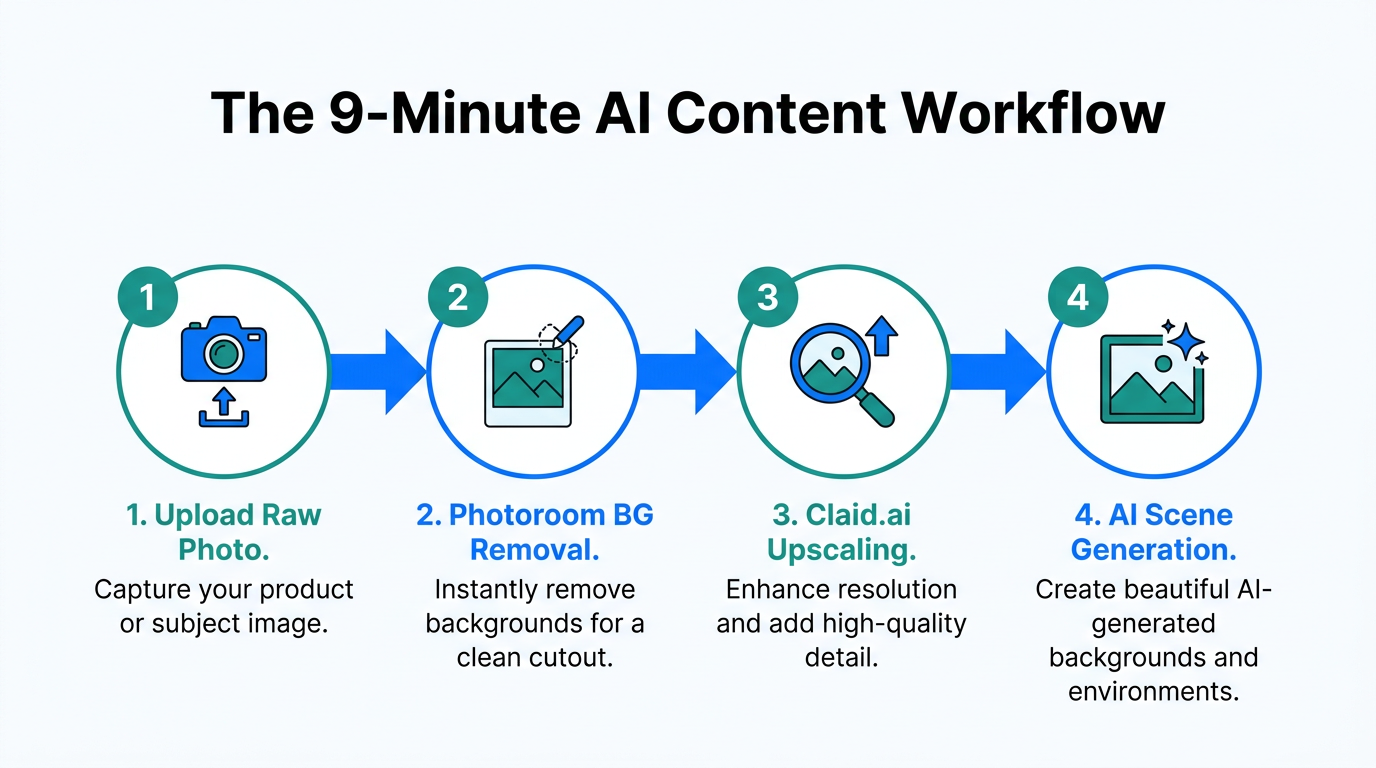
The greatest advantage of AI in 2026 is speed. What used to take two weeks—shipping products, hiring a photographer, editing, and uploading—now takes nine minutes. The "Six-Figure AI Agency" model has proven that a single person can handle the visual needs of 50+ brands simultaneously by using an automated pipeline.
Step 1: Capture the Base Image
You don't need a DSLR anymore. A high-quality smartphone photo is more than enough. The key is to get the lighting even and the product angles sharp. For brands working with UGC creators, sourcing these raw "base images" is critical. Platforms like Stormy AI can help you discover creators who specialize in high-quality raw footage that acts as the perfect foundation for AI enhancement.
Step 2: Background Removal with Photoroom
Using Photoroom for business, you can remove backgrounds in bulk. Their 2026 Instant Diffusion model is specifically trained on product lighting, ensuring that when the background is removed, the shadows and edges of your product remain realistic. This eliminates the "uncanny valley" effect that often plagues low-end AI tools.
Step 3: Lifestyle Generation and Upscaling
Once you have a clean PNG of your product, use Claid.ai to generate a hyper-realistic background. Claid.ai excels in ecommerce conversion rate optimization because it doesn't just swap backgrounds—it re-lights the product to match the new environment. Finally, pipe the image through their 4K upscaler to ensure it meets the high-resolution standards of Amazon and Shopify.
Benchmarking Efficiency: AI vs. Traditional Photography
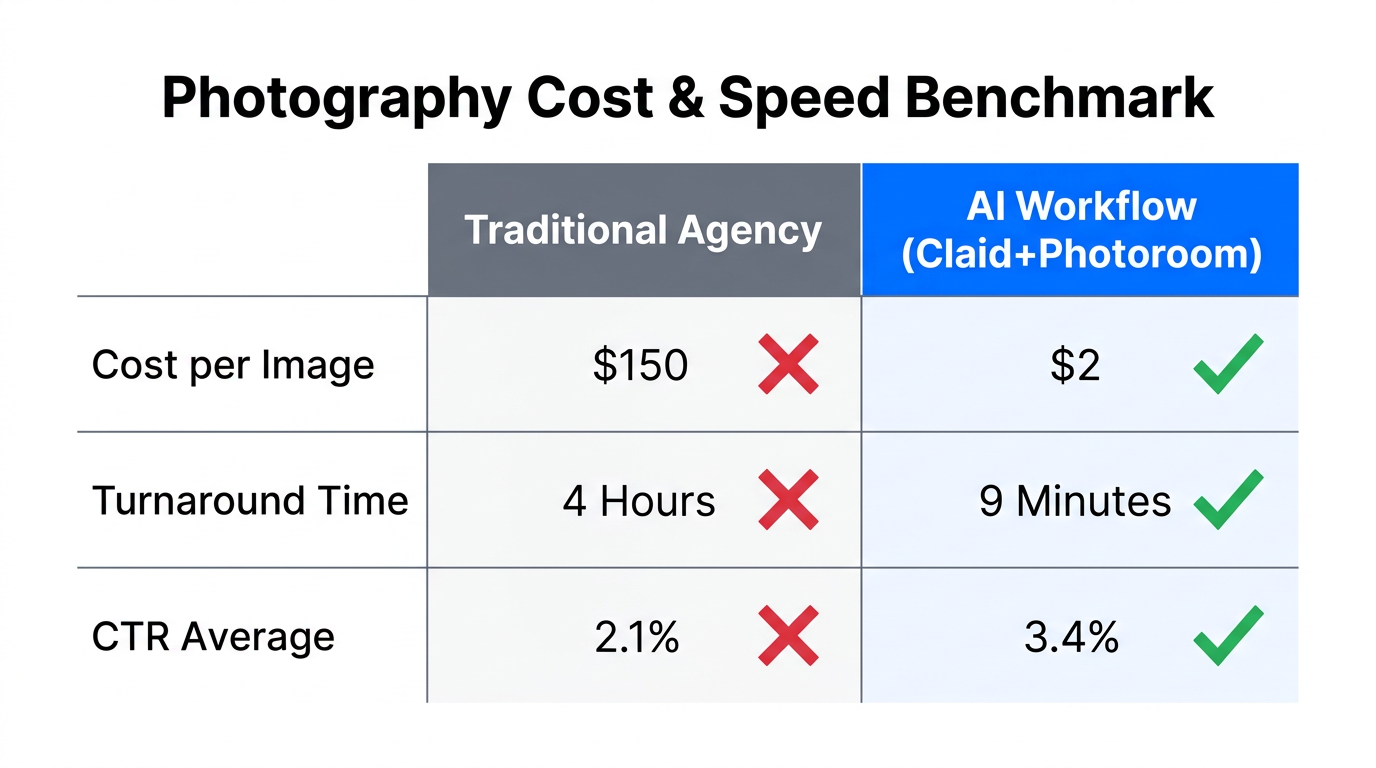
To truly understand the ROI, we must look at the data. Traditional studio photography is a linear expense—if you have more products, you pay more money. AI product photography offers exponential scalability. By leveraging tools like Nightjar to maintain visual consistency, brands can generate thousands of assets for the price of a single lunch.
| Feature | Traditional Photography | AI Pipeline (Photoroom + Claid) |
|---|---|---|
| Cost per Shoot | $2,000 - $10,000 | $10 - $100 (Subscription) |
| Turnaround Time | 1 - 3 Weeks | 1 - 9 Minutes |
| Scalability | Linear (Manual) | Infinite (Automated) |
| CTR Impact | Baseline | 30-50% Increase |
Case Study: How Eva Candles Slashed Budgets by 88%
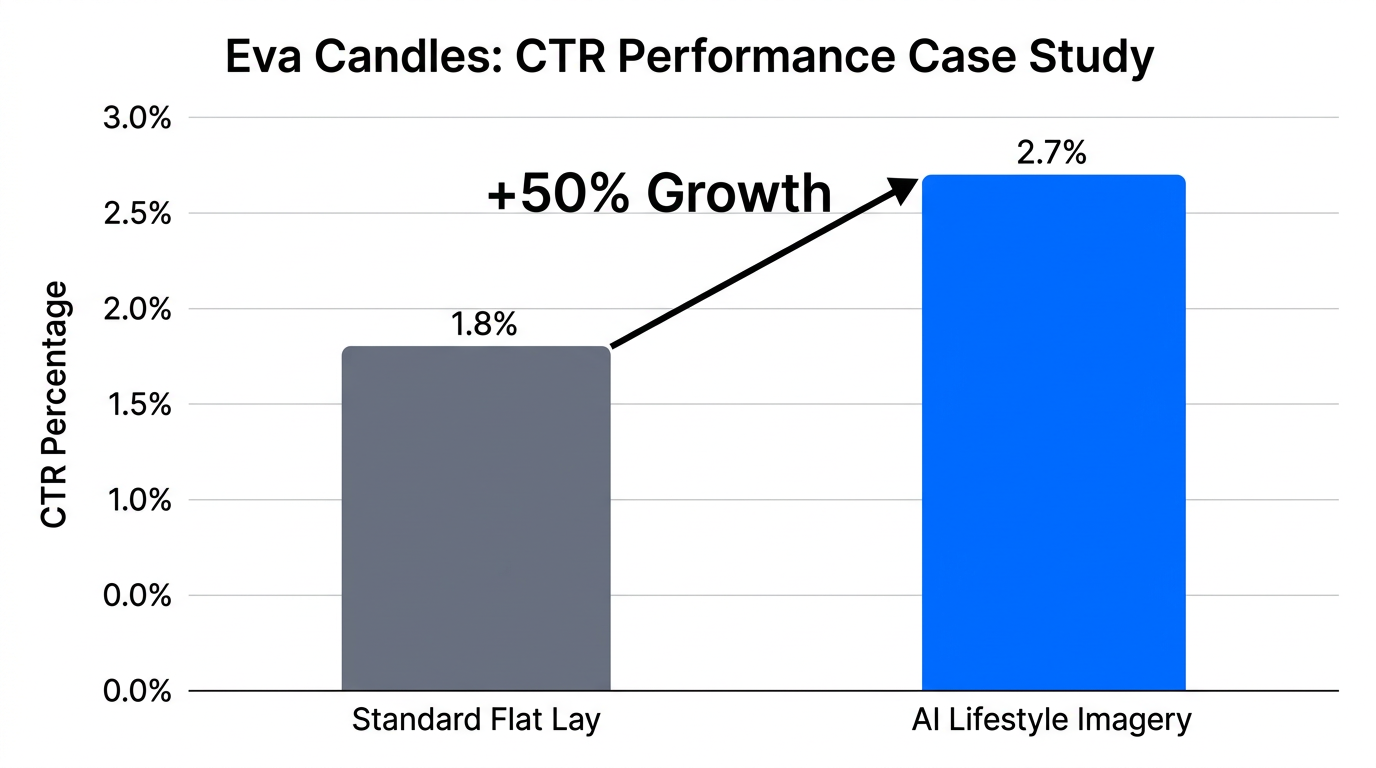
Eva Candles, a boutique scent brand, faced a common 2026 problem: seasonal fatigue. In a world of fast-moving social trends, their spring-themed photos were irrelevant by June. Using AI-driven photography, they generated over 1,000 lifestyle images for their entire catalog in a single afternoon. By automating their visual production, they reduced their annual photography budget by 88% while simultaneously launching new seasonal scents in hours rather than weeks.
Similarly, food delivery giant Rappi implemented Claid.ai to manage images from thousands of vendors. According to case study data, by automating the editing process, they reduced time-to-site by 42%. This speed-to-market is the ultimate competitive advantage in 2026; if you can't get your product in front of customers with high-quality visuals today, your competitor will tomorrow.
"The ROI isn't just in the money you save on photographers; it's in the hundreds of hours of 'speed-to-market' you gain by bypassing the studio."
Advanced Strategy: A/B Testing 10+ Background Variations
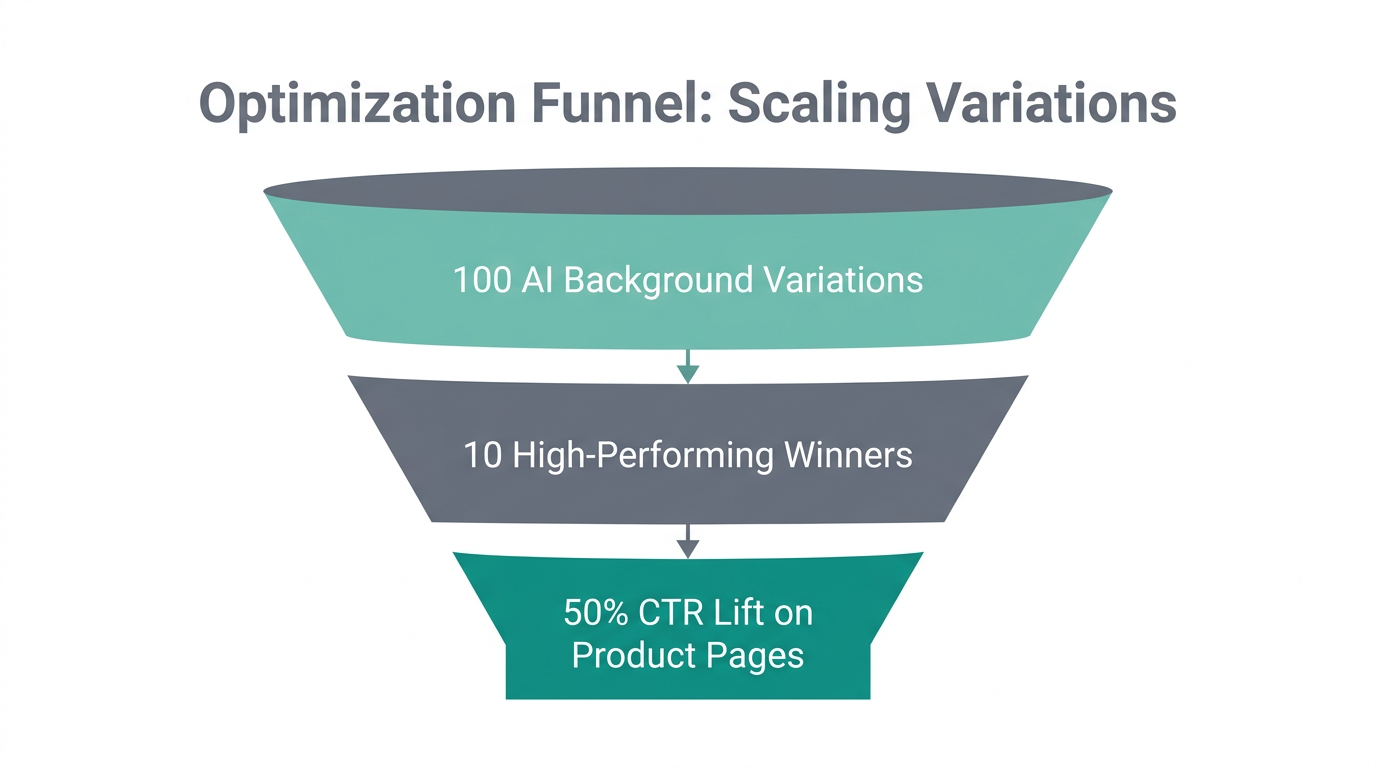
One of the most overlooked benefits of digital marketing ROI 2026 is the ability to A/B test visual assets at zero marginal cost. In the past, you were stuck with the 5-10 shots the photographer gave you. Today, you can use generative AI to create 10 distinct environments for a single product and test them against different audience segments on platforms like Meta Ads Manager or TikTok Ads Manager.
For example, an apparel brand might use AI-driven fashion technology to test their new winter jacket on a hiker in the Swiss Alps versus a city-dweller in New York. By identifying which lifestyle scene resonates most with specific demographics, brands can optimize their ecommerce conversion rate without spending a dime on additional production.
The Human-in-the-Loop: Avoiding the "AI Slop" Backlash
While automation is king, brand dilution is the enemy. Data shows that while shoppers rarely distinguish AI from real photos, 43% are less likely to buy if the imagery feels "lazy" or "fake." This is where the human touch remains vital. Expert marketers in 2026 use AI for the "grunt work"—backgrounds, lighting, and scaling—but use human creativity for the storytelling and brand strategy.
If you're managing a large roster of creators to provide these base assets, using a creator CRM like Stormy AI is essential. It allows you to track which creators are providing the best "raw material" for your AI pipeline, ensuring that the human foundation of your marketing remains authentic while your AI agents handle the high-volume scaling.
Conclusion: Future-Proofing Your Brand for 2026
The transition to AI-driven ecommerce photography is no longer a futuristic prediction—it is a current operational standard. By combining the bulk editing power of Photoroom with the 4K realism of Claid.ai, ecommerce brands can achieve a level of visual sophistication that was previously reserved for Fortune 500 companies with million-dollar budgets.
The playbook for maximizing ROI this year is simple: hybridize your approach. Use traditional photography or high-quality UGC for your core "Hero" assets, and then use AI to scale those assets into thousands of personalized, seasonal, and platform-specific variations. By focusing on visual consistency and data-driven A/B testing, you can boost your CTR by 50% and ensure your brand stands out in an increasingly crowded digital marketplace.