For most startup founders, the transition from product developer to salesperson is the most jarring shift in their professional lives. You’ve spent months building a solution, and now you’re thrust into a world where your survival depends on convincing strangers to part with their budget. According to research from Y Combinator on how to get your first 100 customers, the initial acquisition phase is the single biggest hurdle for any new venture. Most founders default to a high-energy, high-friction approach—constantly pushing for a "Yes"—without realizing that they are actually triggering a defensive response in their prospects.
When you push for a "Yes," you create friction. When you allow a prospect to say "No," you create a safety zone. This is the core of the Chris Voss framework for negotiation, a method honed in high-stakes FBI hostage situations and now adapted for the world of founder-led sales. By shifting your customer acquisition strategy from "Yes-seeking" to "No-oriented," you can lower the barriers to entry and build the kind of trust necessary to scale from zero to one hundred customers.
The Friction of 'Yes' vs. The Safety of 'No'
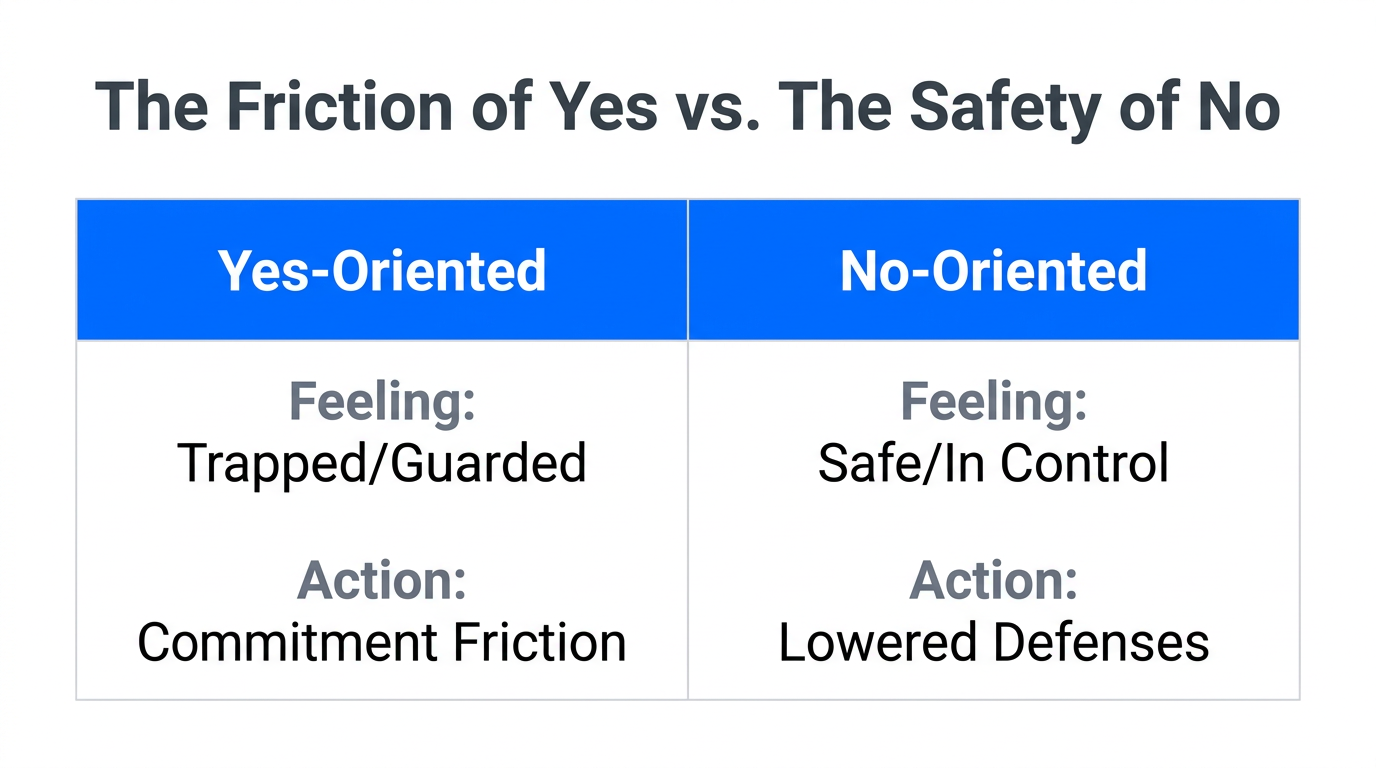
In traditional sales training, we are taught to lead prospects down a "Yes-staircase." We ask small questions that require a "Yes" (e.g., "Do you want to save money?" or "Do you have five minutes?") in the hope that once the prospect has said it five times, they’ll be more likely to say it when the contract is on the table. However, Chris Voss argues that "Yes" is a trap. From a psychological perspective, saying "Yes" feels like a commitment, and commitment feels like a threat.
When a prospect says "Yes," they immediately start wondering what they just signed up for. Are they going to be stuck in a 45-minute demo? Are they going to be hounded by follow-up emails via Lemlist for the next month? In contrast, saying "No" makes the prospect feel protected and in control. It is a decision that requires no future commitment. By phrasing your questions to invite a "No," you remove the fear of being trapped.
| Approach | Prospect Feeling | Sales Outcome |
|---|---|---|
| Yes-Oriented | Cornered, defensive, wary of commitment | Artificial agreement followed by "ghosting" |
| No-Oriented | Safe, in control, empowered | Authentic engagement and faster discovery |
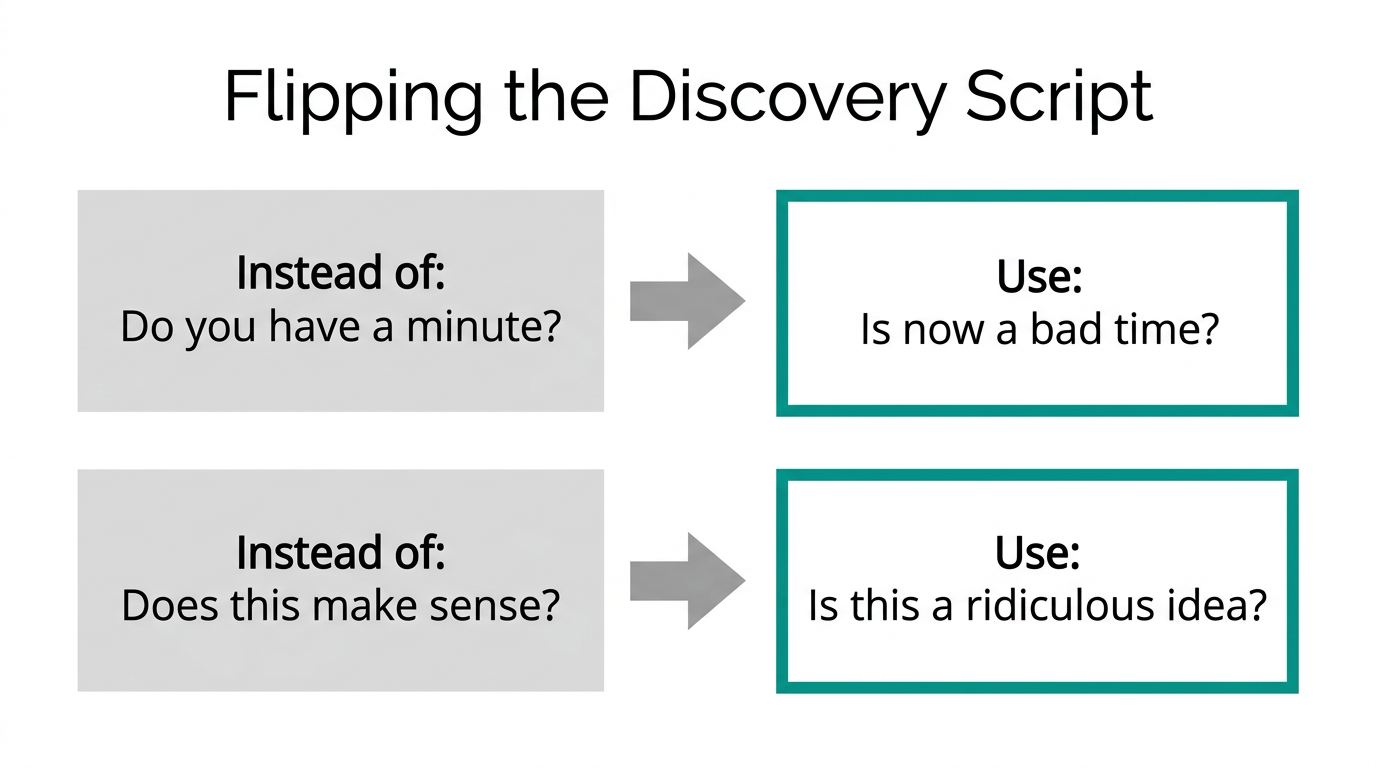
Instead of asking "Do you have a few minutes to talk?" (which triggers a defensive "Yes" or a polite lie), try asking: "Is it a bad time to talk?" If they say "No," they have just given themselves permission to focus on you. They are essentially saying, "No, it is not a bad time, therefore I am choosing to speak with you." This subtle shift moves the power dynamic from you chasing them to them opting in.
"Going for 'Yes' creates friction, but going for 'No' creates protection and safety."Practical Examples of No-Oriented Questions for Customer Discovery
During the customer acquisition strategy phase, your goal isn't just to close a deal—it’s to gather proprietary information that helps you refine your product-market fit. If you interrogate your prospects with standard discovery questions, they will shut down. If you use no-oriented questions, they will open up. This is essential when managing your early leads in a CRM like Pipedrive or Notion.
Here are several no-oriented questions you can use in your next discovery call:
- Instead of "Are you interested in a solution for X?": Try "Would it be totally ridiculous to explore a new way to handle X?"
- Instead of "Does this make sense?": Try "Am I completely off base here?"
- Instead of "Can we meet next Tuesday?": Try "Would you be opposed to a brief chat next Tuesday to see if this fits your roadmap?"
- Instead of "Are you the decision-maker?": Try "Is it unreasonable to ask who else besides yourself would need to be involved in this process?"
Running to Trouble: The Art of the Accusation Audit
Voss often speaks about a philosophy he calls "Running to Trouble." In his early days as a negotiator, he realized that ignoring a problem doesn't make it go away; it makes it fester. For a startup founder, "trouble" usually comes in the form of unspoken objections: "You’re too small," "This is too expensive," "I don't trust a first-time founder."
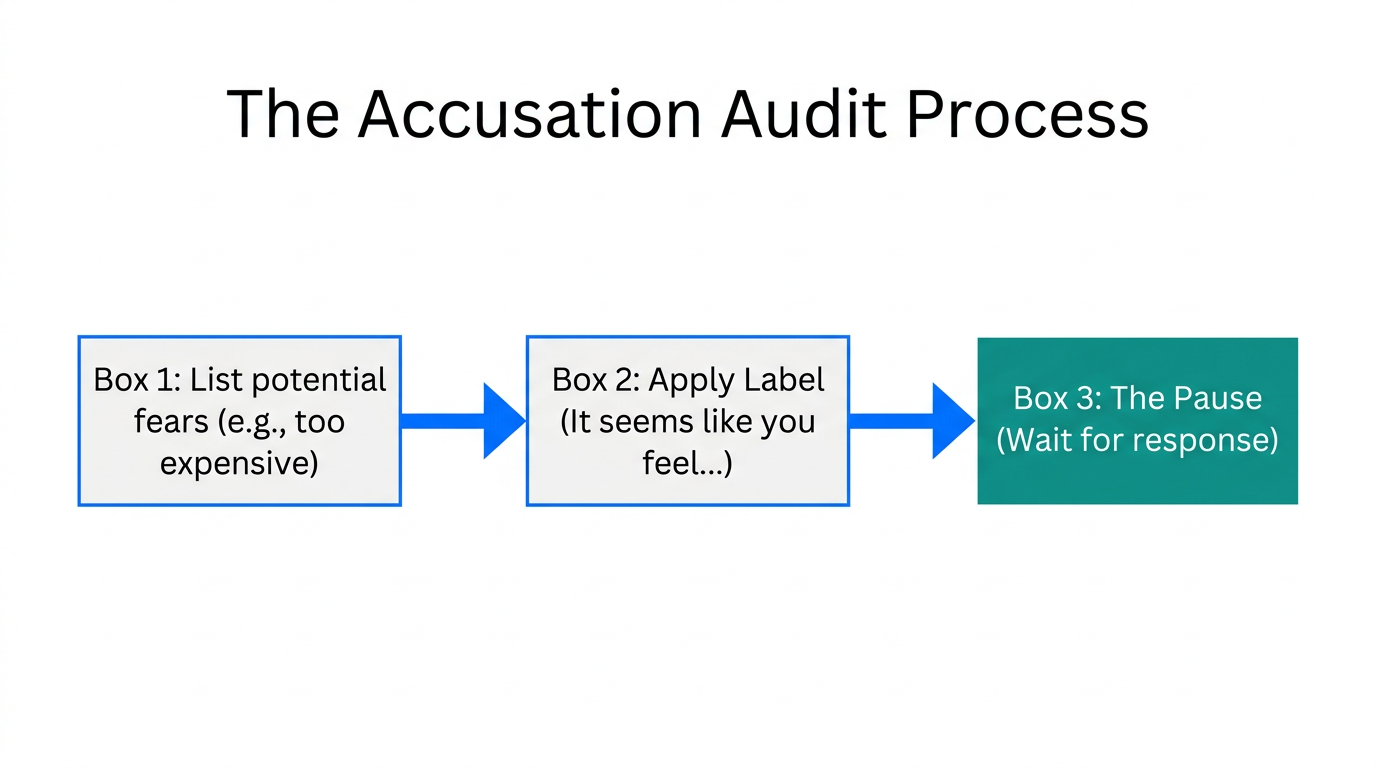
Instead of waiting for the prospect to bring these up, you should address them immediately using an Accusation Audit. This involves listing every negative thing the other side might be thinking about you before they have a chance to say it. By labeling the negative, you deactivate it. This is a form of tactical empathy that demonstrates you are a straight shooter.
When you are sourcing partners or creators—perhaps using tools like Stormy AI to find influencers for your first campaign—you might lead with: "You’re probably thinking we’re just another tiny startup that’s going to waste your time and then disappear in six months." By saying it first, you appear starkly honest. You’ve taken the ammunition out of their gun. This level of transparency is exactly how founders build the predictability that leads to long-term trust.
"Run to trouble. It’s amazingly liberating if your philosophy is to run to trouble."Building Trust Through Predictability
Chris explains the simplest and most effective way to build professional trust.
Most founders try to build rapport through "common ground." They look for a shared hobby or a mutual friend. Voss calls this "story stealing." When a prospect mentions they just got back from Ireland and you jump in with your own story about a trip to Dublin, you aren't building a bridge—you're hijacking their moment. You feel good because you’re sharing, but they feel squashed because you had to "one-up" them.
True trust in founder-led sales isn't built on shared vacations; it’s built on predictability. If you are predictable in your communication, you are perceived as safe. This is vital when you are asking a customer to share proprietary data or switch from a legacy tool like Salesforce to your new platform. They need to know that you understand their world better than they do.
Using labels to demonstrate this understanding is a superpower. Instead of asking "How are you doing?" (a nonsensical question that yields a nonsensical "Fine" response), use a label based on your observation of their state: "It seems like you’ve been under a lot of pressure to hit your quarterly targets." This triggers a hit of oxytocin in the prospect, which facilitates bonding and truth-telling.
Starting High-Stakes Meetings with the 'Centered' Label
Whether you are walking into an investor pitch or a final-stage sales negotiation, the first 60 seconds dictate the next 60 minutes. Voss suggests using a "Centered" label or a situational observation to ground the meeting. If a prospect looks wound tight, don't ignore it. Label it: "It looks like you've had a tough day."
Wait for the silence. Silence is your most powerful tool in the Chris Voss framework. After you drop a label, you must shut up. Let them fill the void. Often, they will give you the exact piece of information you need to win the deal—information they had no intention of sharing. They might say, "Yeah, my boss is breathing down my neck because our current vendor just failed a security audit." Boom. You now know the real problem you need to solve.
The Last Impression is the Lasting Impression
Discover why the final moments of a negotiation define the entire relationship.As you scale your customer acquisition strategy and move toward your 100th customer, pay attention to how you end your interactions. Chris Voss cites Oprah Winfrey as a master of this. In the entertainment business, the joke is "In a limo, out of a taxi"—once people get what they want from you, they discard you. At Oprah’s studio, it was "In a limo, out in a limo."
Even if a deal doesn't close, ensure the prospect feels respected and heard. The last impression is the one that sticks in the brain's 75% negative-bias architecture. If you leave a prospect feeling understood, they will return to you when their situation changes. This is especially true in the world of Meta Ads Manager or TikTok Ads Manager, where performance fluctuates and brands are constantly looking for new edges.
To manage these high-touch relationships at scale, successful founders often pair these negotiation techniques with automated discovery tools. For example, Stormy AI can handle the initial sourcing of creators or leads, allowing the founder to focus purely on the high-level negotiation and relationship-building where these Chris Voss tactics are most effective.
Conclusion: From Zero to One Hundred
Final thoughts on starting your journey to master negotiation from zero to one hundred.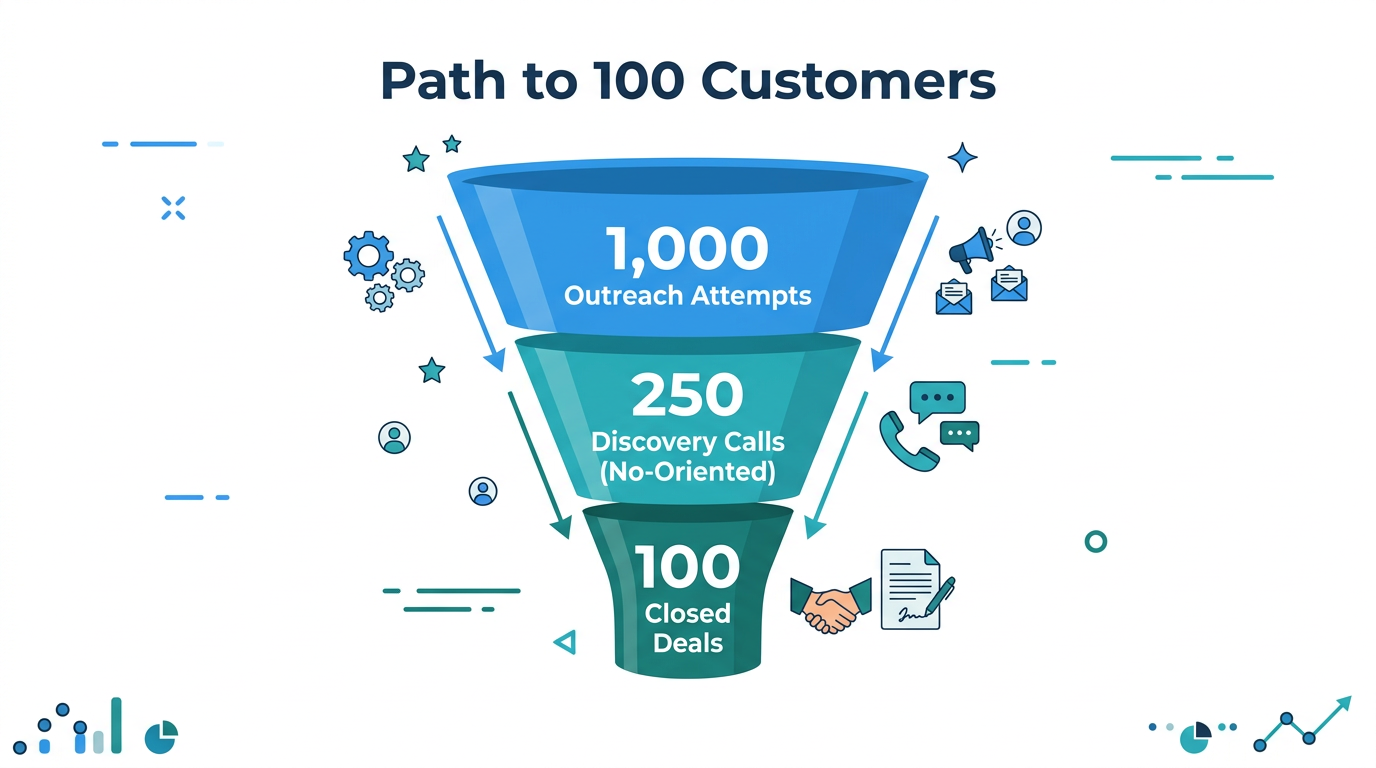
Mastering founder-led sales is not about being the loudest person in the room or having the most "leverage." As Voss points out, leverage is the ability to inflict harm, and you can't build a billion-dollar company by threatening your customers. You build it by being the most empathetic person in the room.
By adopting the no-oriented question framework, you reduce the friction of the initial contact. By running to trouble and performing accusation audits, you build radical transparency. And by focusing on the prospect's need to feel heard, you move from being a vendor to a trusted partner. Start your next sales call not by asking for a "Yes," but by inviting a "No." You might be surprised at how quickly the doors start to open.