The era of manual bid adjustments and tedious keyword mining is officially in the rearview mirror. As we move through 2026, the paradigm has shifted from basic automation to autonomous agentic AI. For the modern growth marketer, mastering the Google Ads AI agent is no longer an optional skill—it is the baseline for survival in a hyper-competitive digital landscape. With over 80% of advertisers now utilizing AI-powered bidding, the competitive advantage has moved from *who* uses AI to *how* effectively you guide your agents.
This playbook outlines the transition from "Smart Bidding" to a fully integrated agentic AI marketing strategy. We will explore how to use the native Google Ads Advisor, implement a "Glass Box" framework for transparency, and ensure your data hygiene is sharp enough to fuel machine learning at scale.
The Shift from Automation to Agentic AI in 2026
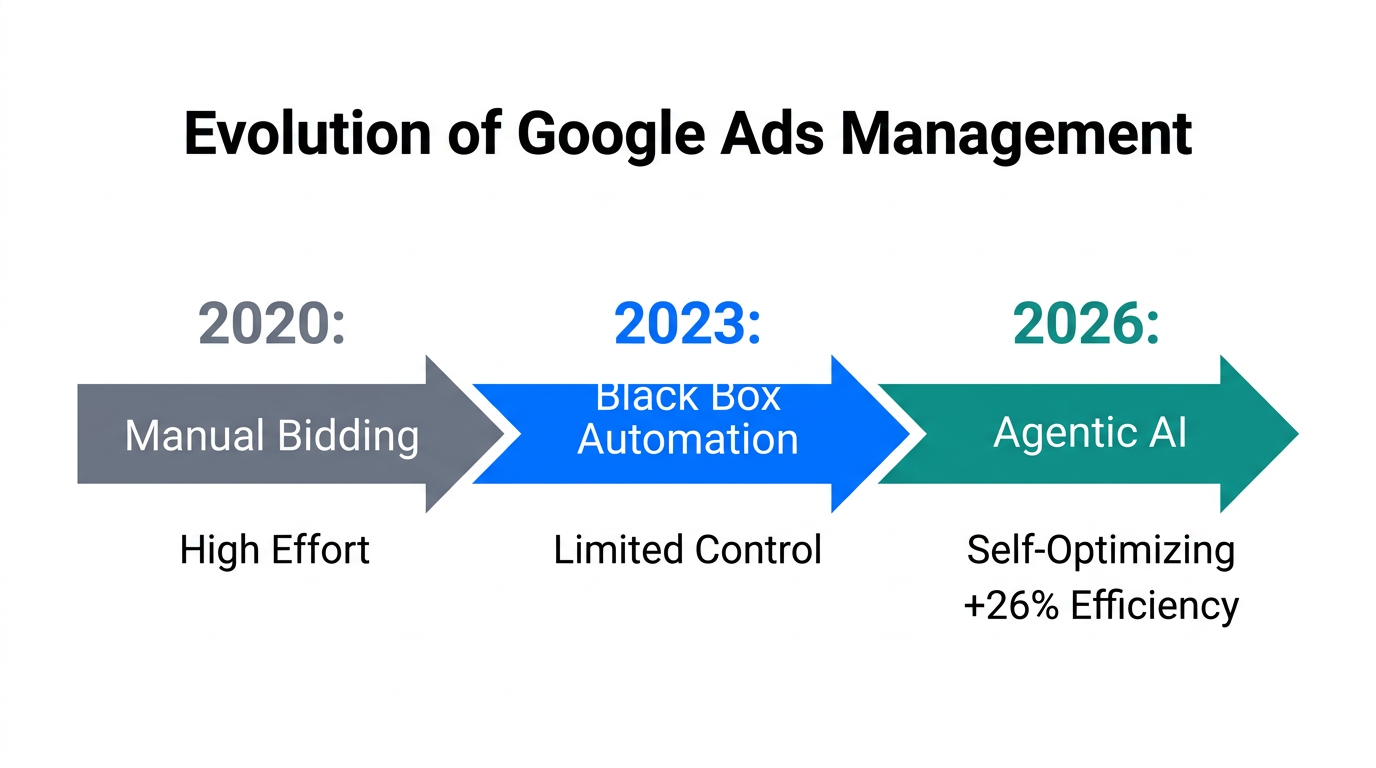
In years past, "automation" meant setting rules: "If CPA is over $50, lower the bid." In 2026, the google ads ai agent acts as a semi-autonomous partner that doesn't just follow rules but understands business intent. This shift is driven by the rise of agentic AI marketing, where systems analyze, recommend, and execute complex tasks with minimal human intervention.
According to recent reports from Google Ads, Demand Gen campaigns have seen a 26% increase in conversions per dollar this year, largely due to AI-powered ramp-time and bidding optimizations. The system is no longer just a calculator; it’s a strategist that leverages over 20 billion visual searches per month on platforms like Google Lens to find commercial intent where keywords don't exist.
"The move to Agentic AI represents the single largest shift in PPC history—moving the marketer from a 'pilot' to a 'flight commander' who manages a fleet of autonomous systems."
Leveraging the Google Ads Advisor for Execution
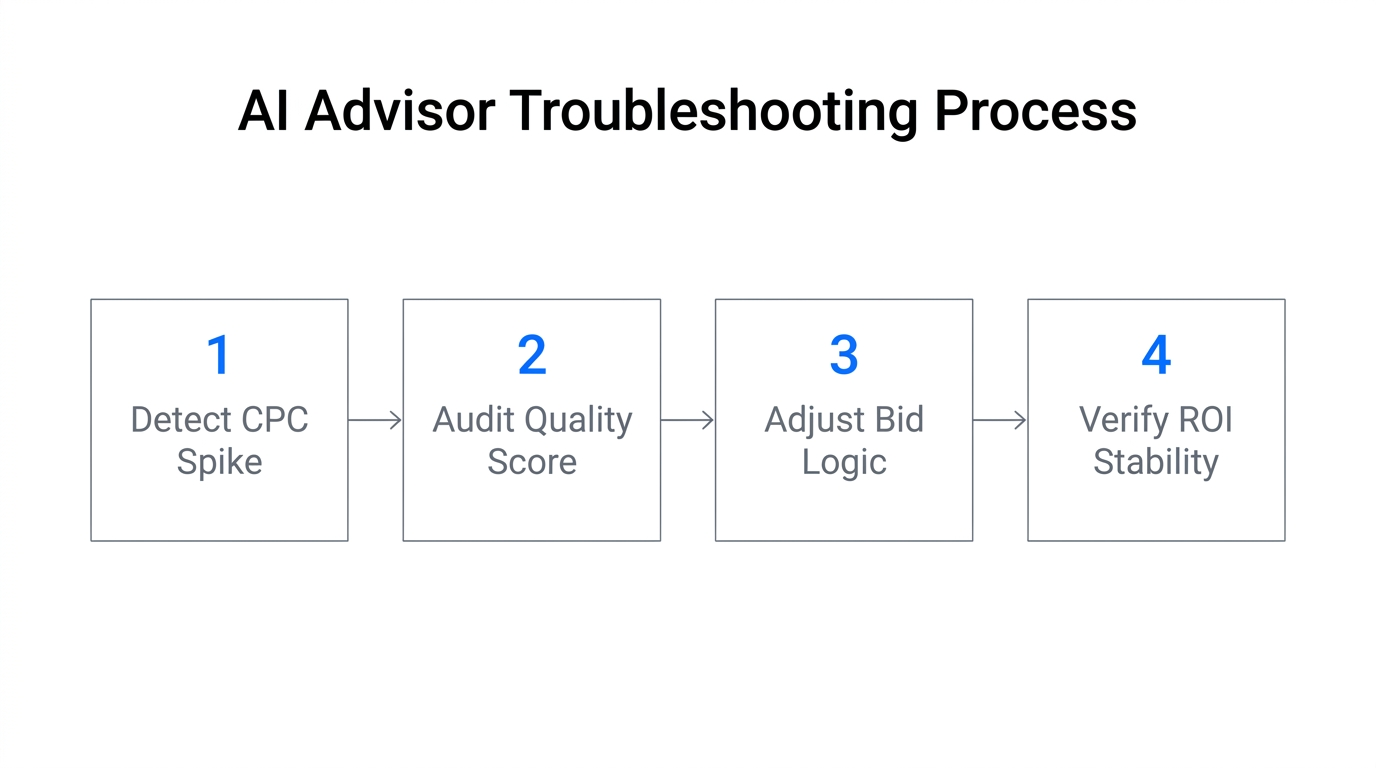
One of the most powerful tools in your 2026 arsenal is the Google Ads Advisor. This native agent provides a conversational interface to manage your account. Instead of digging through sub-menus to find why a campaign is under-delivering, you can simply ask the agent to troubleshoot policy issues or suggest budget reallocations across your portfolio.
Data shows that small businesses using this conversational experience are 63% more likely to publish campaigns with "Good" or "Excellent" Ad Strength. This is critical because improving Ad Strength from "Poor" to "Excellent" yields an average 12% lift in conversions.
What the Google Ads Advisor Can Handle:
- Policy Troubleshooting: Instantly identifying which creative asset triggered a flag and suggesting compliant alternatives.
- Budget Fluidity: Recommending shifts from low-performing "Search" campaigns to high-intent "AI Max" segments based on real-time ROAS.
- Asset Generation: Creating headlines and descriptions directly from your landing page URL, which can be further refined using tools like AdCreative.ai.
- Performance Reporting: Pulling complex cross-channel data into a simple conversational summary.
| Feature | Traditional Automation | Agentic AI (2026) |
|---|---|---|
| Decision Making | Rule-based (Static) | Intent-based (Dynamic) |
| Creative Handling | Manual A/B testing | Autonomous Asset Synthesis |
| Troubleshooting | Manual Audit | Conversational Diagnosis |
| Data Source | Pixels/Cookies | First-Party Data & LLM Insights |
The 80/20 Rule: Human-in-the-Loop Strategy
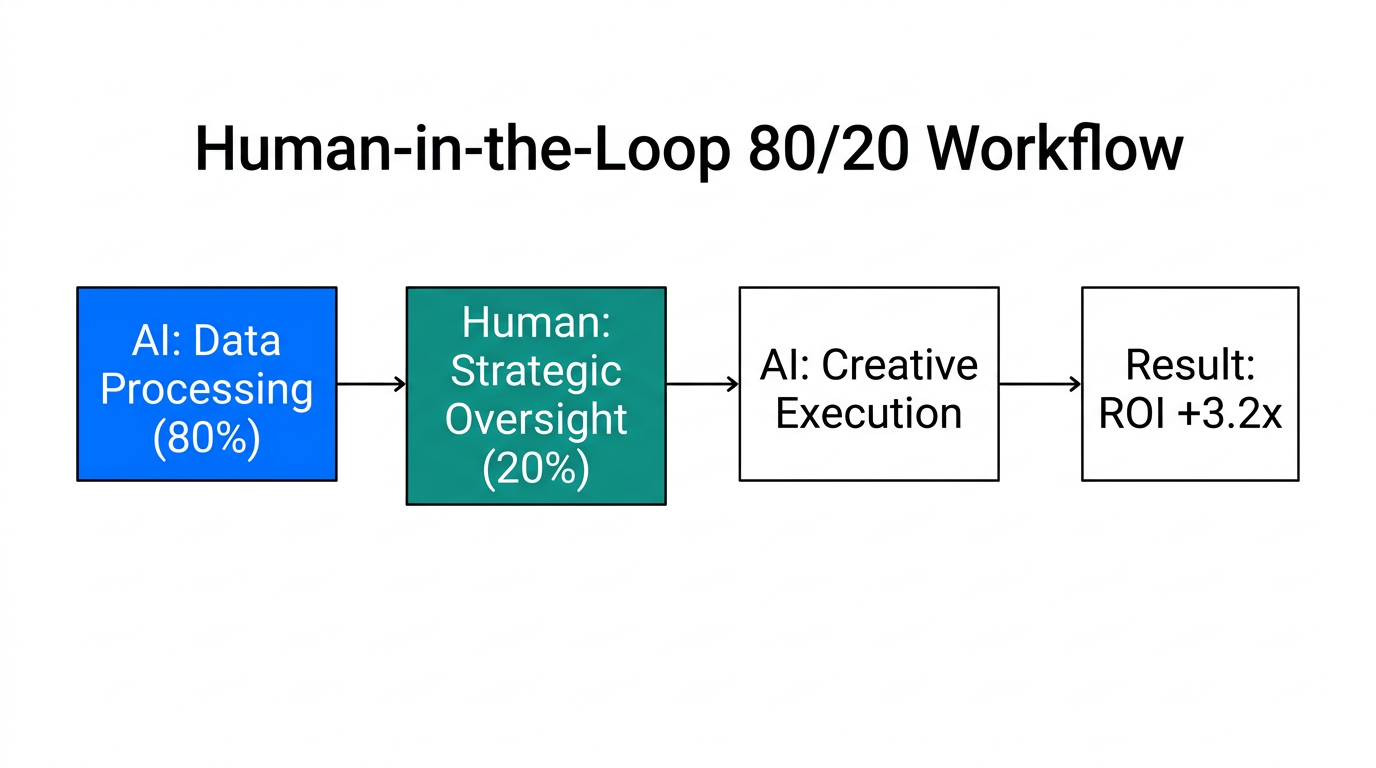
Despite the autonomy of the google ads ai agent, human oversight remains the "Chief Strategic Officer." Experts at Blue Flame Thinking emphasize that AI optimizes for what it can see (clicks and conversions), but it cannot feel the brand pulse or understand long-term profitability shifts. Use the 80/20 rule: let the AI handle 80% of the execution (bidding, placements, basic copy) while humans focus 20% of their time on high-level strategy and conversion rate optimization.
For example, while an AI agent might find cheap clicks on a broad keyword, a human strategist knows that those clicks aren't qualified for a high-ticket SaaS product. You must feed the agent negative keyword themes and audience exclusions to prevent budget bleed. Even in fully automated campaigns, manual exclusion lists are essential to keep the AI from "hallucinating" into irrelevant, low-intent queries.
"AI is your execution engine, but humans are the steering wheel. Without a strategic direction, your AI will simply find the fastest way to spend your budget on the wrong people."
Setting Up a 'Glass Box' Framework
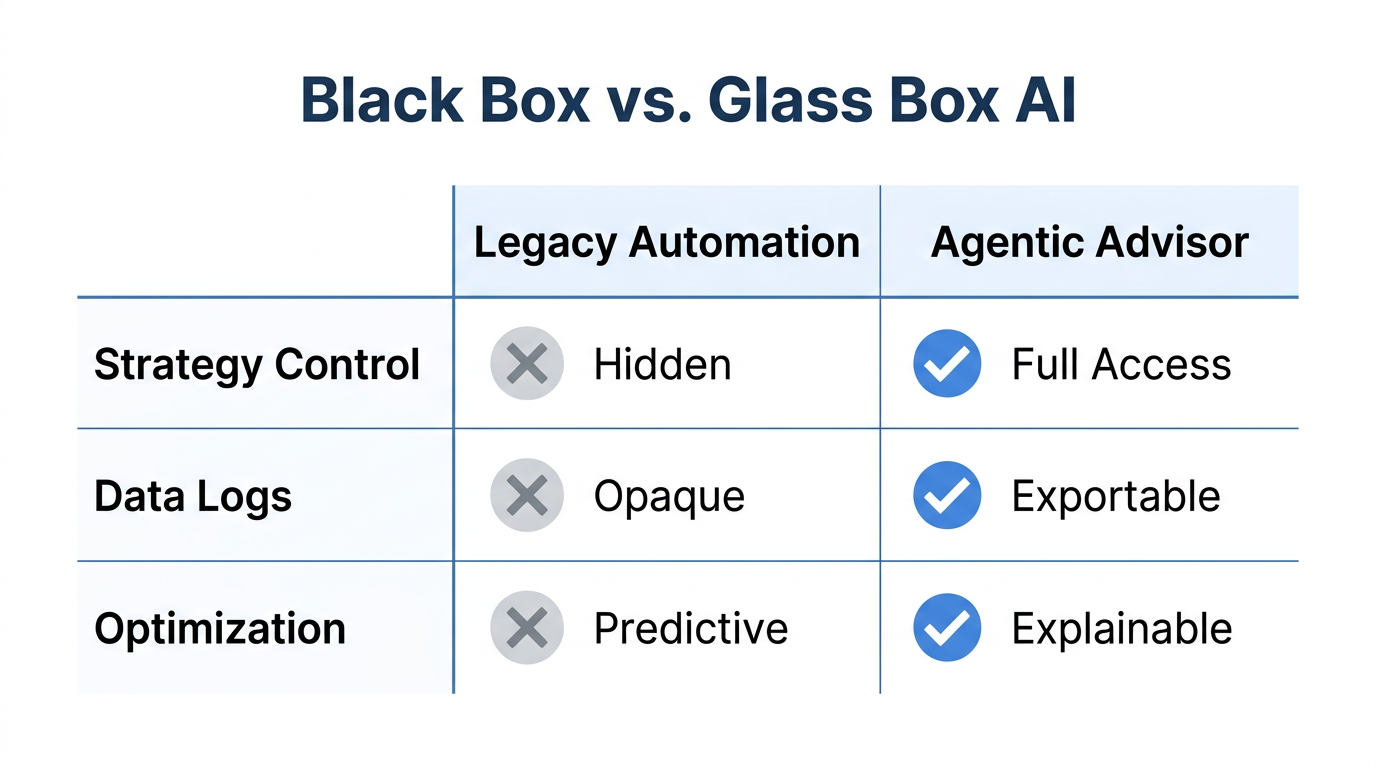
One of the biggest complaints in early ppc automation strategy was the "Black Box" nature of Google’s algorithms. In 2026, top-tier marketers demand a "Glass Box" framework. This means using third-party tools and internal audits to gain transparency into *why* an AI agent is making specific choices.
Platforms like Adsroid and Optmyzr allow marketers to peel back the layers of AI-driven campaigns. By implementing these "Glass Box" audits, you can ensure that the AI isn't over-relying on branded search or retargeting existing customers to inflate ROAS—a common pitfall that hides true incremental growth.
Step-by-Step Data Hygiene Audit for 2026
Your google ads ai agent is only as intelligent as the data it consumes. If your tracking is broken, the AI will optimize for the wrong signals. To succeed with agentic ai marketing, you must follow this data hygiene playbook:
Step 1: Audit Google Tag Manager (GTM)
Ensure that every conversion event—from lead form submissions to button clicks—is firing correctly. Use Napkyn’s methodologies for server-side tagging to bypass cookie restrictions and ensure 100% data accuracy.
Step 2: Implement Enhanced Conversions
With the death of third-party cookies, Enhanced Conversions allow you to send hashed first-party customer data (like email addresses) back to Google. This gives the AI agent the "offline" signals it needs to understand which clicks actually turned into revenue.
Step 3: Feed the Agent UGC Assets
The AI needs raw material to test. Provide at least 20 high-quality images and 5 videos per asset group. For top-tier creative that feels native to social platforms, growth marketers often use platforms like Stormy AI to discover and manage UGC creators who can produce the high-volume video content that Performance Max requires to succeed.
Step 4: Connect Your CRM
Integrate HubSpot or Pipedrive directly with Google Ads. This allows the agent to optimize for "Qualified Leads" or "Closed Won" deals rather than just top-of-funnel form fills, which are often targets for bot spam.
Success Stories: Agentic AI in Action
The transition to agentic workflows is already yielding massive results for early adopters. Look at KEH Camera, which unified its data feeds with Performance Max and saw a 76.3% boost in sales and a 10x ROAS. By letting the AI agent handle the complex cross-channel placements, they were able to focus on high-level inventory strategy.
In the education space, Duolingo utilizes a specialized AI agent named "Birdbrain" to analyze user engagement. This data is then fed back into their google ads ai agent to focus ad spend specifically on users most likely to perform high-value in-app actions, rather than just chasing low-cost installs. This synergy between internal AI and ad platform AI is the hallmark of a 2026 ppc automation strategy.
"The future of growth isn't about finding the right keywords; it's about building the best data loop for your AI agent to learn from."
Common Pitfalls to Avoid in 2026
Even with advanced technology, mistakes can be costly. Avoid these three common traps:
- The "Set it and Forget it" Trap: AI agents can "drift." A campaign that was profitable on Monday can become a "hallucination" of waste by Friday if not audited. Weekly reviews of search term reports and asset performance are mandatory.
- Spreading Budgets Too Thin: AI agents need data volume. If you break a $1,000 monthly budget across 10 campaigns, no single campaign will reach the 30–50 monthly conversion threshold required for stable machine learning.
- Ignoring Bot Protection: In lead gen, AI agents are often fooled by bot traffic. Use tools like PPCrush.ai to filter out junk leads before they reach your CRM and pollute the AI's learning model.
Conclusion: The Road to 2027
Mastering the Google Ads AI agent requires a fundamental mindset shift. You are no longer just a media buyer; you are a data architect and a strategic conductor. By leveraging the Google Ads Advisor for execution, maintaining a Glass Box for transparency, and ensuring your conversion rate optimization is backed by flawless data hygiene, you will outperform the competition in 2026.
For brands looking to scale their creative assets to meet the voracious appetite of AI-driven campaigns, integrating a platform like Stormy AI can streamline the process of finding the right creators to fuel your Performance Max asset groups. The future is agentic—make sure your brand is the one leading the charge.