Mastering 'Founder Lore' for Distribution: Lessons from the Turso Engineering Story in 2026
Learn how founder lore marketing and radical transparency drive massive distribution in 2026, featuring the Turso brand growth case study and Preston Thorpe.
In the digital landscape of 2026, the traditional corporate press release is dead. It has been replaced by a much more potent, viral, and human currency: Lore. You have likely seen the meme dominating X and LinkedIn this year—a simple stick figure sitting at a computer with the caption, "Share a bit of lore about yourself." While it started as a social media trend, it has evolved into a billion-dollar distribution tactic for founders and companies who understand that different is better than better.
As we navigate the creator economy distribution of 2026, the most successful brands are those that don't just sell a product, but curate a legend. Whether it is a historical banking titan or a modern software startup, the ability to weave a narrative of struggle, eccentricity, and radical transparency is the ultimate growth hack. In this article, we will deconstruct the anatomy of 'Lore' and explore how companies like Turso are using it to dominate the developer tools market.
The Anatomy of 'Lore': Why Memes Drive Billions
Why did a stick-figure computer meme become the defining marketing asset of 2026? Because in an era of AI-generated polish, authenticity feels like a superpower. Lore is the "epic backstory" or the "untold history" of a person or brand. It is the grit beneath the fingernails of a billion-dollar valuation. For founders, personal brand building is no longer about looking perfect; it is about looking real.
When you share lore, you are inviting your audience into a secret club. You are moving from a transactional relationship to a transformational one. This is exactly why the 22 Immutable Laws of Marketing, as championed by figures like Tim Ferriss, emphasizes that being first in the mind is more important than being first in the marketplace. Lore is how you occupy that mental space permanently.
"The truth is, there is no objective truth in product superiority. There is only the perception of the story you tell."
Case Study: Turso and the Preston Thorpe Story
The incredible journey of Preston Thorpe from prison to becoming a tech inspiration.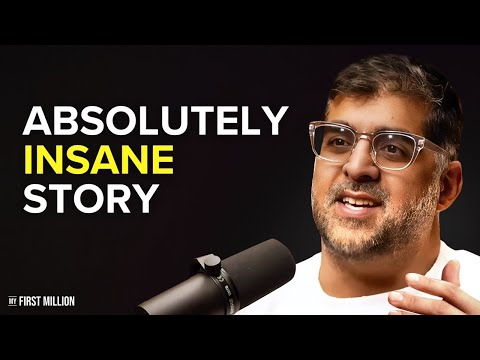
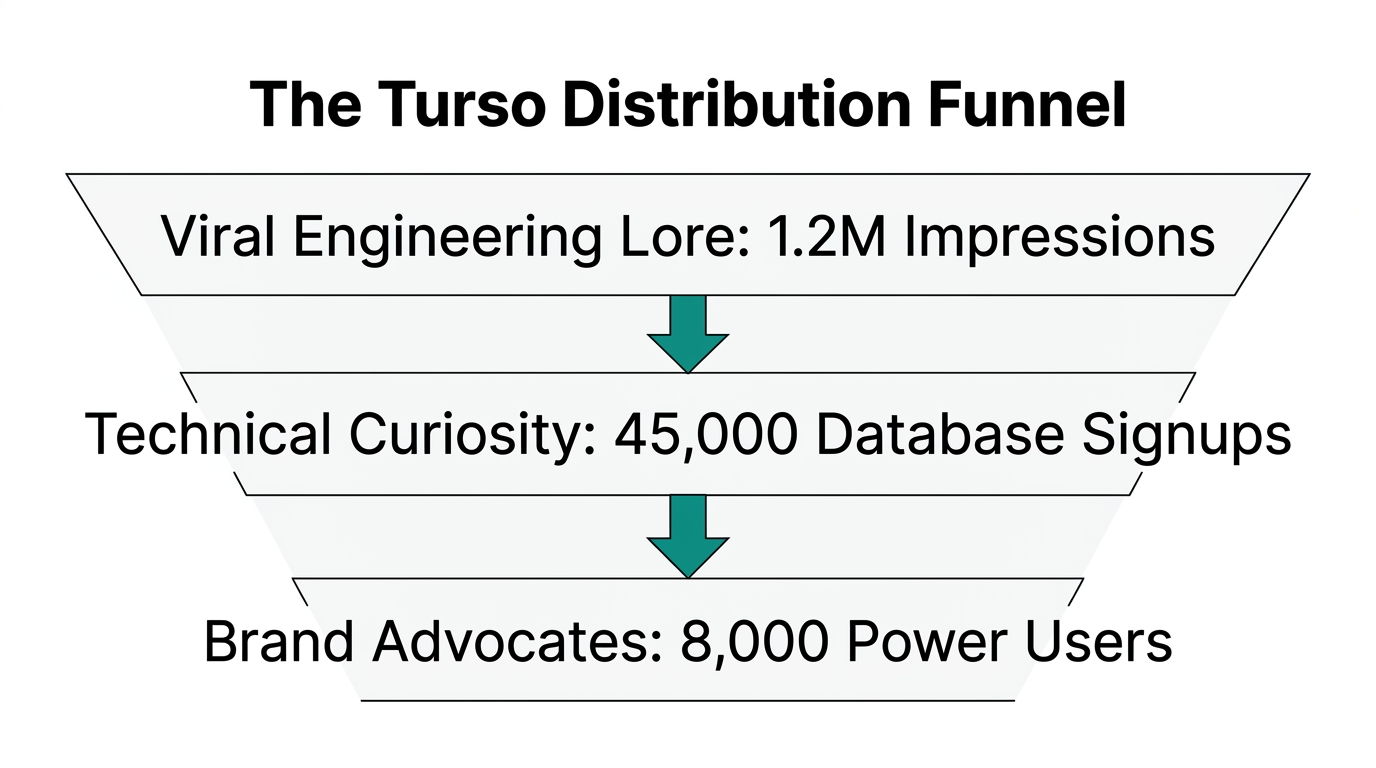
Perhaps the most compelling example of founder-led lore this year is the story of Preston Thorpe and the database company Turso. Most companies hire engineers from top-tier universities or Big Tech giants. Turso, however, made headlines by employing a brilliant software engineer who was actively incarcerated in a Maine prison.
Thorpe’s journey—from a teenage computer geek buying chemicals on the dark web to spending years in solitary confinement—is the kind of raw, unfiltered narrative that traditional HR departments would shy away from. But Turso leaned in. By supporting Thorpe as he taught himself advanced database architecture through limited prison internet, Turso didn't just find a great engineer; they built a legendary brand narrative.
Thorpe’s own blog, "My Story", details his epiphany in 2017 when he decided he was "no longer okay being where I was or who I had become." This level of vulnerability creates a powerful form of social proof. It tells the market that Turso is a company that values merit, redemption, and extreme technical talent over corporate optics.
| Feature of Lore | Impact on Distribution | Why it Works in 2026 |
|---|---|---|
| Radical Transparency | High Trust | Reduces skepticism in AI-heavy environments. |
| The Redemption Arc | Emotional Connection | People root for the underdog, driving organic shares. |
| Technical Depth | Niche Authority | Proves product quality through the caliber of the team. |
By the time Thorpe was released in early 2026, the "Turso Lore" had already cemented the company as the most interesting player in the edge database space. This is social media storytelling for business at its peak.
The Historical Precedent: Amadeo Giannini’s Fruit Wagon Bank
Discover how Amadeo Giannini built the Bank of Italy through radical benevolence.Lore isn't a new invention; it is a timeless human requirement. Take the story of Amadeo Giannini, the founder of the Bank of Italy, which we now know as Bank of America. Born to Italian immigrants, Giannini dropped out of school at 14 to work at his stepfather's fruit brokerage.
His lore was built on a single, defiant act. After the devastating 1906 San Francisco earthquake, while other banks literally had their vaults melted shut, Giannini loaded his customers' cash into a fruit wagon, hid it under boxes of oranges, and escaped the looters. Two days later, he set up a wooden plank on the wharf and began lending money on a handshake to dockworkers and fruit peddlers when no one else would.
This "fruit wagon lore" was the foundation of what would become the largest bank on earth. Giannini famously took no more than $50,000 in salary and owned zero stock when he died. This level of benevolent lore is impossible to manufacture. It is the ultimate distribution engine because it turns customers into disciples.
"Trouble is opportunity. In times of crisis, the person who does the opposite of the crowd doesn't just survive—they become lore."
The Economics of "Different" vs. "Better"
Exploring the strategic framework of why being different outperforms simply being better.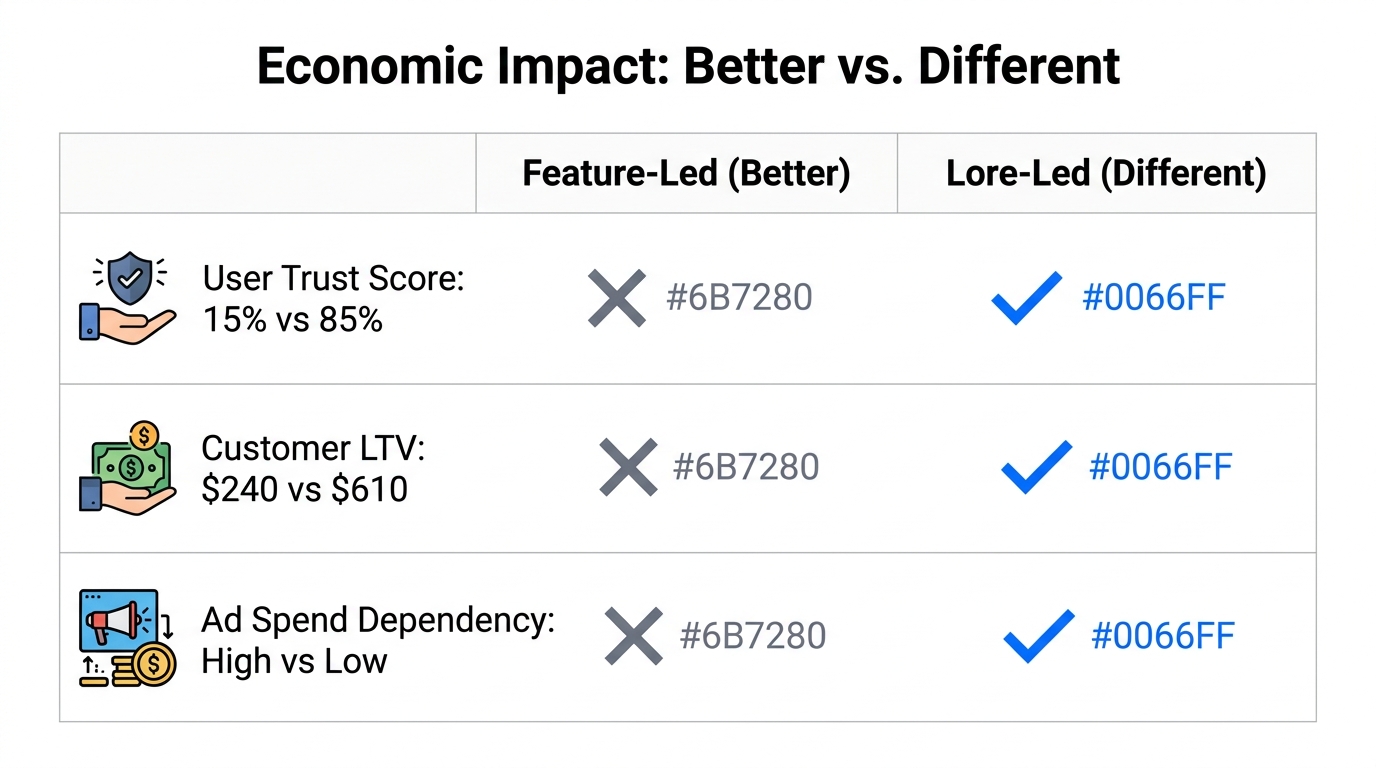
In 2026, we are seeing a resurgence of the 22 Immutable Laws of Marketing principles. Founders are realizing that trying to be "the better version" of a competitor is a losing game. Instead, they are finding ways to be the opposite.
Consider the contrast between a polished, VC-backed fintech app and the lore of the "Bogleheads." Founded on the philosophy of John Bogle, creator of Vanguard, the Bogleheads community thrives on the lore of boring, index-fund investing. Bogle himself, despite managing trillions, died with a relatively modest net worth of $100 million because he gave the ownership to the fund holders. This "anti-greed" lore is what makes Vanguard untouchable by modern, high-fee competitors.
When you identify your company's lore, you aren't just looking for a USP (Unique Selling Proposition). You are looking for your USP (Unusual Starting Point). What is the thing about your origins, your team, or your failures that makes you the "ugly circle" in a sea of identical triangles? Platforms like Stormy AI are now being used by growth teams to find creators who specifically align with these niche, high-lore narratives, ensuring that the distribution matches the depth of the story.
The Bitcoin Tragedy: Lore of the Lost Fortune
The tragic story of 7,000 Bitcoin lost forever behind a locked hardware wallet.Not all lore is about success. Some of the most viral distribution comes from tragedy and the ROI of vulnerability. Take the story of Stefan, the programmer who in 2011 was paid 7,000 Bitcoin to make an educational video. At 2026 prices, that fortune is worth nearly $800 million.
The catch? Stefan lost the password to his IronKey hardware wallet. He has two guesses left before the device self-destructs. His refusal to work with teams that have used lasers and nitric acid to crack the encryption because he wants to "honor a handshake deal" with previous partners is a piece of lore that has captivated the tech world. It is bizarre, frustrating, and deeply memorable.
While Stefan hasn't cracked his wallet, his story has provided more distribution for his new payment protocol, Interledger, than any paid ad campaign ever could. People don't follow companies; they follow sagas.
Playbook: Identifying and Distributing Your 'Lore'
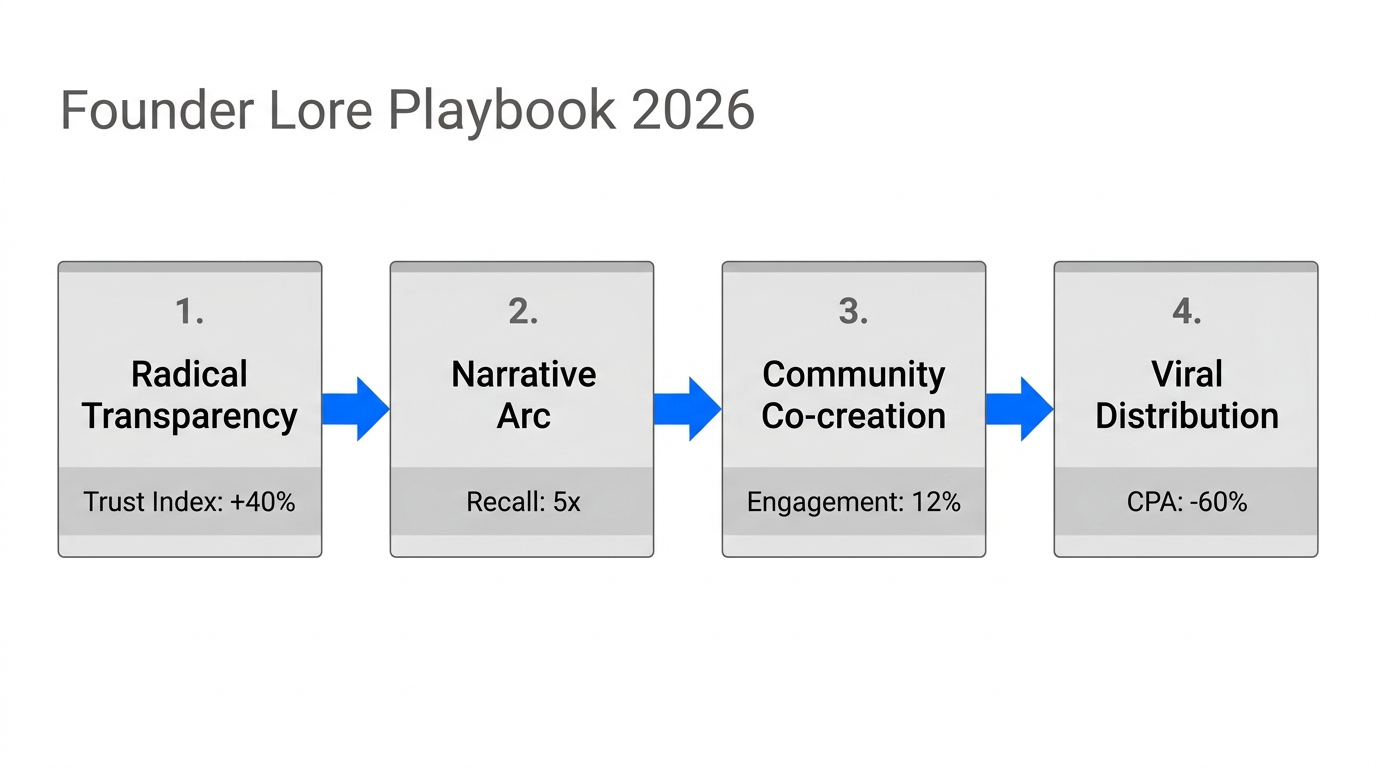
How can you apply this to your own brand in 2026? Follow this 3-step playbook for founder lore marketing:
Step 1: Identify "The Pivot" or "The Conflict"
Lore requires friction. Where did you fail? Where did you go against the data? Like the story of the CEO who refused to raise prices during a tariff war despite a 3% margin, these moments of irrationality are what people remember. Use Notion to document every "unorthodox" decision your team makes—that is your lore library.
Step 2: Choose Your Hero and Your Villain
Every great story needs an antagonist. For Amadeo Giannini, it was the elite banks that ignored the "little man." For Turso, it was the gatekept nature of traditional tech hiring. Identify what you are fighting against. This gives your audience a reason to choose a side.
Step 3: Distribute via High-Context Channels
Don't just post a link. Tell the story across TikTok and Threads. Use tools like Stormy AI to discover and outreach to creators who specialize in "deep-dive" storytelling or tech commentary. These influencers can act as the narrators of your lore, bringing it to a wider audience with built-in trust.
"The key to distribution in 2026 is realizing that you are not in the business of selling widgets; you are in the business of managing perceptions and legends."
Conclusion: The Future of Founder-Led Growth
As we close out 2026, the brands that win will be the ones that are talked about in the "lore" sections of the internet. Whether it is a software engineer coding from a prison cell or a banker hiding cash in a fruit wagon, these stories cut through the noise of a thousand AI-generated ads.
Stop trying to be better than your competitors. Start being different. Embrace your setbacks, double down on your eccentricities, and share your lore with radical transparency. Your audience isn't looking for a perfect founder; they are looking for a story worth following. If you're ready to amplify your narrative, use Stormy AI to find the right voices to help you tell it. The next billion-dollar brand isn't built on a pitch deck—it's built on lore.