The Validation Trap and the $2,000 MRR Plateau


In the early stages of Jenni AI, Park and his co-founder Henry were trapped in a cycle familiar to many SaaS founders. They had a functional product powered by OpenAI's GPT-2 (and later GPT-3), but growth was non-existent. They were cold-calling agencies for eight hours a day, facing a 99% rejection rate, and living off ramen in their parents' basements. Even when they managed to snag users, the revenue wouldn't budge past the $2,000 mark. The problem wasn't a lack of effort; it was a lack of real SaaS user research.
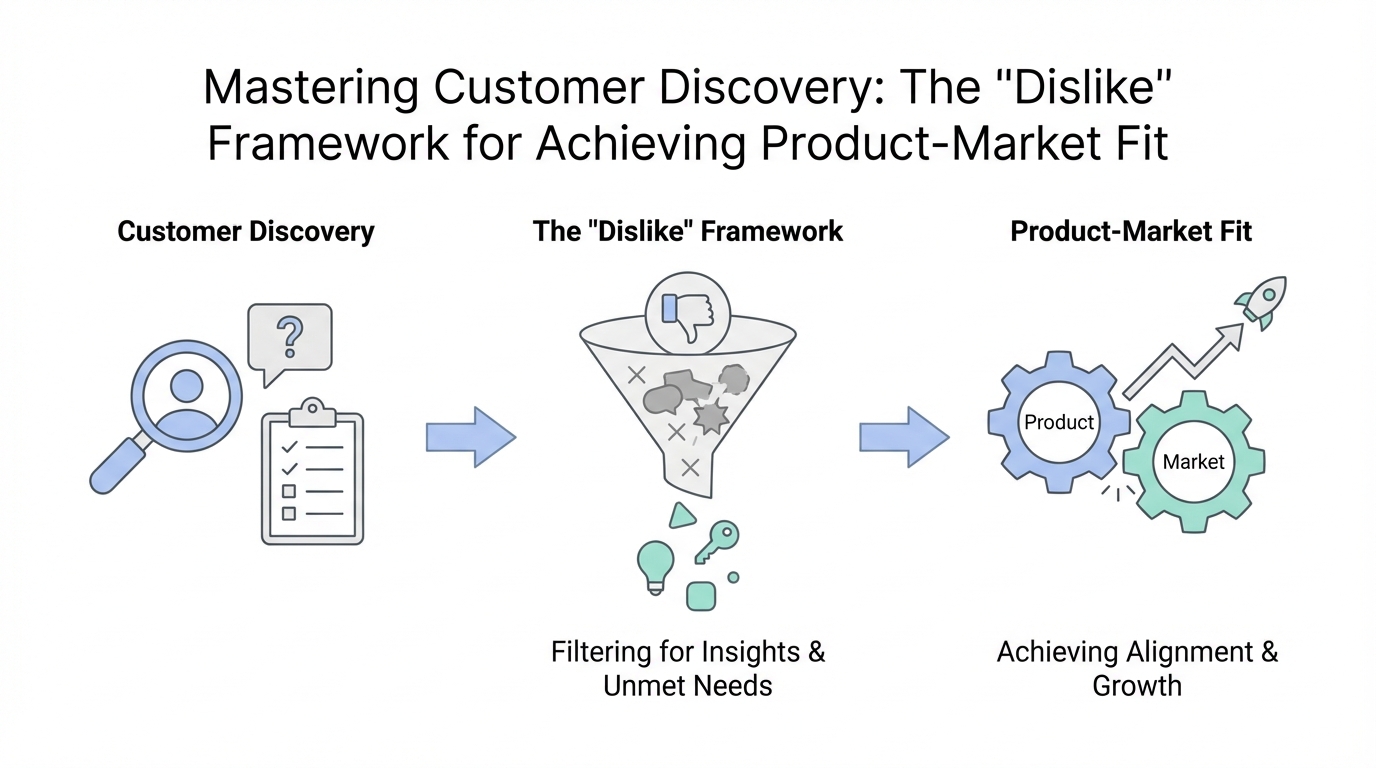
The duo had spent years iterating on ideas—9 or 10 failed startups in total—before stumbling upon the potential of AI-assisted writing. Yet, even with a 'cool' technology, they weren't solving a deep enough pain point. They were asking users, "What do you like about Jenni?" and receiving polite, useless answers. To break through, they had to stop making the conversation about themselves and start making it about the user's friction. This is where the 'Dislike' Framework was born.
The 'Dislike' Framework: Asking the Hard Questions

To truly understand how to get product market fit, you must be willing to hear that your baby is ugly. Park shifted his customer discovery questions from vanity metrics to friction points. Instead of asking for compliments, he began asking: "Why do you dislike my product?" and "What do you love about other people's products?"
This shift in psychology is critical. When you ask a user what they like, they feel social pressure to be kind. When you ask what they dislike, you give them permission to be honest. To find the right users to ask these brutal questions, many modern teams use Stormy's AI search for discovery across TikTok, YouTube, Instagram, LinkedIn, TikTok Shop, and newsletters to find creators and power users within specific niches who are already vocal about their workflows on platforms like TikTok and LinkedIn. By identifying these experts, you can gather high-signal feedback that casual users might not provide.
Park’s framework focuses on three core pillars: identifying workflow gaps, uncovering feature fatigue, and benchmarking against competitors. By leaning into the 'dislike,' Jenni AI was able to prune away the features that were cluttering the experience and double down on the 'friendly AI-assisted journey' their users actually craved.
Workflow Observation: Stop Listening, Start Watching
One of the most transformative tactics Park implemented was workflow observation. He didn't just ask users what they did; he asked them to share their screens. "Can we write an article together?" became his most powerful research prompt. This allowed him to see exactly where users hesitated, where they got frustrated, and where the AI failed to meet their creative needs.
Observation often reveals truths that users can't articulate. A user might say the product is 'fine,' but you might watch them struggle to find a button for 30 seconds. Unlike legacy influencer databases like Tagger or Julius which rely on static data, Stormy AI provides influencer vetting, fake follower detection, and real-time content quality scoring to look past raw follower counts and see how an audience actually interacts with content. You aren't looking for the 'stated preference'; you are looking for the 'revealed preference.'
Through these sessions, the Jenni AI team realized that users didn't just want a raw text generator. They wanted a partner in the writing process. They wanted a tool that felt like a 'journey' rather than a 'command line.' This insight led to a massive pivot in the UI/UX, removing unnecessary clutter and focusing on a seamless, collaborative writing experience. This is a primary product market fit strategy: use specific user complaints to prune unnecessary features and focus on core value.
The 'Aha' Moment: From Text Generator to Friendly Journey
Before the pivot, Jenni was just another tool in the burgeoning AI space. After the pivot, it became a specific solution for a specific group of people. They discovered that their target audience—students, researchers, and content creators—weren't looking for an 'auto-complete' button; they were looking for a way to overcome writer's block while maintaining their own voice.
This 'Aha' moment changed everything. By focusing on the user feedback loops that highlighted the 'loneliness' of the writing process, they built features that felt more interactive and supportive. If you're currently struggling to find your own 'Aha' moment, you might need to broaden your reach. Using Stormy's AI outreach can help you automate the process of contacting hundreds of potential users with hyper-personalized emails and auto follow-ups, ensuring you have a large enough sample size to spot these patterns.
The Malaysia Pivot and the $100K Miracle

Even with better insights, David Park was broke. He describes the humiliation of having to ask his mother for her credit card to buy Chipotle. But his persistence led him to a random podcast appearance that caught the ear of a scout for Jason Calacanis. This resulted in a $100,000 investment—a lifeline that allowed the team to move to Malaysia to cut their burn rate by 75%.
Moving to a low-cost environment wasn't just about saving money; it was about extending the runway for iteration. With 100k in the bank and a low burn, they could afford to 'get their hands dirty' for months without the immediate pressure of bankruptcy. This period was 'character building' for Park, who spent his days alone in a foreign country, obsessively refining the product based on the feedback he had gathered. Product-market fit is rarely a lightning bolt; it is a slow burn of iteration and sacrifice.
Scaling Through Social Virality and Post Tracking

Once the product was right, the growth followed—explosively. A single viral Twitter thread by Zane Kahn took Jenni from $2,000 to $10,000 MRR in just thirty days. This was the first 'semblance of success' for Park, but he knew virality was a fickle friend. He couldn't rely on random influencers to carry the business forever.
To build a sustainable growth engine, Park brought on a dedicated team to handle TikTok and Instagram Reels. They didn't just post randomly; they treated social media like a laboratory. They tried multiple creative formats, identified the ones that worked, and then scaled them by hiring multiple creators on a baseline salary with performance incentives.
For modern brands, managing this level of content scale requires robust tools. Stormy's post tracking allows you to monitor views, likes, and engagement across all these creators in one place, ensuring you know exactly which 'series' or 'format' is driving your ROI. By treating social media as a repeatable user feedback loop for marketing, Jenni AI scaled from $1M to over $3M ARR in record time.
The Persistence of a Decade of Failure
The story of Jenni AI is not just about a clever product market fit strategy; it's about the grit required to survive a decade of failure. David Park started his first company at 16 and didn't see real success until he was 27. Along the way, he faced a cancer diagnosis that almost put him out of commission, leading to a moment where he nearly sold the company for a few million dollars just to find peace.
However, he chose to double down. He realized that the business was unstable because it relied too heavily on him, so he focused on hiring for the marketing and growth sides. Within six months of that decision, the business doubled again. Today, the company is valued at roughly $25 million, a testament to the fact that persistence—combined with a brutal honesty about your product's flaws—is the ultimate competitive advantage.
Key Takeaways for Your PMF Journey

Achieving product-market fit is a grueling process, but you can shorten the path by following David Park's playbook:
- Ask 'Hard Questions': Move past validation and ask users exactly why they would cancel their subscription or why they prefer a competitor.
- Observe, Don't Just Listen: Use screen-sharing sessions to watch users interact with your SaaS user research in real-time. Revealed preferences are more valuable than stated ones.
- Prune Ruthlessly: Use negative feedback to remove features that cloud your core value proposition. A simpler product is often a more successful one.
- Scale What Works: Once you find a marketing format that resonates on TikTok or X, use Stormy's creator CRM to manage your relationships, deal stages, and collaboration history in one place.
- Stay the Course: Success often takes a decade of 'gut punches.' If you believe in the problem you are solving, don't throw your cards in early.
If you're ready to find the creators who will help you validate (or invalidate) your next big idea, start your journey with Stormy's AI-powered search. Whether you're looking for niche experts for research or viral creators for scaling, Stormy provides the data you need to make informed decisions and achieve the growth your product deserves.