The dream of the "one-person unicorn" is no longer a Silicon Valley fever dream—it is becoming a technical reality. For growth leaders and founders, the traditional marketing team automation journey used to involve hiring a fleet of specialists: a SEO manager, a content writer, a designer, and a social media coordinator. Today, that entire structure is being collapsed into a single, cohesive AI-driven workflow. By leveraging the power of n8n, the Model Context Protocol (MCP), and Claude 3.7, savvy entrepreneurs are practicing what is now known as "Vibe Marketing"—a high-leverage, automated approach to growth that focuses on strategy and vibes rather than manual execution.
The Rise of Vibe Marketing and Automated Operations
Vibe Marketing represents a fundamental shift in how startups scale. Instead of managing people and spreadsheets, growth leaders are now managing compute and workflows. The goal is to identify existing demand on the internet and siphon that traffic to your product with surgical precision. This requires a growth marketing stack that can listen to search data, analyze competition, and generate high-quality assets in seconds.
As discussed in recent startup circles, tools like n8n allow founders to build custom marketing tools tailored to their specific niche. Unlike rigid SaaS platforms, these workflows can be as simple or complex as your business requires. The objective is to eliminate the "cold start problem" by using data to dictate exactly what content you should create to reduce customer acquisition costs (CAC).
"The most powerful workflow you can build is often the simplest one. It’s about identifying where the demand is and letting AI do the heavy lifting of meeting it."Building Your Growth Stack: n8n vs Zapier for Marketing
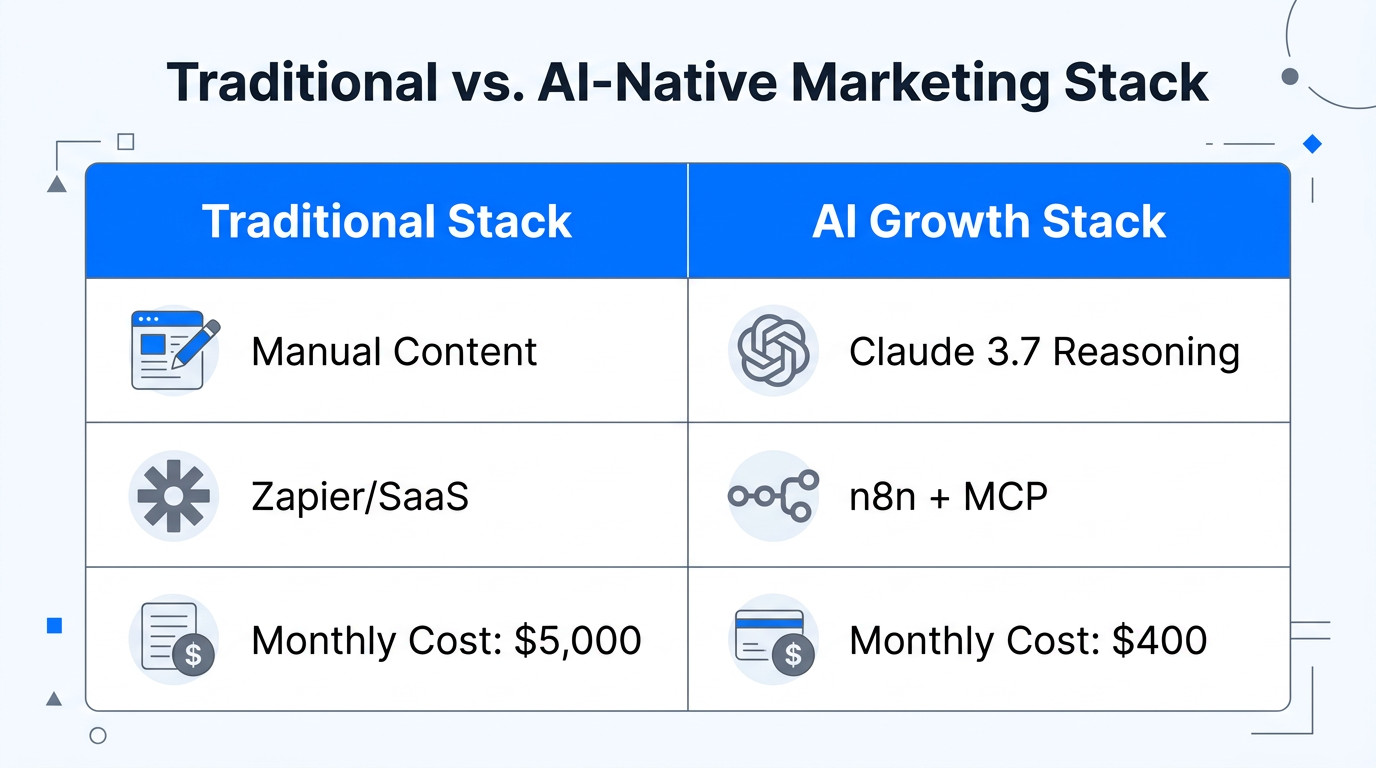
When choosing a foundation for your startup growth automation, the debate usually centers on n8n vs Zapier for marketing. While Zapier is excellent for simple "if-this-then-that" connections, n8n offers the flexibility needed for multi-node, data-heavy marketing operations. For founders who need to pull thousands of keywords from Ahrefs or Semrush, categorize them using an LLM, and then push them to a dashboard, n8n is the superior choice.
| Feature | Zapier | n8n |
|---|---|---|
| Ease of Use | High (No-code) | Medium (Low-code) |
| Complexity Support | Basic Linear Flows | Deep Multi-Branch Workflows |
| Data Transformation | Limited | Advanced (JavaScript/Python) |
| Cost Scalability | Expensive per task | Self-hosted/Predictable |
By using n8n, you can build a AI for business owners solution that acts as a fractional CMO. This isn't just about sending an email when a form is filled; it's about autonomous market research that runs while you sleep.
MCP: The Missing Link Between Claude 3.7 and Your Data
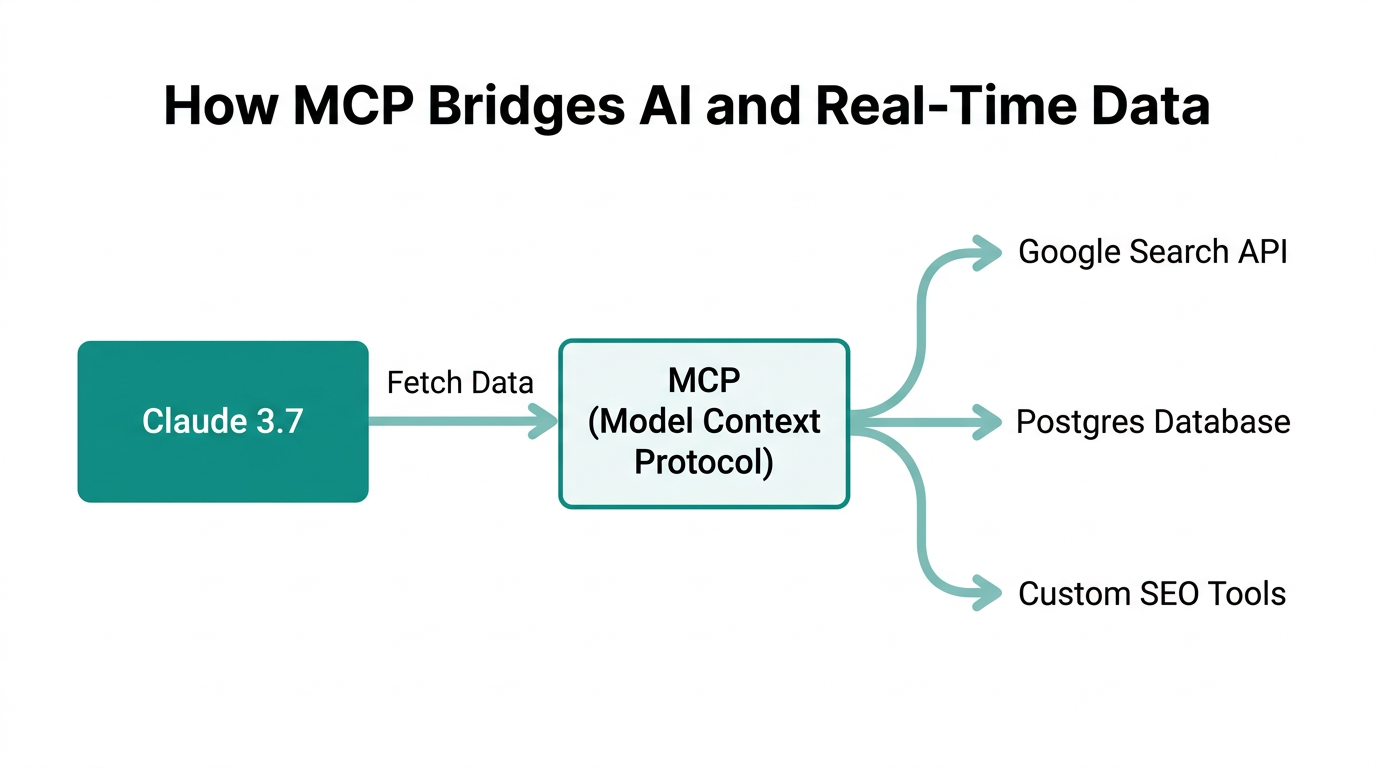
One of the most revolutionary developments in the growth marketing stack is the Model Context Protocol (MCP). Think of MCP as a "two-way radio" between your LLM and your third-party software. In the past, if you wanted Claude 3.7 to analyze your SEO data, you had to manually export a CSV and upload it. With MCP, Claude can directly "reach into" your tools.
For example, you can create a tool in n8n that connects to the Ahrefs API. Using MCP, you can then prompt Claude: "Find me 20 long-tail, high-intent keywords for my newsletter platform." Claude doesn't just guess; it uses the keyword tool you built to pull real-time search volume, difficulty, and competitor data. This transforms Claude from a chatbot into a data-driven decision-making engine.
"MCP enables a seamless communication channel between your AI and your data, eliminating the context-switching that kills productivity for growth teams."The Automated SEO Playbook: From Research to Webflow
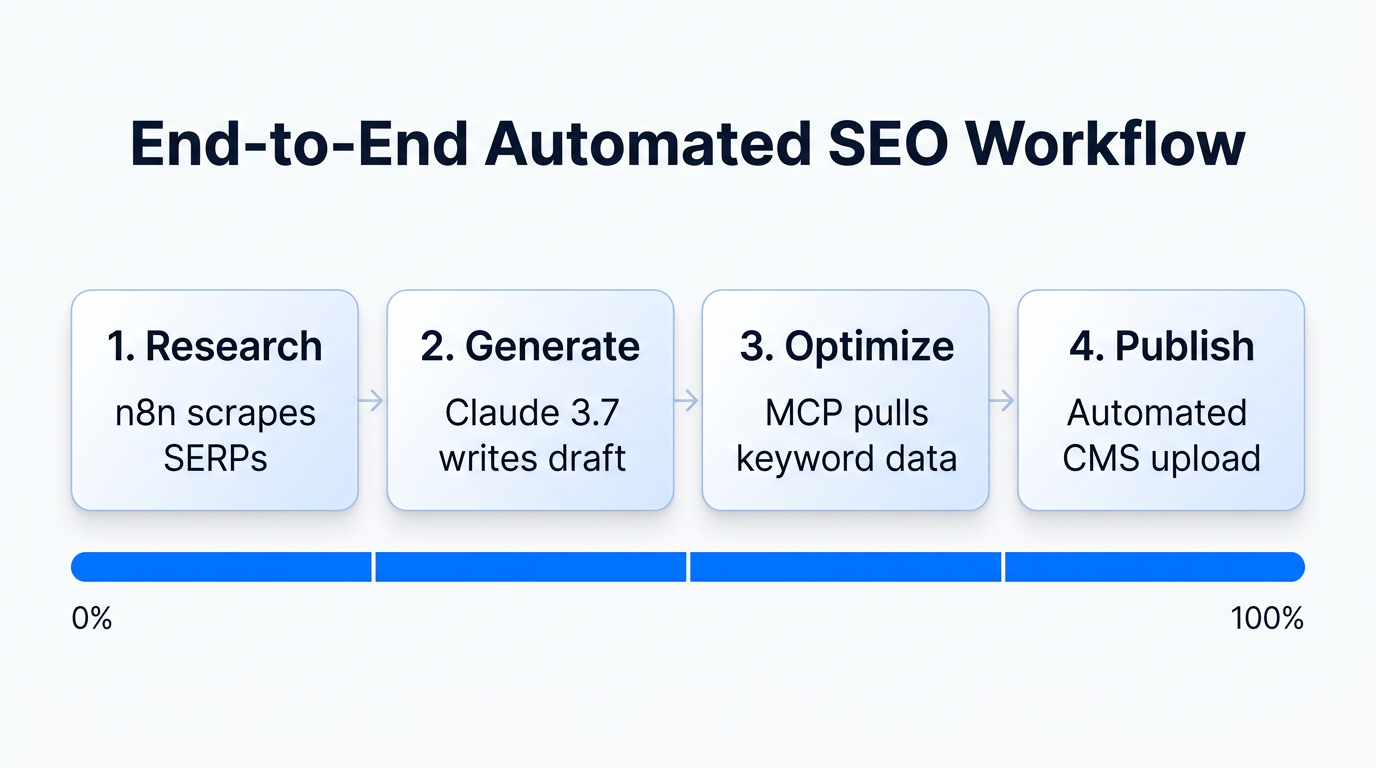
To replace a full marketing team, you need a workflow that mirrors the human process of content creation but at 100x the speed. Here is how you can use n8n and AI to build a content factory:
Step 1: Identify High-Intent Demand
Start by identifying keywords that your competitors are missing. Instead of manually browsing Ahrefs, use an n8n workflow to pull "non-branded long-tail keywords." For a platform like Beehiiv, this might mean targeting terms like "newsletter platform for creators" or "email marketing software for writers"—terms that imply the user is ready to buy.
Step 2: Competitive Gap Analysis
Once you have your keywords, the next step in marketing team automation is scraping the current top results. Use a tool like Claude 3.7 to analyze the front two pages of Google. Ask the AI: "What are these articles missing?" Usually, the gaps are in technical depth, retention strategies, or multi-channel coordination. This ensures your content isn't just "AI slop"—it's genuinely better than the competition.
Step 3: Content Production and Distribution
With the gaps identified, use Claude’s "Artifacts" feature to generate a 30-day content dashboard. This dashboard should include:
- Complete content briefs based on search intent.
- Search-optimized blog posts using your unique brand voice.
- High-conversion social threads for X and LinkedIn.
- Hero images generated via DALL-E 3 or Midjourney.
Scaling with Creators and UGC
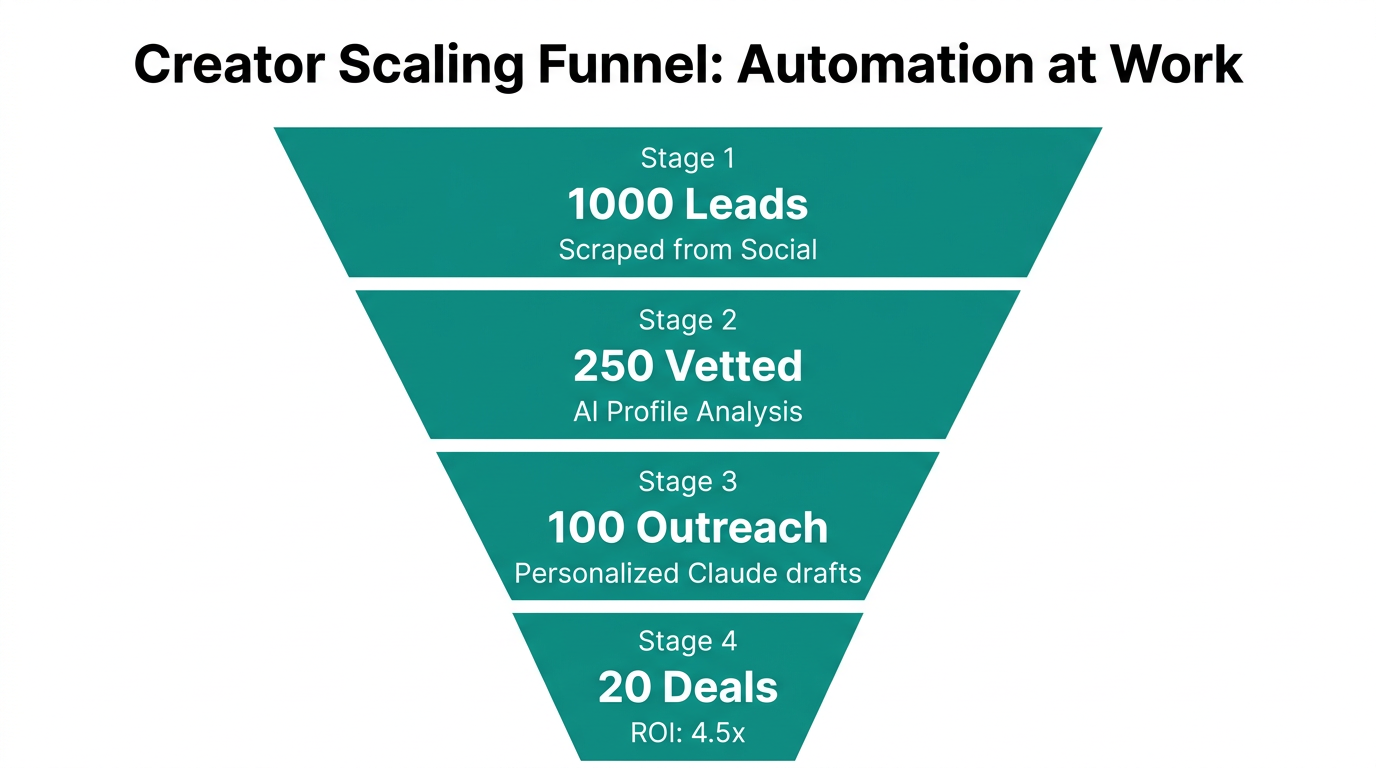
While automated SEO and technical content are powerful, modern growth marketing also requires a human touch—usually in the form of User-Generated Content (UGC). Even with the best automated stack, you need real people talking about your brand to build trust. This is where platforms like Stormy AI become essential. You can use Stormy AI to discover and vet UGC creators who fit your specific niche, then integrate their content back into your automated landing pages.
By pairing your n8n workflows with a creator discovery tool, you can automate the sourcing of authentic video content. This "hybrid" approach—AI for SEO and real creators for social proof—is the most effective way to reduce CAC in 2025. You can manage the entire creator relationship, from discovery to payment, while your AI agent handles the repetitive outreach and follow-ups.
"The future of growth is a mix of automated systems and authentic creator partnerships. One handles the reach; the other handles the trust."Publishing and the Human-in-the-Loop
The final stage of startup growth automation is the transition to production. While it is technically possible to have AI publish directly to Webflow or Shopify, the best Vibe Marketers maintain a "human-in-the-loop" for brand safety.
A common workflow involves sending the final AI draft to a Slack channel. A marketing manager reviews the content, clicks a button to "Approve," and then the n8n workflow pushes the content to the live site via API. This ensures that your brand voice remains consistent while still saving 95% of the manual labor typically associated with blogging.
Why This Matters for Your ROI
By replacing a traditional marketing agency or a 5-person team with this stack, you aren't just saving on salaries. You are gaining speed. A manual keyword study and content plan can take 30-40 hours; an n8n-powered Claude workflow can do it in 30 seconds. This allows you to test more niches, more keywords, and more creative angles than your competitors ever could.
The Future of the Automated Growth Leader
Replacing your marketing stack with n8n, MCP, and Claude 3.7 isn't about removing the human element—it’s about empowering the strategist. As an entrepreneur, your job is to find the "vibe" that resonates with your audience and build the machine that delivers it at scale. By using n8n for logic, Claude for intelligence, and tools like Stormy AI for creator management, you can build a marketing engine that is leaner, faster, and more profitable than any traditional team could dream of.
Ready to start? Begin by automating your most tedious task—whether that is keyword research or social media scheduling—and watch your ROI climb as your manual hours drop. The era of Vibe Marketing is here; it’s time to start building.