In the landscape of 2026, the traditional marketing funnel hasn't just evolved; it has been entirely re-architected. We have officially moved past the era of "if-this-then-that" logic into the age of autonomous reasoning. For CMOs and growth leaders, the choice is no longer about which software to buy, but which digital workforce to deploy. According to Grand View Research, the global market for AI agents is projected to exceed $10.9 billion in 2026, marking a definitive shift from rigid automation to agentic orchestration. While legacy workflows offered a respectable 195% ROI, modern agentic systems are delivering a staggering 544% ROI over a three-year horizon, fundamentally changing how brands interact with context and customers.
The $10.9 Billion Shift: Why Workflows Are Breaking
The marketing automation market, valued at over $50 billion in early 2026, is currently on a trajectory toward $81 billion by 2030. This growth is fueled by a massive internal pivot within organizations. Data from the PwC 2026 AI Business Survey indicates that 79% of companies have adopted AI agents in at least one business function. In the marketing sector specifically, that number jumps to 90.3%. However, there is a massive disconnect at the top: while 76% of teams use AI in core operations, only 12% of CEOs report seeing "real results."
The reason for this "results gap" is the limitation of deterministic workflows. Traditional tools like Zapier are designed for high-stakes, simple, repetitive data movements. They are deterministic, meaning they follow a fixed path. If the data format changes by even a single character, the workflow breaks. In contrast, 2026's marketing environment is highly unstructured. Agents are probabilistic; they use reasoning engines to achieve a goal regardless of the path. This allows them to handle the 69% of searches that now result in zero clicks, as noted by Search Engine Land, by focusing on Answer Engine Optimization (AEO) rather than just keyword ranking.
"The shift from managing campaigns to managing context is the defining challenge for CMOs in 2026. We are no longer just building paths; we are building minds."
Deterministic vs. Probabilistic: A Technical Breakdown
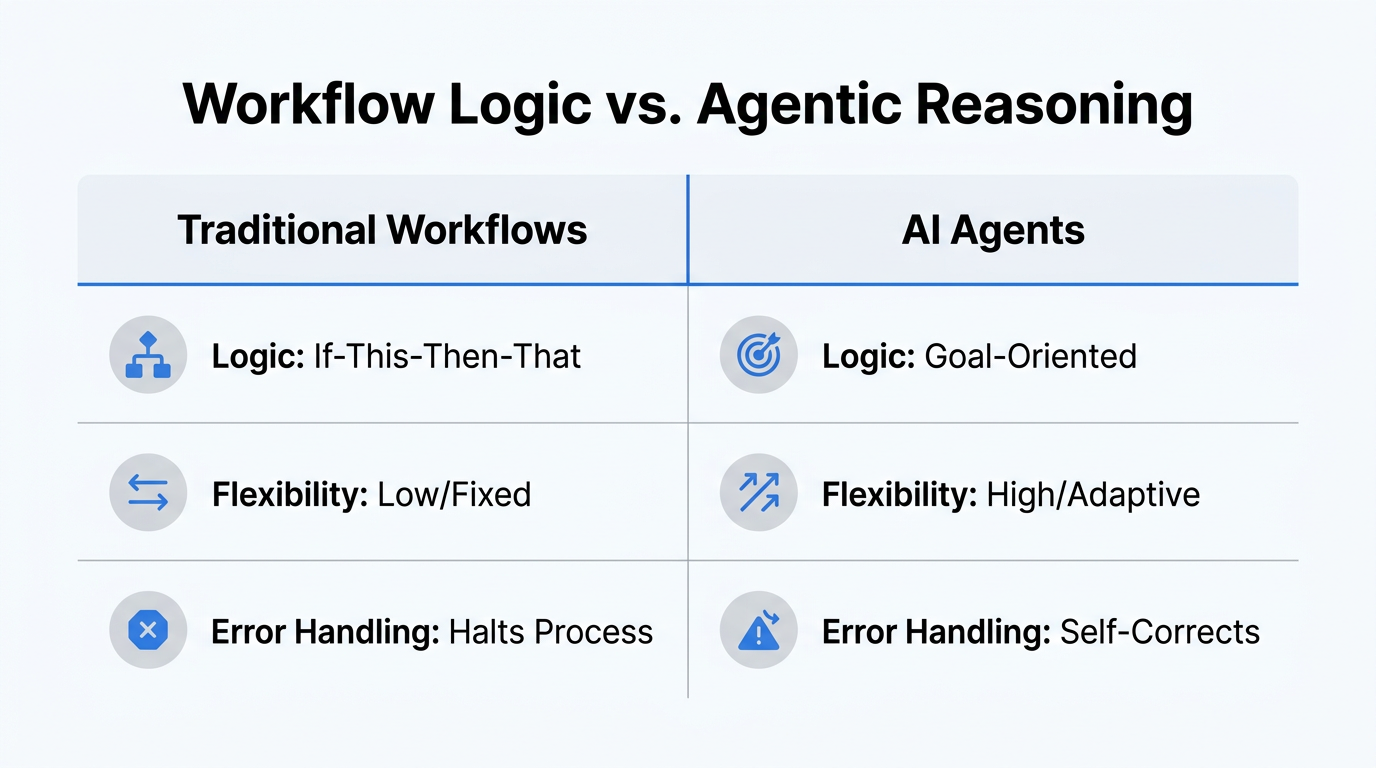
To understand why traditional marketing operations are stalling, we must look at the underlying logic. A traditional workflow is a linear or branching path. For example, a form fill triggers a one-day delay, followed by an email. If the user opens the email, they move to path A; if not, path B. This is rigid and requires constant manual updates. In the dynamic world of multi-channel marketing, these rules become a liability as they cannot adapt to nuanced customer behavior.
AI agents, such as those built on CrewAI or Salesforce's Agentforce, operate on continuous loops: Plan -> Act -> Reflect. They don't just send an email; they analyze the lead's LinkedIn profile and latest website activity, write a custom message, and then reflect on whether the response (or lack thereof) requires a different tactic. This adaptability is why platforms like Stormy AI have become essential for influencer marketing—using agentic discovery to find creators based on natural language prompts rather than static filters.
| Feature | Traditional Workflows | AI Agents (2026) |
|---|---|---|
| Logic Type | Deterministic ("If This, Then That") | Probabilistic ("Achieve Goal") |
| Adaptability | Rigid; breaks with data changes | Adaptive; handles unstructured data |
| Maintenance | High; manual rule updates | Moderate; requires Context Engineering |
| Best For | Simple data syncs, billing, GDPR | Research, ABM, Creative Personalization |
| ROI | Average 195% | Average 544% |
The ROI Gap: Analyzing the 544% Return
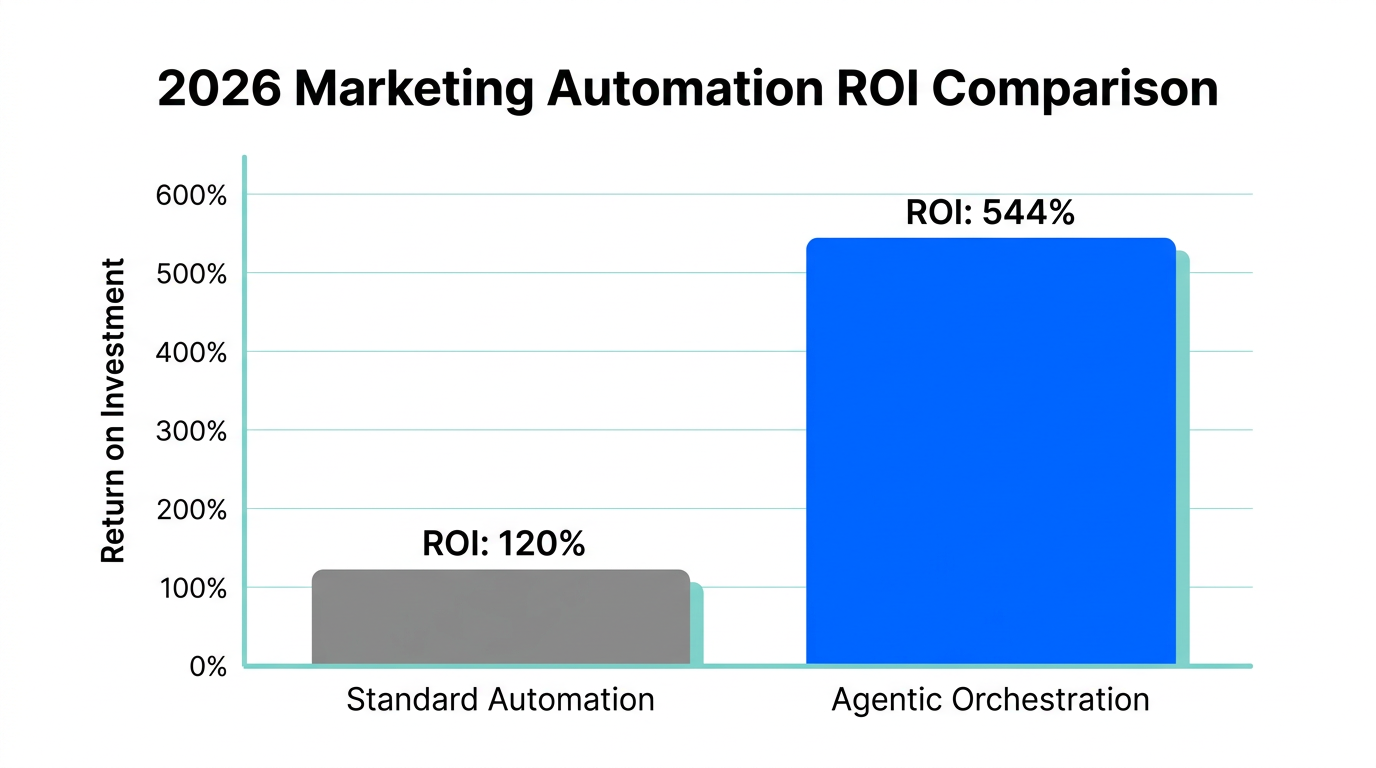
The financial justification for moving to agentic orchestration is now undeniable. According to recent ROI analysis, agent-driven teams see measurable ROI within six months 44% of the time. These gains are primarily driven by labor savings and conversion lift. Implementation of agents typically results in a 60–80% reduction in manual "bridge" tasks—those tedious steps like manual lead enrichment or calendar syncing that previously required human intervention.
Case studies from early adopters show e-commerce brands achieving significant gains. For example, Klarna famously replaced the equivalent of 700 full-time agents with AI assistants that now handle 66% of customer service chats with 80% faster resolution. This isn't just about speed; it's about the ability to scale personalized experiences that were previously cost-prohibitive. For B2B firms, tools like Tofu have reported 8x faster campaign execution and 32x increases in account coverage through agent-led personalization.
"AgentOps is the new DevOps. Managing a fleet of 100 agents requires a different operational layer focused on reliability, cost, and compliance." — Joao Moura, CEO of CrewAI
Overcoming the 95% Pilot Failure Rate
Despite the high ROI, the "Agentic Trough of Disillusionment" is a real threat. Many enterprises fall into the trap of custom-building agents that ultimately fail due to "action hallucinations"—where an agent performs the wrong action rather than just saying the wrong thing. As MarTech.org points out, 42% of enterprise AI deployments are blocked by data quality issues. If your data is siloed across 20 systems, your agent is merely a "hallucination engine."
The secret to success in 2026 is leveraging Model Context Protocol (MCP) and vendor-purchased solutions. Platforms like Salesforce Agentforce and enterprise-grade AI suites provide the infrastructure and guardrails necessary to prevent runaway execution costs. These tools allow marketers to use "Vibe Coding"—using natural language to describe goals—while the platform handles the complex orchestration and data security. By choosing these over custom pilots, organizations increase their success rate from 5% to 67%.
The 'TEAM' Framework: Your 2026 Implementation Playbook
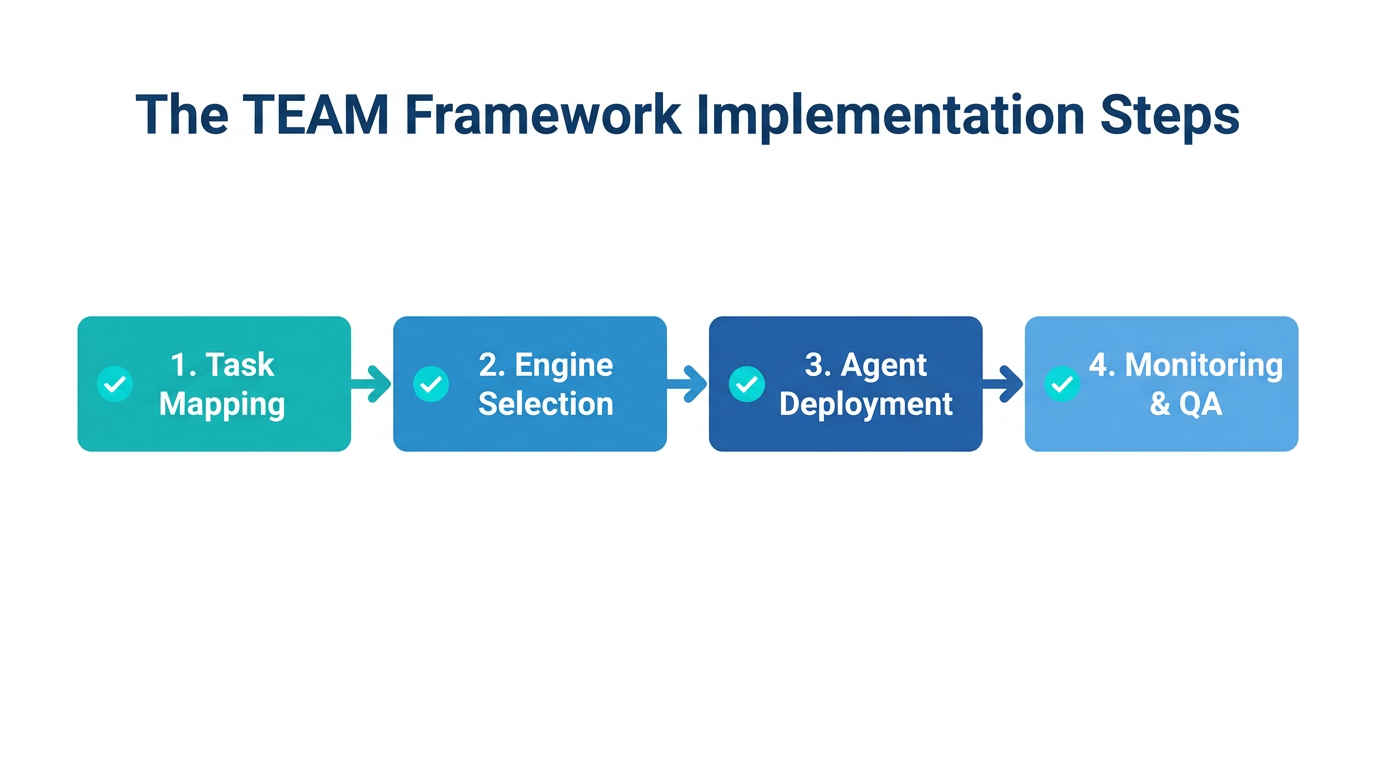
To successfully transition from workflows to agents, growth leaders should follow the TEAM framework, often discussed in modern growth communities like Medium's marketing strategy archives.
Step 1: Triage
Audit your current automated marketing operations. List every repetitive task and rank them by impact (potential time saved) versus risk (potential for customer-facing errors). Start with internal-facing tasks like lead research or content brief generation before moving to customer-facing execution.
Step 2: Experiment
Use low-code or no-code tools such as Lindy.ai or Relevance AI to test goal-oriented prompts. For example: "Find 10 creators in the beauty niche with 50K followers and find a recent video where they mention sustainable packaging." Platforms like Stormy AI are purpose-built for this step, allowing you to discover and vet creators using an AI agent that works while you sleep.
Step 3: Automate
Once the agent's logic is validated, move it into a production orchestrator. Integrate it with your CRM using Zapier for the simple data handoffs and agent-native platforms for the reasoning steps. Ensure you are using Shadow Mode—running agents in the background to log decisions without executing them—to build trust.
Step 4: Measure
Shift your KPIs from "Open Rates" and "Clicks" to "Time to Completion" and "Error Rate vs. Human Benchmarks." Track your ROI using the 544% benchmark to ensure your agent fleet is actually driving P&L impact. As noted in discussions on Reddit's r/CRM, the most successful teams are those that view agents as digital employees with specific performance reviews.
"Humans will win on EQ, while agents win on execution. The future is not 'AI vs. Human,' it is 'You to the power of AI'." — Dharmesh Shah
2026 Trends: The Rise of Agent-to-Agent Commerce
We are entering the era of Agent-to-Agent (A2A) commerce. Industry analysts predict that brand AI agents will increasingly negotiate directly with customer AI assistants. In this world, your marketing content needs to be machine-readable. If an agent cannot parse your real-time inventory or pricing, you are effectively invisible to the consumer's digital assistant. This makes Generative Engine Optimization (GEO) the most critical SEO sub-discipline of 2026.
Furthermore, we are seeing the verticalization of agents. General-purpose agents are being replaced by highly specialized ones, such as those focused exclusively on SaaS Demand Gen or Retail Personalization. These vertical agents understand the specific context of an industry, reducing the likelihood of hallucinations and increasing the precision of their actions. For instance, an agent specifically trained on mobile app marketing data will outperform a generic LLM when optimizing for App Store downloads.
Conclusion: Managing Context in the Age of Autonomy
The transition from AI agents vs workflows is not just a technical upgrade; it is a strategic necessity. By 2026, those who cling to deterministic rules will find themselves buried under the complexity of a context-heavy world. By adopting agentic orchestration, marketing leaders can unlock a 544% ROI, drastically reduce labor costs, and provide a level of personalization that was previously impossible.
Success requires a shift from managing campaigns to managing context. It requires pristine data, a "buy-over-build" mentality for core infrastructure, and a willingness to let go of the linear funnel. Whether you are using Stormy AI to automate your influencer discovery and outreach or Salesforce to manage your global CRM agents, the goal remains the same: scaling human intent through autonomous execution. The decade of the AI agent is here—ensure your marketing stack is ready to respond.