When Cathie Wood founded ARK Invest, she didn't just build another investment firm; she built a predictive engine for disruptive innovation. Moving from a cashier at McDonald's to managing nearly $40 billion in assets, Wood’s trajectory is a masterclass in identifying exponential growth before it hits the mainstream. For founders and growth marketers, the strategies utilized by the ARK Innovation ETF offer more than just stock picks—they provide a robust go-to-market strategy for timing market entry and calculating the true scale of a total addressable market analysis.
Understanding Wright’s Law: The Math Behind Market Dominance
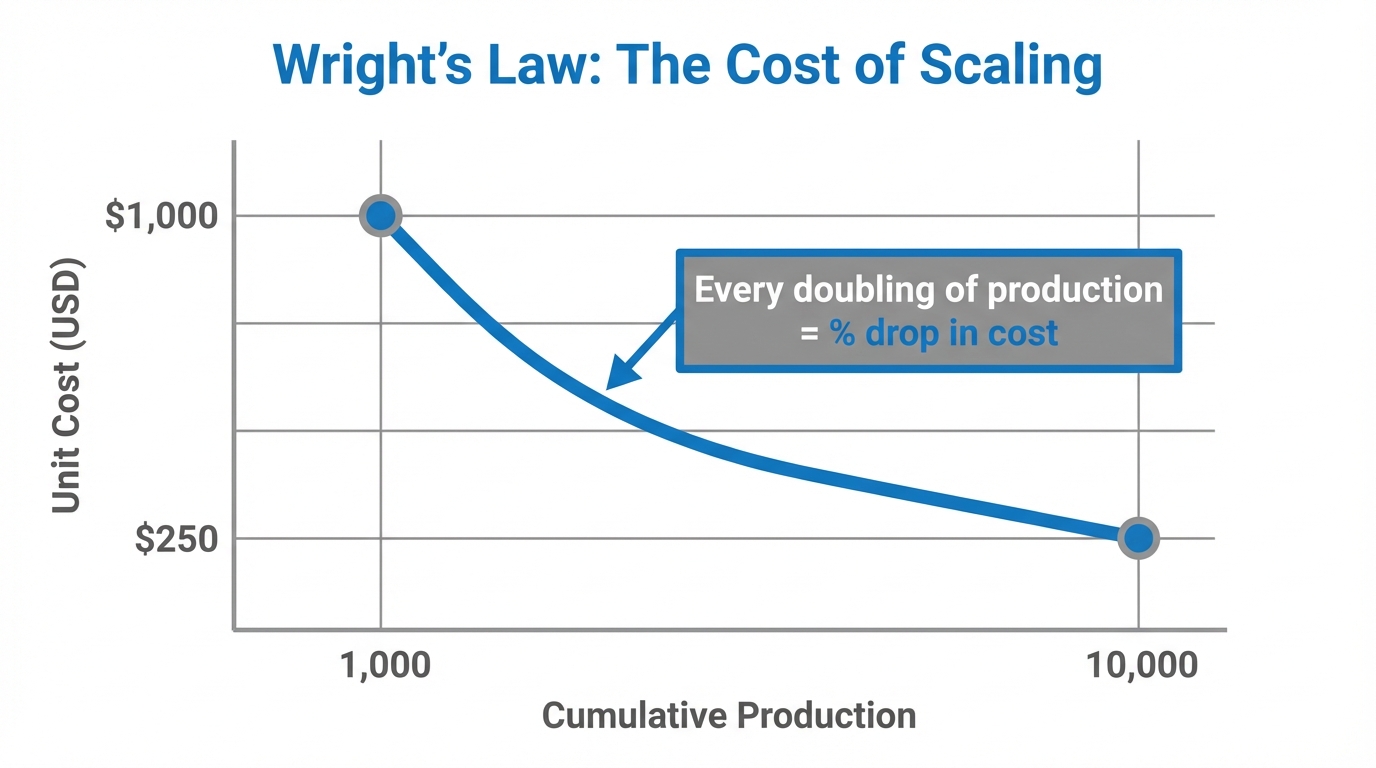
Most companies use Moore’s Law (focused on time) to predict technological advancement. However, Wood and her team rely on Wright’s Law, which focuses on cumulative doubling. The principle is simple: for every doubling of cumulative production, costs decline at a consistent percentage rate. This is the secret weapon for any TikTok Ads Manager or growth lead trying to forecast when a product will reach mass-market affordability.
Take the automotive industry as an example. The internal combustion engine (ICE) is a mature technology; it has no more "cumulative doublings" left to significantly drive down costs. In contrast, Electric Vehicles (EVs) are still early on their cost-decline curve, as noted in the IEA Global EV Outlook. By tracking these learning curves, founders can predict exactly when a disruptive product will undercut an incumbent's price point, effectively making the go-to-market strategy a matter of mathematical certainty rather than guesswork.
The $10 Trillion Shift: From Ride-Hail to Autonomous Transport
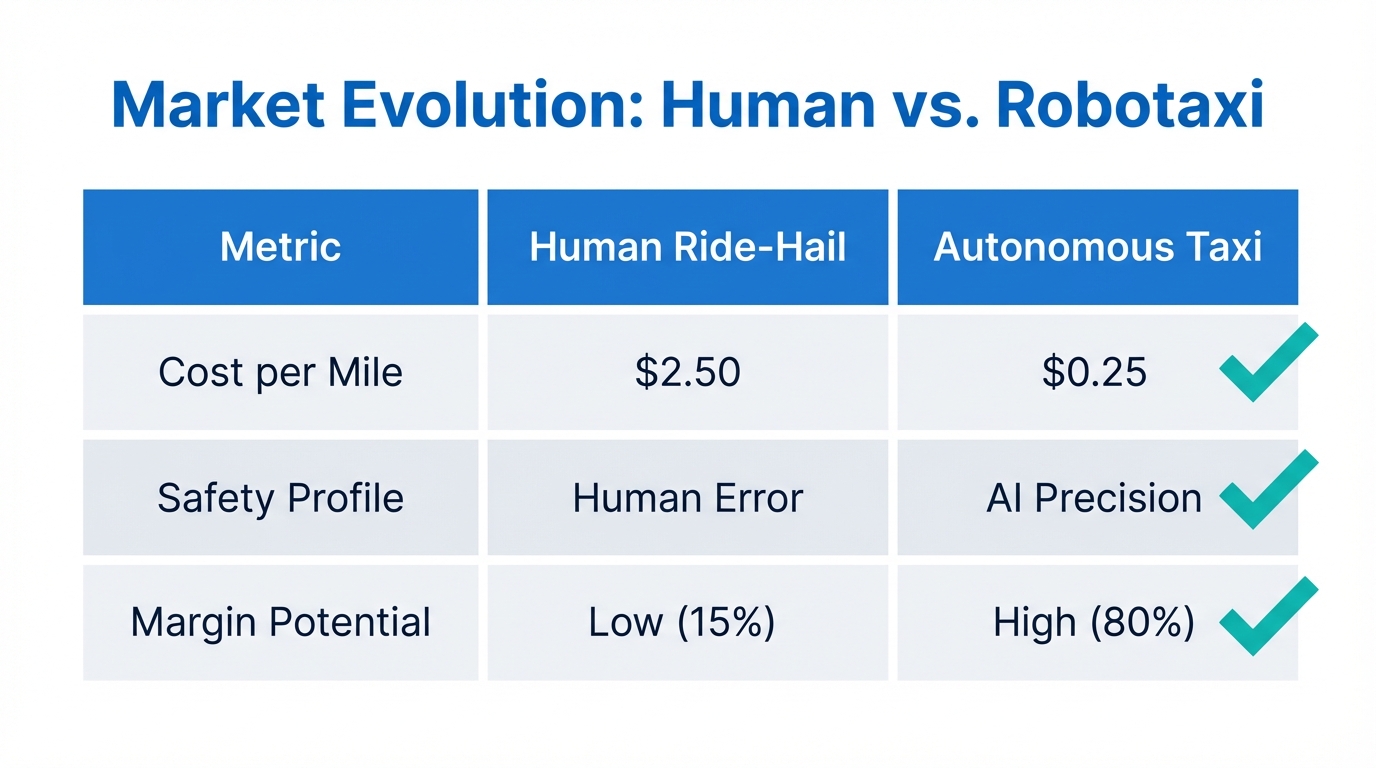
One of the most misunderstood aspects of Wood’s total addressable market analysis is the transition from current "Ride-Hail" (like Uber and Lyft) to "Autonomous Transport." Many critics look at the current combined revenue of Uber, Lyft, and DoorDash—roughly $60 billion—and struggle to see how the market could reach $10 trillion.
Wood’s insight is that autonomous technology doesn't just improve ride-hailing; it absorbs all of transportation. By removing the cost of a human driver and utilizing the efficiency of EVs, the cost per mile for transport is projected to drop from $2.50 to roughly $0.25. This 10x reduction in cost expands the market from a "luxury convenience" to the default method for moving people and goods globally, a thesis detailed in ARK's Big Ideas research.
"Moving from ride-hail to autonomous transport is moving from a narrow subset of the market to the entire global transportation infrastructure—an 8 to 10 trillion dollar revenue opportunity."
| Metric | Horse & Carriage (1800s) | ICE Vehicle (Today) | Autonomous EV (Future) |
|---|---|---|---|
| Cost Per Mile (Adj.) | $2.10 | $1.10 | $0.25 |
| Market Size (TAM) | Local/Niche | ~$60B (Ride-hail) | $8-$10 Trillion |
| Primary Constraint | Speed/Endurance | Labor/Fuel Costs | Regulatory/Tech Scale |
Venture Capital Dynamics: Why the 'Security Selects the Investor'
In the world of high-growth startups, the power dynamic is often inverted. Wood notes that in elite venture capital, the security selects the investor. The hottest startups on LinkedIn aren't begging for cash; they are choosing which brand names they want on their cap table. This is a critical lesson for disruptive innovation marketing: your brand must provide value beyond capital.
To win a spot on the cap tables of giants like SpaceX or OpenAI, ARK Invest utilizes a strategy of open-source research. By giving away their research on platforms like X (formerly Twitter), they attract the very innovators they want to invest in. For founders, this means your business growth frameworks should focus on building a "magnetic" brand that attracts top-tier talent and partners automatically.
When sourcing partners for high-impact campaigns, tools like Stormy AI can help source and manage UGC creators at scale, allowing brands to build the kind of social proof that attracts these elite partnerships. By automating the discovery and outreach process, founders can focus on the high-level brand positioning that makes them the "selected security" in their niche.
Identifying 'Mispriced' Segments: The Tesla Case Study
A core tenet of the ARK Innovation ETF philosophy is finding "mispriced" or "misunderstood" companies. Tesla is the ultimate example. While most of the market viewed Tesla as a car company (and valued it against Ford or Toyota), Wood viewed it as a robotics and AI company. This distinction changed the entire valuation model.
Founders should ask: "What is my company actually?" If you are building a SaaS tool that automates creator outreach, are you a software company, or are you an AI efficiency engine for the creator economy? Mispricing often happens because incumbents use old-school benchmarks from tools like Meta Ads Manager to measure new-world disruption.
Rebalancing for Resilience: Handling Supply Chain and Interest Rate Volatility
Even the most aggressive go-to-market strategy must account for macroeconomic shifts. Wood admits that one of the biggest lessons from the post-COVID era was the impact of supply chain bottlenecks on unit growth models. When unit growth is interrupted, even the best models lose their 15-25% compound annual return projections.
Wood’s framework for rebalancing involves:
- Focusing on Unit Growth: If units aren't moving, the model is broken.
- High Conviction Rebalancing: Selling the "winners" that have become overvalued to double down on high-conviction "losers" that are temporarily mispriced.
- Cash Management: Moving into larger-cap tech stocks with massive cash positions when interest rates rise to hedge against volatility.
For a modern startup, this might mean shifting your budget from pure acquisition on Google Ads to retention and LTV optimization when CAC (Customer Acquisition Cost) spikes due to market conditions. Integrating a tool like Stormy AI allows for more efficient creator management, ensuring that your business growth frameworks remain lean even when the broader economy experiences a "sinking spell."
"Our models are driven by unit growth. When there is an interruption in unit growth, the rate of return expectations must be re-evaluated instantly."
The ARK Strategy Playbook for Founders
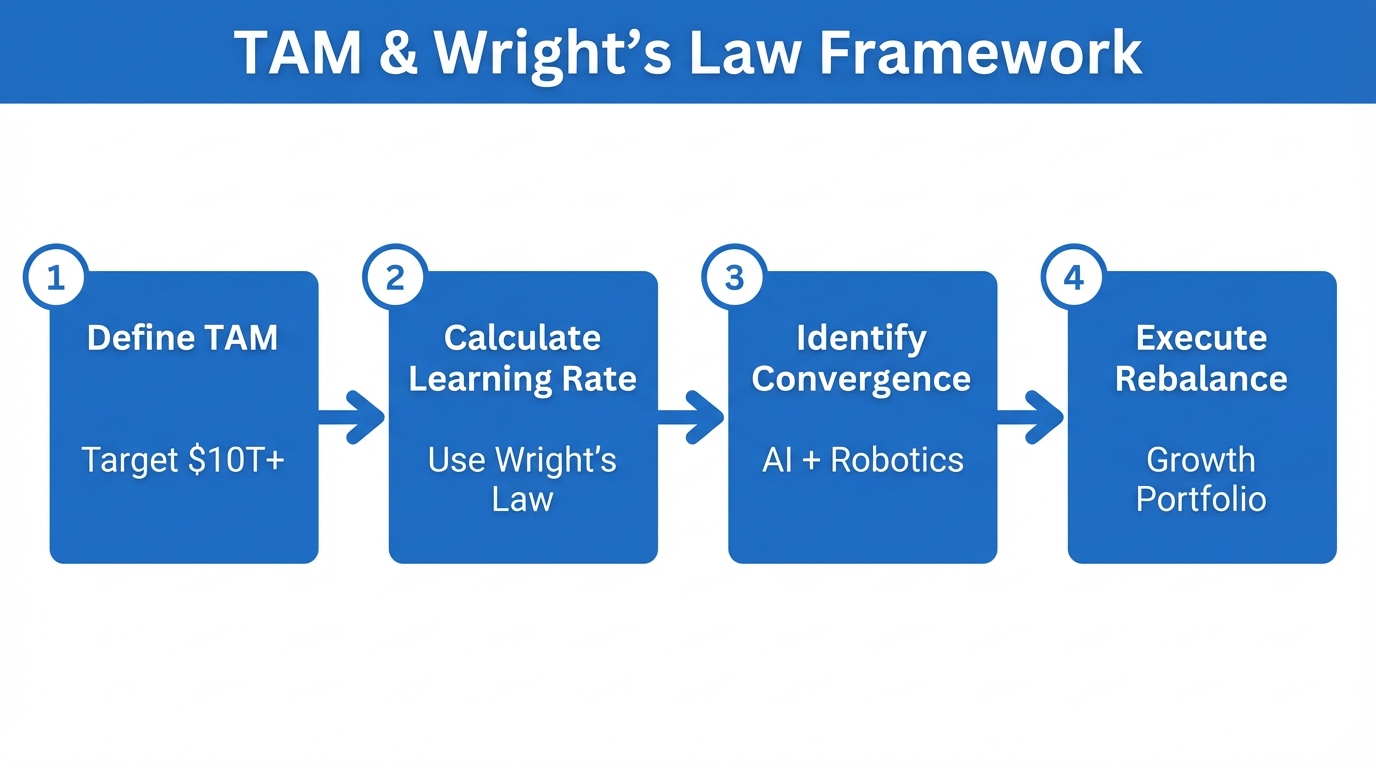
To implement these business growth frameworks, founders should follow this sequential playbook:
- Map Your Learning Curve: Determine if your product follows Wright’s Law. How much does your cost-to-serve drop every time your customer base doubles?
- Define Your 10-Year TAM: Don't look at the current market size. Look at the market size once your technology makes the service 10x cheaper.
- Open-Source Your Insights: Use Shopify to sell products, but use your proprietary research to sell your vision. Give away enough knowledge to become a magnet for the industry's best.
- Vet for Mispricing: Ensure your investors and customers understand you as a tech/AI play, not a legacy service provider.
- Rebalance Daily: Use data from Google Analytics and internal CRM tools to move resources from low-performing channels to high-conviction opportunities.
By shifting your focus from short-term metrics to long-term total addressable market analysis and technological learning curves, you position your company to be the disruptor rather than the disrupted. Whether you are building the next SpaceX or a niche e-commerce brand, the math of Wright's Law remains the same: the company that learns the fastest, wins the market.