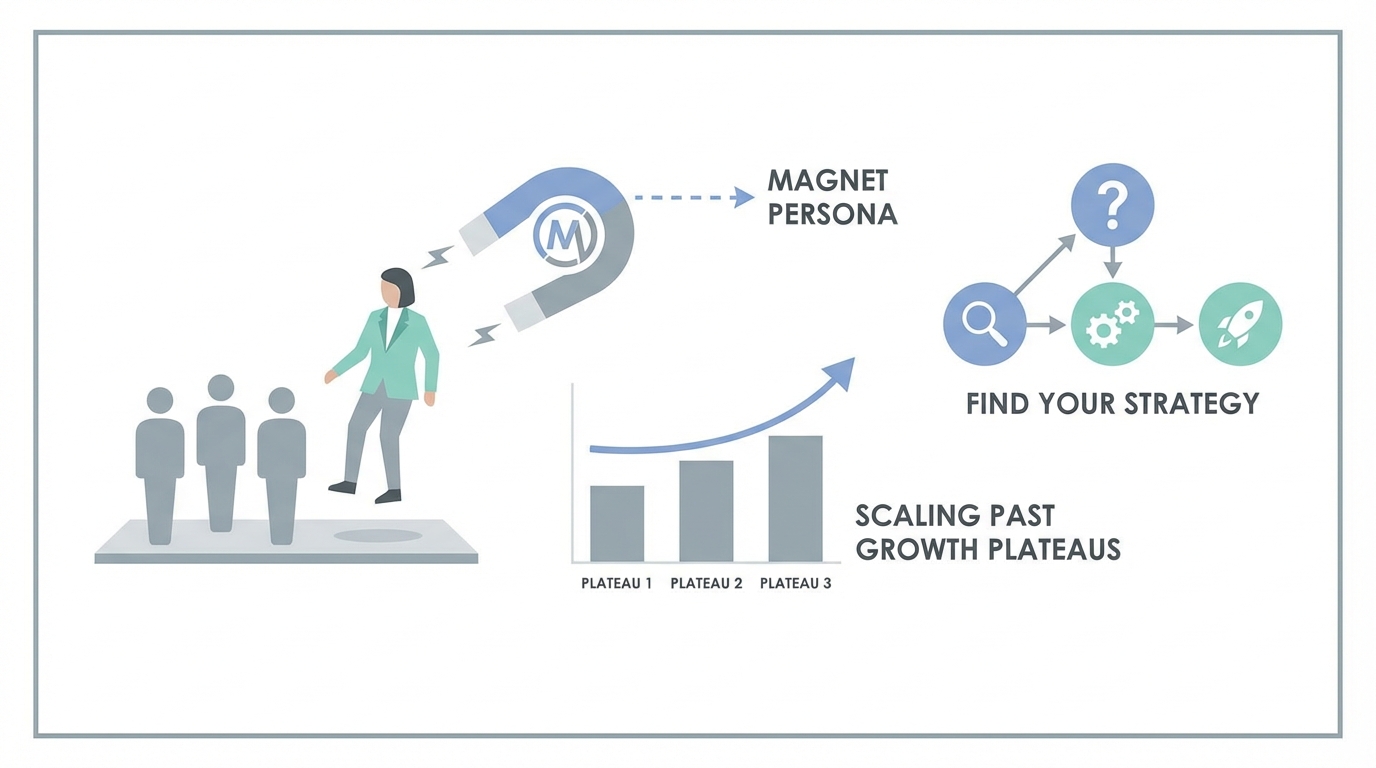
Every founder dreams of the moment they hit true product-market fit. It is often described as poetry or magic—a state of bliss where every marketing campaign seems to land, every sales call closes, and your growth chart looks like a vertical line to the moon. But as Guillaume Moubeche, founder of Lemlist, discovered on his journey from a $1,000 savings account to a $150 million valuation, this exponential rise is rarely permanent. Eventually, every successful startup hits a wall. The tactics that got you to $1 million ARR rarely work to get you to $10 million, and the strategies for $10 million often fail at $30 million.
Breaking through these plateaus requires more than just spending more on Meta Ads Manager or hiring more SDRs. It requires a fundamental shift in how you view your audience. To scale past the inevitable stagnation of the S-curve, you must identify and double down on your Magnet Persona: the specific, high-authority user group that naturally attracts the rest of the market. This article will outline the playbook for identifying this core group, aligning your B2B marketing strategy around them, and leveraging AI-powered tools to automate the expansion.
Understanding the S-Curve: Why Growth Isn’t Linear
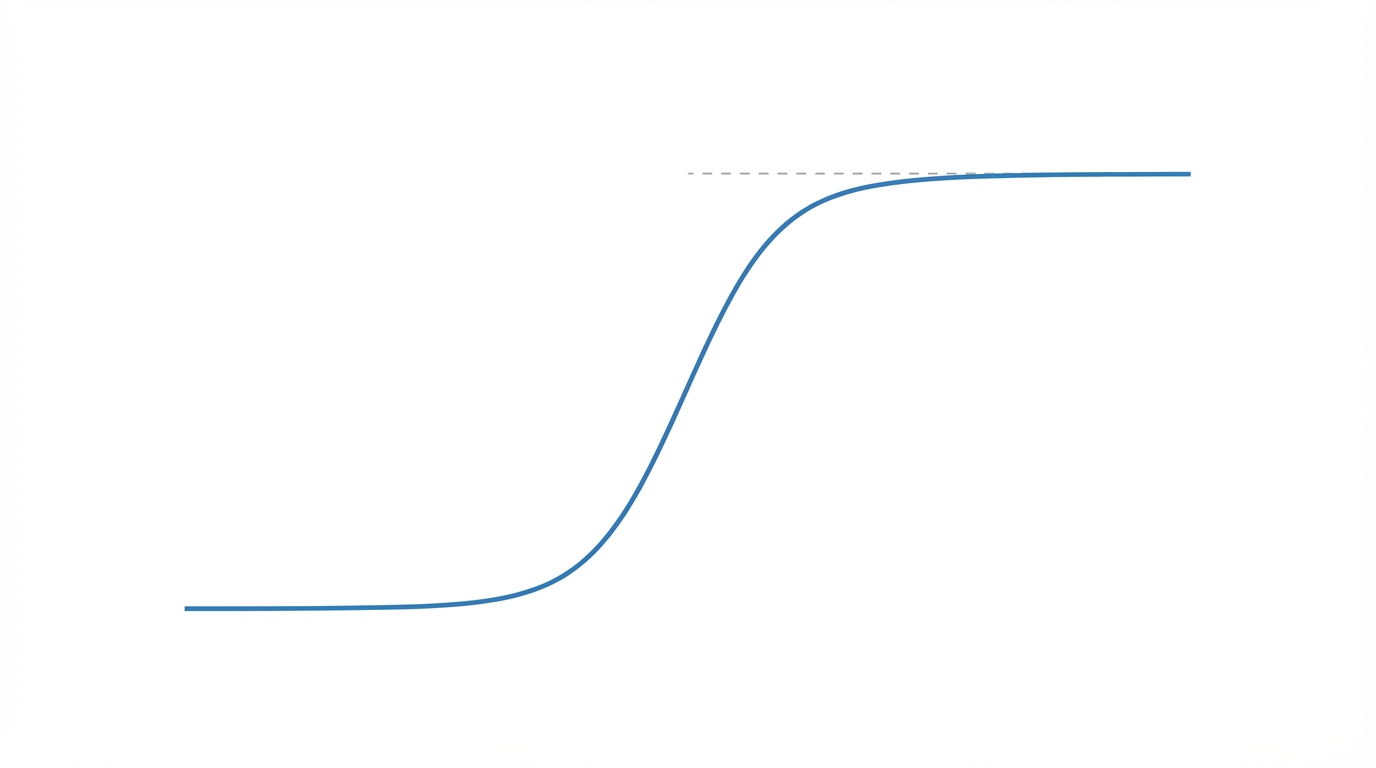
In the early stages of a startup, growth often feels like an exponential curve. You are capturing the low-hanging fruit—the early adopters who have been waiting for a solution like yours. However, growth is actually a series of S-curves. An S-curve starts with slow initial growth, moves into a rapid acceleration phase, and eventually tapers off into a plateau as you exhaust your immediate market segment or face technical debt.
Guillaume Moubeche experienced this firsthand when Lemlist plateaued at $10 million ARR. Despite growing at 15% to 25% month-over-month for years, the company hit a ceiling. The architecture that worked for a few thousand users couldn't sustain the next ten thousand. More importantly, the generic marketing message that appealed to everyone started appealing to no one. To break the plateau, you must anticipate the next S-curve before the current one flattens. This involves a deep SaaS growth strategy audit to find the "power users" who are seeing the most success and staying the longest.
When you reach a plateau, it is a signal that your product-market fit has evolved. You are no longer selling to the early adopters; you are moving into the early majority. This transition requires a more sophisticated B2B marketing strategy. Instead of casting a wide net, you need to find the specific segment that provides the highest customer retention and use them as a beacon for the rest of the industry.
Defining the Magnet Persona: The Secret to Brand Authority
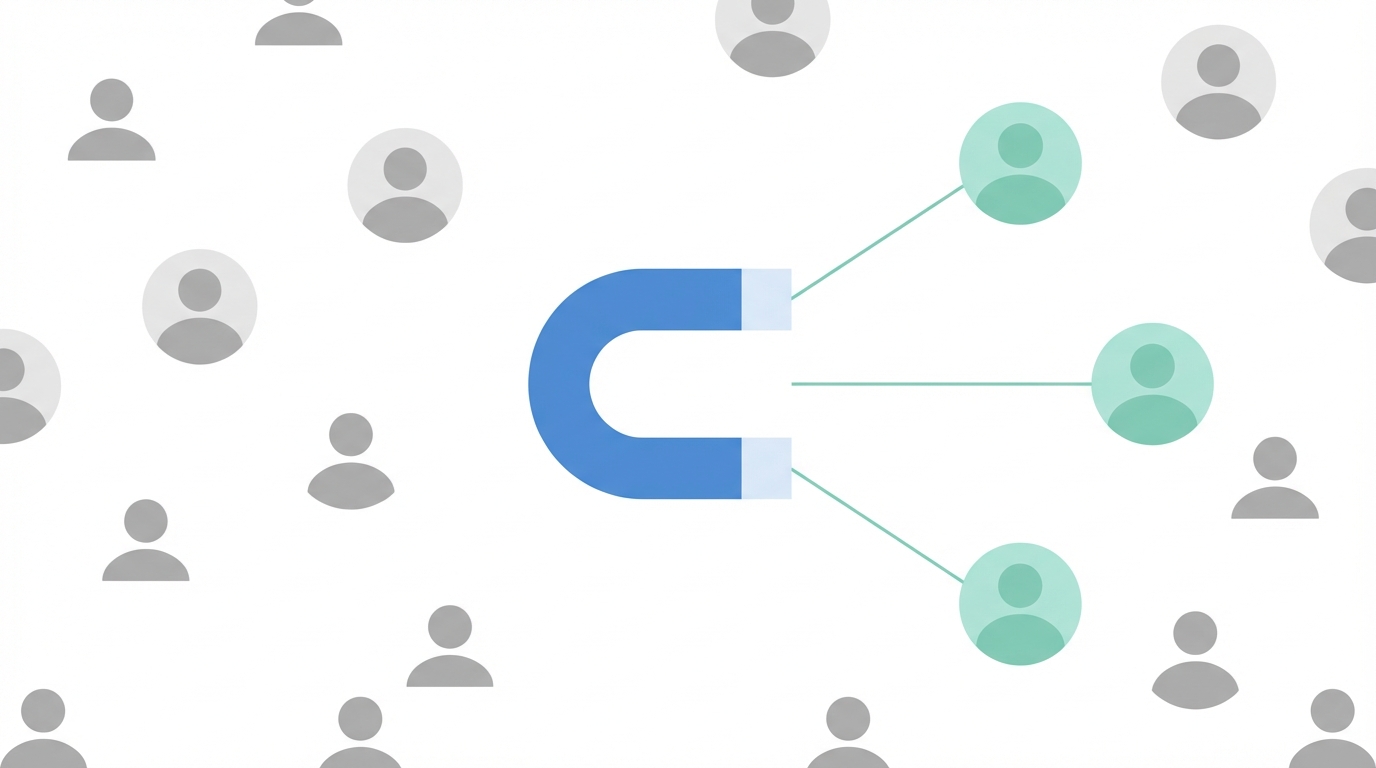

The Magnet Persona is not just your "ideal customer profile" (ICP). While an ICP focuses on who can buy your product, a Magnet Persona focuses on who influences others to buy your product. This group possesses a high "cool factor" or professional authority within their niche. When this group adopts a tool, it signals to the rest of the market that the tool is the industry standard.
Consider these classic examples:
- Apple and Designers: For decades, Apple focused almost exclusively on designers and creatives. Designers are viewed as tastemakers. By becoming the go-to choice for the "cool" creative crowd, Apple ensured that every other professional—from accountants to lawyers—eventually wanted a Mac to feel part of that innovative circle.
- Lemlist and Sales Reps: In the crowded sales automation space, Lemlist focused on the individual sales representative rather than the VP of Sales. By helping reps book more meetings through human-centric personalization, they turned their users into advocates. When a company wants to drive revenue, they look at what their best sales reps are using.
To find your Magnet Persona, you need to look beyond demographics. You need to look at influence and community. Using Stormy’s AI search, brands can identify which creators and thought leaders are already talking about their niche on platforms like LinkedIn and TikTok. By finding the "creators' creator," you find your magnet.
The Playbook: How to Audit Your User Base for Power Users
Before you can scale, you must understand who is currently winning with your product. A common mistake founders make is focusing on total signups rather than activation and retention. Guillaume Moubeche noted that early in Lemlist's journey, their activation rate—the percentage of people who actually launched a campaign—was only 15%. By redesigning the product and focusing on the core needs of their most successful users, they boosted that to 35%, aligning with SaaS industry benchmarks for high-growth startups.
Step 1: Segment by Retention
Identify the users who have been with you for 6+ months and have a high usage frequency. Customer retention is the ultimate truth-teller in SaaS. Filter out the "tourists" and focus on the "residents." Look for patterns: Are they all from a specific industry? Do they all use one specific feature? In the Lemlist case, the Magnet Persona was the sales rep because they were the ones most tied to the revenue outcome of the software.
Step 2: Analyze the "Success Association"
Your product must be associated with a specific win. If your software helps people make money, you are a "success tool." If it just saves time, you are a "utility tool." Success tools have much higher product-market fit and lower churn. Ask your power users: "What is the one metric that improved after you started using us?" If the answer is tied to revenue, you have found your magnet.
Step 3: Map the Influence Network
Once you have a list of power users, see who they follow and what content they consume. This is where AI-powered discovery becomes essential. While legacy platforms like Tagger or Julius offer basic database filtering, they lack the real-time AI context needed to find true magnets. Instead, you can use Stormy’s influencer analysis to vet the creators your power users follow. This ensures your B2B marketing strategy is aligned with the voices your Magnet Persona actually trusts, rather than just chasing high-follower accounts that lack engagement.
Aligning Product and Marketing Around One Cool Persona
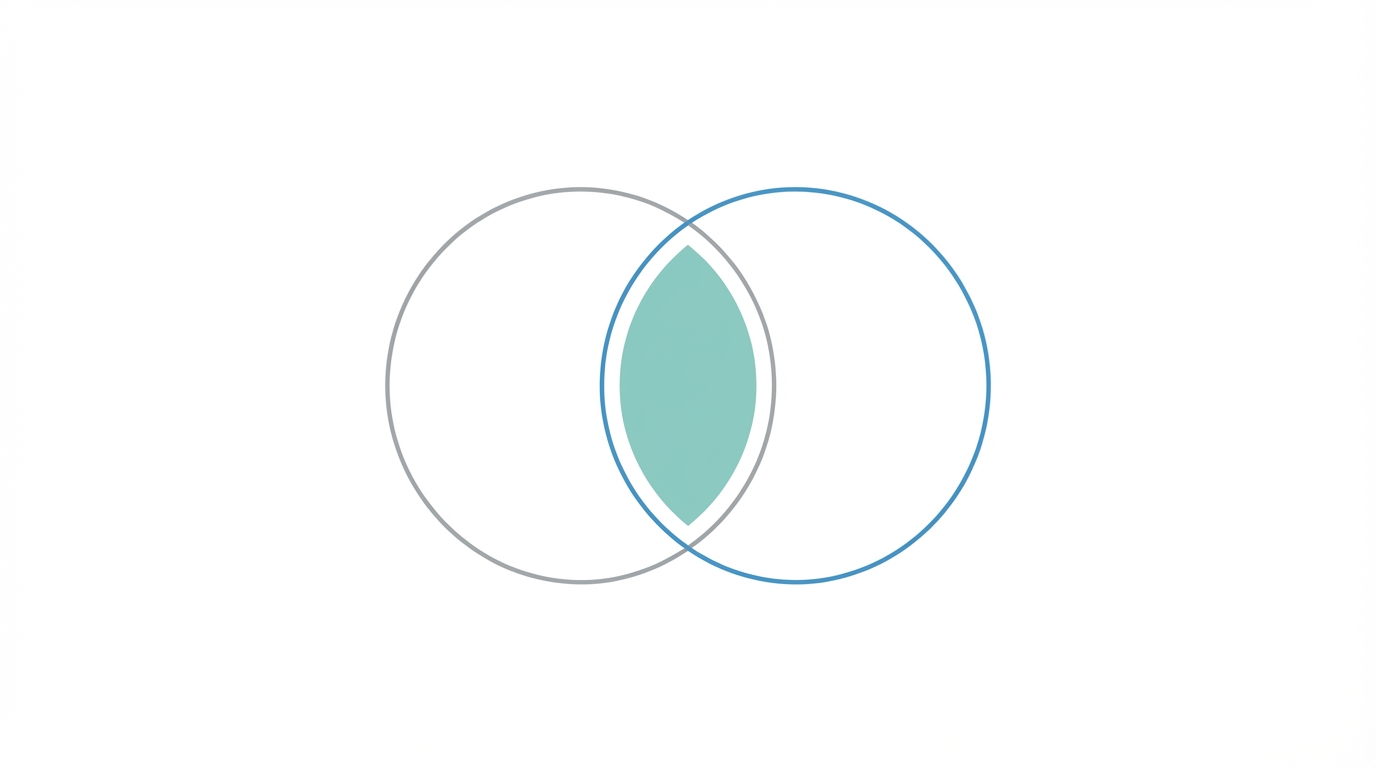

Once you have identified your Magnet Persona, every part of your company must align around them. This is often the hardest part of a SaaS growth strategy because it requires saying "no" to other potential customers. Narrowing your focus is the only way to deepen your authority.
For Lemlist, this meant making the product "more human." They added features like personalized images and custom landing pages that sales reps loved, even if those features were more complex to build. They didn't try to be a generic email tool like Gmail; they tried to be the best sales tool for sales teams.
Marketing Messaging
Your messaging should speak the language of the Magnet Persona. If your persona is a "growth hacker," use technical terms and share experimental data. If your persona is a "design lead," focus on aesthetics and workflow integration. Use your Magnet Personas in your content. Guillaume used his first 100 customers as success stories, writing their campaigns for them to ensure they won. He then turned those wins into templates that others could follow.
Scaling Outreach
When you are ready to scale, you don't need a massive sales team. You need targeted, hyper-personalized outreach. Using Stormy’s AI outreach, you can automate the process of contacting new potential Magnet Personas. Stormy’s AI handles the discovery and the follow-ups, allowing you to build a community of high-value advocates while you sleep. This is the modern, AI-native alternative to manual prospecting.
Case Study: Breaking the $10M Plateau to Reach $30M ARR
The transition from $10 million to $30 million ARR is often called the "Valley of Death" for SaaS companies. For Lemlist, this period required a complete rebuild of their technical architecture and a refocusing of their team. Guillaume Moubeche found himself managing tech, support, product, sales, and marketing simultaneously—a state that pushed him to his limits.
The breakthrough came from two realizations:
- Operational Scalability: The architecture had to match the scale. You cannot build a $100M company on a $1M foundation.
- The Magnet Persona Shift: By leaning into the "Sales Rep" persona, Lemlist became the default choice for any company wanting to drive revenue. This narrowed focus actually expanded their market because it gave them a clear identity in a crowded Red Ocean.
Today, Lemlist generates $30 million in annual recurring revenue with $10 million in EBITDA. They serve customers in over 100 countries with a team of about 100 people. This success wasn't an overnight phenomenon; it was a "10-year overnight success" built on the back of relentless iteration and a deep understanding of who their most valuable users were.
Measuring Success: How to Track Your New Growth Loop
As you implement your Magnet Persona strategy, you need to monitor if the "magnet" is actually working. Are these high-authority users bringing in others? Is your customer retention improving? Is your word-of-mouth increasing?
Tracking these metrics manually is impossible at scale. Advanced platforms like Stormy’s post tracking allow you to monitor individual videos and posts across YouTube and Instagram. This helps you see which Magnet Personas are driving the most engagement and views for your brand. If a specific niche is performing well, you can instantly double down on that segment in your next B2B marketing strategy cycle.
Additionally, keeping your Creator CRM organized is vital. You should treat your Magnet Personas like partners, not just customers. Using Stormy’s creator CRM, you can track every interaction, negotiation, and collaboration in one place. This ensures that as you scale from $10M to $30M, your relationships with your most important advocates don't fall through the cracks.
Conclusion: Start Your Next S-Curve Today
Scaling a SaaS company is a game of patience and aggressive action. As Guillaume Moubeche suggests, you must be patient with results but impatient with actions. If you are currently sitting on a growth plateau, the solution isn't to do more of the same. The solution is to find your Magnet Persona—that core group of users who find your product indispensable and whose adoption signals success to the rest of the world.
By auditing your data for customer retention, aligning your product with a specific success outcome, and using AI-powered tools like Stormy AI to discover and reach out to influencers, you can build a growth loop that is truly exponential. For founders who want to go fully hands-off, setting up an autonomous AI agent through Stormy can ensure your brand is constantly discovering and following up with new Magnet Personas daily. Don't wait for your current curve to bottom out. Invest in your strategy, focus on your values, and start building the architecture for your next $20 million in growth today.