In early 2014, a small app allowing teenagers to lip-sync to 15-second pop songs was widely dismissed by the marketing elite as a 'toy.' It was frivolous, niche, and supposedly lacked the 'utility' required for a billion-dollar platform. That app was Musically. Today, known as TikTok, it has fundamentally rewired global commerce, attention, and the creator economy 2026. For those who dismissed it, the cost wasn't just a missed trend—it was an 'anti-portfolio' of lost billions. As we navigate the landscape this year, the question isn't whether a new platform is 'silly,' but whether you are falling into the same cynic’s trap that cost early investors and brands a seat at the table.
The Cynic’s Trap: Why Dismissing 'Toys' Costs Billions
 9:20
9:20The history of the creator economy is littered with the corpses of 'precision-based' forecasts that were accurately wrong. When Musically first emerged, it looked like a distraction. Even seasoned entrepreneurs at the time saw their own children using it and told their teams to 'get back to work' on 'serious' social products. They were essentially kicking a briefcase full of cash into the gutter because the wrapper looked like a toy.
This is the cynic’s trap: the tendency to overestimate the risk of a new platform being a fad while drastically underestimating the opportunity of it becoming a dominant distribution channel. As Jeff Bezos famously noted, human nature is biased toward overestimating risk. In the TikTok Ads Manager era of 2026, we see this repeating with emerging AI-driven video platforms and niche newsletter ecosystems on platforms like beehiiv.
"The risks are probably not as big as you perceive, the opportunities may be a lot bigger than you perceive."
The mistake marketers made with Musically history wasn't failing to see the app; it was failing to see the market expansion. When a platform lowers the friction for creation (like lip-syncing did for video), it doesn't just steal share from existing platforms; it explodes the total addressable market. People who never thought they could be 'creators' suddenly became global influencers overnight.
The Math of Underestimation: Shopify, Uber, and the 10,000x Miss
3:30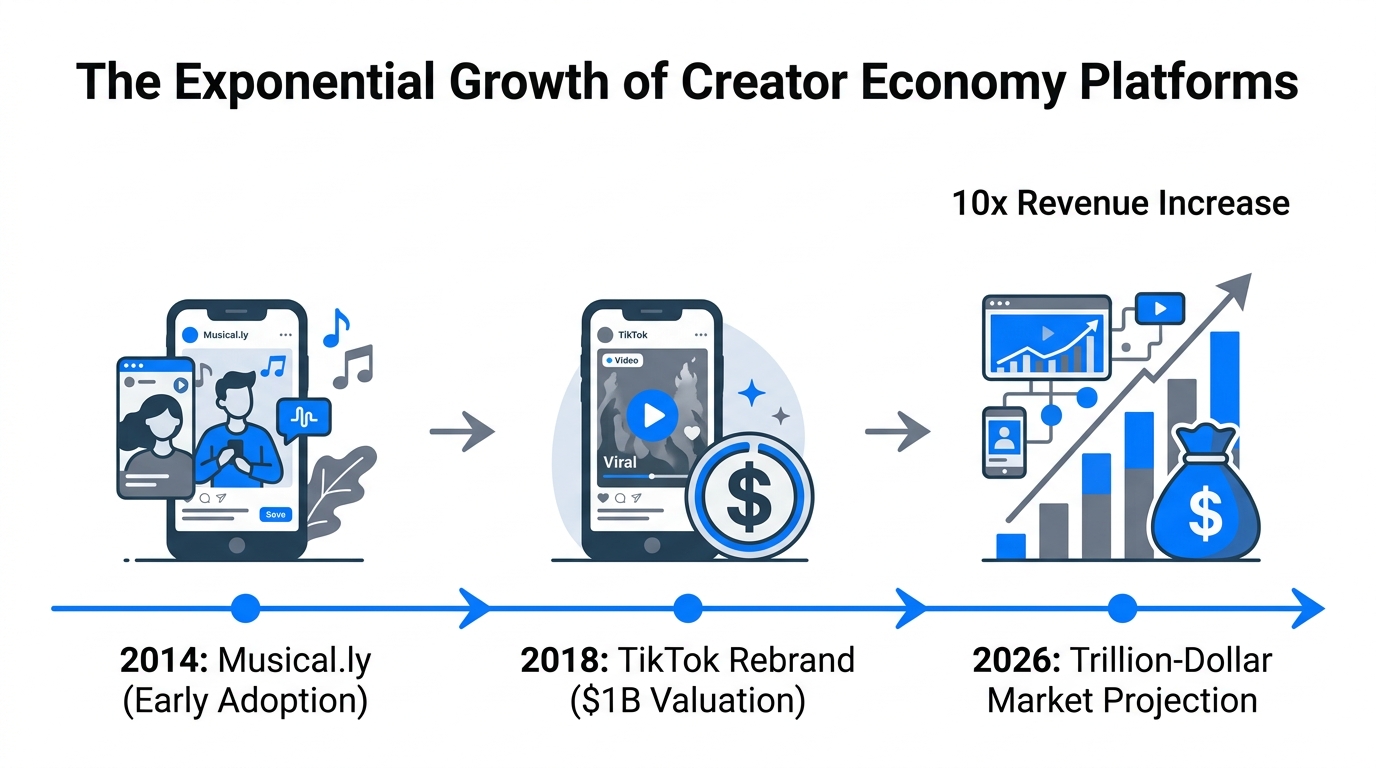
To understand the creator economy 2026, we must look at how professional analysts consistently miss the mark. Consider the venture capital firm Bessemer Venture Partners. When they invested in Shopify in 2010, the company had 10,000 customers and was doing $5 million in revenue. Their 'best-case scenario' memo projected an exit value of $400 million. Today, Shopify handles nearly a trillion dollars in GMV.
They were precise, but they weren't accurate. They sized the market based on how many 'online shops' existed in 2010, rather than realizing that Shopify would create millions of new entrepreneurs. This is the same error marketers make when sizing influencer marketing trends today. They look at the current pool of creators rather than the millions of people currently using AI tools to enter the market.
| Company | Initial 'Expert' Projection | 2026 Reality / Outcome | The Lesson |
|---|---|---|---|
| Shopify | $400 Million Exit | $130B+ Valuation | Infrastructure creates its own demand. |
| Uber | $100B Total Market | Trillion-dollar logistics shift | Convenience expands the category 3x. |
| Musically | "Niche dance app" | TikTok (Global Dominance) | Low-friction creation tools win. |
| Airbnb | "Couchsurfing for niche users" | 1/30th of all US travel spend | Trust-at-scale disrupts incumbents. |
As Bill Gurley noted in his legendary essay 'How to Miss by a Mile,' analysts often fail to realize that a new offering changes the behavior of the consumer. An NYU professor famously argued that Uber wasn't worth $17 billion because the global taxi market was only $100 billion. He failed to see that by being 10x more convenient and 30% cheaper, Uber would make people stop buying cars entirely.
The Anti-Portfolio: Why Traditional Brands Keep Missing Out
11:00Bessemer famously maintains an 'anti-portfolio'—a list of companies they had the chance to invest in but passed on, including Apple, Google, and Airbnb. For brands in 2026, your anti-portfolio is the list of creators and platforms you deemed 'too small' or 'too risky' three years ago.
In the future of social media platforms, the risk of ruin is rarely financial; it's reputational and opportunity-based. Brands like Dominos once thought delivery was just a 'convenience' rather than a game-changer. By the time they realized delivery was the entire business, the landscape had shifted. Similarly, in the creator economy, by the time a distribution channel is 'proven' by the incumbents, the customer acquisition cost (CAC) has already skyrocketed.
"Sizing the market for a disruptor based on the incumbent's market is like sizing the car industry based on how many horses there were in 1910." — Aaron Levie
To avoid this, savvy growth teams are moving away from manual vetting. They use AI-powered discovery engines to find 'Park Avenue real estate' in the creator world—the high-value, high-retention creators who are currently undervalued. Platforms like Stormy AI allow brands to scan millions of profiles across TikTok and YouTube to find these emerging powerhouses before they become too expensive to partner with.
Niche Distraction vs. Nascent Powerhouse: The 2026 Framework
How do you tell the difference between a 'toy' like the early Calm app (which many dismissed as a niche meditation tool) and a genuine shift in emerging distribution channels? In 2026, the signal is utility hidden inside entertainment.
- Frictionless Creation: Does the platform allow a non-pro to create pro-level content? (e.g., using Descript or AI video editors).
- Category Expansion: Does it bring new people into the market who weren't there before?
- Liquidity: Is there a rapid feedback loop between the creator and the audience?
If the answer to these is yes, you are looking at a powerhouse. For instance, the shift toward UGC (user-generated content) for mobile app marketing was once seen as a 'cheap' alternative to high-production ads. Now, it is the gold standard for driving app installs on platforms like Google Ads and Apple Search Ads.
Playbook: A 3-Tier Vetting System for Emerging Platforms
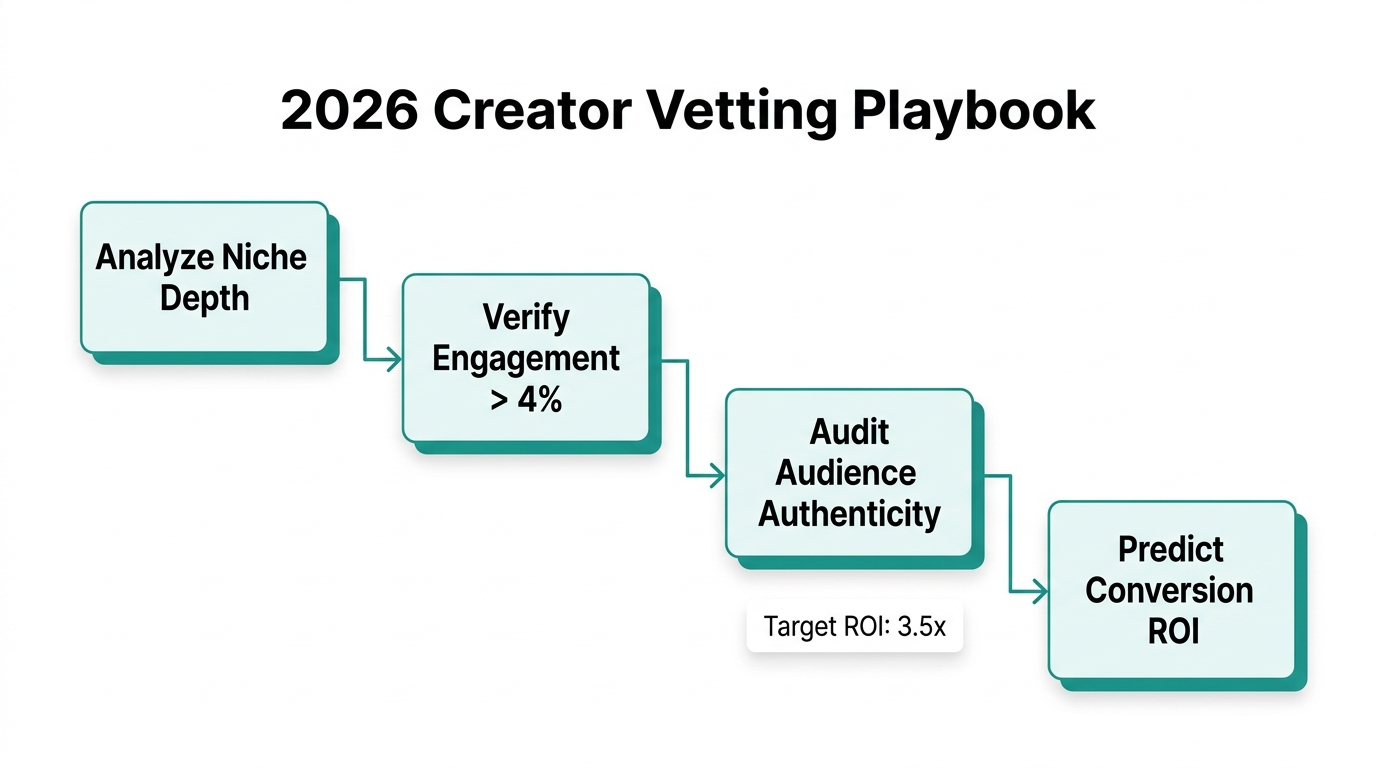
Marketers in 2026 cannot afford to wait for 'certainty.' Certainty is expensive. Instead, use this 3-tier system to test new creator channels without risking ruin.
Step 1: The 'Toy' Test (The $5k Experiment)
Identify a platform or creator niche that 'serious' competitors are ignoring. Allocate a small, 'safe-to-fail' budget. Your goal isn't immediate ROI; it's data and sentiment. Are people engaging in a way that feels 'fundamental'? Use tools like Canva or CapCut to quickly spin up assets for these tests.
Step 2: The Utility Shift (The $50k Scale)
If Step 1 shows high engagement, look for utility. Is this platform solving a problem (like OpenAI solved the 'blank page' problem for writers)? If the 'toy' starts becoming a 'tool,' increase your spend and begin building long-term creator relationships. This is where you move from transactional ads to a Creator CRM approach.
Step 3: The Infrastructure Phase (Full Integration)
Once a channel is proven, move it into your 'Park Avenue' portfolio. This is where you lock in multi-year deals. At this stage, you should be using an automated system like Stormy AI to handle the outreach and management of hundreds of creators simultaneously, ensuring you own the category before the 'cynics' arrive.
"You only need one 'hit' in tech investing to make up for ten 'duds.' The same is now true for creator marketing."
AI, Labor, and the Trillion-Dollar Creator Shift
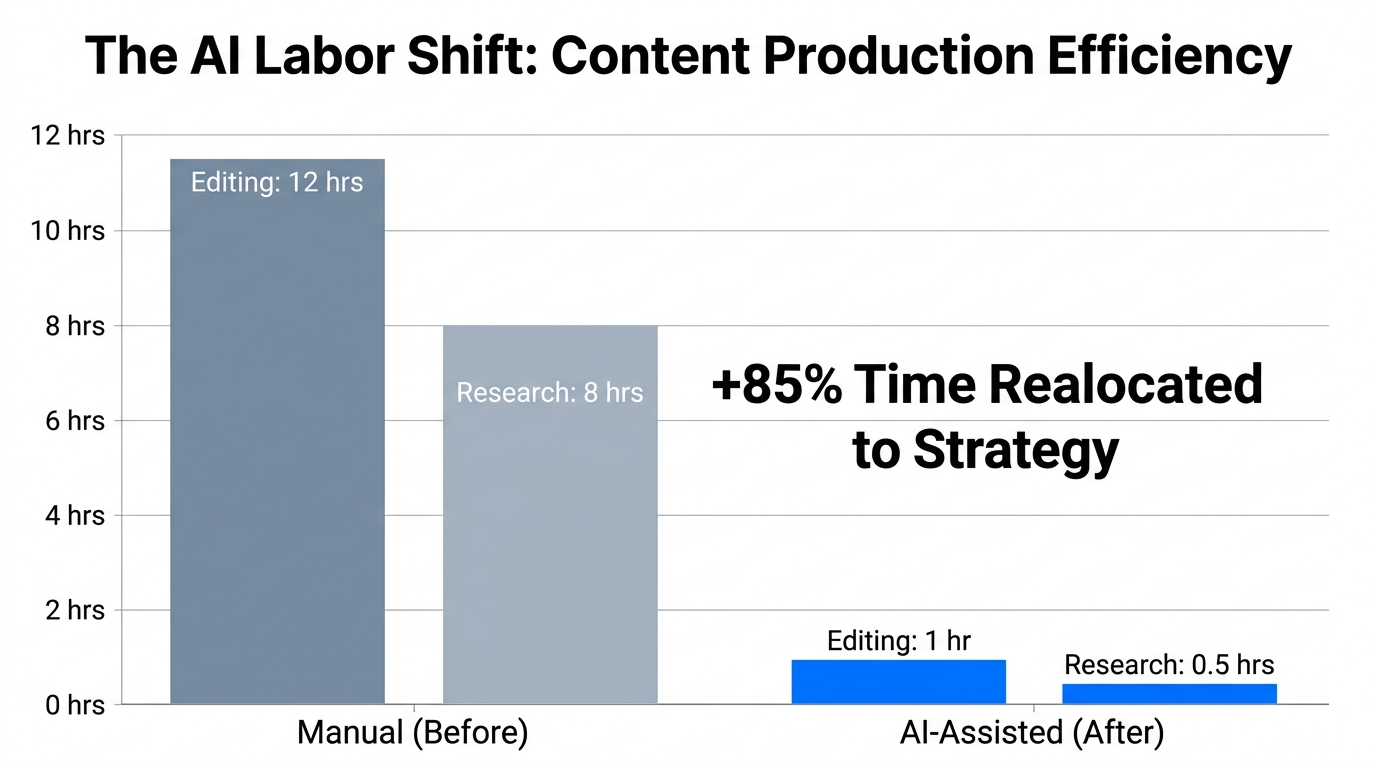
As we look deeper into 2026, the biggest 'underestimated' market isn't just a new social app—it's the replacement of labor with AI-creator services. Just as cloud computing didn't just 'move' software but made the software market 10x larger, AI is making the creator economy 10x larger by lowering the cost of production to near-zero.
We are seeing 'AI agents' that don't just help with writing, but handle the entire influencer marketing workflow—discovery, negotiation, and even post-tracking. According to Goldman Sachs research, this is the 'Park Avenue' real estate of the 2026 marketing stack. Those who view AI as a 'threat' to creators are falling for the same trap as those who thought cell phones would only have 900,000 users. In reality, AI models are the new infrastructure that will allow the next 100 million people to become creators.
Conclusion: Buying the 'Manhattan' of the Future
The lesson from Musically history is clear: don't look for the 'third-best thing' because it's cheaper today. Buy the 'Manhattan real estate' of the digital world. In 2026, that means identifying the platforms and creators that own attention and trust, even if they look like toys to the uninitiated.
Your goal is to avoid ruin while maintaining the courage to be an optimist. The cynics will be right eight times out of ten, and they will feel very smart in the short term. But the optimists—those who saw Shopify at $20M or Uber as a market expander—are the ones who get rich. In the creator economy 2026, the tools to find these opportunities are finally here. Don't leave the next 'briefcase of cash' in the gutter.