By early 2026, the novelty of artificial intelligence in the C-suite has evaporated, replaced by a cold, industrial focus on operational efficiency. The era of "experimenting" with chatbots is over; we have entered the age of Agentic Marketing. For CMOs and founders, the goal is no longer just to generate more content, but to collapse the entire "production layer" of the marketing department. Leading fintech giants like Klarna have already proven the model, reportedly saving $10 million annually by bringing agency-level production entirely in-house using advanced AI workflows. In this new landscape, the most successful marketing teams aren't the largest—they are the leanest, most automated, and most strategically dense units in the company.
The Boring Truth: Automating the Marketing Factory
In 2026, the industry has finally embraced what experts call the "Boring Truth." AI hasn't replaced the visionary spark of a creative director; instead, it has liquidated the marketing factory. According to recent data from the Salesforce State of Marketing report, 64% of marketing tasks currently being automated are administrative or clerical—think resizing images for sixteen different social formats, versioning ad copy for A/B tests, and tagging digital assets. This shift has allowed companies to reclaim thousands of man-hours previously lost to the "middle management" of creative production.
"AI isn't replacing the marketing team; it’s replacing the 'marketing factory.' The boring parts of marketing—the logistics, the resizing, the versioning—those are gone."The global AI in marketing market is projected to reach $45.83 billion by the end of this year, but the real value lies in how these tools are orchestrated. We are moving away from "chatting" with AI to building Agentic Configurations. These are systems where an AI agent monitors real-time triggers—like a competitor’s price drop or a spike in sentiment on Reddit—and automatically triggers a Jasper campaign or updates a HubSpot workflow without human intervention.
Jasper Enterprise Strategy: Scaling Brand Voice Without the Noise
One of the biggest risks in the 2026 AI-first world is the "Sea of Sameness." When every brand uses the same base models, content becomes homogenized and loses its soul. To combat this, elite teams are leveraging the Jasper Enterprise AI Suite to maintain a unified brand DNA across thousands of automated posts. Jasper's modern strategy focuses on content acceleration that mirrors your specific brand voice by ingestion of your "Brand Bible" and historical data.
By utilizing Jasper's knowledge base features, a lean team can ensure that every LinkedIn post, email sequence, and blog article sounds like it was written by the founder. This is critical because, as Seth Godin argues, in a world where content is infinite and free, trust and permission are the only remaining currencies. Jasper allows you to scale the volume without diluting the trust.
| Feature | AI-First Team (2026) | Traditional Agency |
|---|---|---|
| Speed | Minutes | Weeks |
| Cost | Fixed Software Subscription | High Monthly Retainer |
| Scalability | Infinite | Limited by Headcount |
| Best For | Performance marketing, SEO, Social | Brand identity, High-stakes TV ads |
Writer AI for Marketing Teams: The Klarna Effect
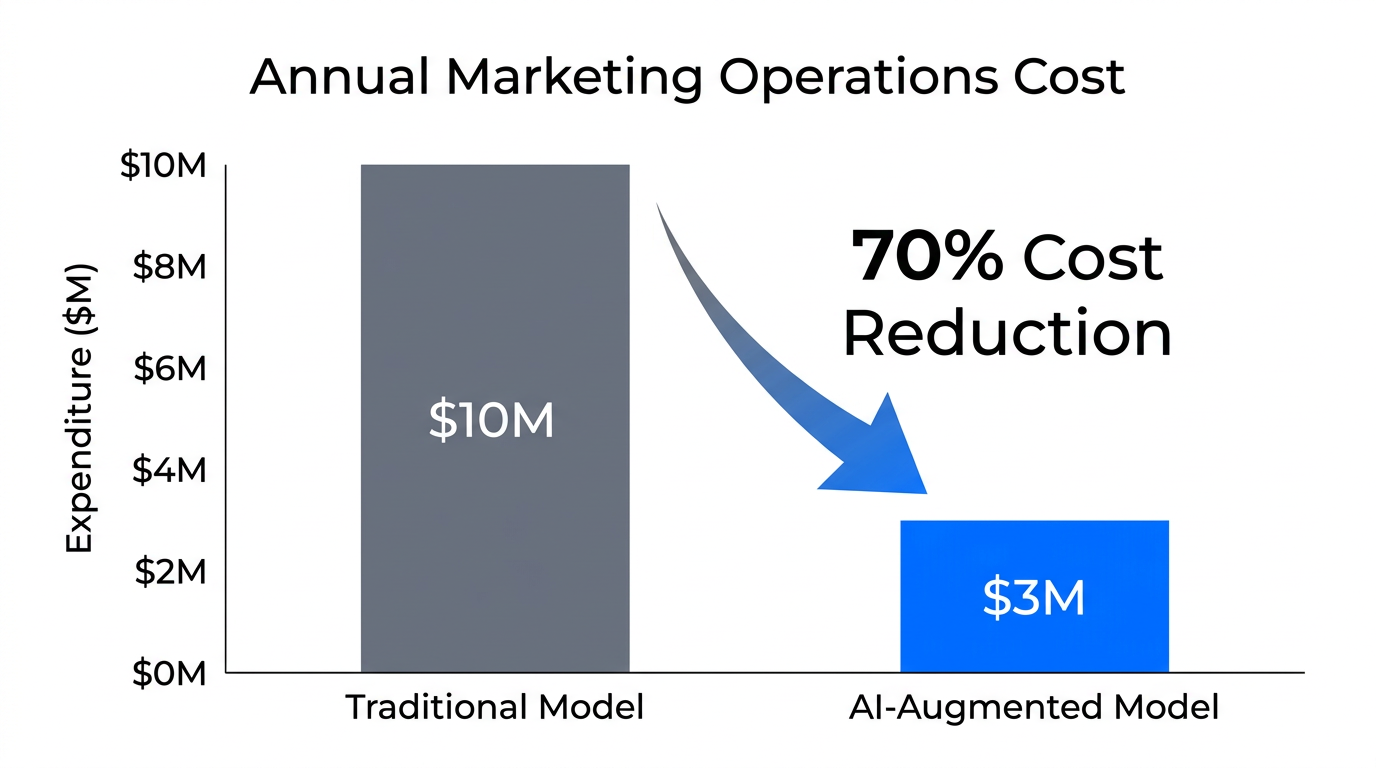
While Jasper handles the creative acceleration, Writer has become the platform of record for enterprises concerned with data security and custom model development. Leading companies are using Writer to build a "Family of Models" trained on their proprietary data. This ensures that no sensitive company information leaks into the public domain, a major concern for fintech and healthcare sectors.
The "Klarna Effect" is the ultimate case study for this transition. By 2026, Klarna's AI assistants have performed the work equivalent to 700 full-time agents. More impressively, they have moved almost all creative production in-house, effectively ending their reliance on expensive external agencies. This shift to a tool like Writer allows for Hyper-Individualization at scale—similar to how Nutella used AI to design 7 million unique jar labels, a feat impossible for human designers alone.
"The 'Boring Truth' of 2026 is that marketing is becoming more like software engineering: you build the system that produces the content, rather than producing the content yourself."Structuring the 3-Person "Full-Stack" Marketing Team
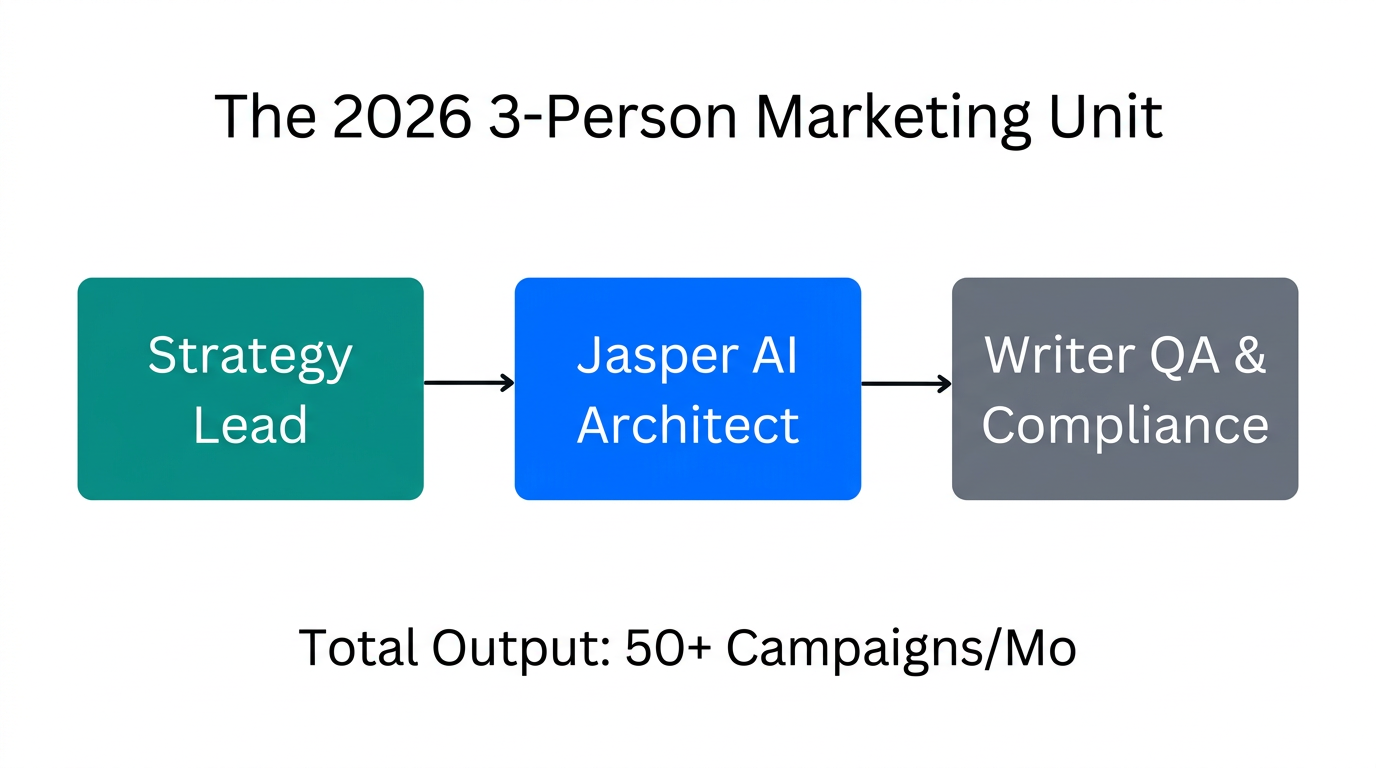
The traditional 10-person marketing department is a relic. In 2026, the high-output department is structured around a 3-person pod that acts as the architect of an AI-powered ecosystem. This lean team typically consists of:
- The Marketing Engineer: Not a copywriter, but an orchestrator who chains APIs together using tools like Zapier or Gumloop to automate workflows.
- The Creative Architect: Uses Midjourney and Adobe Firefly to set the visual direction and brand standards that the AI agents must follow.
- The Growth Strategist: Focuses on Answer Engine Optimization (AEO), ensuring the brand is cited by AI bots like Perplexity and Gemini rather than just ranking on a search page.
To manage this high-velocity output, these teams rely on integrated platforms. For instance, while AI handles the bulk of content production, sourcing the right human faces for UGC (User-Generated Content) is still vital for authenticity. Platforms like Stormy AI allow these lean teams to instantly discover and vet creators using natural-language AI search, closing the loop between automated production and human-centric influence.
Utility Pricing: The Shift to "Per Task" Models
A significant shift in the 2026 SaaS landscape is the death of the "Per Seat" pricing model. As marketing teams shrink in headcount but explode in output, paying per user no longer makes sense for software vendors. We are seeing a move toward utility pricing or "Per Task" models. For example, Eesel AI has pioneered charging a flat fee for a specific number of blog posts or AI-generated citations.
This shift aligns marketing spend directly with ROI. If your customer acquisition cost (CAC) is high, you can scale back your task-based AI spending in real-time. Organizations using these agentic models have reported a 32% reduction in CAC and a 41% increase in revenue due to the ability to optimize spend at the task level rather than the seat level.
The 2026 Marketing Playbook: Step-by-Step
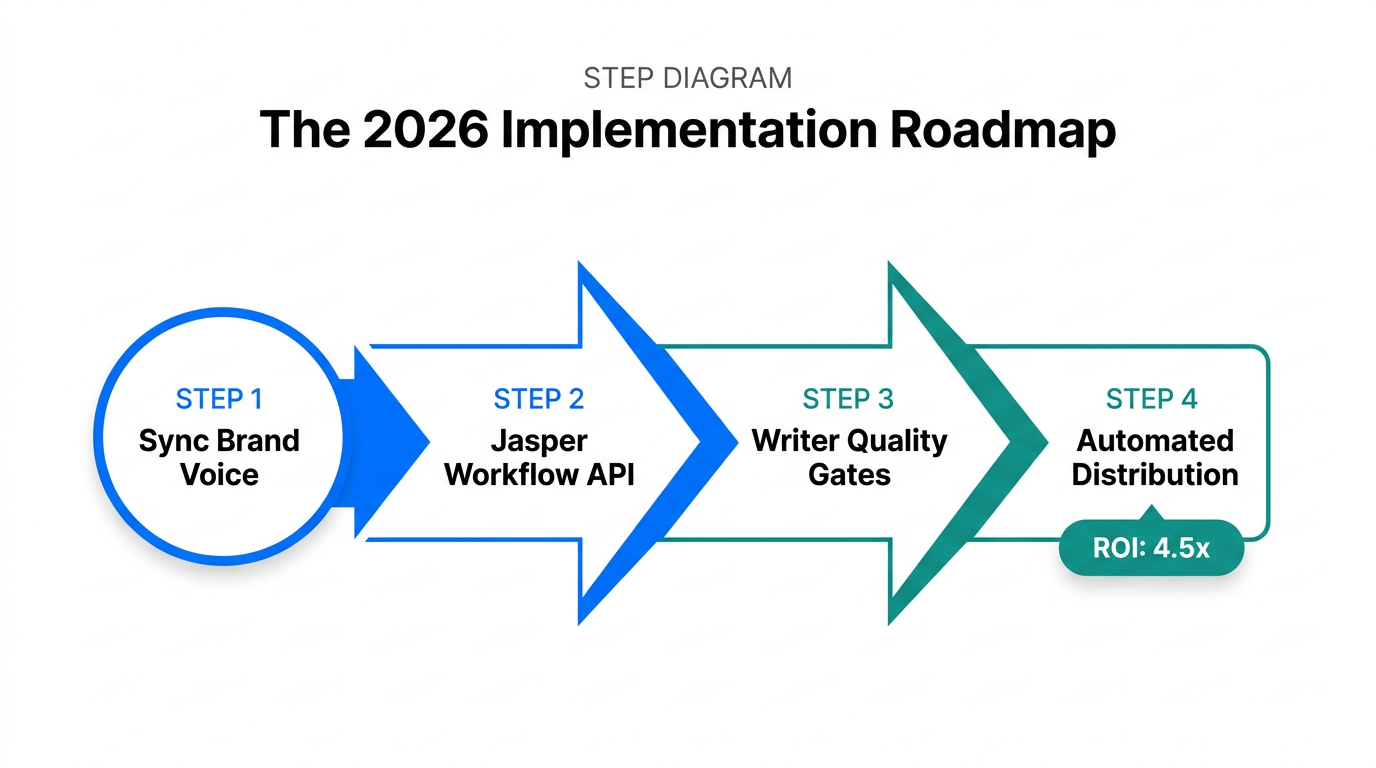
If you are looking to collapse your production layer this year, follow this three-step playbook:
Step 1: Audit the "Boring" Tasks
List every repeatable task that takes more than two hours per week. This includes turning webinars into social snippets or resizing ad creative. These are your first candidates for automation using the Google Workspace CLI or HubSpot Breeze.
Step 2: Build Your Prompt Bible
Upload your brand guidelines, past successful campaigns, and customer personas into a central Knowledge Base. Whether you use Jasper, Writer, or a custom-tuned Claude instance, this "Brand DNA" is what prevents your AI from producing generic noise.
Step 3: Orchestrate with Agents
Move beyond manual prompting. Use an agent orchestrator to monitor signals—such as a specific keyword trending on TikTok—and automatically generate a brief, find relevant creators on Stormy AI, and draft the initial outreach emails.
"The remaining 5% of marketing—the vision—is now 100x more valuable because the other 95% is effectively free."Conclusion: The Visionary Advantage
In 2026, the goal of the lean marketing team isn't to work harder; it's to architect better systems. By leveraging the enterprise capabilities of Jasper and Writer, companies are successfully removing the friction of production. However, as Sam Altman and other leaders have noted, while AI can handle the production, the human vision remains the only true differentiator. The winners this year will be those who use AI to handle the volume, while they focus their human capital on building deeper relationships, fostering community, and crafting the "weird" creative ideas that an LLM would never think of.