In 2026, the traditional marketing agency model is dead. The days of charging high retainers for manual A/B tests that take weeks to implement and months to analyze are over. Today, the most successful entrepreneurs are pivoting toward a high-margin “Optimization as a Service” model. The catalyst? Auto Research. Originally pioneered by AI visionary Andrej Karpathy, this autonomous experimentation framework is transforming how we think about agency growth strategies and client results.
Imagine a performance marketing business model where your team doesn’t sleep, doesn’t make manual errors, and runs 100x more experiments than your closest competitor. This isn't a futurist fantasy; it's the current standard for any AI marketing agency in 2026. By deploying “agent swarms” that plan, execute, and refine marketing strategies in real-time, agencies are delivering unprecedented KPI lifts that manual shops simply cannot match.
"Auto Research is like having a super nerd robot intern that runs science experiments on your business goals all night while you sleep, keeping only the winners."The '100x Test' Value Proposition
Discover the unique competitive advantage of running hundreds of experiments compared to traditional agencies.
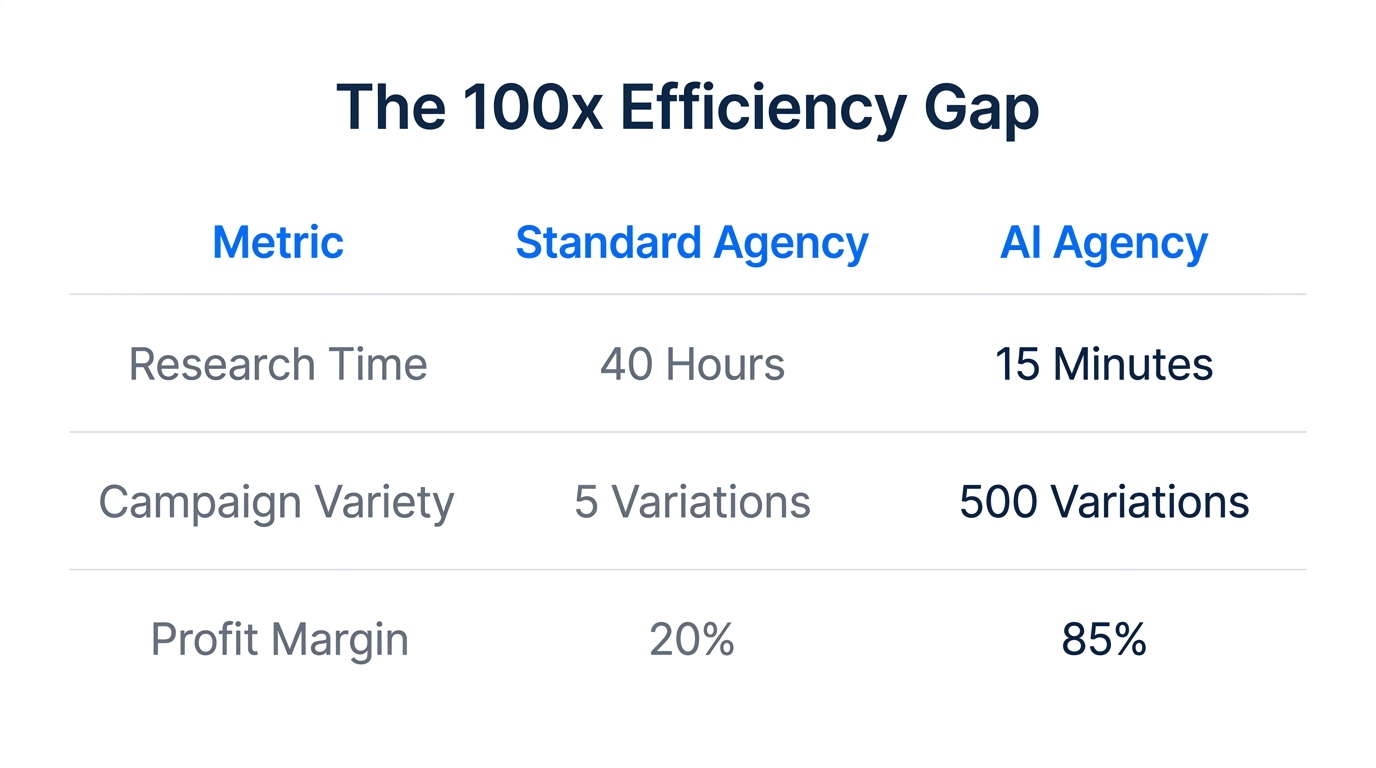
The core pitch of a 2026 performance agency is no longer about “creativity” or “brand voice” in the abstract. It’s about volume and velocity. When you sit down with a client, you aren’t selling them on a single campaign; you are selling them on the 100x Test. You are promising that your agency will run hundreds of autonomous experiments on their pricing, landing pages, and ad creatives while traditional agencies are still debating the color of a CTA button.
This volume is made possible by the “Karpathy Loop.” By giving an AI agent a clear goal—such as lowering CAC (Customer Acquisition Cost) or raising ROAS (Return on Ad Spend)—the agent edits the underlying code or settings, runs a short training/testing cycle on a GPU, reads the results, and iterates. This means by the time your client wakes up, you’ve already discarded 95 failing ideas and identified five winners that are ready to scale.
Structuring Performance-Based Retainers and Bonus Incentives
Discover how to combine monthly retainers with performance bonuses for maximum agency revenue.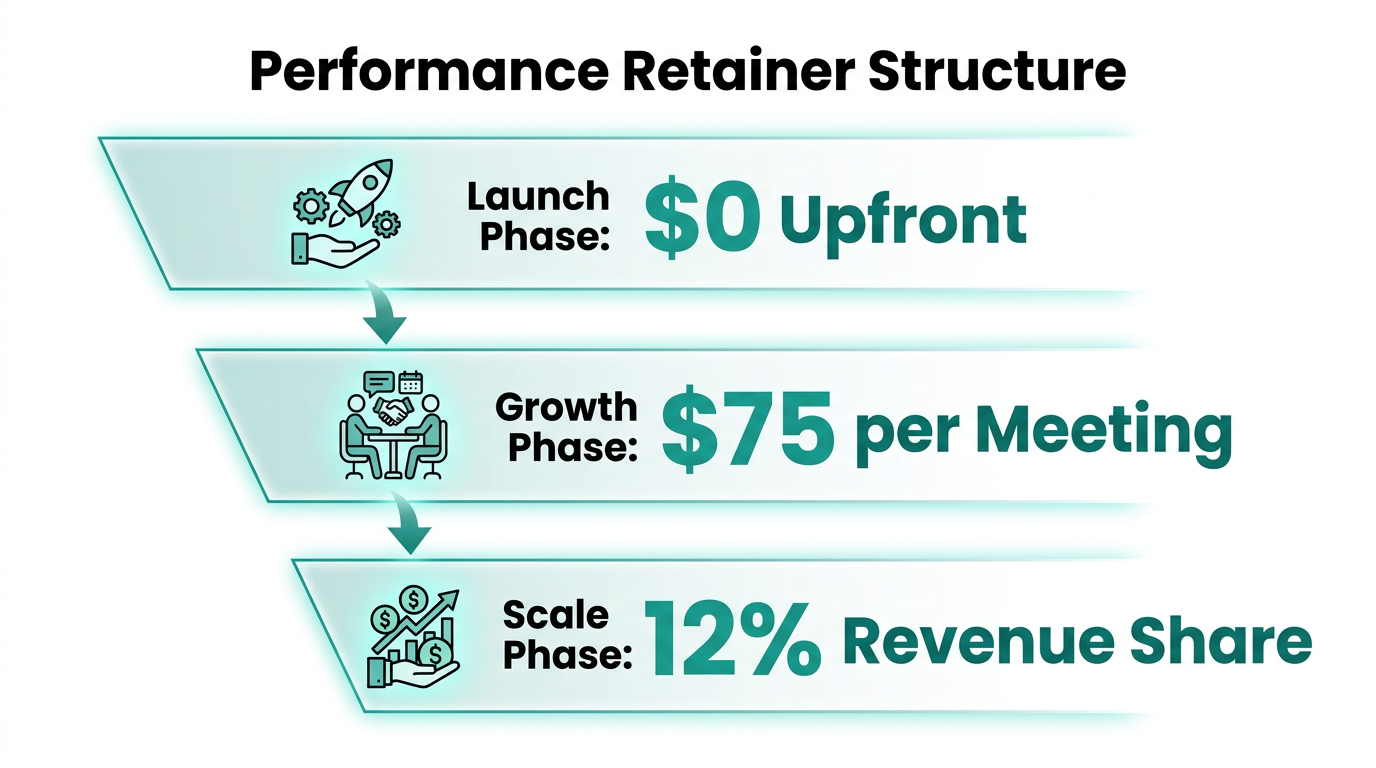
Because Auto Research for business delivers measurable, incremental gains, your pricing model should reflect that value. Moving away from flat fees toward performance-based retainers allows you to capture the massive upside generated by your agent swarms. In 2026, the most profitable agencies use a tiered structure:
- Base Infrastructure Fee: A monthly retainer (e.g., $5,000 - $10,000) that covers the cost of the “Optimization Lab” architecture, including GPU compute time and agent management.
- Experimentation Credits: Charging for the volume of tests run. More tests equal a higher likelihood of finding a “unicorn” winner.
- The KPI Lift Bonus: A percentage of the revenue growth or cost savings generated by the AI’s optimizations. If your agent swarm lowers lead costs by 40%, you take a “success fee” based on those savings.
| Feature | Traditional Agency (Manual) | Auto Research Agency (AI-Powered) |
|---|---|---|
| Test Volume | 2-4 per month | 100+ per week |
| Optimization Cycle | Bi-weekly / Monthly | Continuous / Real-time |
| Staffing Needs | Account Managers & Designers | Agent Architects & Prompt Engineers |
| Pricing Model | Flat Hourly/Retainer | Retainer + Performance Bonus |
Clients are happy to pay these bonuses because the results are documented through transparent dashboards. For instance, when managing creator-led campaigns, using tools like Stormy AI allows agencies to discover the right influencers instantly, while an Auto Research loop can then iterate on the specific outreach scripts and offer structures to maximize response rates. The combination of rapid discovery and autonomous optimization is the ultimate marketing automation service.
"The future of agency revenue isn't billable hours; it's the delta between the current baseline and the AI-optimized peak."Developing a 'Niche Agent in a Box'
Learn how to build specialized AI agents focused on solving specific niche pain points.One of the most scalable agency growth strategies this year is the “Niche Agent in a Box.” Instead of being a generalist, you package specific Auto Research loops tuned for one painful vertical. This creates a “moat” around your business because your agents become highly specialized in the nuances of that industry.
Step 1: Identify the High-Value Pain Point
Look for industries where small changes in conversion or efficiency equal millions of dollars. Real estate, SaaS pricing, healthcare lead qualification, and e-commerce conversion rate optimization (CRO) are prime targets. For example, an Amazon Listing Experimenter agent can rotate headlines, images, and bullet points 24/7 to find the combination that maximizes the “Buy Box” win rate.
Step 2: Build the Specialized Loop
Using Claude or similar LLMs, you can design a markdown-based program that defines the rules of the niche. If you are in the SaaS vertical, your agent might be tasked with testing different “freemium” vs. “free trial” durations across different geolocations, reading the data from Stripe or Mixpanel to decide the winner.
Step 3: Productize the Output
Charge a monthly subscription for the “Always-On Optimization.” Your client doesn’t need to know how the GPU cluster works; they just need to see the daily report in their Slack channel showing which new landing page version is currently beating the “control” and by what percentage.
Technical Implementation: The 2026 Agency Stack
A step-by-step breakdown of the hardware and software needed to run Auto Research.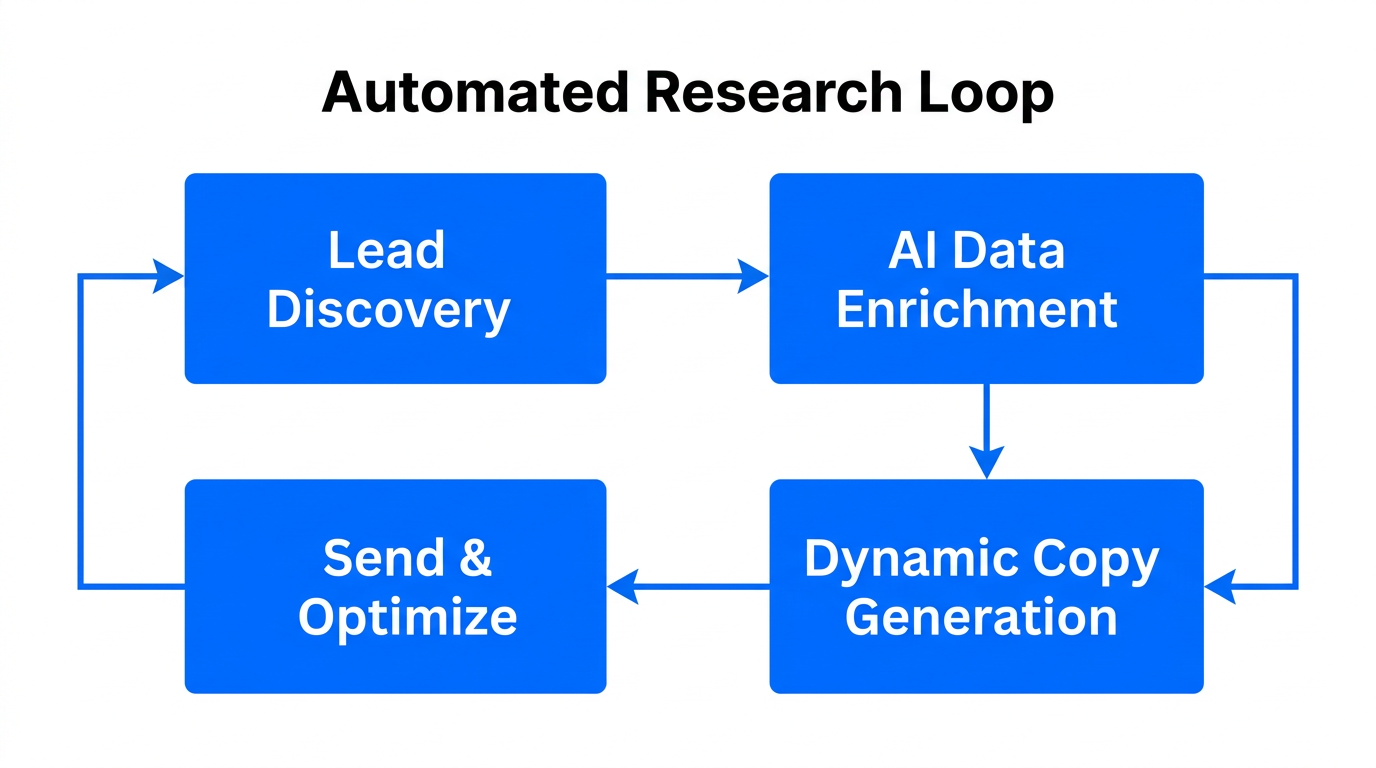
To run an “Optimization Lab,” you need more than just a laptop. As noted by industry leaders, you need an NVIDIA GPU or access to cloud-based compute. If you aren't running your own NVIDIA H100 clusters, you should be using services like Lambda Labs, RunPod, or Google Colab to host your research agents.
The workflow for setting up your first Auto Research loop typically looks like this:
- Define the Objective: Clearly state the task (e.g., "Increase click-through rate on TikTok Ads creatives").
- Provision the Agent: Use a tool like AgentHub—which Karpathy describes as a “GitHub for agents”—to coordinate a swarm of AI workers on the same task.
- The Training Loop: The agent edits the ad copy, generates new visual variants via Canva or Figma APIs, and pushes them to Meta Ads Manager.
- Metric Analysis: The agent reads the performance data. If a variant fails, it logs the attempt and discards the configuration. If it wins, it becomes the new “control.”
"We are moving toward a 'One-Man Billion Dollar Company' era where the entrepreneur manages the agents, and the agents manage the labor."Case Study: Transitioning from Manual Agency to 'Optimization Lab'
Consider the transformation of “GrowthFlow,” a mid-sized marketing agency that struggled with high churn in 2025. Their team of 15 spent 80% of their time on manual reporting and basic A/B testing. By early 2026, they transitioned to an Optimization Lab architecture.
The Before: GrowthFlow could manage 10 clients comfortably. Each client received one new landing page variant per month. Profit margins were squeezed at 20% due to high headcount costs.
The After: They implemented an Auto Research loop for marketing automation services. They reduced their human team to 4 “Agent Architects” and scaled to 50 clients. Each client now receives daily optimizations. By using Stormy AI for creator sourcing, they automated the hardest part of UGC (User Generated Content) campaigns, allowing their agents to focus solely on testing the output of those creators. Profit margins soared to 75%.
Conclusion: The Future of Optimization
Launching a performance agency in 2026 requires a fundamental shift in mindset. You are no longer a service provider; you are an experimentation architect. By leveraging Auto Research, you can offer a value proposition that is mathematically superior to any human-led team.
Whether you are building a “Niche Agent in a Box” for healthcare or a high-end “Conversion Lab” for Shopify stores, the blueprint is the same: define the goal, let the agents rip, and charge for the lift. The “fog of opportunity” is thick right now, but for those who master these autonomous loops, the rewards are generational. Start tinkering with Auto Research today, and build the agency that will dominate tomorrow.