In 2026, the App Store is more crowded than ever, yet the fundamental rule of organic growth remains unchanged: if you can't be found, you don't exist. Recent data from Apple Developer relations shows that 65% to 70% of all app downloads still originate directly from App Store searches. However, most developers make the fatal mistake of chasing "head terms"—ultra-competitive keywords like "fitness" or "photo editor"—where the app store keyword difficulty is so high that new entrants are buried on page 50. To win in this climate, growth marketers are turning to the Keyword Opportunity Benchmark (KOB), a tactical formula designed to identify the "Goldilocks" keywords: those with enough volume to drive traffic, but low enough competition to actually rank.
The Foundation: Decoding Search Popularity in 2026
Before we dive into the KOB formula, we must understand the data provided by Apple. Unlike web SEO, Apple does not share exact search counts. Instead, they provide a Search Popularity (SP) score on a scale of 5 to 100. According to research from AppRadar, anything below an SP of 20 is virtually invisible, likely receiving fewer than 10 searches per day.
To accurately gauge volume, marketers use the Apple Search Ads dashboard, which uses a 1-to-5 blue dot indicator to show keyword popularity. By the time we reach 2026, AI-driven discovery has caused massive shifts; for instance, searches for "AI headshot generator" or "AI productivity agent" (driven by tools like ChatGPT) have seen volume spikes of over 300% compared to previous years. Relying on outdated data is a recipe for stagnation.
"In ASO, volume is vanity, but difficulty is reality. Chasing a score of 80 volume with 90 difficulty is a guaranteed way to burn your marketing budget for zero organic returns."
Step-by-Step Guide to Calculating the KOB Ratio
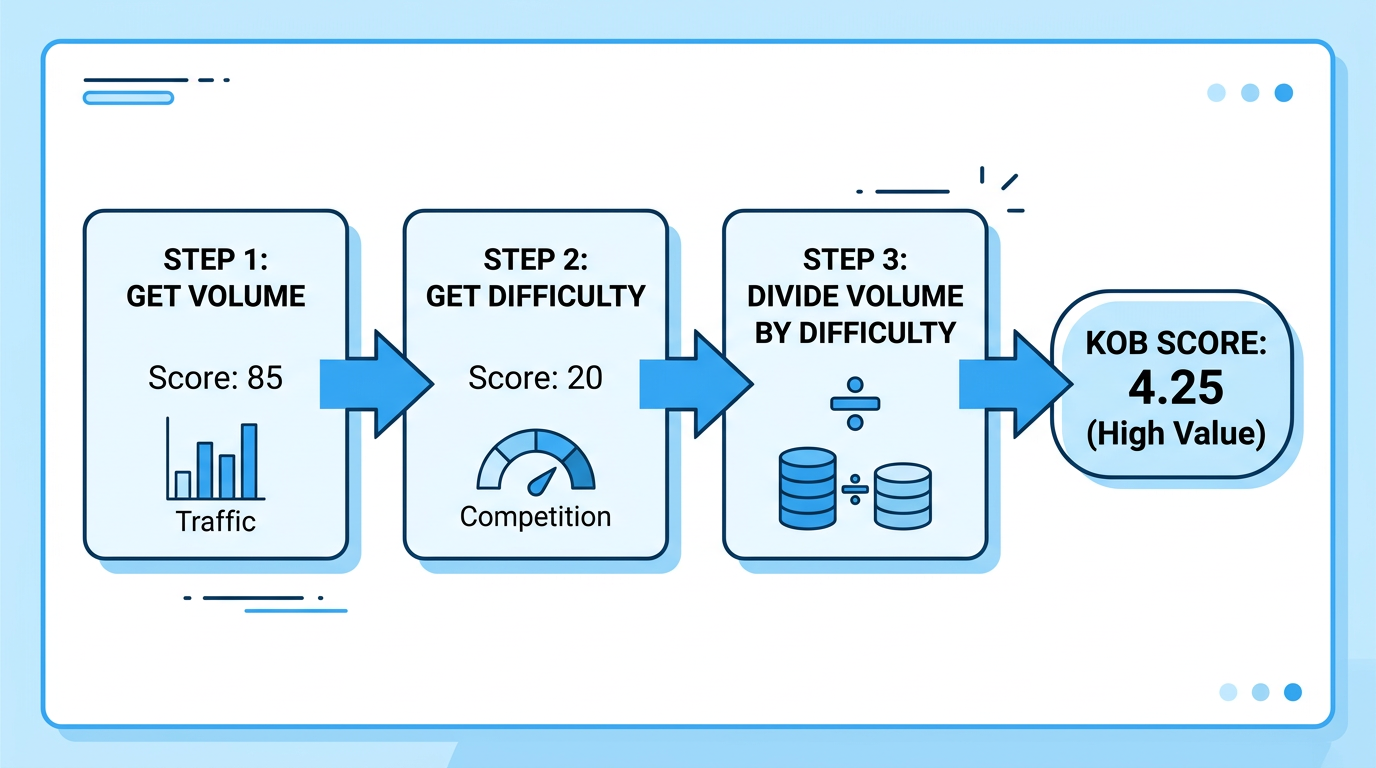
The Keyword Opportunity Benchmark (KOB) is the north star for App Store Optimization. It allows you to mathematically rank your keyword ideas based on their "winnability." The goal is to find terms where the ratio of volume to difficulty is skewed in your favor.
The KOB Formula
To calculate your KOB score, use this simple equation:
KOB Score = (Search Volume / Keyword Difficulty) x 10
When evaluating keywords through tools like AppTweak or Sensor Tower, you should aim for the following benchmarks:
| Keyword Type | Volume (SP) | Difficulty | KOB Recommendation |
|---|---|---|---|
| Head Term | 75+ | 85+ | Avoid (Unless you are a Top 10 Global App) |
| The "Sweet Spot" | 40-60 | < 45 | Primary Target - High ROI potential |
| Initial Authority | 25-40 | < 30 | Secondary Target - Great for new apps |
| Long-Tail | 20-30 | < 20 | Niche Target - High conversion potential |
By prioritizing keywords with a Volume > 30 and Difficulty < 40, you ensure that your ranking acquisition efforts aren't wasted on terms dominated by giants like TikTok or Instagram, who capture nearly 50% of top-volume branded searches.
Competitor Keyword Gap Analysis: Stealing Traffic Strategically
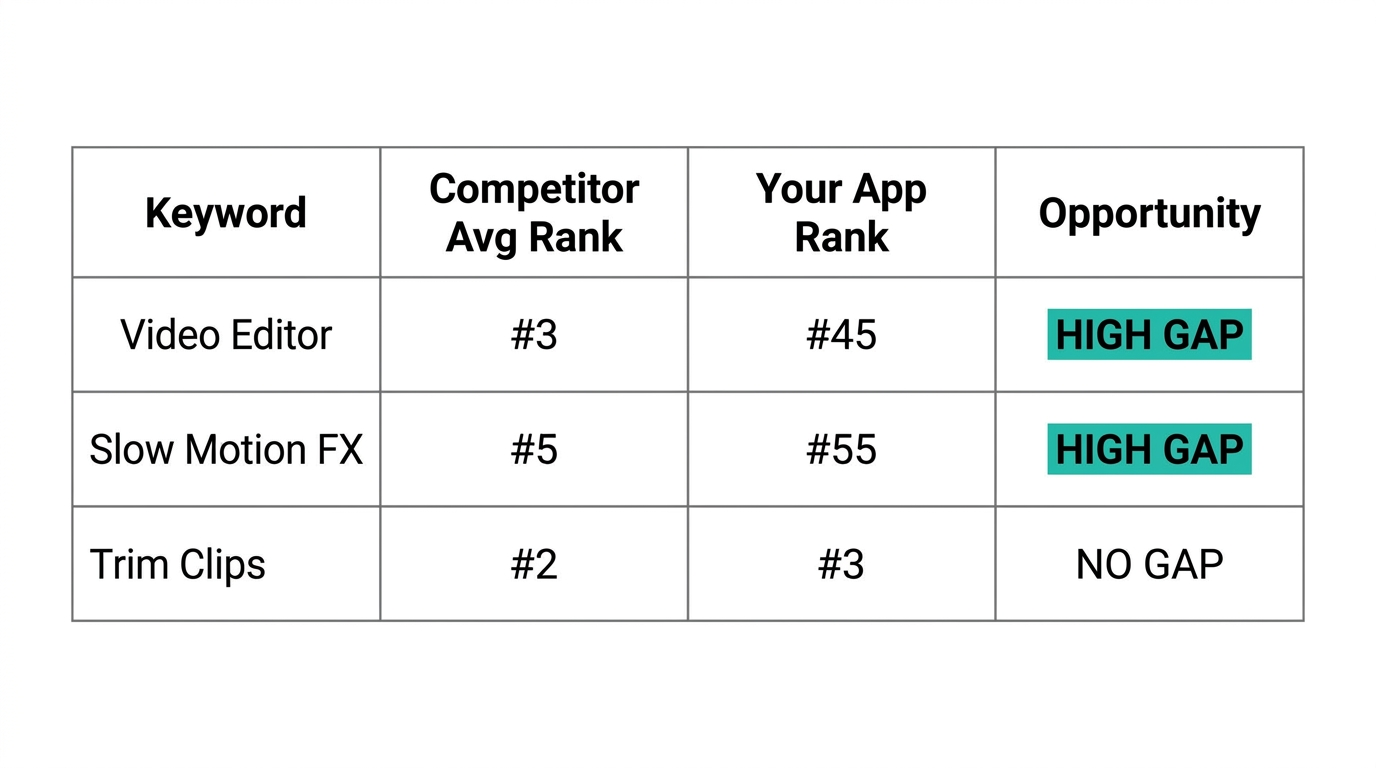
You don't always need to find new keywords; often, your competitors have already done the hard work for you. A competitor keyword gap analysis involves identifying keywords where your rivals are ranking in positions 1-10, but your app is either unranked or buried.
Using enterprise intelligence tools, you can map out the "keyword share of voice" in your category. Look for "vulnerable" competitors—apps that rank well but have declining ratings or haven't updated their metadata in months. If they are ranking for a long tail app keyword with high intent, you can likely out-optimize them by creating a more relevant landing page and updating your 100-character keyword field. For e-commerce apps, ensuring your Shopify integration mentions specific niche products in the metadata can capture this intent.
Remember the 100-character rule for iOS: never repeat keywords used in your Title or Subtitle. Apple’s algorithm automatically combines these fields. Repeating "fitness" in your title and your keyword field is a waste of precious space that could be used for 3-4 additional niche terms discovered during your gap analysis.
Long-Tail Expansion: Capturing High-Intent Users
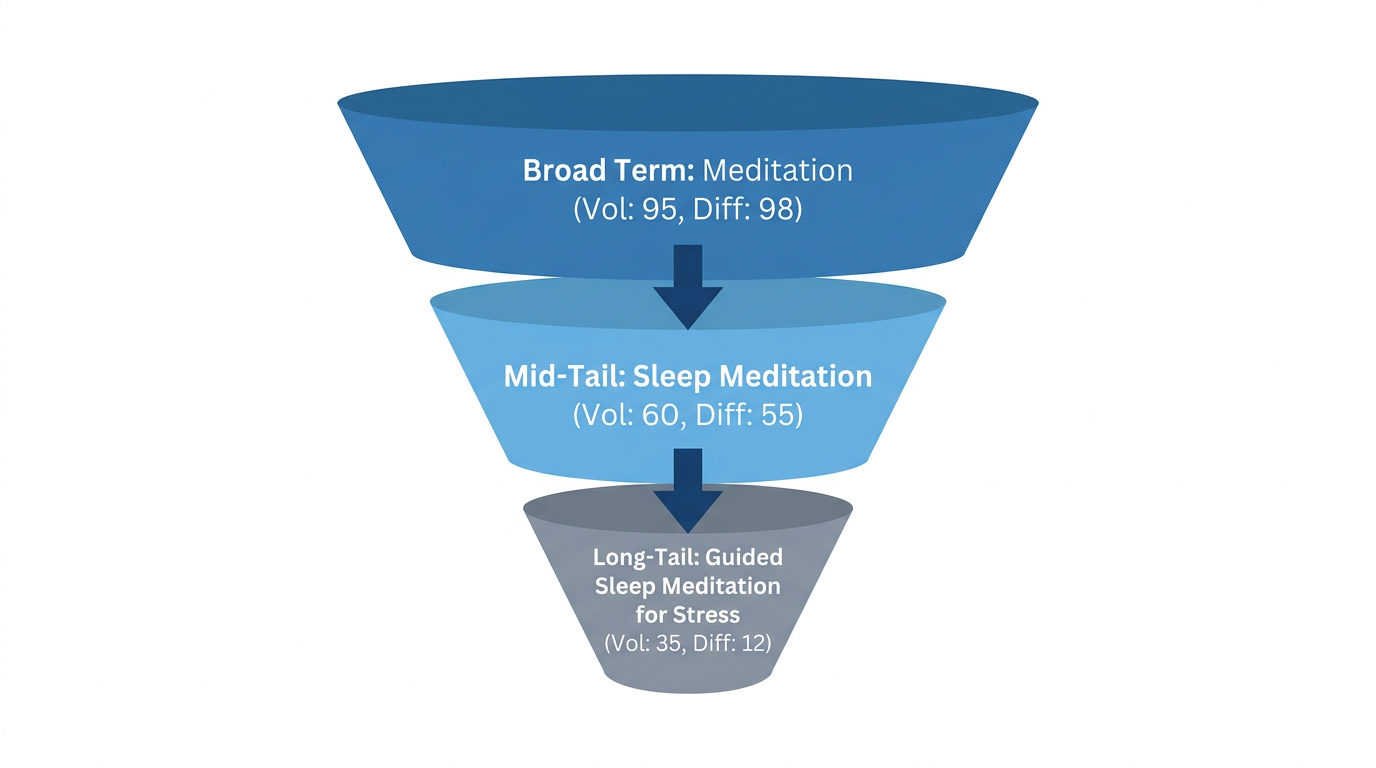
As the App Store matures in 2026, user search behavior has become more specific. Instead of searching for "Money," users search for "budget tracker for freelance designers." These are long tail app keywords. While their individual volume is lower, their conversion rate is significantly higher because the user's intent is crystal clear.
"Generic category terms drive discoverability, but long-tail phrases drive the downloads that actually stick. It's the difference between a window shopper and someone holding a credit card."
A classic case study is FitnessPro. In their early stages, they struggled to rank for "Fitness" (SP 85). By shifting their focus to seasonal and high-intent long-tail phrases like "summer body workout 2026" and "home bodyweight workout for beginners," they grew from 50k to 1.2M users in under a year. They didn't win by being the biggest; they won by being the most relevant for winnable terms.
Setting Up a Seasonal Metadata Update Cycle
ASO is not a "set-it-and-forget-it" strategy. Top-performing apps in 2026 update their metadata 2–4 times per year to adapt to seasonal shifts. A keyword that has an SP of 60 in January (e.g., "tax tracker") might drop to an SP of 10 by July. Conversely, "travel planner" volume peaks during summer months.
Furthermore, Apple has moved toward Semantic Indexing. Their algorithm now understands the relationship between words. This means your Localization 2.0 strategy must go beyond simple translation. You need to research regional search intent and culturally specific slang. For example, a "running app" in the US might be a "jogging tracker" in another region. Use resources like Business of Apps to track these macro-trends and ensure your metadata remains fresh.
The 2026 Edge: Connecting ASO with UGC
While technical ASO provides the framework, User-Generated Content (UGC) provides the fuel. In 2026, the most successful apps don't just rely on search; they create a loop where viral UGC on social media drives specific branded and generic searches on the App Store. When a creator on TikTok showcases a specific feature of your app, that feature's name often becomes a trending search term overnight.
This is where an all-in-one AI platform like Stormy AI becomes invaluable. By using Stormy's AI search engine to find creators across platforms like YouTube and LinkedIn, you can identify the exact phrases they use to describe your app's value. You can then feed those phrases back into your Keyword Opportunity Benchmark analysis to see if they are winnable. This synergy between influencer marketing and ASO is the ultimate growth hack for 2026.
Your ASO Action Plan
To dominate the App Store in 2026, stop guessing and start calculating. Follow this playbook to ensure your app gets the visibility it deserves:
- Audit your current keywords: Use the KOB formula to see if you are wasting effort on high-difficulty head terms.
- Identify the Gaps: Perform a competitor keyword gap analysis to find rank 1-10 keywords you can "steal."
- Expand into Long-Tail: Prioritize high-intent phrases that convert at a higher rate than generic terms.
- Update Seasonally: Refresh your metadata 2-4 times a year based on Search Popularity shifts.
- Leverage Social Trends: Use platforms like Stormy AI to discover what creators are saying and turn those insights into high-volume keywords.
By focusing on winnable keywords rather than just popular ones, you'll build a sustainable organic growth engine that outlasts any algorithm update.