In the world of high-growth entrepreneurship, the difference between a moderate success and a culture-changing behemoth rarely comes down to effort alone. It comes down to timing. We often celebrate founders for their vision, but that vision is useless without a market inflection point—a fundamental shift in the environment that turns the impossible into the inevitable. Whether it is the sudden availability of GPS in every pocket or a regulatory door swinging open in the middle of a global crisis, these inflections are the hidden scaffolding of every billion-dollar success story. This article serves as your business growth strategy playbook for identifying these shifts before the rest of the world catches on.
Defining the Inflection Framework

An inflection point is more than just a trend; it is a catalyst that changes the trajectory of an entire industry. According to legendary investors like Mike Maples Jr., spotting these moments requires looking beyond the immediate noise of the market. Most founders build for the world as it exists today, but the most successful tech trend analysis focuses on how the world is about to change. When you correctly identify an inflection, you aren't just competing; you are riding a wave of external forces that accelerate your growth far beyond what your marketing budget could ever achieve.
Identifying market opportunities starts with understanding that inflections are rarely internal to a company. They are external shocks—technological, regulatory, or cultural—that create a vacuum. When platforms like Stormy AI help brands find UGC creators through AI-powered search and discovery, they are tapping into a broader cultural shift where authenticity and person-to-person recommendation carry more weight than traditional corporate advertising. This is an example of a social and technological inflection converging to create a new category of marketing.
The 5 Pillars of Market Inflections

To master identifying market opportunities, you must look at the world through five distinct lenses. Most massive shifts are triggered by one or more of these pillars moving simultaneously:
- Technological Inflections: A new capability becomes possible or affordable. The rise of OpenAI and Large Language Models (LLMs) is the most recent and powerful example, enabling software to perform tasks previously reserved for human cognition.
- Regulatory Inflections: Laws change, suddenly creating or destroying entire industries. The shift in telemedicine rules during the pandemic allowed companies like BetterHelp to scale rapidly by removing the geographic barriers between patients and therapists.
- Cultural Inflections: Collective beliefs or behaviors shift. The transition from physical ownership to the "access economy" was a cultural prerequisite for the success of SaaS and sharing platforms.
- Economic Inflections: Changes in the cost of capital, labor, or resources. Significant shifts in interest rates or the sudden availability of massive computing power at low costs can redefine what business models are viable.
- Social Inflections: Broad societal movements that change consumer expectations. Movements toward sustainability or privacy often force legacy companies to pivot while creating space for new, agile competitors.
Case Studies: The Uber and BetterHelp Effect
Why did Uber succeed when previous attempts at ride-sharing failed? It wasn't just a better app; it was a technological inflection. The mass adoption of smartphones equipped with precise GPS was the catalyst. Before 2008, you couldn't reliably see where a driver was in real-time. Once GPS became a standard feature, the trust barrier for getting into a stranger’s car vanished. Uber didn't create the technology; they were the first to realize that the technology had reached an inflection point that made their business model possible.
Similarly, the telemedicine industry had been stagnant for a decade due to strict state-by-state licensing and insurance reimbursement rules. When the COVID-19 pandemic hit, a regulatory inflection occurred. Governments were forced to relax telehealth HIPAA rules overnight to maintain healthcare access. This wasn't a minor change; it was a structural shift that allowed companies to treat patients across state lines and receive insurance payouts, fundamentally altering the economics of the industry. This is the essence of a business growth strategy: finding the crack in the wall created by external forces and driving through it.
Demis Hassabis and the "Last Invention"
Perhaps no one understands the power of a technological vector better than Demis Hassabis, the co-founder of Google DeepMind. Hassabis, a child chess prodigy and game developer, has spent his life obsessed with the ultimate inflection: Artificial General Intelligence (AGI). He famously told Elon Musk that he was working on the "last invention" humans would ever need to make, because once a machine can learn and think better than humans, it will handle all subsequent inventions at a pace we cannot imagine.
Hassabis didn't just wait for the future of tech industries to arrive; he built the framework for it using games. By teaching computers to master Atari, Chess, and eventually the incredibly complex game of Go, he proved that AI could do more than just follow rules—it could develop original strategies. When Stormy AI uses AI to analyze creator performance and vet profiles for fraud, it is utilizing a descendant of this same logic: using vast datasets to predict success where humans see only noise.
Move 37: The Moment AI Became Creative
The history of AI changed forever during a match between DeepMind's AlphaGo and Lee Sedol, one of the world's greatest Go players. In "Move 37," the computer made a move that confused every human expert in the room. They initially thought it was a mistake. However, it turned out to be a brilliant, novel strategy that no human would have ever conceived. This was the moment AI shifted from pattern matching to creative problem-solving.
This creative breakthrough is a major indicator for anyone performing tech trend analysis. It signals that we are moving out of the "copycat" era of technology and into an era of generative discovery. For marketers, this means AI is no longer just a tool for automation; it is a tool for finding the "Move 37" in their campaigns. When brands use Stormy AI to handle personalized outreach, they are leveraging AI agents to scale creative novelty in ways that manual teams never could. Stormy AI helps brands identify high-potential partners and automate the relationship-building process while the team focuses on strategy.
The Next Vector: Computational Biology
If you are looking for the next billion-dollar market inflection point, look no further than computational biology. For decades, biology was a "wet science"—slow, manual, and prone to error. DeepMind changed this by solving the 50-year-old "protein folding problem" with AlphaFold. Proteins are the building blocks of life, and their shape determines their function. Predicting that shape used to take years of lab work; AlphaFold can now do it in minutes with 90% accuracy.
This has led to the creation of Isomorphic Labs, a company dedicated to using AI to "solve all disease." By turning biology into a search and prediction problem, the industry is entering a new era. The inflection here is the transition of biology from a discovery-based science to an engineering-based science. For entrepreneurs, the opportunities aren't just in the lab; they are in the infrastructure, the data wrappers, and the simulation tools that will power the next generation of pharmaceutical giants.
Managing the J-Curve of Progress

Implementing a new business growth strategy based on a tech inflection is rarely a linear path to success. There is a phenomenon known as the J-Curve of Progress. As noted by business experts like Alex Hormozi, when you switch to a new, superior technology or process, your results will often drop by roughly 20% in the short term. This is because your team is in a learning phase, and the old efficiencies are lost before the new ones are mastered.
The "amateur" panics during this 20% drop and retreats to the old way of doing things. The "pro" understands that this dip is the cost of entry for a massive leap forward. Whether you are integrating AI into your mobile app marketing or switching your content strategy to focus on UGC creators, you must have the stomach to weather the initial decline in efficiency. The goal is to ensure your project selection is high-quality enough that the eventual upside far outweighs the temporary dip.
Playbook: How to Evaluate Your Business Idea
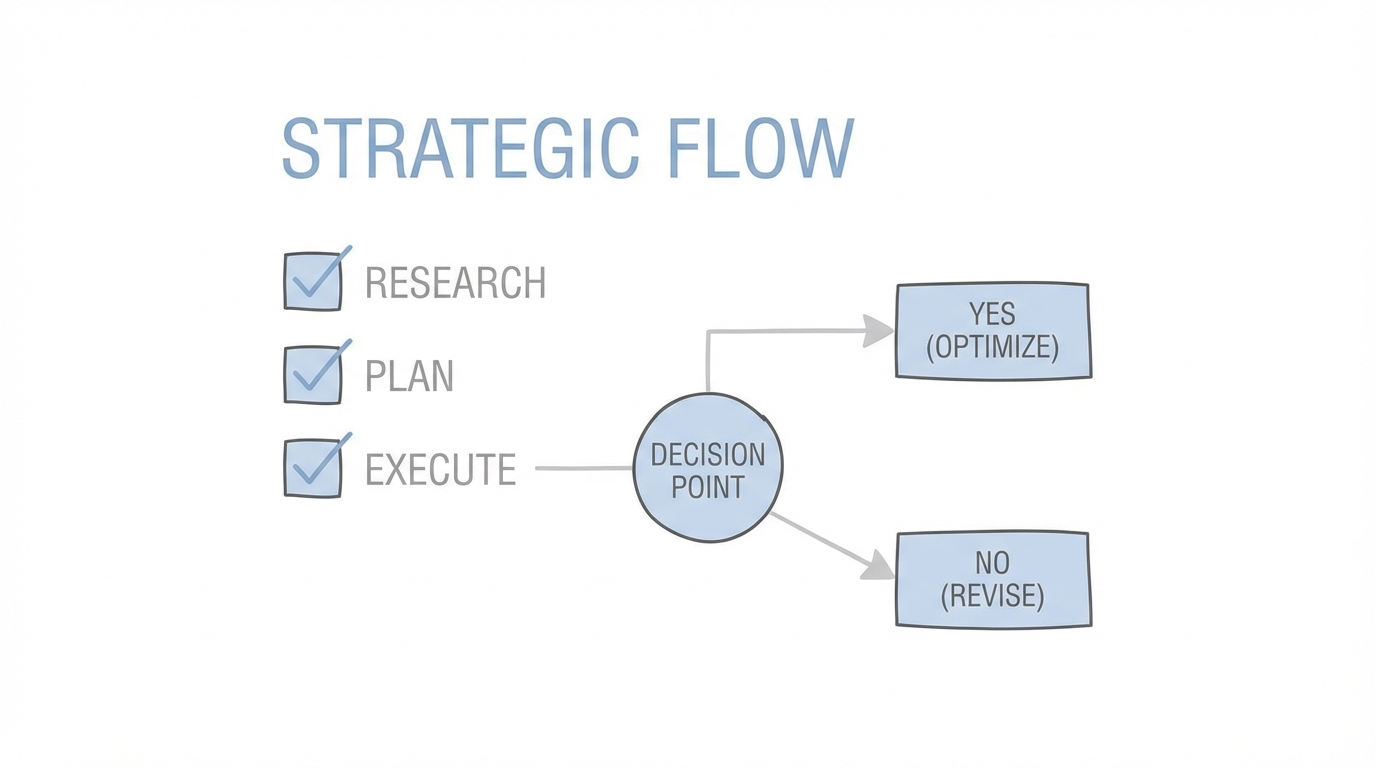
If you have a new idea, use this checklist to determine if you are truly riding a market inflection point or just chasing a fleeting trend:
Step 1: Identify the External Catalyst
What has changed in the last 12-24 months that makes your idea possible now, when it wasn't possible five years ago? If the answer is "nothing," you aren't riding an inflection; you are competing on pure execution, which is a much harder path to a billion-dollar valuation.
Step 2: Map the Convergence
The most powerful ideas sit at the intersection of two or more inflections. For example, mobile app marketing is currently at the intersection of a technological inflection (AI-driven ad optimization) and a cultural inflection (the demand for authentic UGC). Platforms like Stormy AI capitalize on this by using autonomous AI agents to discover, outreach, and follow up with creators on a daily schedule.
Step 3: Measure the "Novelty Gap"
Does your solution provide a result that is 10x better, faster, or cheaper than the status quo? A 20% improvement is not enough to overcome the J-Curve. You need a Move 37—a way of solving the problem that legacy competitors literally cannot replicate because their business model depends on the old way of thinking.
Step 4: Audit for Regulatory or Social Friction
Is there a law or a deeply held social belief standing in your way? If so, is that barrier currently under pressure? Wait for the crack to appear. Trying to force a regulatory shift is expensive; waiting for one to happen naturally and being ready to pounce is a much better identifying market opportunities strategy.
Step 5: Call Your Shot and Document It
Just as figures like Kanye West or Conor McGregor filmed their "come up" long before they were famous, modern founders should document their process. Not only does this build a cultural inflection around your brand, but it also creates a feedback loop of accountability. High-potential founders are often those who are willing to publicly commit to a vision before the rest of the world sees the data.
The Future of Tech Industries and UGC

As we look toward the future of tech industries, the role of the creator is only going to grow. We are entering a "post-advertising" world where traditional commercials are filtered out by both software and human psychology. In this environment, user-generated content (UGC) becomes the primary currency of trust. App developers who find and work with the right creators will see much higher conversion rates in their app install campaigns than those who rely on slick, corporate creative.
This is where AI-powered discovery and analytics from Stormy AI becomes critical. Using specialized tools to analyze which creators are actually driving results—not just likes—is the modern equivalent of Hassabis using AI to predict protein folds. It’s about using data to find the hidden structures of success. By combining App Store Optimization (ASO) with a robust influencer strategy, brands can dominate their category by being present exactly where the attention is shifting.
Conclusion: Riding the Wave
The next billion-dollar shift is already happening in computational biology, generative AI, and the decentralized creator economy. To capitalize on it, you must stop looking at what is working today and start analyzing the forces that will make today's leaders obsolete tomorrow. Master the inflection framework, prepare for the J-Curve, and be ready to move when the external environment aligns with your vision. The world is constantly breaking and reforming; your job is to be the one who knows where the pieces will land.