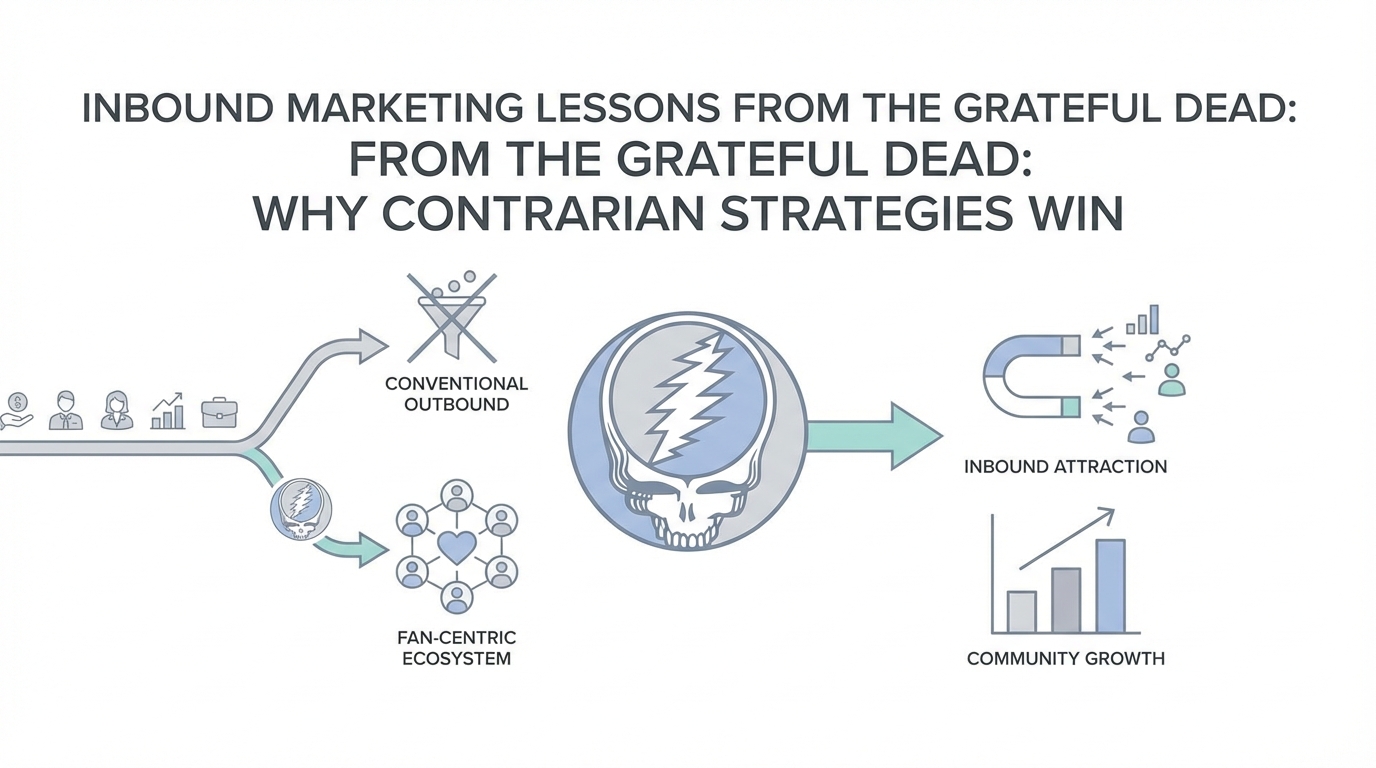
In the late 1960s, while the rest of the music industry was obsessed with protecting intellectual property and charging for every needle drop, one band was busy doing the unthinkable: encouraging their fans to record their live shows for free. That band was the Grateful Dead, and their frontman, Jerry Garcia, wasn’t just a psychedelic guitar wizard—he was a first-principles thinker who pioneered a contrarian marketing playbook decades before the internet existed. Today, that same spirit lives on in the most successful SaaS growth stories, proving that the best way to build a brand cult isn't by following the herd, but by zigging when everyone else zags. This is the story of how 1960s rock-and-roll philosophy became the foundation for modern inbound marketing strategy.
The 'Taper Section' Strategy: Giving Away IP as a Growth Hack

Most record labels in the 70s and 80s viewed bootleg recordings as an existential threat. They saw every cassette tape as a stolen sale. The Grateful Dead took a radically different view. They realized that their live performance was their most valuable asset, and that allowing fans to record and share tapes was the ultimate form of viral marketing. They even went so far as to create a dedicated 'Taper Section' right behind the soundboard, inviting fans with microphones and recording equipment to capture the show.
This was content marketing in its purest, most primitive form. Fans didn't just listen to the music; they became distributors. They would go home, make 50 copies of a high-quality tape, and trade them with friends. This peer-to-peer sharing created a network effect that no traditional advertising budget could buy. It transformed the band from a musical act into a movement. In a modern context, this is equivalent to a software company open-sourcing its most valuable code on platforms like GitHub or a brand creating high-value guides that competitors would charge for. By giving away the IP, you aren't losing revenue; you are lowering the friction of discovery. In today’s competitive landscape, leveraging platforms like Meta Ads Manager to distribute high-value, free content is the digital evolution of the taper section.
The lesson here for mobile app developers and marketers is clear: Don't hide your value behind a paywall too early. Whether you are running campaigns through Google Ads or organic social, the goal should be to provide so much value upfront that the customer feels like they already belong to your community before they've even spent a dime. This is how you transition from a simple vendor to a mission-driven brand that people are proud to support.
Building a 'Spiky Team': Why Diverse Talent Creates New Categories


When Jerry Garcia assembled the Grateful Dead, he didn't just look for the best rock-and-roll musicians. He looked for 'spiky' talent—people who were world-class in fields that didn't necessarily belong together. His bass player was an avant-garde trumpet player; his keyboardist was a blues harmonica specialist; his drummer was a drum majorette. This bizarre mix of influences meant they didn't just play rock; they created an entirely new genre: the jam band.
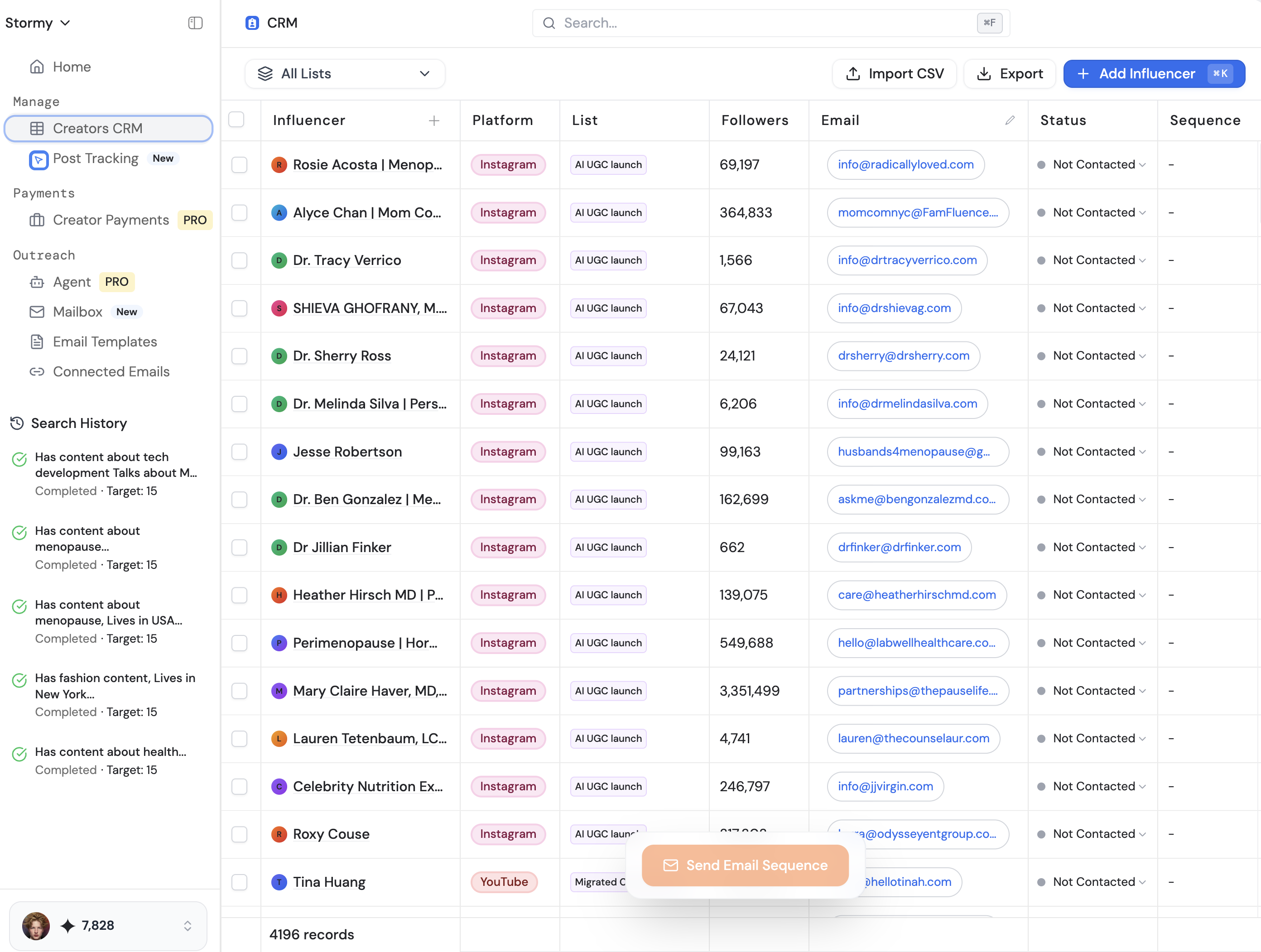
Brian Halligan, the co-founder of HubSpot, applied this exact logic when building his early team. Instead of hiring traditional enterprise sales veterans, Halligan and his co-founder Dharmesh Shah looked for people with high agency and unique backgrounds. They famously hired talent directly out of Apple Stores in Cambridge. The value proposition was simple: "You're great with people, you know tech, how'd you like to sit down for a living?" These hires weren't just employees; they were the architects of a new culture. In the modern era, finding this kind of unique talent—especially for UGC (User-Generated Content)—is what differentiates a brand. Stormy AI is an AI-powered search engine for creator discovery, especially for mobile app marketing and UGC campaigns, helping companies find these 'spiky' creators across TikTok, Instagram, and YouTube who can speak authentically to an audience in a way that corporate actors never could.
Halligan uses a rubric called FLOCK to evaluate potential talent and founders, which is a masterclass in brian halligan marketing lessons:
- F – First Principled: Do they think for themselves, or are they just derivative?
- L – Lovable: Would someone walk over broken glass to work for this person?
- O – Obsessed: Have they gone down a rabbit hole to become the best in the world at something?
- C – Chip on the shoulder: Do they have something to prove?
- K – Knowledgeable: Do they have deep founder-market fit?
When you hire for these traits, you aren't just filling roles; you are building a team capable of contrarian marketing. You need people who aren't afraid to look at a standard industry practice—like outbound cold calling—and declare it dead. This spiky team approach allows you to create your own category, just as the Dead created the jam band and HubSpot created inbound marketing.
Zigging When Others Zag: Choosing the SMB Market
One of the most profound content marketing examples of contrarian strategy is HubSpot’s decision to focus on Small and Medium-Sized Businesses (SMBs). In the mid-2000s, the conventional wisdom on Sand Hill Road was that you had to go after the Enterprise market. That’s where the big checks were. Salesforce was the unassailable giant of the era, and everyone was trying to build the "Salesforce for Enterprise X."
HubSpot did the opposite. They realized that selling to Enterprise CIOs was soul-crushing and that the real opportunity lay in democratizing marketing tools for the millions of small businesses that the giants were ignoring. Every VC told them they were wrong. They were told SMB churn would kill them and that the unit economics would never work. But they had deep conviction. They weren't just building a software company; they were on a mission to help small businesses grow.
This contrarian bet required them to rethink everything from their sales model to their product design. They couldn't afford a high-touch enterprise sales force, so they leaned into inbound marketing strategy to pull customers in. They used Apple Search Ads and other performance channels not just to sell, but to educate. By the time they reached 2,000 employees, they had proven that the SMB market was not just viable, but potentially more lucrative because of the sheer volume of underserved customers. If you are a mobile app developer today, you face a similar choice: do you chase the top 1% of whales, or do you build a product that serves the 'long tail' so well that they become your biggest advocates?
How to Build a Brand Cult: Fans Over Customers
The Grateful Dead didn't have customers; they had Deadheads. A customer buys a ticket; a fan follows you across the country for 40 shows in a row. The difference lies in the mission. The Dead represented a lifestyle of freedom, community, and musical exploration. When you bought a ticket, you weren't just paying for music; you were reinforcing your own identity.
In the SaaS world, building a cult-like following requires a similar level of stewardship. HubSpot achieved this by creating the 'Inbound' movement. They didn't just sell software; they taught a new way of doing business that felt more human and less intrusive. This mission-driven approach attracted 'missionary' employees rather than 'mercenaries.' As a company scales, maintaining this culture becomes the primary job of the CEO.
To keep the "cult" alive, you must remain risk-seeking even as you grow. Most companies become risk-averse the moment they hit $100M in revenue. They hire lawyers to protect what they have rather than founders to find what’s next. To avoid this, successful leaders often hire ex-founders to keep that "nothing to lose" mentality alive. If you are marketing a mobile app, you can build this same loyalty by utilizing UGC creators managed through a dedicated creator CRM like Stormy AI. When real people share their genuine excitement for your product, it creates a sense of community that traditional high-production ads can never replicate.
The Stewardship of Brand: Lessons for the AI Age
As we move into the era of Artificial Intelligence, the lessons of the Grateful Dead are more relevant than ever. We are entering a period where content is becoming a commodity. If an AI can write a blog post or generate an image in seconds, what remains valuable? The answer is taste, trust, and community.
Brian Halligan, who is now a steward of Jerry Garcia’s famous 'Wolf' guitar, views brand management as a form of stewardship. You don't 'own' a brand cult; you look after it. In the AI age, this means using technology to enhance the human connection, not replace it. You can use Stormy AI to send AI-personalized outreach to creators, ensuring your communication remains hyper-personalized and relevant while leveraging automation to scale your community growth.
Modern marketing is shifting from SEO (Search Engine Optimization) to AEO (Answer Engine Optimization). How do you get your brand found when people are asking ChatGPT or Gemini instead of typing keywords into Google? You do it by having a brand that is so distinct and a community that is so vocal that the AI models cannot ignore you. You build a brand that people actually search for by name. This is the ultimate goal of any inbound marketing strategy: to be the signal in an increasingly noisy, AI-generated world.
The Pothole Report: Scaling Without Losing the Soul
Scaling a company from 10 to 10,000 employees is a series of self-inflicted mistakes. Halligan refers to these as 'potholes.' At HubSpot, they instituted a Pothole Report—a retrospective on every major failure to ensure it never happened again. Often, these potholes occurred because the company moved from 'founder mode' to 'manager mode' too quickly. They started valuing processes over outcomes and private feedback over public radical candor.
To stay relevant, companies must resist the urge to 'grow up' too fast. Being corporate is the death of creativity. Whether you are managing a legacy band or a multi-billion dollar tech company, the key is to keep the risk-seeking appetite high. This means continuing to experiment with new formats, like AI-generated video content or UGC-driven app install campaigns. When you stop taking risks, you stop being a leader and start being a target for the next first-principles entrepreneur.
Conclusion: Embracing the Contrarian Path
The Grateful Dead and HubSpot both succeeded by rejecting the status quo. They gave away their IP, focused on ignored markets, and built teams of 'spiky' misfits who believed in a mission. For modern marketers, the lesson is clear: the safe path is the riskiest path. If you do what everyone else is doing, you will get the same mediocre results as everyone else.
To build a lasting brand in the age of AI, you must return to first principles. Focus on how to build a brand cult by putting your fans first. Use Stormy AI to find the authentic voices and automate your creator discovery so you can focus on building those deep relationships. And most importantly, never be afraid to zig when the rest of the world is zagging. In the end, the brands that win are the ones that aren't afraid to let their fans record the show.