The era of clicking through the Meta Ads Manager to manually adjust bids and refresh creatives is rapidly coming to a close. As we move into 2025, the industry is witnessing a tectonic shift from traditional Software-as-a-Service (SaaS) to Agent-as-a-Service (AaaS). Performance marketers are no longer looking for tools that merely display data; they are looking for autonomous teammates that can reason, act, and optimize in real-time. At the forefront of this revolution is OpenClaw, an open-source AI agent framework that is redefining Facebook ad optimization. By implementing agentic workflows, brands are now seeing an average 22% improvement in Return on Ad Spend (ROAS), turning every dollar of ad spend into significant revenue growth.
The State of AI in Meta Advertising (2024–2025)
AI is no longer a luxury feature in the world of digital advertising; it is the fundamental engine driving performance. According to recent Meta performance reports, advertisers who embrace AI-driven tools like Advantage+ are seeing transformative results. The data is clear: automated campaigns have led to a 30% reduction in Cost Per Acquisition (CPA) and a 22% increase in conversion rates across the e-commerce sector. This isn't just a marginal gain; it represents a fundamental shift in how influencer marketing and paid social strategies are executed.
Adoption is skyrocketing. 75% of PPC professionals now utilize some form of AI for campaign optimization, and automated bidding adoption has increased by a staggering 340% year-over-year [source: Search Engine Journal]. This surge in Meta Ads automation is fueled by the platform's ability to keep users engaged; AI-driven content recommendations have increased time spent on Instagram by 6% and on Threads by 35%, creating more inventory for savvy advertisers to exploit.
"The transition from SaaS to Agent-as-a-Service marks the point where software stops being a tool and starts being a teammate."
Industry Trends: From Dashboards to Autonomous Agents
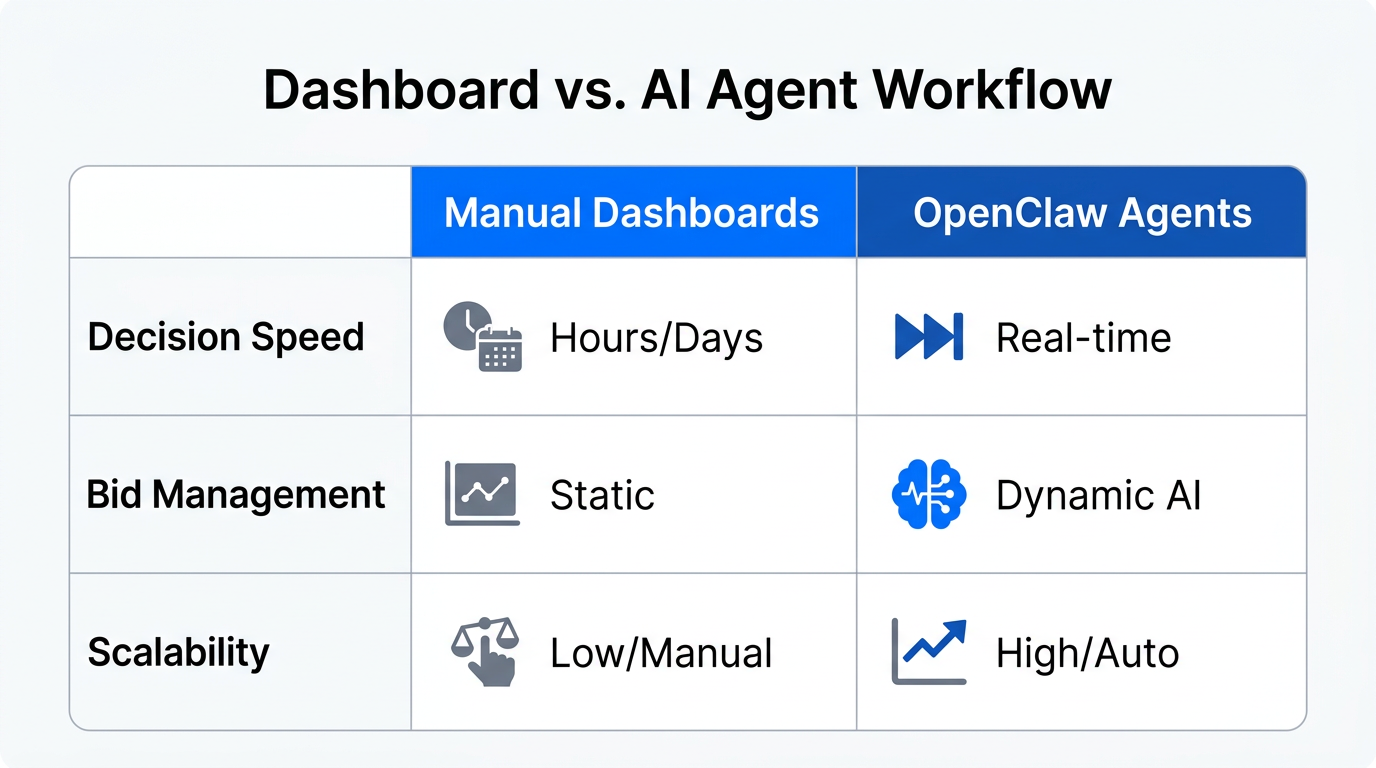
The "Manual Era" of performance marketing—characterized by spreadsheets and static dashboards—is being replaced by AI marketing agents that live where the data lives. Two major trends are dominating the landscape: Local-First AI and Agentic Workflows.
Due to increasingly strict privacy regulations like GDPR and CCPA, many top-tier brands are moving away from cloud-only AI solutions. OpenClaw allows advertisers to run models locally on hardware like a Mac Mini, ensuring that sensitive first-party customer data never leaves their own infrastructure. This local-first approach provides the security of an enterprise solution with the agility of an open-source framework.
Furthermore, we are moving beyond simple "If-Then" rules. Traditional automation might say, "If CPA is over $20, pause the ad." An agentic workflow powered by OpenClaw actually reasons. It can identify creative fatigue by analyzing CTR decay over 7, 14, and 30-day windows and suggest structural account changes via natural language, much like a human media buyer would.
The OpenClaw Strategic Playbook: 4 Steps to Automation
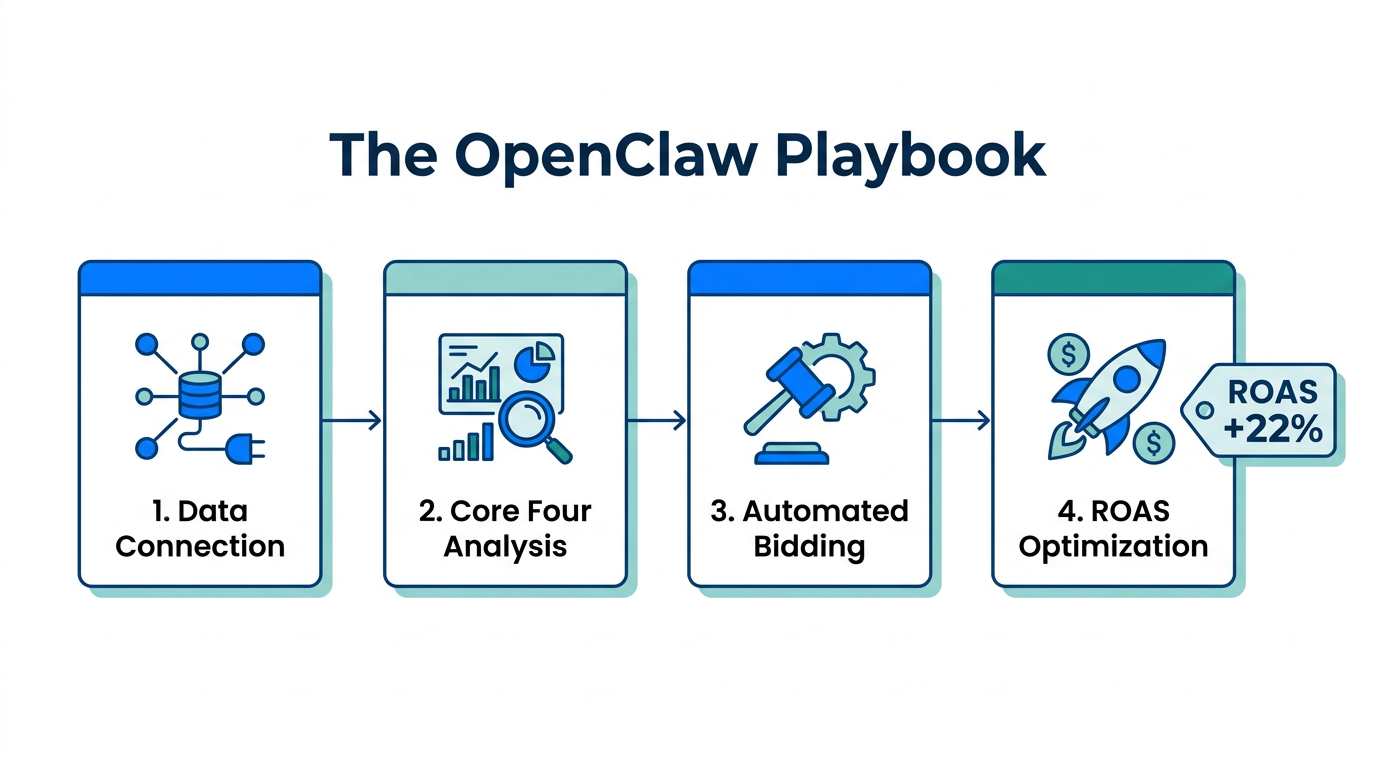
To successfully implement OpenClaw and achieve a Return on Ad Spend (ROAS) boost, marketers should follow this structured playbook.
Step 1: Establish Your AI Infrastructure
The first step is setting up the environment where your agent will live. You don't need a massive server farm. Many performance marketers host OpenClaw on a VPS like AWS Lightsail or even a local dedicated machine for 24/7 execution. To bridge the gap between your Large Language Model (like Claude 3.5 or GPT-4o) and the Meta Ads API, you should utilize the Model Context Protocol (MCP). This protocol allows your AI agent to securely read and write data to your ad account.
Step 2: Deploy the 'Core Four' OpenClaw Skills
OpenClaw operates via modular instruction sets known as "Skills." To dominate Meta Ads, you must deploy the following four:
- Performance Auditor: This skill constantly scans your account for budget leaks—such as ad sets stuck in the "Learning Phase" for too long—and ranks issues by their potential revenue impact.
- Creative Analyst: It tracks the lifecycle of your visual assets. By monitoring frequency and conversion rates, it flags assets for replacement before the ROAS begins to drop.
- Bid & Budget Manager: This is where the scaling happens. You can instruct the agent to "Increase budget by 20% if ROAS is greater than 3.0 over the last 3 days," ensuring you aggressively back winners.
- Audience Architect: This skill detects overlap between your prospecting and retargeting funnels, preventing "internal competition" that drives up your CPMs.
| Feature | Manual Management | OpenClaw AI Agent |
|---|---|---|
| Optimization Speed | Daily/Weekly | Real-time / 24/7 |
| Data Processing | Sampled/Manual | Full API Integration |
| Creative Analysis | Subjective | Data-driven Fatigue Tracking |
| Scaling | Reactive | Proactive Reasoning |
Step 3: Use Messaging as Your Command Center
One of the most powerful aspects of AI marketing agents is the ability to communicate with them naturally. By connecting OpenClaw to Telegram or WhatsApp Business, you can receive daily performance audits directly to your phone. If the agent finds a winning ad, it can message you: "Ad Set A is performing at a 4.5 ROAS. Should I increase the budget by $200?" You simply reply "Yes," and the agent handles the execution.
Step 4: The 'Read-Only' Safety Phase
Never give an AI agent full "Write" access to your bank account on day one. Experts recommend a 14-day Read-Only safety phase. During this time, the agent will suggest changes and provide reasoning, but it won't execute them. This allows you to validate the AI's marketing logic and ensure its decisions align with your brand's financial goals. Once the agent has proven its reliability, you can grant it the permissions needed to scale your Meta Ads automation.
"Running AI agents with shell access is 'spicy.' Always follow the Least Privilege Principle—only give the agent the specific permissions it needs to manage ads."
The Foundation: Meta Conversions API (CAPI)
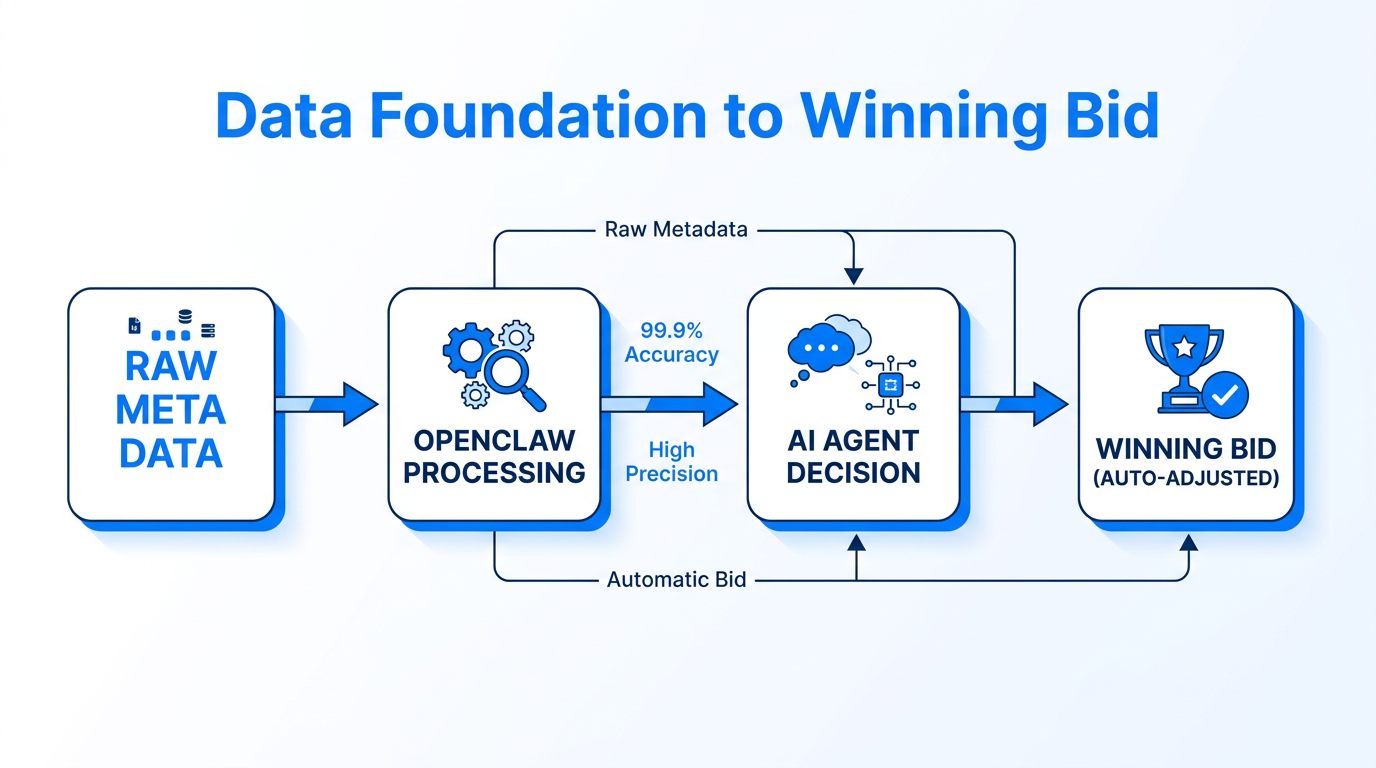
An AI agent is only as good as the data it consumes. To boost your ROAS by 22%, you must provide a high-quality data foundation. This means properly integrating the Meta Conversions API (CAPI). CAPI allows you to send web events directly from your server to Meta, bypassing the limitations of browser-based tracking and cookies. Without CAPI, your AI agent will be making decisions based on incomplete signals, which inevitably leads to wasted spend and "model degradation." Tools like Shopify and Stape make CAPI implementation significantly easier for modern brands.
Real-World Impact: From Creators to Agencies
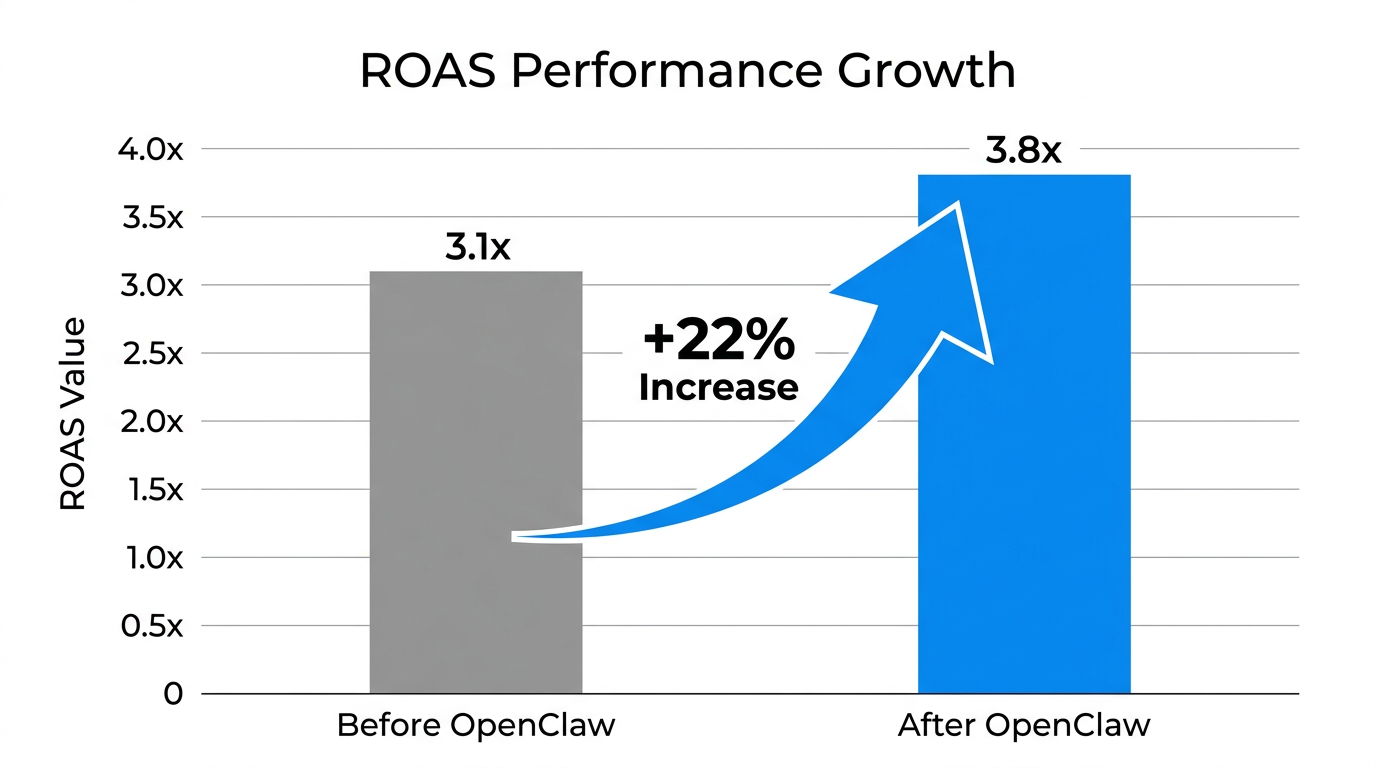
The results of implementing OpenClaw are already being felt across the industry. For instance, digital agencies using Ryze AI (a managed implementation of the OpenClaw framework) report saving an average of 13 hours per week on routine reporting and bid adjustments. This allows account managers to focus on high-level strategy and creative direction rather than data entry.
In the e-commerce world, a B2B SaaS founder recently utilized an OpenClaw agent to manage Meta Ads via Telegram while traveling. Despite having zero manual dashboard intervention for weeks, the account maintained a consistent 1.8x ROAS. Meanwhile, in the social growth space, creators have used agents to automate content testing, generating over 2 million views in just two weeks by identifying and scaling winning video formats automatically. This level of efficiency is exactly why platforms like Stormy AI are becoming essential for brands looking to find the right creators to fuel these automated ad machines.
Common Mistakes to Avoid in AI Automation
While the potential for ROI is massive, Facebook ad optimization via AI agents is not without risks. To ensure success, avoid these common pitfalls:
- The "Set and Forget" Trap: AI still requires human oversight. Without monitoring, an agent might optimize for low-cost leads that are actually poor quality for your sales team.
- Ignoring Brand Voice: Generic AI copy can alienate your audience. Always use a "Brand Kit" skill within OpenClaw to ensure the agent maintains your unique tone.
- Poor Data Inputs: As mentioned, failing to fix CAPI issues will feed the AI bad signals. If the agent thinks a sale happened when it didn't, it will scale the wrong ads.
- Security Oversights: Ensure you are using secure frameworks and following the principle of least privilege when connecting your ad accounts to any AI tool.
Conclusion: Embracing the Agentic Future
The shift toward AI marketing agents represents the single biggest opportunity for performance marketers since the launch of the Facebook Pixel. By leveraging OpenClaw to automate the mundane aspects of Meta Ads automation—from budget management to creative auditing—you free yourself to focus on what truly moves the needle: strategy and storytelling. Whether you are a solo founder managing ads from Telegram or a large agency scaling hundreds of accounts, the agentic model is the key to unlocking a 22% ROAS boost and staying ahead in an increasingly automated world. Start with a read-only phase, fix your data foundation with CAPI, and let the agents do the heavy lifting.