In 2026, the App Store is no longer just a digital shelf; it is a sophisticated, AI-driven discovery engine where visibility is the only true currency. For app marketers and founders, the game has shifted from generic "keyword stuffing" to a precise science of data interpretation. With search being the primary driver of intent-based acquisition, understanding app store keyword volume is the difference between a top-charting success and an app that remains buried on page ten. This guide provides the blueprint for mastering Search Popularity (SP) scores and the latest 2026 benchmarks to fuel your organic growth.
The Dominance of Search: 2026 Industry Benchmarks
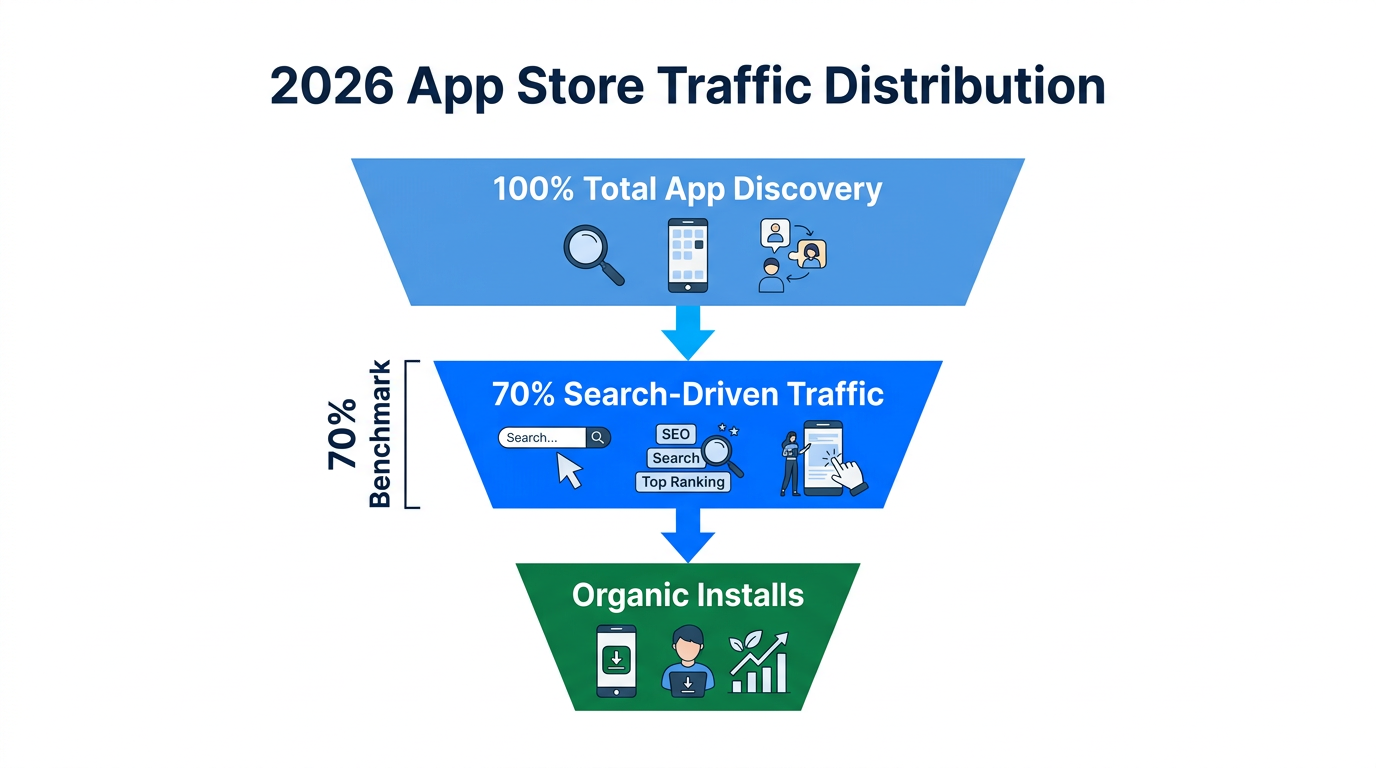
As we navigate through 2026, the data remains undeniable: search is the undisputed king of discovery. Recent research consistently shows that 65% to 70% of all app downloads originate directly from App Store searches, according to industry leaders like MobileAction and AppTweak. If your ASO keyword research 2026 strategy isn't optimized for this volume, you are essentially ignoring two-thirds of your potential market.
However, the nature of these searches has changed. While approximately 50% of top-volume keywords are branded—users searching for TikTok or Instagram—the most significant opportunity for growth lies in generic category terms. High-intent phrases like "photo editor" or "meditation for sleep" drive the most "discoverable" organic growth for new and mid-tier apps. Furthermore, the stakes for ranking have never been higher; apps positioned in the Top 3 for a high-volume keyword now capture over 50% of the total clicks for that search term, as noted by ASOMobile.
"Search visibility is the lifeblood of organic growth; in 2026, without a deep understanding of volume data, your app is a billboard in a basement."
Decoding the Search Popularity (SP) Score
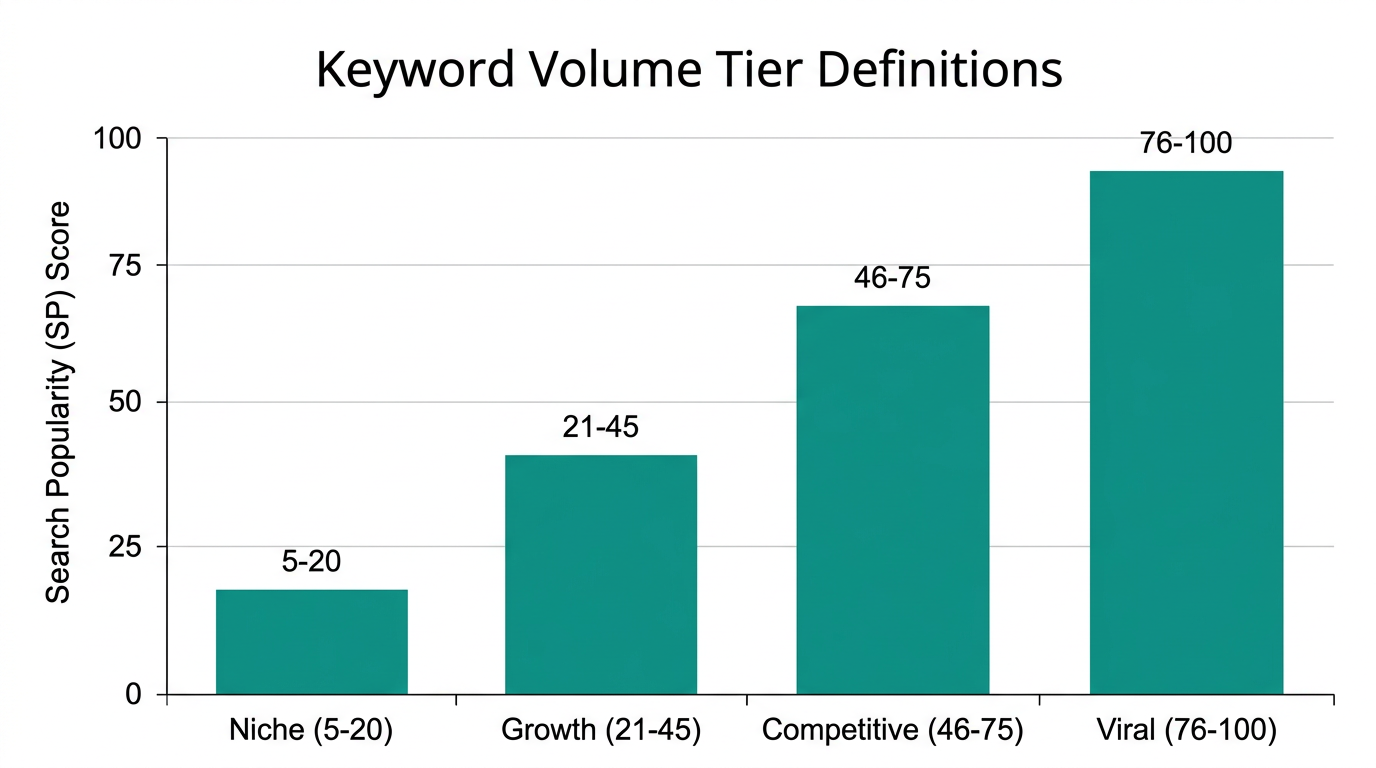
Apple does not provide marketers with exact daily search numbers. Instead, they utilize a proprietary metric known as the Search Popularity (SP) score. This score, which operates on a scale of 5 to 100, is the foundation of modern app store search statistics analysis.
Understanding the hierarchy of these scores is critical for resource allocation:
- SP < 20: Very low volume. These terms likely receive fewer than 10 searches per day. While they may be easy to rank for, they rarely move the needle unless you are targeting a hyper-niche "golden" long-tail keyword.
- SP 20–40: Low-to-mid volume. This is the "sweet spot" for new apps. It allows you to build initial "ranking authority" without being instantly crushed by enterprise-level competitors.
- SP 40–60: High volume. These terms are very competitive and require high conversion rates and significant download velocity to maintain a top position.
- SP > 60: Extreme volume. These are dominated by giants like YouTube and Spotify. For most startups, chasing these head terms early on is a waste of budget.
| SP Score Range | Traffic Potential | Competition Level | Recommended Strategy |
|---|---|---|---|
| 20 - 40 | Moderate | Low/Medium | Target for new apps to build authority. |
| 40 - 60 | High | High | Target once initial traction is established. |
| 60+ | Extreme | Very High | Only for established brands with high velocity. |
The Hierarchy of Volume: Targeting SP 20-40 vs. 60+
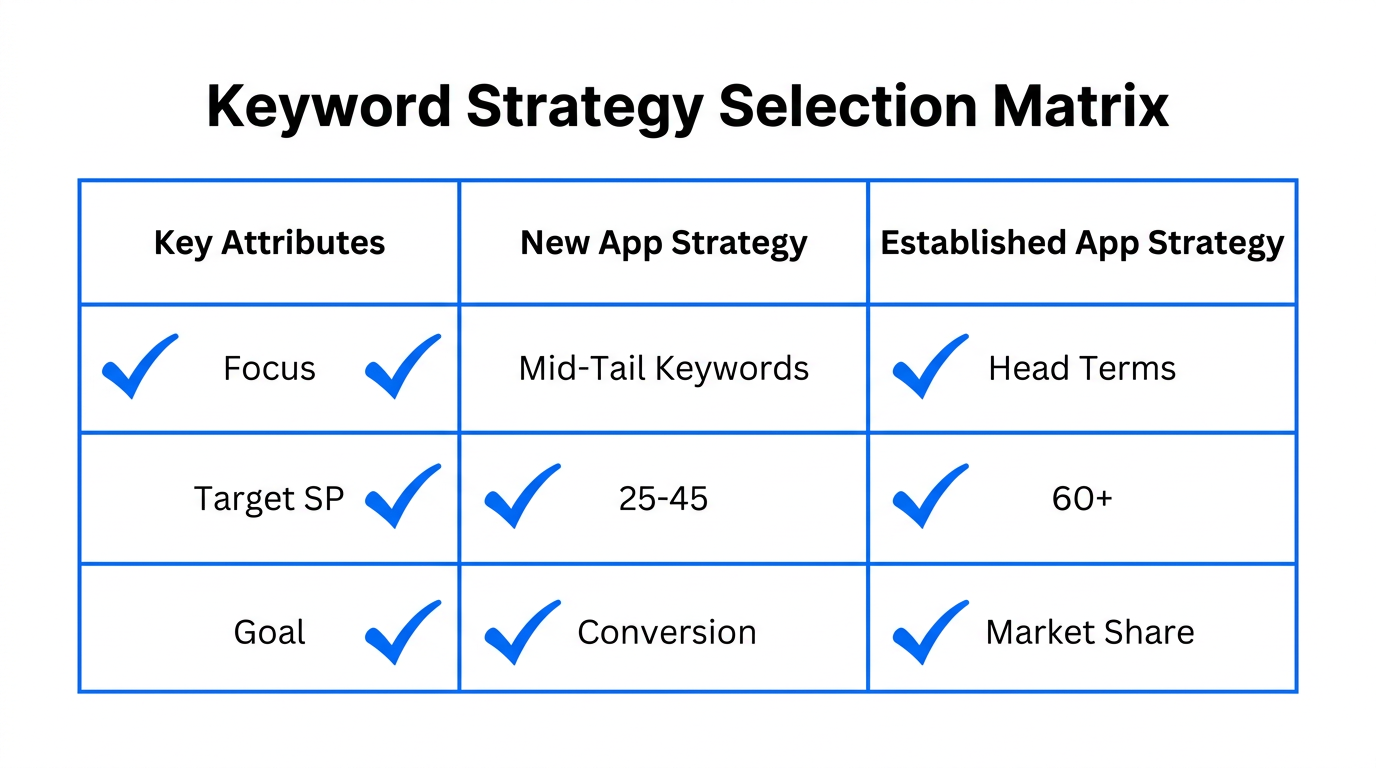
A common mistake in 2026 is "chasing the dragon"—targeting extreme volume keywords before your app has the metadata strength to compete. For a new app, your app store keyword volume strategy should focus on the Keyword Opportunity Benchmark (KOB). This ratio, championed by Sensor Tower, compares search volume against keyword difficulty. Aim for terms with a Volume > 30 but a Difficulty < 40.
For established brands, the strategy shifts toward defending high-volume head terms (SP 60+) while expanding into long-tail variants to capture high-intent users. For example, instead of just targeting "Fitness," an established app might target "home bodyweight workout for beginners." This approach, supported by research from AppFollow, ensures you are capturing users at every stage of the funnel.
To supplement these organic efforts, many brands are turning to creative-led growth. By using an AI-powered influencer platform like Stormy AI, marketers can discover and outreach to UGC creators who drive high-quality traffic. This external traffic increases your app's download velocity, which Apple's algorithm interprets as a signal of relevance, helping you rank faster for those competitive SP 40-60 terms.
"Don't just chase volume; chase winnable volume. A rank of #1 for an SP 30 keyword is infinitely more valuable than a rank of #150 for an SP 90 keyword."
Using Apple Search Ads 'Blue-Dot' Indicators
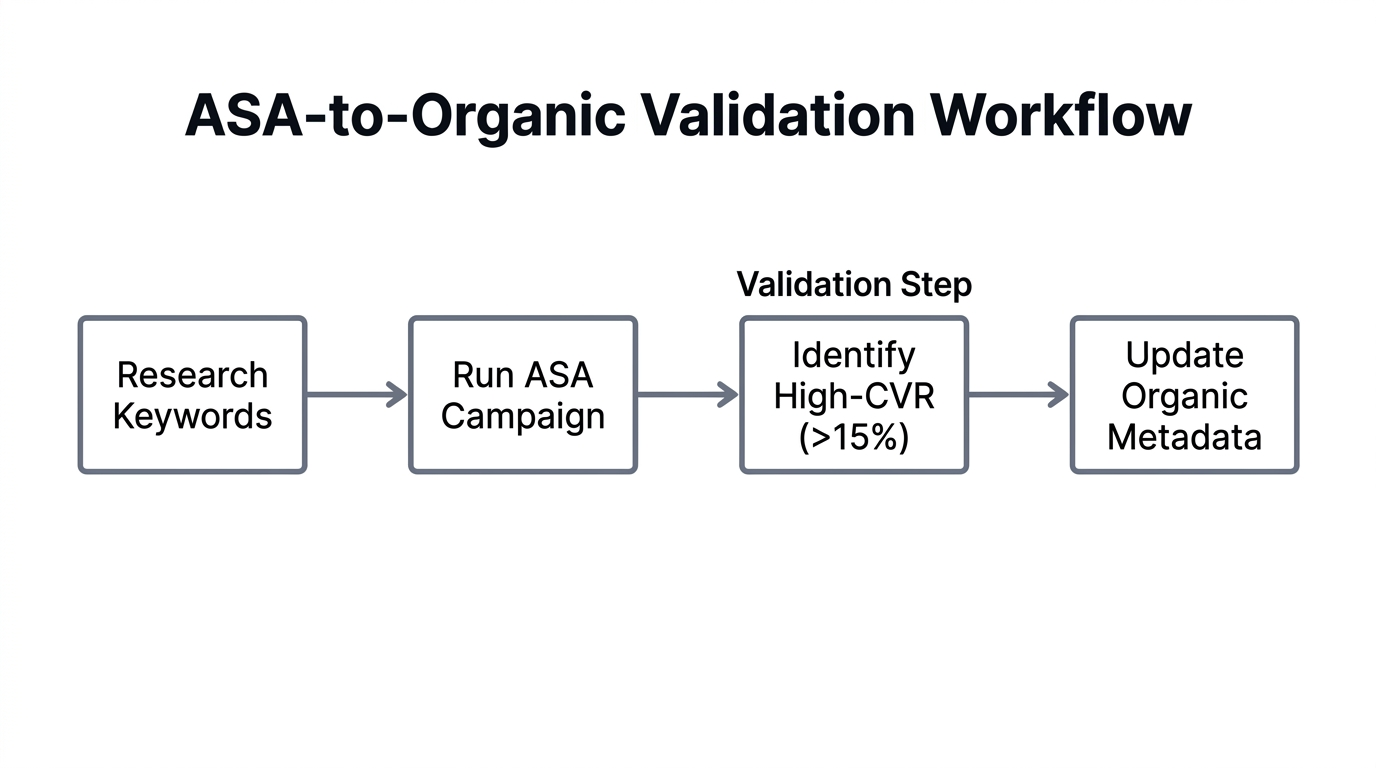
While third-party tools are essential, the closest thing to "source truth" comes from Apple Search Ads (ASA). Within the ASA campaign manager, Apple provides a "blue-dot" popularity indicator (ranging from 1 to 5 dots). This is a vital validation step in ASO keyword research 2026.
Before committing to a keyword in your metadata, cross-reference the SP score from your ASO tool with the blue dots in ASA. If a tool claims a keyword is high volume but Apple only shows one blue dot, the tool's data may be lagging or based on outdated seasonal trends. Top-performing apps update their metadata 2–4 times per year to adapt to these shifts, as noted by AppTweak.
Mastering the 100-Character Metadata Rule
Efficiency is the hallmark of professional ASO. On iOS, you have a 30-character Title, a 30-character Subtitle, and a hidden 100-character Keyword Field. One of the most pervasive errors is repeating keywords across these fields. Apple’s algorithm combines these fields automatically; repeating a term in the 100-character field that is already in your Title wastes valuable growth space.
As AppRadar emphasizes, every character must count. Furthermore, the algorithm has evolved toward semantic indexing. This means Apple now understands related terms and search intent, ranking apps for synonyms even if they aren't explicitly listed, according to specialists at ConsultMyApp.
Common Pitfalls in 2026 ASO
Despite the wealth of data, many marketers still fall into legacy traps. To succeed in 2026, avoid these four common mistakes:
- Keyword Stuffing Descriptions: On the Apple App Store, the long description is not indexed for search. Cramming keywords here is a waste of time and harms user experience. This strategy only works for Google Play, as clarified by Gummicube.
- Ignoring Localization 2.0: Don't just translate keywords. Use tools to research culturally specific slang and regional search intent. A direct translation of a high-volume US term may have zero volume in the UK or Australia.
- Neglecting Seasonality: A keyword like "tax tracker" peaks in April but dies in July. Use real-time volume trends to rotate your metadata. For instance, the safety app iSharing increased visibility by 20% by updating keywords every few weeks based on trends.
- Chasing "Head Terms" Too Early: Targeting "Games" or "AI" as a new app will result in a rank of #200+ and zero downloads. Focus on the long-tail first.
"AI-related searches saw a 300% volume spike recently. The trend is your friend, but only if you have the conversion rate to back it up."
The 2026 ASO Tech Stack
To master app store keyword volume, you need a robust stack that provides more than just raw numbers. You need competitive intelligence and opportunity analysis.
| Tool Name | Core Strength | Website |
|---|---|---|
| AppTweak | Deep data science and volume accuracy | AppTweak |
| Sensor Tower | Enterprise-level revenue and download estimates | Sensor Tower |
| AppRadar | AI-powered ASO workflow and metadata editing | AppRadar |
| SplitMetrics | A/B testing for keyword conversion (CRO) | SplitMetrics |
While these tools handle the technical ASO, remember that organic ranking is also heavily influenced by external traffic. Modern growth teams often pair these ASO tools with Stormy AI to identify niche creators on LinkedIn and YouTube who can drive the initial burst of installs needed to climb the rankings for high-volume keywords.
Conclusion: Mastering Organic Growth
Mastering app store keyword volume in 2026 requires a blend of data-driven discipline and creative agility. By prioritizing the 70% of downloads that come from search and utilizing search popularity scores to find winnable keywords, you can outmaneuver even the largest competitors. Remember to respect the 100-character rule, validate your findings with Apple Search Ads' blue dots, and continuously iterate based on seasonal shifts.
Organic growth isn't a "set-it-and-forget-it" task; it’s a constant cycle of research, implementation, and analysis. Start by auditing your current metadata for repeats, move into the SP 20-40 range for your secondary keywords, and use high-velocity external traffic to push your app into the Top 3 where the real volume lives.