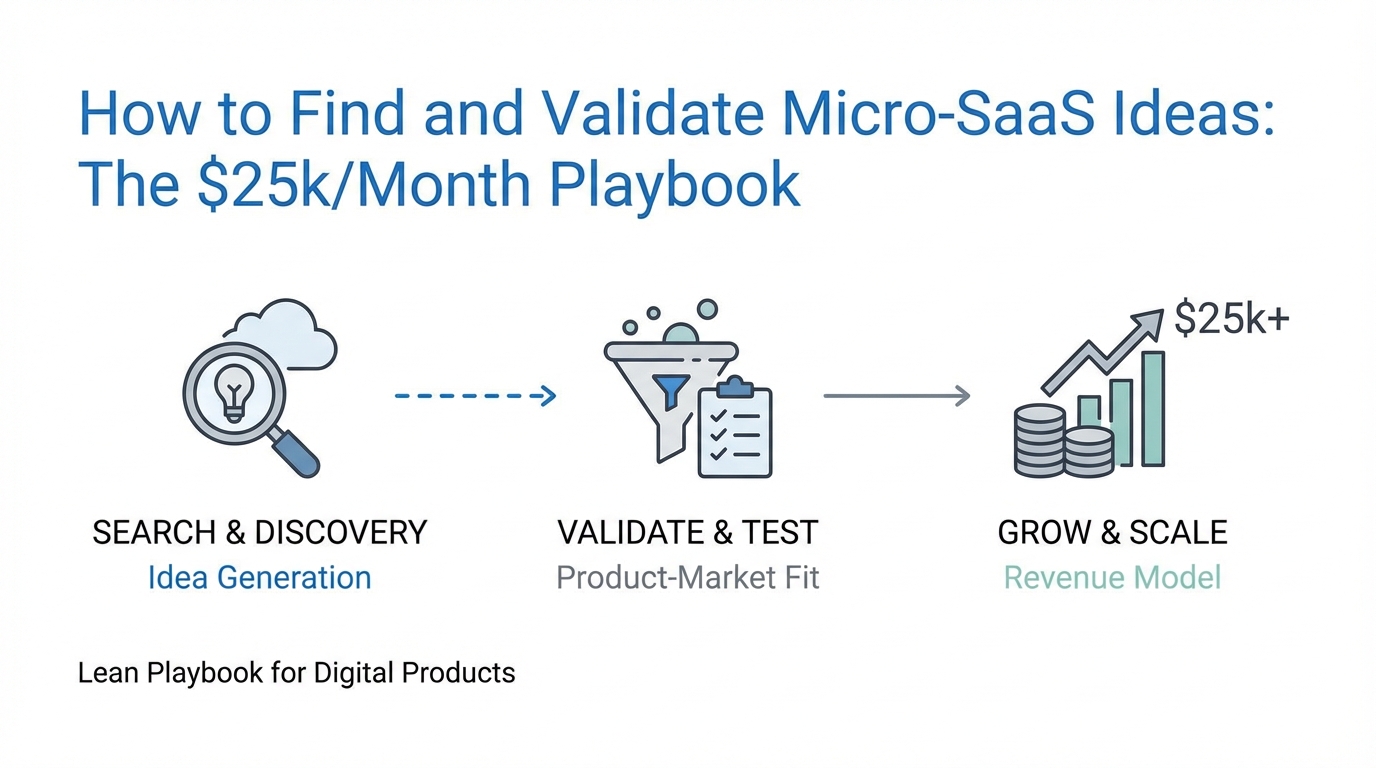
Most aspiring software entrepreneurs fall into the same trap: they try to build the next revolutionary social network or a complex AI platform that solves every problem at once. In reality, some of the most successful businesses are built on stupidly simple ideas. Take Lucas Hermann, a developer from Germany who turned a basic countdown timer into a SaaS business generating $25,000 in monthly recurring revenue (MRR). By focusing on micro SaaS ideas that solve specific, manual inefficiencies, solopreneurs can build highly profitable software niches without the need for venture capital or massive engineering teams.
The Power of Boring Tools in Profitable Software Niches
We often overlook "boring" tools because they don't seem exciting to build. However, in the world of the solopreneur business model, boring is beautiful. A boring tool typically solves a singular, high-utility problem for a very specific group of people. For Lucas, that tool was StageTimer, an app that allows event organizers to display a countdown timer for speakers on stage. While it sounds simple, it solved a critical pain point in the live events and video production industry.
The beauty of these profitable software niches is that they are often too small for giant tech companies to care about, but large enough to support a multi-million dollar business. When you build a tool that does one thing exceptionally well, you eliminate the noise and focus entirely on user experience. According to research from Starter Story, Lucas managed to attract 20,000 total users with 4,400 of them becoming paying customers, proving that simplicity is a feature, not a bug.
The Observation Framework: How to Spot Inefficiency

To find your own micro SaaS ideas, you must step outside the "developer bubble." Developers often build tools for other developers, leading to a saturated market. The most successful solopreneur business model involves looking at non-tech industries—like horse racing, election broadcasts, or even shoe stores—and observing how they work. Lucas found his idea by accident while visiting a friend's studio. He noticed his friend using an outdated Flash app on an old laptop, having to physically walk across a room to hit a button to start a timer.
His "web developer mind" immediately saw the manual inefficiency. This is the Observation Framework: finding places where people are wasting hours or using awkward workarounds for tasks that could be automated with a simple web interface. If you can find a workflow where people are still using physical signs, old hardware, or complex Excel sheets for a simple task, you've found a potential goldmine. Just as Stormy's AI search helps brands find niche creators by filtering through the noise across TikTok, YouTube, and LinkedIn, you must filter through real-world workflows to find hidden software needs.
The 3-Day MVP Rule: Speed Over Perfection
Once you identify a potential niche, the next step is how to build a SaaS quickly. Many founders spend months building a product before even knowing if anyone wants it. Lucas followed a 3-day MVP rule, shipping the first version of StageTimer in just 72 hours. The goal of an MVP (Minimum Viable Product) is to provide the core utility—in this case, one person clicking a button and another person seeing a timer.
To achieve this speed, you must use a tech stack you are already comfortable with. Lucas used JavaScript, Vue.js, and Node.js because he knew them inside out. He avoided the temptation to learn trendy new frameworks like Vercel at the time, which would have slowed him down. By shipping fast, he was able to gather feedback immediately and iterate. This lean approach is essential when you are trying to validate a SaaS idea without wasting thousands of dollars in development time.
Validation Without an Audience via Niche Subreddits
You don't need a massive Twitter following or a huge marketing budget to validate a SaaS idea. The secret weapon for many solopreneurs is Reddit. The key is to find "hidden" subreddits where your target users hang out. For Lucas, this meant finding a specific niche for video production professionals. He posted a link, explained what he built, and asked for honest feedback without trying to sell anything initially.
A single Reddit post with 58 upvotes provided the initial validation he needed. Users started making lists of features they wanted, confirming that he had hit a nerve. When validating, it is vital to vet the quality of the feedback you receive. In the same way that Stormy AI for influencer vetting detects fake followers and engagement fraud for brands, you must distinguish between genuine user interest and empty praise. If people are asking for specific features and offering to pay, you have a viable business.
Distribution and Growth: Turning Side Projects into Full-Time Income

Building the tool is only half the battle; distribution is everything. Lucas scaled his revenue by focusing on two main channels: SEO and Product-Led Growth (PLG). Around 50% of his traffic comes from Google. He targeted super-niche keywords like "countdown timer Stream Deck companion" by creating specific SEO documentation pages and YouTube videos. These are high-intent keywords; when someone searches for a solution to a concrete problem, they are much more likely to convert into a paying user.
Additionally, he utilized a freemium model to drive word-of-mouth. By putting the StageTimer.io logo on every shared timer link, he turned his users into a marketing engine. Freelancers would bring the tool to events, other professionals would see it, and the cycle would repeat. To manage this growing base of users and potential partnerships, solopreneurs often need sophisticated systems. While Lucas uses Airtable as a CRM, many growth-minded founders use Stormy's creator CRM to track interactions, manage deal stages, and scale their outreach to industry influencers who can promote their software.
Transitioning: The $3,000 MRR Benchmark
One of the hardest decisions for any solopreneur is knowing when to quit their day job. Lucas stayed in his role until StageTimer reached $3,000 MRR—a figure that allowed him to cover his basic expenses in Germany. It took him 224 days to get his first dollar, proving that while building an MVP is fast, building a business is a marathon. He eventually reached the $10,000 monthly revenue mark in late 2023, a common goal for solo founders.
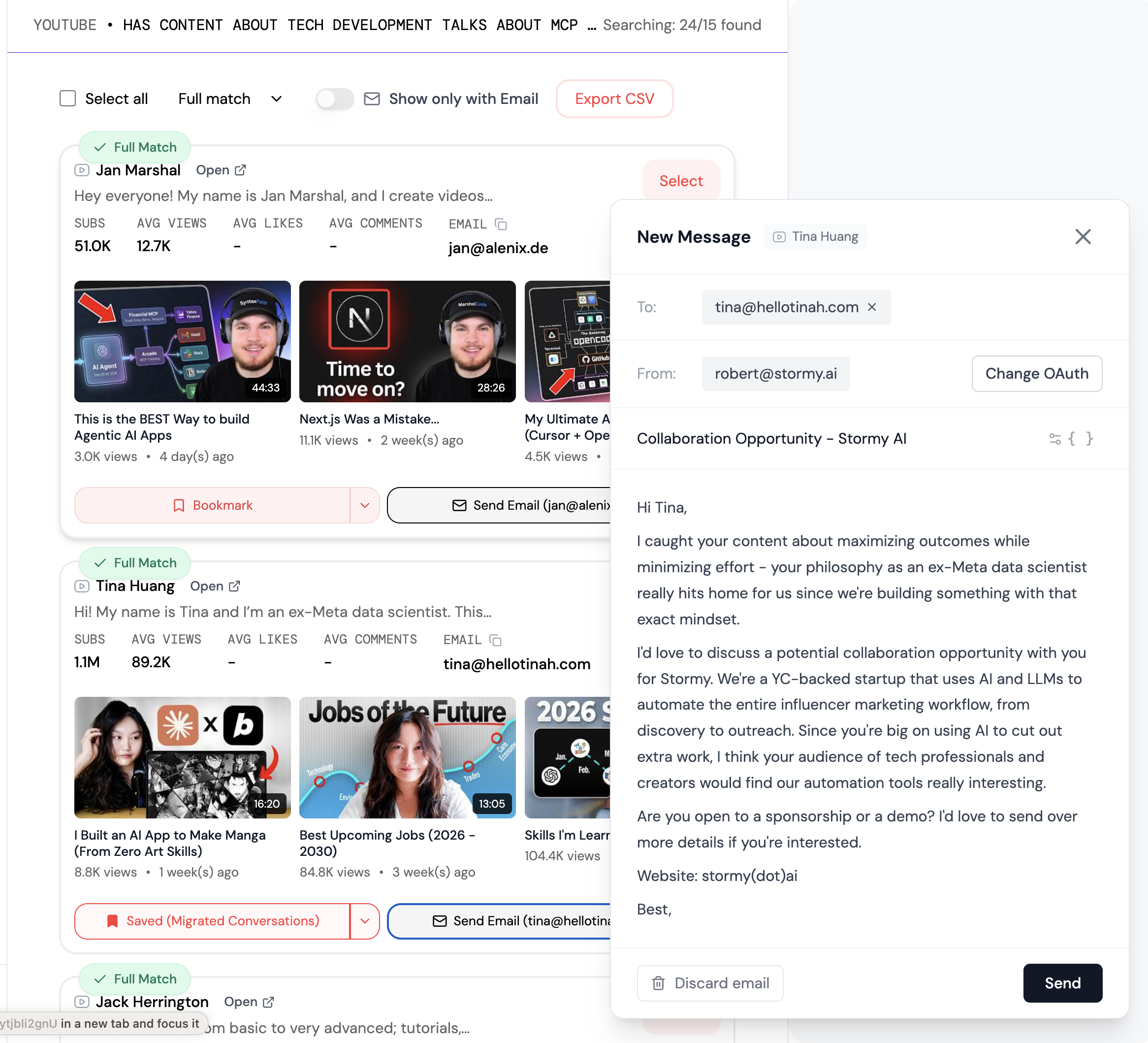
To keep margins high (often 80-90%), he keeps overhead low. His server costs are only around $280 a month, and he uses efficient tools like Postmark for transactional emails and Claude for AI-assisted coding. For those looking to scale their marketing without hiring a large team, Stormy's AI outreach can automate the process of finding and contacting partners via hyper-personalized emails, allowing the founder to focus on product development and CEO-level tasks.
Your Playbook for Building a Micro-SaaS
If you are ready to stop dreaming and start building, follow these steps to launch your own profitable software niches:
Step 1: The Observation Audit
Spend a week observing non-tech industries. Talk to friends who work in retail, logistics, or specialized services. Ask them: "What part of your job do you hate doing manually?" or "What software do you use that looks like it's from 1999?"
Step 2: Build the Core Utility
Set a 72-hour timer. Build an MVP using Sublime Text or your favorite editor. The app should do exactly one thing. Don't worry about user accounts, billing, or fancy UI yet—just the core utility.
Step 3: Hunt for Subreddits
Find at least three niche communities where your potential users live. Post your free tool and ask for feedback. Be humble, transparent, and responsive. If the thread gains traction, you have successfully completed the validate saas idea phase.
Step 4: Scale via Niche Content
Create documentation for specific integrations. If your tool works with other platforms like monday.com or Google Sheets, write about it. This builds long-term SEO value and attracts high-intent users.
Step 5: Automate and Track
As users grow, use automation to manage the load. Whether it's automated email follow-ups or Stormy's post tracking to see how people are talking about your tool online and monitor video engagement, leverage AI to stay lean as a solopreneur.
Conclusion: The World is Full of Simple Opportunities
The success of StageTimer proves that you don't need a revolutionary idea to build a life-changing business. You just need to find a simple idea, validate it through community feedback, and scale it with consistent distribution. There are millions of "ugly" interfaces and inefficient workflows waiting for a developer to fix them. By following this playbook and leveraging modern tools like Stormy AI for your marketing and discovery needs, you can turn a boring countdown timer—or any simple utility—into a $25k/month powerhouse. The only thing left to do is start observing.