
In the high-stakes world of venture capital, the ability to evaluate early stage startups is often the difference between a total loss and a 250x return. Traditionally, this world was reserved for the ultra-wealthy or institutional partners at massive firms. However, a shift is occurring. Figures like Alex Pattis, who scaled a side-hustle syndicate into a $60 million investment vehicle while working a full-time job, have demonstrated that anyone with the right framework can participate in the next generation of unicorn growth. By leveraging Special Purpose Vehicles (SPVs) and syndicate models, investors can now back high-growth companies with as little as $1,000.
The Founder-First Framework: Assessing Market Relevance

When you are looking at a startup in its infancy, the product is often little more than a slide deck or a primitive beta. At this stage, traditional financial metrics like EBITDA or quarterly churn are virtually useless. Instead, the primary indicator of success is founder market fit analysis. You are looking for a CEO who possesses a unique relationship with the problem they are solving. Are they a multi-time founder who has seen this movie before? Or perhaps they were an early employee at a market leader, giving them a front-row seat to the industry’s greatest pain points?
A syndicate lead must ask: "Is this person in it for the long run?" The startup journey is notoriously volatile, and early-stage investors are betting on the person’s ability to navigate "choppy waters" and pivot when necessary. A founder who understands the market nuances can iterate much faster than a generalist. For instance, if a founder spent a decade selling medical devices before launching a healthcare SaaS, their domain expertise becomes a significant competitive advantage that lowers the risk for the entire syndicate.
Piggybacking Diligence: Why Following Lead VCs is a Winning Strategy
Most syndicate leads do not have the resources to conduct the same level of startup due diligence for angels that a tier-one institutional fund can. A crucial part of a successful strategy is "piggybacking"—investing alongside institutional VCs who have already set the terms and signed off on the technical and legal audit. When a Tier 1 fund leads the round, they are providing a massive market signal that the deal has been thoroughly vetted. This allows smaller investors to participate in competitive rounds for a fraction of the traditional cost.
Just as a syndicate lead looks for signals from institutional VCs, modern brands look for quality signals when hiring creators. For example, if you are vetting influencers for a campaign, you can use Stormy AI for influencer vetting, fake follower detection, and AI-powered quality scoring to detect fraud instantly. In both venture capital and influencer marketing, vetting for quality is the first line of defense against wasting capital. Using tools like Notion to organize your deal flow or Google Analytics to track traffic trends can further sharpen your assessment of a startup’s digital footprint.
Market Size and Growth: Identifying 'Uber-Scale' Potential

To achieve the legendary 100x or 250x ROI, the startup must be operating in a market with massive tailwinds. A common mistake is investing in a great product that serves a tiny niche. Syndicate leads should look for markets that are not only large but growing aggressively. The goal is to find companies with the potential to accommodate multiple billion-dollar players. Think of the ride-sharing or short-term rental markets; these weren't just companies, they were entire industry shifts that created massive value for early backers.
When you evaluate early stage startups, you must ask if the total addressable market (TAM) is large enough to sustain a unicorn valuation. If the market is too small, even a 100% market share won't produce the returns needed to offset the rest of your portfolio’s losses. To find these emerging trends, investors often use AI-powered discovery engines. For brand builders, Stormy's AI search for discovery across TikTok, YouTube, Instagram, LinkedIn, TikTok Shop, and newsletters allows you to find creators in any niche—from fitness in LA to tech in London—using natural language prompts, effectively mapping out a market's influence in seconds.
Spotting Early Traction: Signals Beyond Revenue

Early-stage companies often have limited revenue, making it difficult to gauge product-market fit (PMF) through a spreadsheet. Instead, look for qualitative signals of traction. Is the product being adopted organically? Are users raving about it on social media? Is there a waiting list? These are the early indicators that a founder has built something people actually want. Even if the current version of the product is "ugly" or incomplete, high user retention is a powerful signal that the core value proposition is sound.
Monitoring this traction requires tracking how the brand is being discussed in real-time. Much like how a VC tracks a startup's growth, marketing teams use Stormy's post tracking to monitor views, likes, and engagement on social campaigns. By analyzing these engagement rates, you can see if a product is gaining genuine cultural momentum. If you see a startup’s content consistently outperforming its peers on TikTok or YouTube, it’s a strong signal that the market is ready for their solution.
Portfolio Construction 101: Navigating the Venture Power Law

The venture capital portfolio strategy is fundamentally different from the public stock market. In public markets, a 10% gain is a win. In venture, the "Power Law" dictates that a single investment will likely return more than the rest of the portfolio combined. Because 90% of startups fail, a syndicate lead needs to invest in a large enough volume of companies—often 200 or more—to ensure they capture that one "outlier" that returns 100x or 500x. Diversification isn't just a safety net; it's a requirement to hit the jackpot.
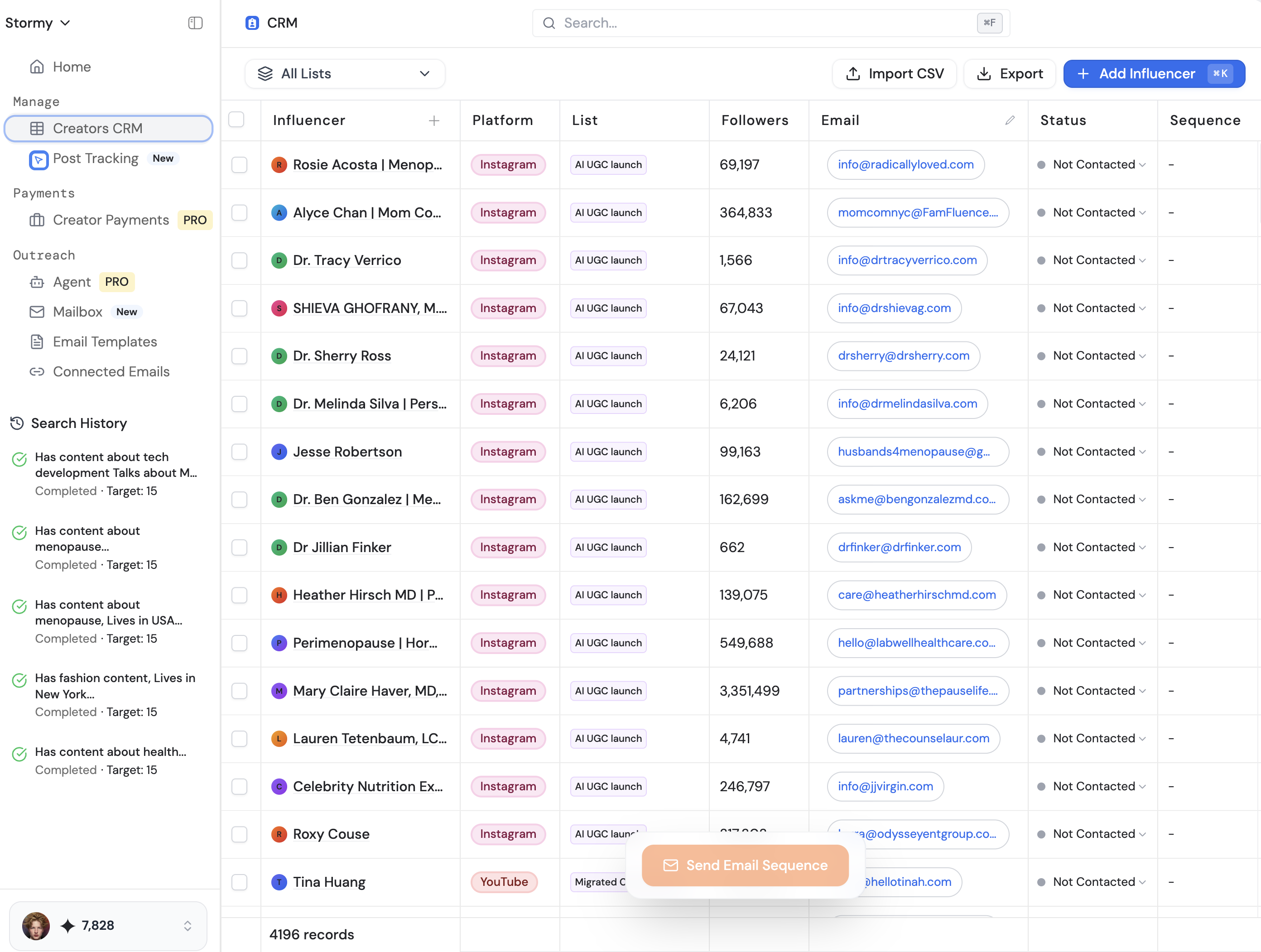
Managing this volume of deals requires a sophisticated flywheel for sourcing. This includes building relationships with other VCs, co-syndicating deals, and leveraging a network of angel investors. Managing these hundreds of relationships manually is impossible. Professional syndicate leads use tools like Stormy's creator CRM to track interactions, negotiation stages, and collaboration history. Whether you are managing 200 startups or 200 influencers, having a centralized hub for your contacts and deal history is essential for scaling.
The Scout’s Advantage: Building a Deal Flow Flywheel
If you are starting with zero assets under management (AUM), your greatest asset is your deal-flow hustle. By becoming a "scout"—finding high-quality deals and sharing them with larger VCs—you build social capital. Over time, those VCs will return the favor by sharing allocations in competitive rounds. This "pay it forward" mentality transforms you from an insignificant check-writer into a strategic partner in the venture ecosystem.
To accelerate this process, you need to automate your outreach. Using Stormy's AI outreach, you can set up an autonomous agent that discovers, outreaches, and follows up with partners every day on a schedule. This hyper-personalized approach ensures you are always top-of-mind for the best deals, even while you sleep. Once the deal is secured, platforms like Stripe or Shopify can help you understand the underlying transaction infrastructure of the companies you are backing.
Conclusion: The New Era of Accessible Venture Capital
Evaluating early stage startups is no longer a dark art practiced only in Silicon Valley boardrooms. By focusing on founder-market fit analysis, leveraging the diligence of institutional leads, and building a diversified venture capital portfolio strategy, everyday investors can participate in the high-growth economy. The key is to start small, build a network of high-quality founders, and use modern AI tools to manage the complexity of a growing portfolio. Whether you're hunting for the next unicorn or the next viral creator, the principles of rigorous vetting and aggressive discovery remain the same. Start building your syndicate flywheel today and position yourself to catch the next 100x wave.