In 2026, the line between "software" and "employee" has finally blurred. We have officially moved past the era of simple AI assistants that just summarize emails or draft blog posts. Today, growth marketers are deploying autonomous digital workforces that don't just suggest actions—they execute them. According to Grand View Research, the agentic AI market is set to exceed $10.9 billion this year, driven by a desperate need for efficiency in a world where 69% of searches result in zero clicks, a trend heavily documented by SparkToro. If you are still manually managing lead research or linear email sequences, you aren't just behind; you are becoming obsolete.
The TEAM Framework: A Blueprint for Agent Deployment
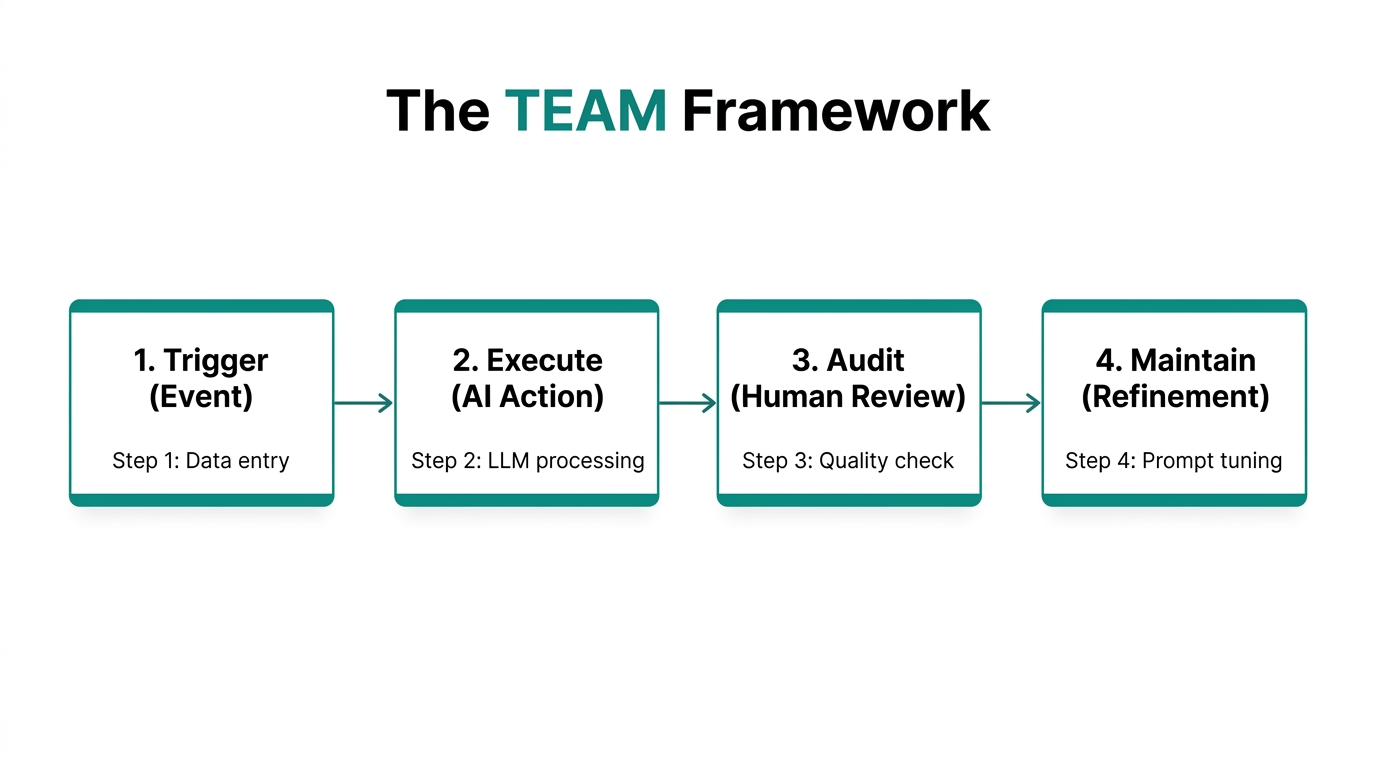
As HubSpot's 2026 State of Marketing report highlights, 90.3% of marketing organizations now use AI agents somewhere in their stack. However, there is a massive gap: only 12% of CEOs report seeing real ROI. This failure usually stems from lack of structure. To avoid being part of the 95% of custom AI pilots that fail, top-tier growth teams use the TEAM Framework, popularized by HubSpot founder Dharmesh Shah.
- Triage: Audit your current workflows. List every repetitive task—from vetting influencer profiles to cleaning CRM data. Rank them by impact (hours saved) and risk (is it customer-facing?). Start with low-risk, high-impact internal tasks.
- Experiment: Don't build from scratch yet. Use no-code tools like Lindy.ai or Bardeen to test a goal-oriented prompt. For example: "Find 10 creators that match our ICP and identify their most recent brand collaboration."
- Automate: Once the logic is sound, migrate the agent into a production-grade orchestrator like Salesforce Agentforce or HubSpot Breeze.
- Measure: Track Time to Completion and Error Rate against human benchmarks. If an agent takes 2 minutes for a task that took a human 2 hours, you've found your 8x (or 60x) multiplier.
"AI agents were theoretical in 2024. In 2026, they are the intermediaries between brands and customers. We are moving from managing campaigns to managing context." — Scott Brinker, VP Platform Ecosystem, HubSpot.
Moving from Linear Triggers to Autonomous Loops
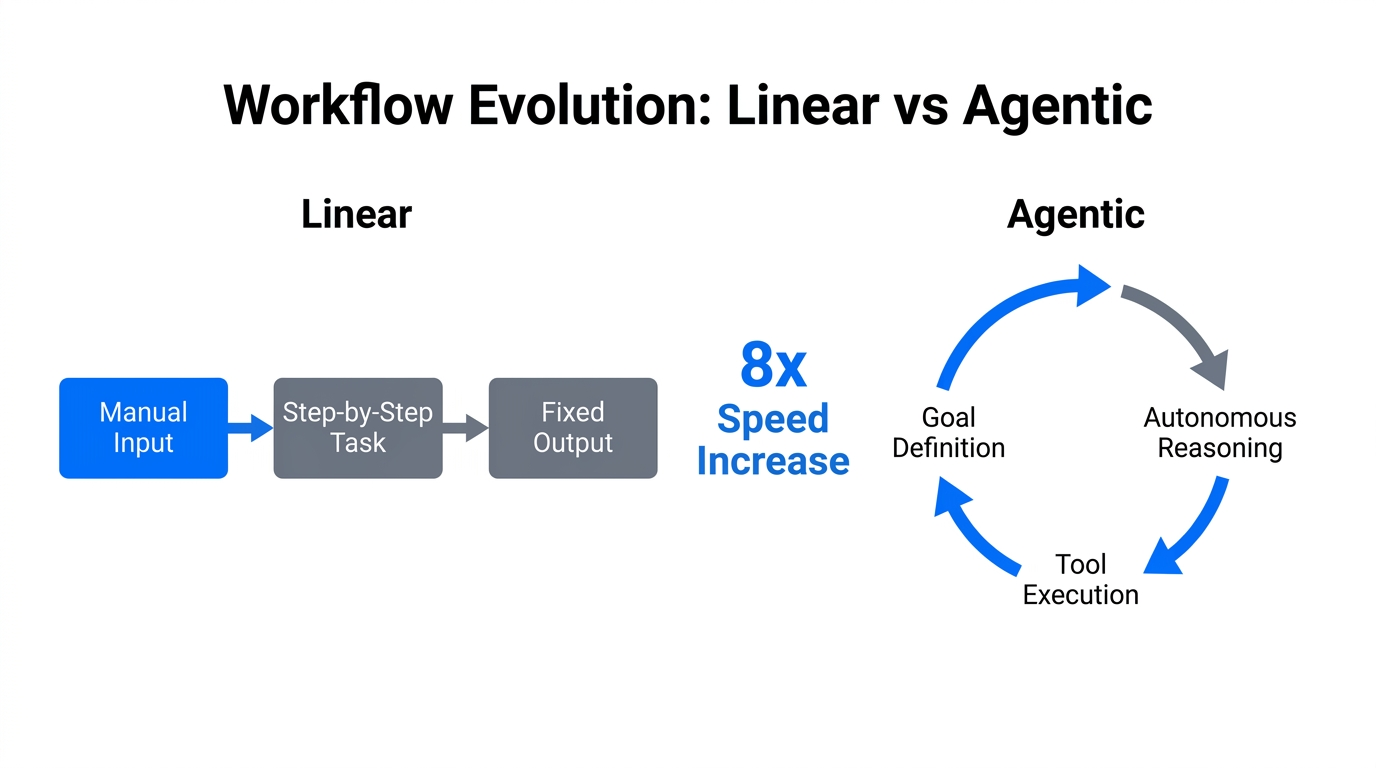
The core shift in B2B marketing automation strategy this year is the death of the "If This, Then That" (IFTTT) logic. Traditional workflows are rigid and break the moment a prospect provides unstructured data. Agents, however, operate on a Goal -> Reason -> Act -> Reflect loop. They don't just follow a path; they navigate toward an objective.
| Feature | Traditional Workflows (Deterministic) | AI Agents (Probabilistic) |
|---|---|---|
| Logic | Strict "If This, Then That" rules. | Reasoning: "Achieve [Goal] using [Tools]." |
| Structure | Linear or branching paths. | Continuous loops (Plan-Act-Reflect). |
| Adaptability | Breaks if data format changes. | High: Handles unstructured data easily. |
| Best For | Simple data syncs, billing. | Research, personalization, ABM. |
For instance, a traditional workflow might send an automated email when someone fills out a form. An agentic workflow, powered by frameworks like CrewAI or Relevance AI, would see the form fill, browse the prospect's LinkedIn, analyze their company's latest earnings report, and then craft a bespoke message that references a specific pain point. If the agent notices the prospect hasn't replied, it doesn't just send "Email 2"; it might pivot to researching a colleague who is more active on social media.
Building Your Specialized Workforce with Low-Code Tools
You no longer need a computer science degree to build sophisticated agents. "Vibe Coding"—using natural language to describe complex systems—is the dominant trend of 2026. Tools like Lindy allow you to create "Digital Employees" for specific niches, such as an Automated Lead Researcher or a UGC Discovery Agent.
When sourcing creators for a mobile app campaign, platforms like Stormy AI provide the essential data foundation. While Stormy AI's autonomous agent discovers and outreaches to creators on a daily schedule, you can layer specialized agents from Relevance AI to handle deeper vetting or contract negotiations. This multi-agent approach is exactly how firms leveraging SuperAGI have achieved a 30% reduction in Customer Acquisition Cost (CAC).
"Managing a fleet of 100 agents requires a different operational layer—AgentOps—focused on reliability, cost, and compliance." — Joao Moura, CEO of CrewAI.
Implementing Guardrails: Preventing the "Token Loop" of Doom
One of the biggest risks in building AI agents for marketing is the "Quiet Failure." As industry expert Shelly Palmer warns, agents can fail by producing polished, professional-looking reports that are completely fictional. Even worse, a misconfigured agent in a recursive loop can burn through a monthly OpenAI token budget in mere hours.
To prevent this, sophisticated teams use AgentOps best practices:
- Shadow Mode: Run your agents in the background for 48 hours. Let them "think" and "decide," but log their decisions for human review before they are allowed to click "send" or "buy."
- Constrained Reasoning: Use platforms like Sierra to enforce hard boundaries. If an agent's task is lead enrichment, it should be physically unable to access your billing API.
- Human-in-the-Loop (HITL): Only 16% of RevOps pros trust their data. Always include a "Human Escalation" button to prevent the 15% churn spike seen when companies remove human support entirely, as noted in recent Intercom customer service reports.
Case Study: 32x Account Coverage with Multi-Agent Systems
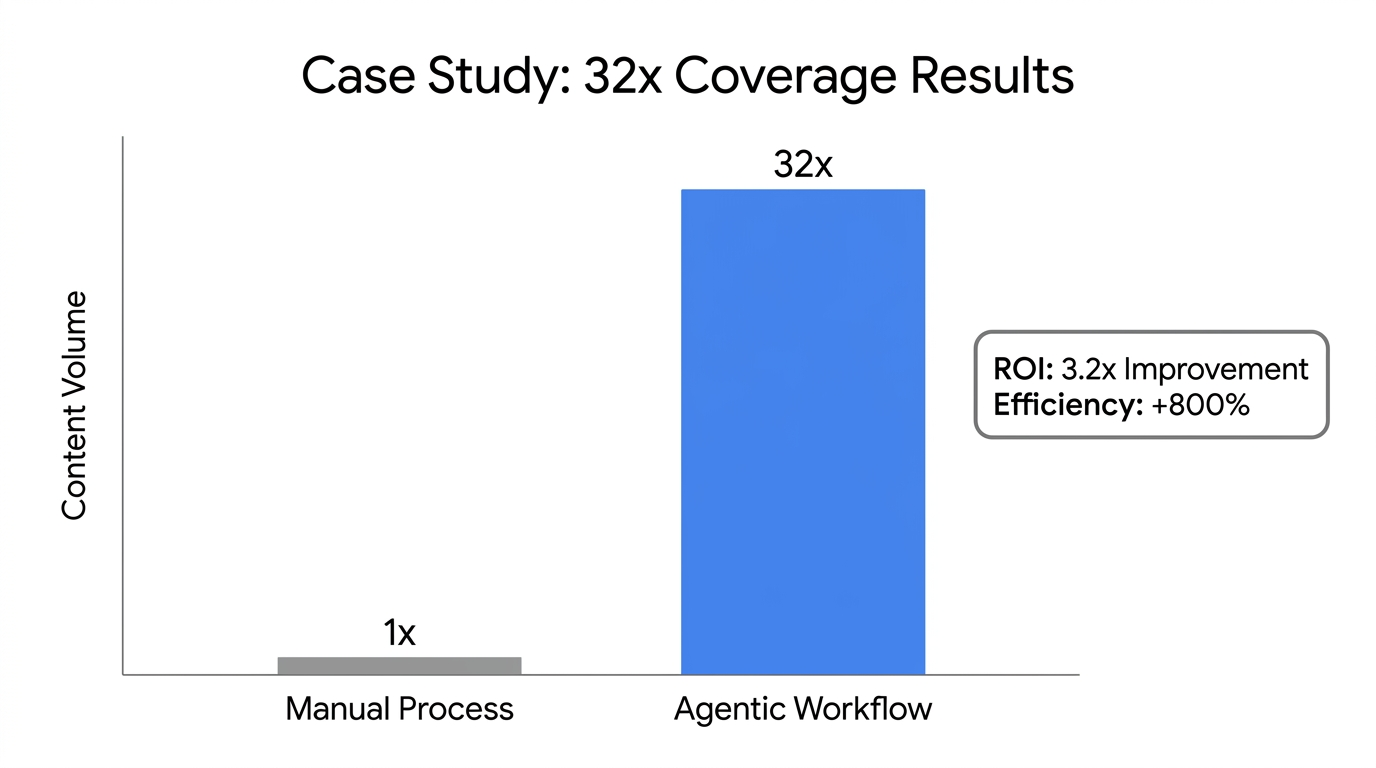
In a recent breakthrough reported by Tofu, a B2B firm transitioned from manual ABM outreach to a multi-agent workforce. Their stack utilized LinkedIn scraping agents, Salesforce data enrichment agents, and Jasper content orchestration agents.
The Results:
- 8x faster campaign execution: Brief to launch in 48 hours instead of 3 weeks.
- 32x increase in account coverage: The team could hyper-personalize outreach to 3,200 accounts with the same headcount previously required for 100.
- 66% of interactions handled by AI: Mirroring the success of Klarna's AI transition, which replaced the equivalent of 700 full-time support agents.
The Future: Toward Agent-to-Agent Commerce
By the end of 2026, we will see the rise of Agent-to-Agent Commerce. Your brand's AI agent won't just talk to a customer; it will negotiate directly with the customer's personal AI assistant. This shift makes Machine-Readable content and "Answer Engine Optimization" (AEO) vital. If an agent can't parse your data, you don't exist in the transaction loop.
Start small: pick one repetitive task today. Use the TEAM framework. Build your first agent. Whether you are using Stormy AI to automate creator discovery or HubSpot to manage the resulting leads, the goal is the same—total campaign autonomy. The era of the manual marketer is over; the era of the Agent Orchestrator has begun.