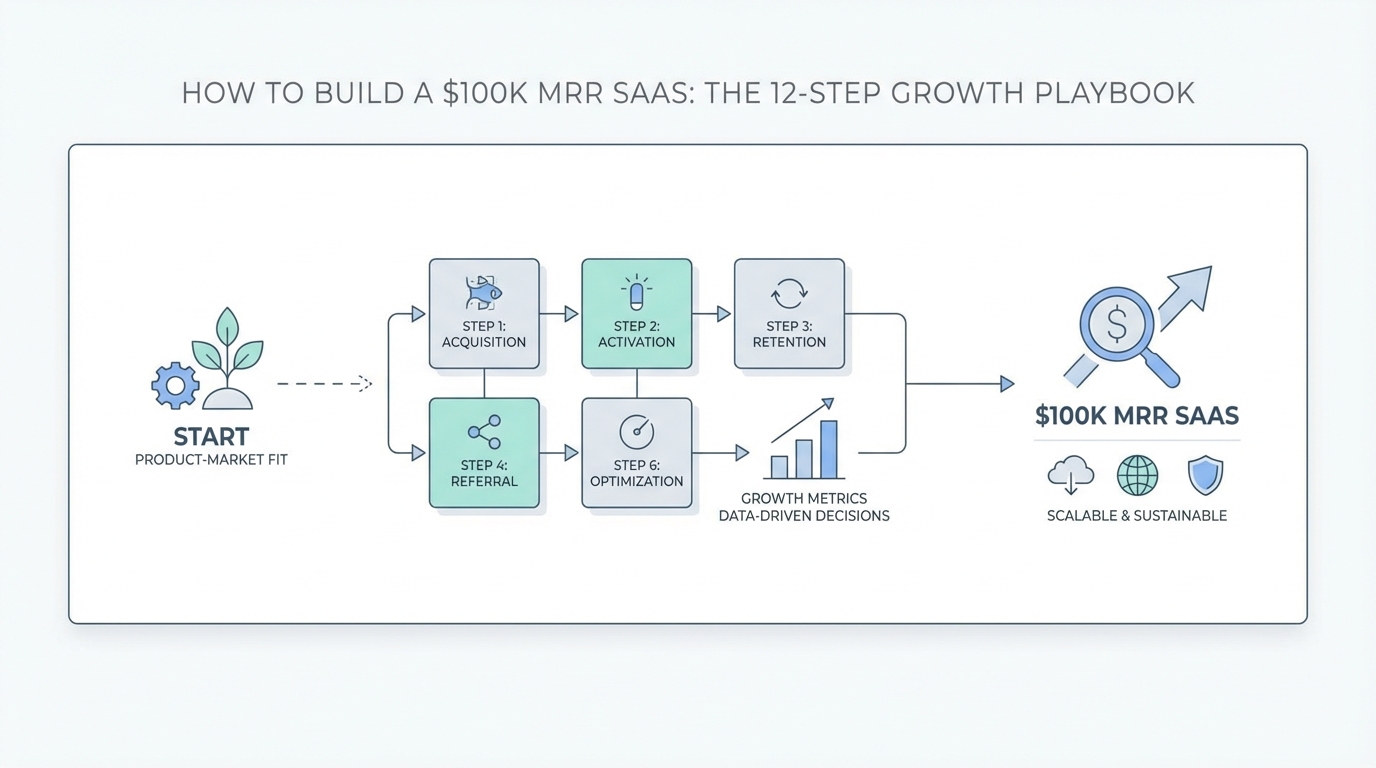
Building a software product from scratch is often portrayed as a slow, academic process of market research and documentation. However, the most successful founders today are proving that speed and radical customer-centricity are the real keys to hitting $100,000 in monthly recurring revenue (MRR). By focusing on shipping quickly and maintaining a direct line of communication with users, entrepreneurs like Tibo, who has scaled four separate apps past the $100K mark, are rewriting the SaaS playbook. This guide breaks down the exact 12-step framework used to build, validate, and scale multiple software companies in today’s fast-moving market.
Step 1: Build Your MVP in Days, Not Months
The biggest mistake founders make when learning how to build a SaaS is spending six months on a product that no one wants. To minimize risk, you must maximize your shipping frequency. Use shortcuts like no-code tools such as Bubble.io or code boilerplates to get a functional version of your idea live in weeks or even days. According to research from Stormy AI, the ability to iterate rapidly is a hallmark of high-growth companies. Remember, you have a 90% failure rate starting out; the goal is to reach that failure quickly so you can pivot to what actually works.
Step 2: Find Your 5-10 Hyper-Relevant Core Users

Once your MVP is live, don't ask your friends or family for feedback. Their opinions are biased and often irrelevant. Instead, find 5 to 10 people who are deeply embedded in the niche you are targeting. Whether it is through niche subreddits, targeted cold email, or platforms like Stormy AI for finding UGC creators and influencers who face these specific pains, you need a core target audience. If these users aren't relevant to your product, their feedback—positive or negative—is essentially noise.
Step 3: Build Deep Customer Relationships
Your early users shouldn't just be data points in an analytics dashboard. At this stage of your SaaS growth strategy, you need to build true relationships. Spend time understanding their daily workflows, their frustrations, and exactly where your software fits into their life. You can manage these early partnerships and design partners using the Stormy AI creator CRM to track every interaction, negotiation, and feedback loop in one place. This deep understanding allows you to deliver 10x more value than a competitor who is just looking at surface-level feature requests.
Step 4: Implement the 'Direct Line' Support Strategy
To foster these relationships, remove all friction between you and the user. Until your product hits $10,000 MRR, consider making the "support" button lead directly to your Twitter DMs. This creates a daily flow of feedback and makes users feel incredibly close to the builder. When a user reports a bug and you fix it in 10 minutes, you create a customer for life who will become a vocal advocate for your brand.
Step 5: Identify the User's Ultimate Goal

Software is just a means to an end. To truly scale your monthly recurring revenue, you must identify the ultimate goal of your users. For example, if you build a tool like Revit.ai, the user's goal isn't just "making a video"; it is growing an audience and generating engagement. By aligning your features with that ultimate outcome, you increase the perceived value and stickiness of your product exponentially.
Step 6: Fix Their Problems, Not Yours
It is easy to get distracted by flashy features that you think are cool. However, your SaaS playbook should prioritize fixing the users' problems. One of the best ways to stay grounded is to be a power user of your own tool. If you are building an SEO tool like Outrank, use it to grow your own organic traffic. When you experience the tiny annoyances yourself, you fix them faster, making life better for every other user in the process.
Step 7: Maintain Constant Iteration
Scaling to a successful software company requires a loop of constant iteration. Stay active on social platforms where your users hang out. By watching what they ask for in real-time, you can maintain a competitive edge. This responsiveness builds trust and ensures your product evolves in the same direction as the market.
Step 8: Repeat Until Retention is Unbreakable
Many founders try to scale acquisition too early. Step 8 is about holding back. Do not go broad until your retention is rock solid. If you push users into a leaky bucket, you waste time and money. High retention is a sign of true value. Interestingly, users who complain are often your most committed users—they want the tool to work because they rely on it. Listen to them to build the stickiness required for long-term growth.
Step 9: Transition to Broad Acquisition
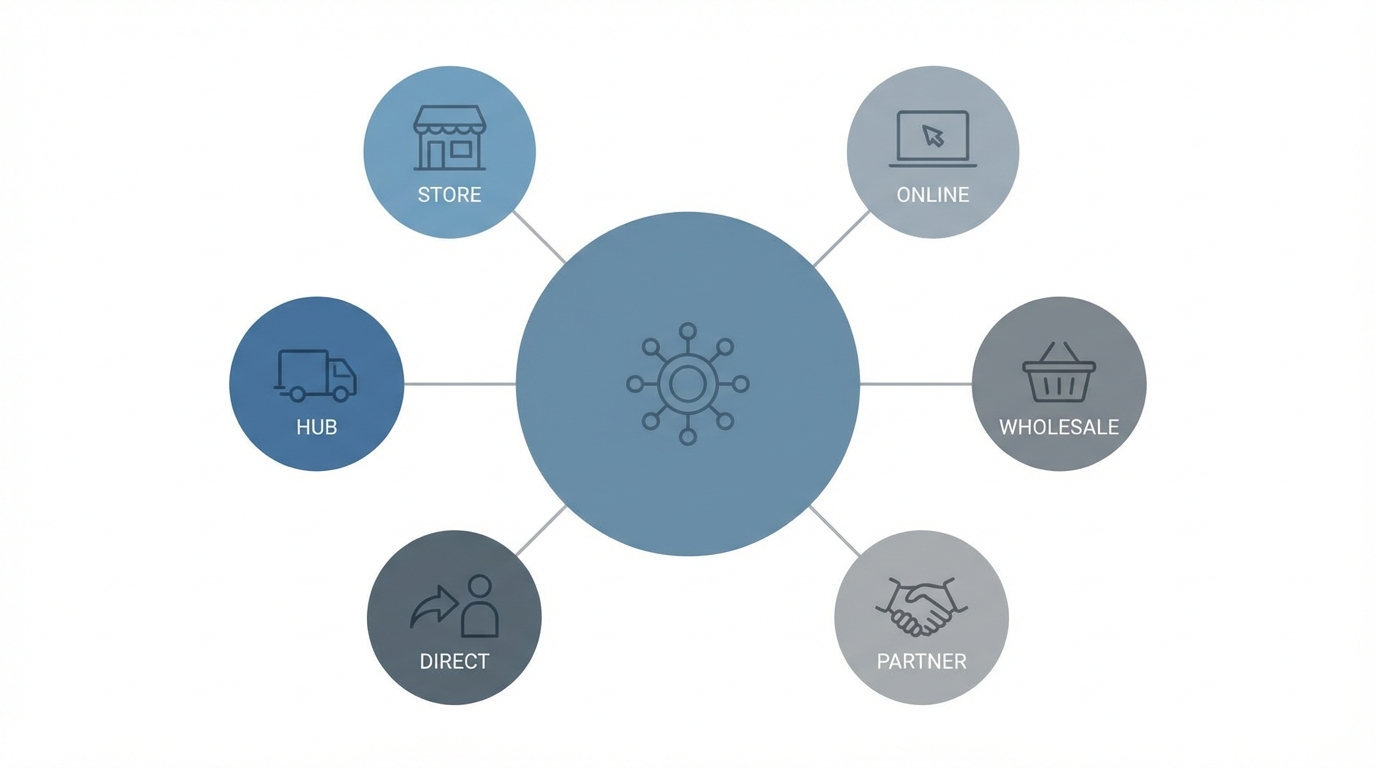
Once you have stickiness, it is time to "go broad." Start by using free or low-cost distribution channels. Launching on Product Hunt or building in public on social media can often get you to your first $2,000 to $3,000 MRR. This revenue is critical because it gives you the breathing room to invest back into your product and explore more scalable growth levers.
Step 10: Become a Media Company
Every modern SaaS needs a content engine. Whether it is SEO-driven blog posts, video testimonials, or case studies, you need a workflow that consistently ships content. To analyze the viral reach of your brand advocates, many founders use Stormy AI to track accounts and monitor individual videos, views, and engagement across social platforms automatically. This content fuels your SaaS growth strategy by building authority in your industry. Share the stories of users who have achieved massive success using your software to create social proof that scales.
Step 11: Scale Sustainable Channels
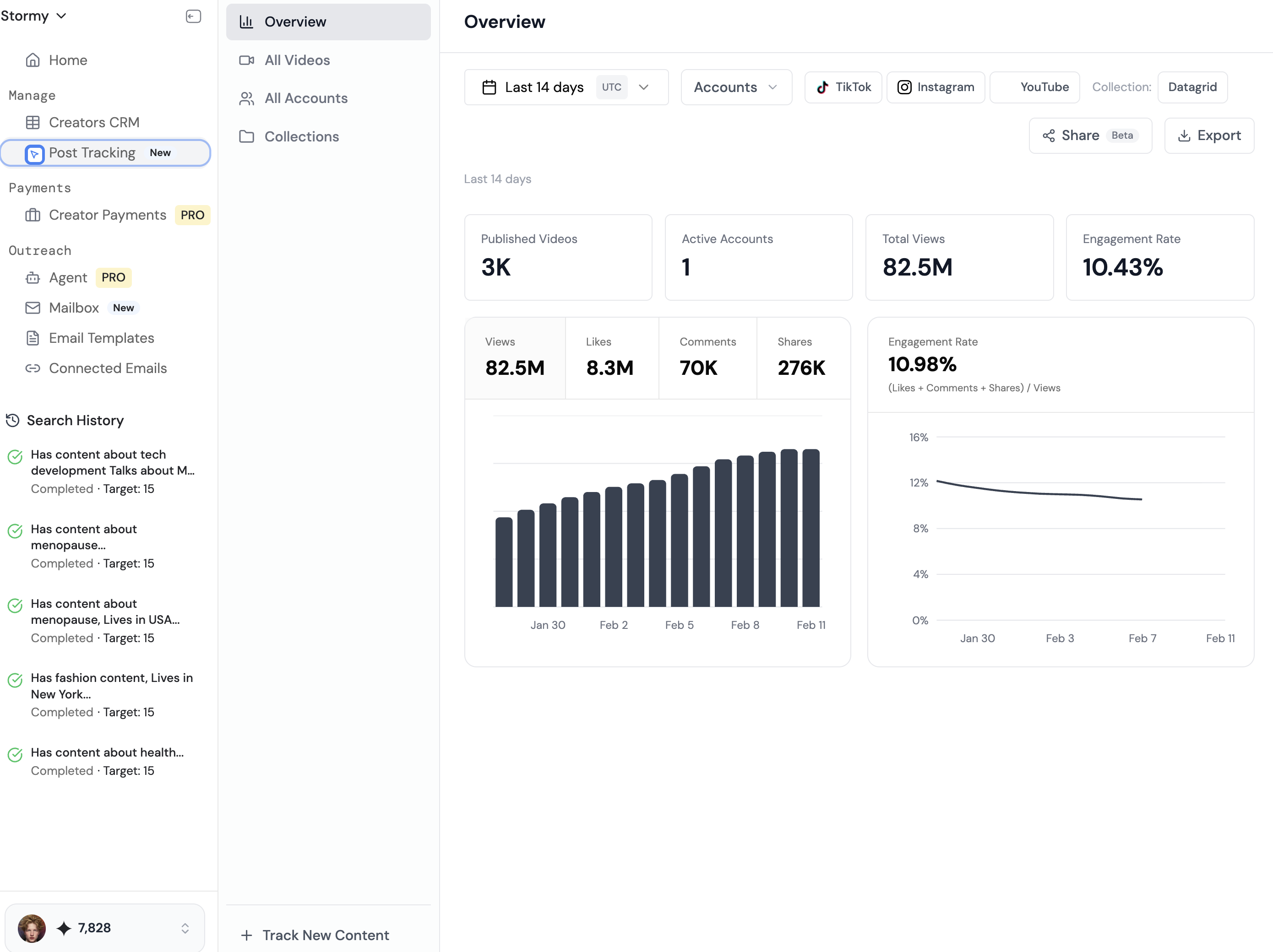
To reach the $100K MRR milestone, you eventually need to move beyond manual outreach and social media posts. This is where you invest in sustainable, scalable channels like SEO, paid ads, and affiliate programs. For instance, you might use Google Ads or Meta Ads Manager to find new cohorts. For mobile-centric apps, Apple Search Ads can be highly effective. Additionally, you can discover creators on Stormy AI to produce authentic UGC (user-generated content) that drives high-intent traffic to your landing pages. Stormy AI is an all-in-one AI-powered platform for creator discovery, vetting, and automated outreach campaigns.
Step 12: Scale What Works and Kill What Doesn't
The final step in the SaaS playbook is ruthless prioritization. While you should experiment with many acquisition channels, most of your growth will likely come from just one or two. If SEO is driving the majority of your trials, hire a dedicated team for it. If affiliate marketing is stagnant despite your efforts, kill it. Focus your energy where the ROI is highest to maintain a consistent 20% month-over-month growth rate.
Conclusion: The Path to $100K MRR
Reaching $100,000 in monthly recurring revenue isn't about having one perfect idea; it's about having a repeatable system. By shipping fast, talking to users daily, and scaling only after you've achieved high retention, you build a resilient software company. In an era where AI can shift the market overnight, a portfolio of successful products and a direct line to your customers are your best defenses against obsolescence. Start small, talk to your first ten users today, and begin your journey toward scaling your first major SaaS success.