In the rapidly shifting landscape of mobile marketing, App Store Optimization 2025 has moved far beyond simple keyword stuffing. Today, success is defined by those who can navigate a sea of over 2 million apps on the Apple App Store and nearly 4 million on Google Play. With approximately 70% of visitors using search to discover new software, and a staggering 65% of all downloads occurring immediately after a search query, according to data from Apple Search Ads, the stakes for identifying high volume app keywords have never been higher. However, the old rules of engagement have been rewritten by algorithm updates and reporting shifts that have left many marketers in the dark.
Navigating the 2025 SAP Crash: The Rise of Monthly Reporting
For years, ASO specialists relied on daily updates to the Search Ads Popularity (SAP) API to gauge real-time shifts in user behavior. That changed in September 2025, an event now widely referred to as the "SAP Crash." Apple transitioned its reporting infrastructure from a daily cadence to a Monthly Search Term Rank Report, fundamentally altering how we view the app store search popularity index. This shift caused a perceived 77% drop in keywords showing high popularity scores, but the traffic hasn't disappeared—it has simply been smoothed out over a 30-day average.
Marketers who fail to adapt to this change risk chasing ghost trends or abandoning high-value terms that appear "dead" in legacy ASO keyword research tools. To succeed in this new era, you must prioritize stability over spikes. Analyzing 30-day averages allows you to see which terms provide consistent, reliable traffic rather than temporary viral anomalies. This is particularly critical when planning long-term organic growth strategies that aren't dependent on fluctuating ad spend.
"The SAP Crash didn't kill search volume; it killed short-termism. The winners in 2025 are those who look at the 30-day horizon to find sustainable growth."
The 30% Opportunity: Dominating Generic Search Traffic
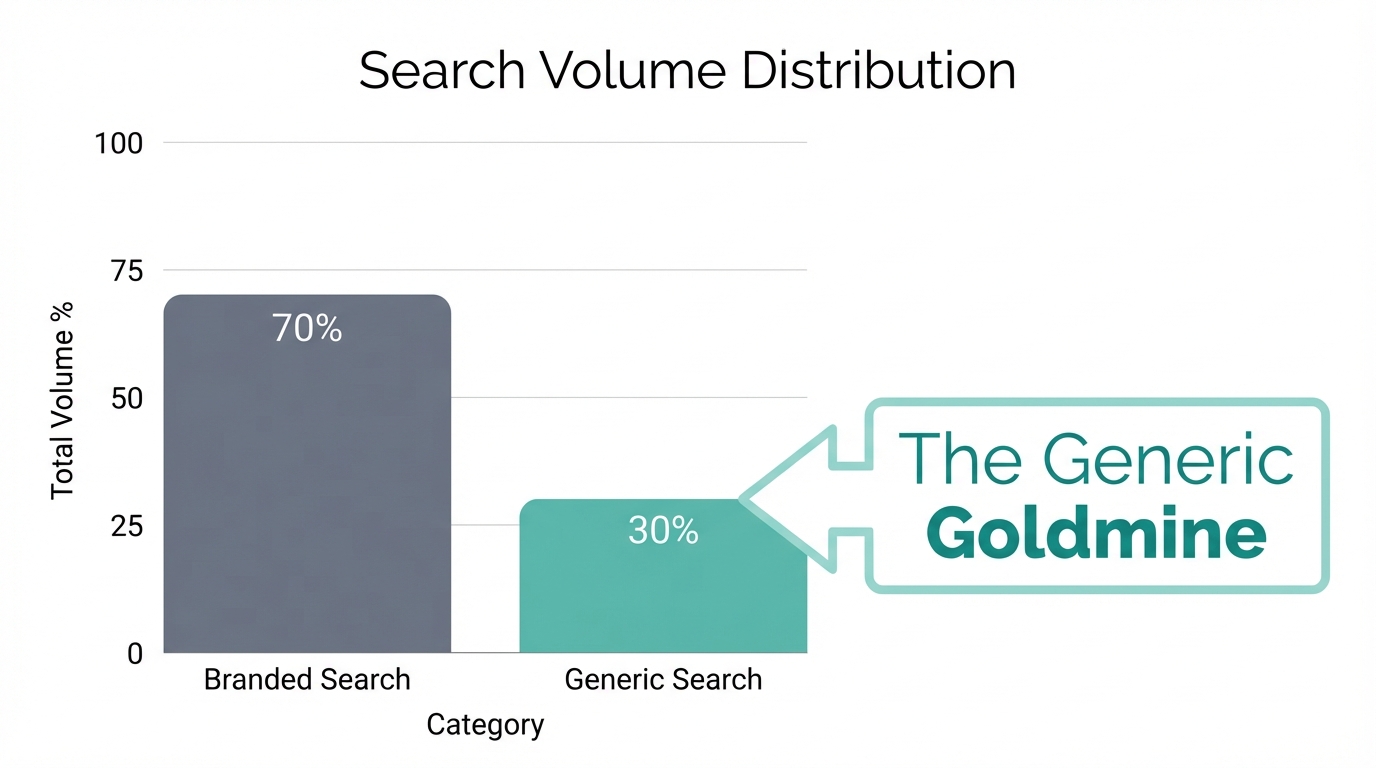
Data from Stormy AI research indicates that while roughly 70% of total search volume is driven by massive branded terms like "TikTok" or "Instagram," the real growth potential for new and mid-sized apps lies in the remaining 30% of generic traffic. Branded terms are high-volume, but they often represent users who already know what they want. In contrast, generic terms represent users with high-intent needs but no specific solution in mind.
Generic keywords like "meditation for sleep" or "budget tracker for couples" are where you can establish authority. Because these terms are less dominated by household names, they offer a realistic path to ranking in the top three results. According to research from MobileAction, capturing even a small slice of this 30% can lead to higher conversion rates because the app directly solves the user's explicit search query.
Semantic Indexing and the Evolution of AI Intent
The App Store algorithms are no longer just looking for exact matches. We have entered the age of semantic indexing. This means that if your app is optimized for "mental health," the App Store may automatically rank you for related clusters like "stress relief" or "mindfulness" based on thematic relevance. This shift, highlighted by Dotcominfoway, requires a more holistic approach to metadata.
Furthermore, predictive AI tools are now being used to forecast "rising star" keywords before they reach their peak. By cross-referencing in-app data with broader social trends, platforms can identify emerging needs—such as the sudden surge in "AI headshot generators" before the market became saturated. Leveraging Practical Logix insights, developers are encouraged to build features around these rising trends rather than trying to shoehorn old features into new keywords.
The 2025 High-Volume Keyword Playbook
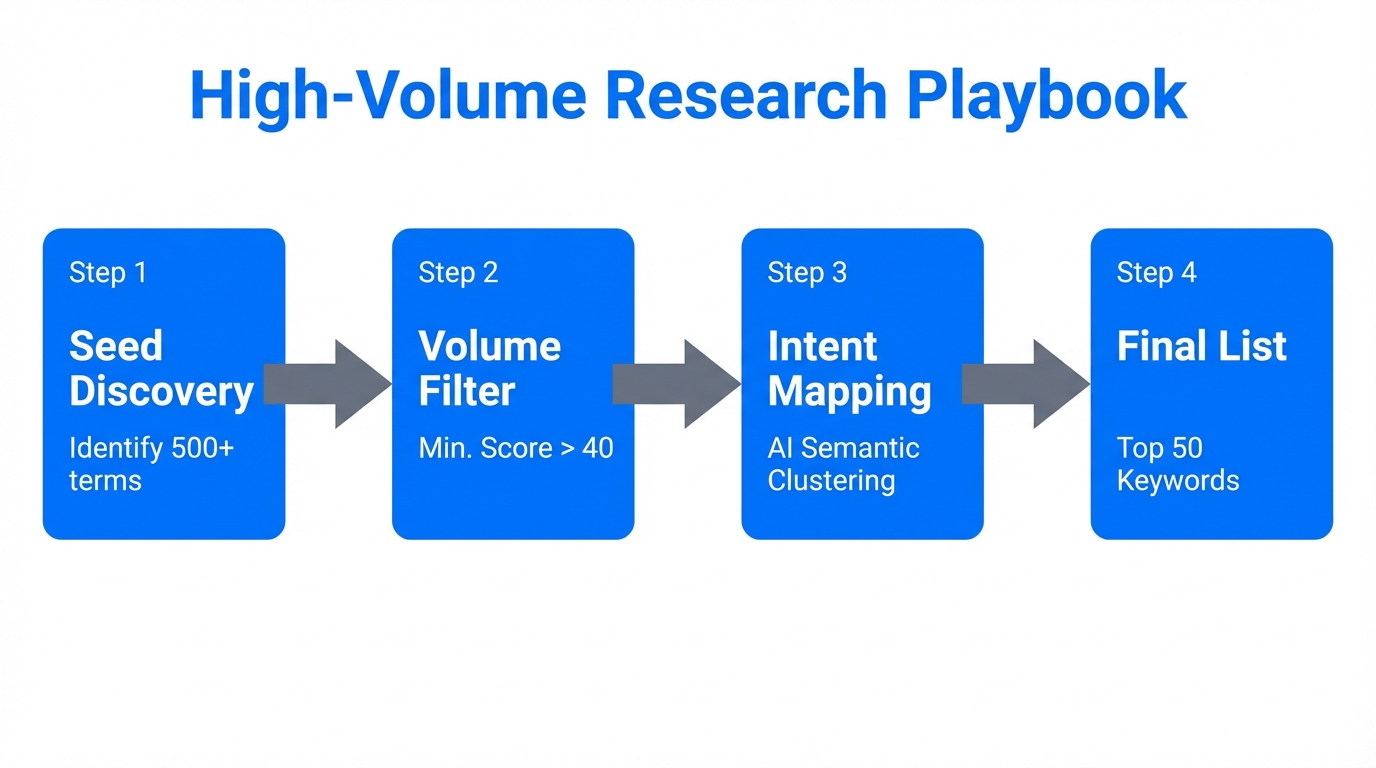
To scale your app growth effectively, you need a repeatable system for finding and implementing keywords. Follow this multi-step workflow to maximize your visibility:
Step 1: Identify "Mid-Tier" Competitors
Do not try to emulate the keywords of category giants like Uber or Airbnb. Their rankings are driven by massive brand power and offline marketing. Instead, use an ASO keyword research tool like ASOTools.io to analyze apps ranked between #10 and #50 in your category. These apps are winning on the strength of their ASO, and their keyword sets will reveal achievable high-volume terms.
Step 2: Apply the 30-30-100 Rule
According to Stormy AI best practices, your metadata should be structured for maximum weight:
- App Title (30 characters): This carries the most weight. Lead with your #1 high-volume generic keyword (e.g., "Sleep Tracker – Relaxing Sounds").
- Subtitle (30 characters): Focus on secondary keywords that define your unique value proposition.
- Keyword Field (100 characters): Use a comma-separated list without spaces. Never repeat terms used in the title or subtitle, as this wastes valuable space.
Step 3: The Secondary Locale Hack
In the US market, Apple also indexes keywords from the Spanish (Mexico) locale. By filling that metadata with an entirely different set of keywords, you effectively double your keyword real estate. This allows you to target a broader range of high volume app keywords without sacrificing the clarity of your primary US English listing.
"Doubling your real estate through locale hacking is the single most underutilized strategy in the current ASO landscape."
Choosing the Right ASO Keyword Research Tool
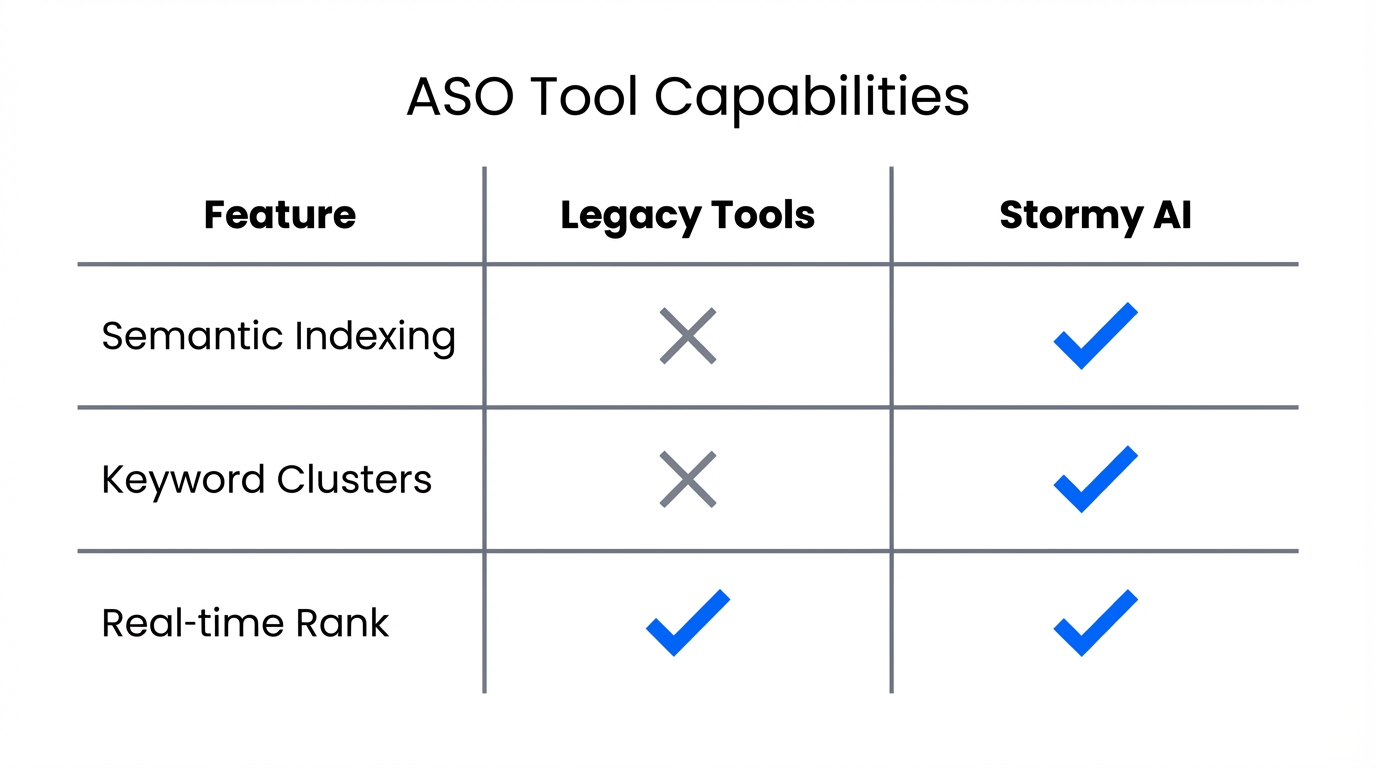
Not all tools are created equal. Depending on your budget and technical needs, you should select a platform that offers more than just raw numbers. Modern tools should provide difficulty scores and intent analysis.
| Tool | Best For | Key Strength |
|---|---|---|
| AppTweak | Market Research | Deep Search Popularity index and competitor gap analysis. |
| MobileAction | Keyword Matrices | Visualizing how you rank against the entire category landscape. |
| ASOTools.io | Competitor Spying | Extracting "hidden" keywords that competitors are successfully targeting. |
| ASOWorld | Growth Scaling | Balancing organic keyword research with visibility services for rapid ranking. |
The Intersection of UGC and Search Popularity
While ASO handles the technical side of discovery, social trends often drive the search volume itself. When a specific feature or use case goes viral on TikTok, search volume for those terms spikes on the App Store. This is where tools like Stormy AI become invaluable. By using Stormy AI to discover and manage UGC creators, you can coordinate social campaigns that specifically target the keywords you want to rank for.
For example, if you are targeting the keyword "productivity planner," you can use Stormy AI to find creators who specialize in desk setups and organization. When they showcase your app, users will naturally head to the App Store and search for that specific term, signaling to the algorithm that your app is the most relevant result for that high-volume query. This creates a powerful feedback loop between social proof and organic search rank.
Maintaining Rank: The 4-Week Audit Rule
Search volume is volatile. Due to the shift toward monthly reporting, the old "set-and-forget" mentality will lead to a slow decline in rankings. Experts now recommend a comprehensive metadata audit every 4 weeks. This allows you to rotate out keywords with a difficulty score >70 (out of 100), which are often too competitive for new apps to rank in the top positions.
It is far more effective to rank #1 for a medium-volume term than #150 for a high-volume branded keyword. Use your monthly audit to identify "declining stars" and replace them with fresh, rising keywords identified during your research. Avoid the common mistake of keyword stuffing, especially on Google Play, as this can trigger algorithmic penalties and hurt your conversion rates by making your description look spammy to human users.
Conclusion: Scaling Growth in a Post-SAP World
Scaling app growth in 2025 requires a sophisticated blend of data analysis and strategic execution. By embracing the Monthly Search Term Rank Report, focusing on the 30% generic traffic goldmine, and utilizing the 30-30-100 rule, you can build a sustainable organic engine for your app. Remember that ASO is not a one-time task but a continuous cycle of auditing and optimization.
Combine these technical strategies with the power of creator-led discovery using tools like Stormy AI to drive intentional search volume. By staying ahead of the app store search popularity index and consistently refining your approach, you will secure the visibility needed to thrive in an increasingly crowded marketplace. The era of guessing is over; the era of AI-driven, intent-based ASO has arrived.