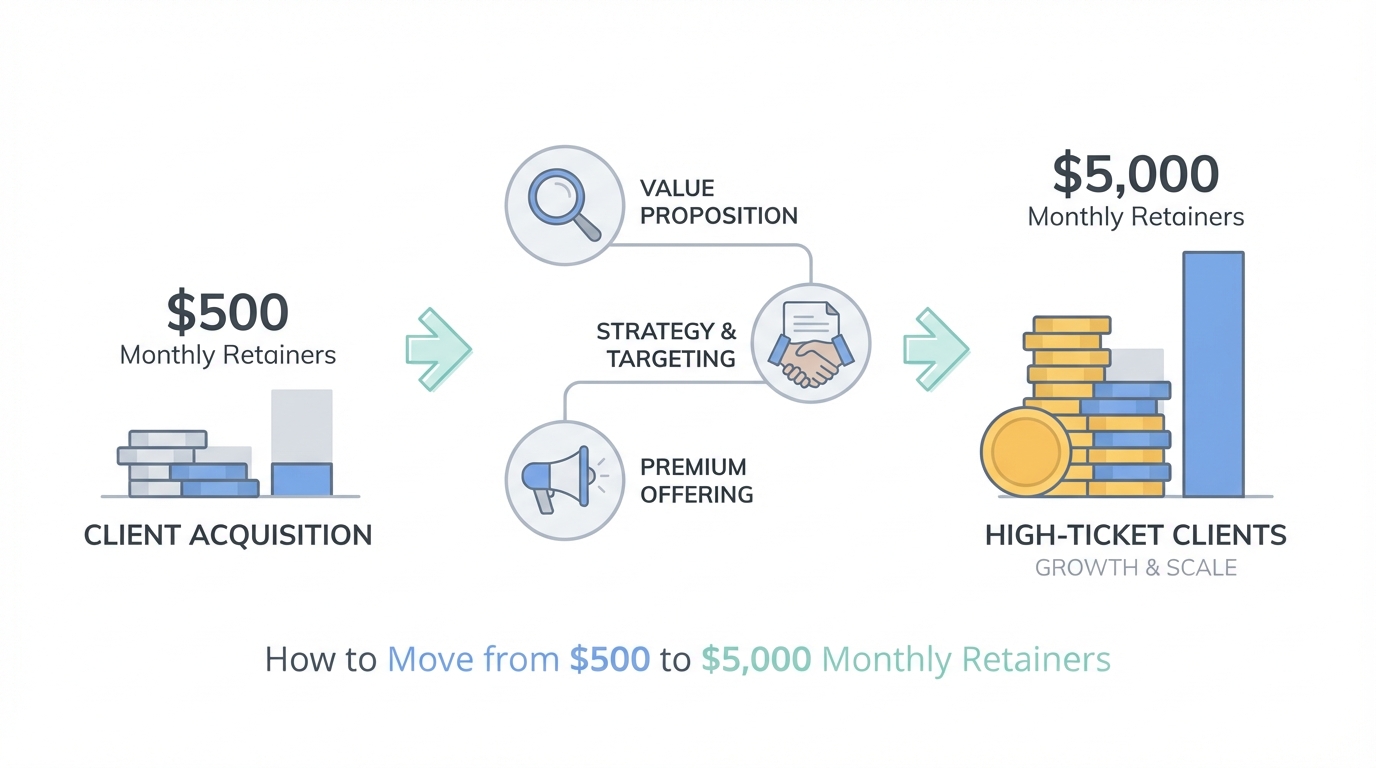
For most creators and solopreneurs, the journey begins with a grind. You take any project that comes your way, often charging a few hundred dollars just to prove your worth. But there is a ceiling to how many $500 projects you can manage before your quality of life—and your output—begins to suffer. Moving into the realm of high-ticket client acquisition isn't just about adding a zero to your invoice; it is a fundamental shift in how you position your value, manage your time, and identify your target audience. To build a sustainable 1.8 million dollar per year business as a solo operator, you must stop selling your time and start selling your impact.
The Psychology of the $500 vs. $5,000 Client
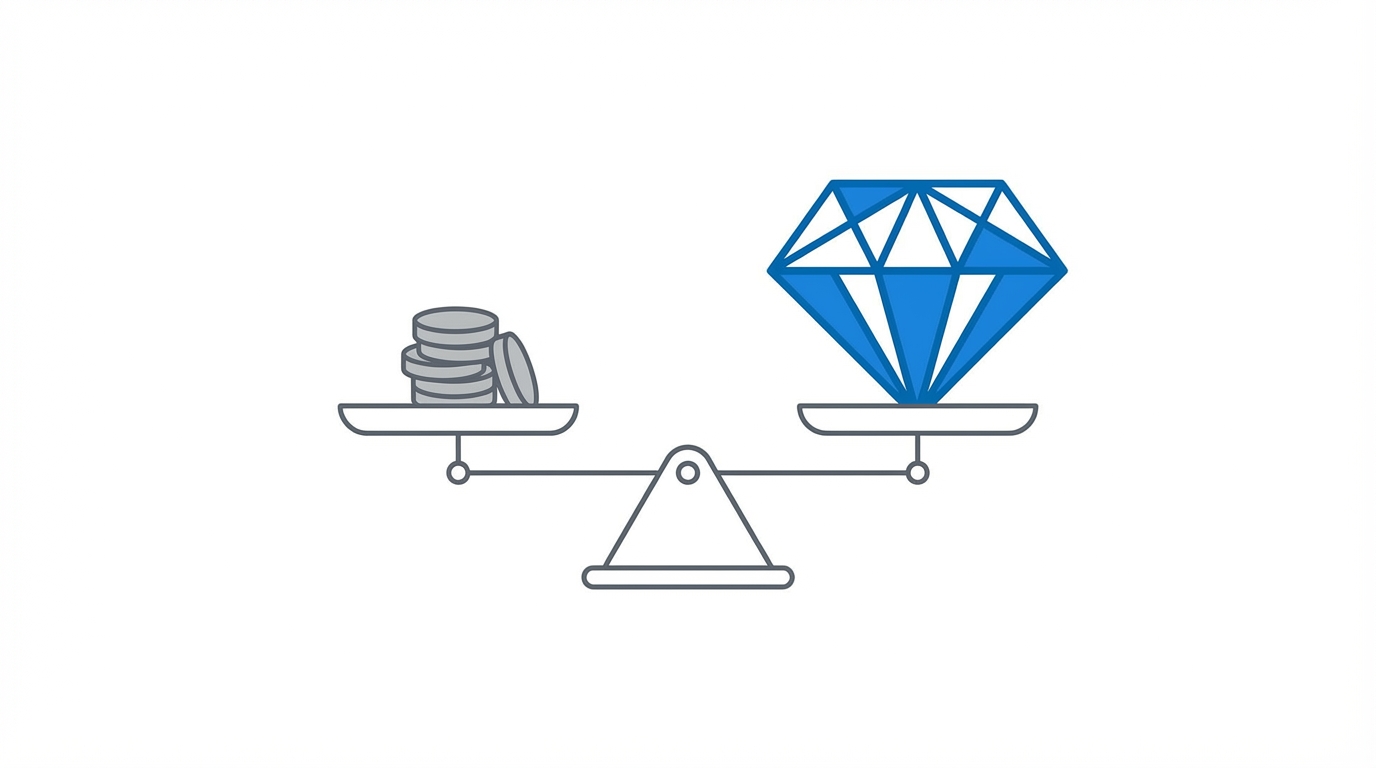
One of the most counterintuitive lessons in business is that the client paying you $500 is often significantly more difficult to manage than the one paying you $5,000. This phenomenon exists because of the different psychological profiles of these two groups. A $500 client is often a small business owner where every dollar represents a personal sacrifice. Because the stakes feel high to them, they are more likely to micromanage, request endless revisions, and demand constant communication via Google Calendar meetings that eat into your productive hours. They are often struggling themselves, and they view your service as a cost rather than an investment [source].
In contrast, a $5,000 client—typically an enterprise-level startup or a well-funded business—values speed and reliability over cost. As highlighted in the research by The Playbook, these "rich" clients don't blink twice at a high invoice if you consistently deliver high-quality work. They have larger budgets and view your service as a "steal" compared to the alternative of hiring a full-time employee or a bloated traditional agency. They want you to solve their problem autonomously so they can focus on their own growth. Understanding this distinction is the first step in your B2B service pricing strategy.
Demand-Based Pricing: The Path to Market Mastery
You cannot jump to $5,000 retainers without first building a foundation of excellence. This requires a demand-based pricing approach. When DesignJoy founder Brett Williams launched his agency, he initially charged just $449 a month for unlimited design. This was intentionally underpriced to gain momentum and put in the "thousands of reps" needed to become world-class. Speed is your greatest asset in the early stages; getting that first customer in 24 hours is more important than getting a high-paying one in six months.

As demand increases, so should your price. You move from $449 to $1,000, then $3,000, and eventually $5,000+. This allows you to vet your workflow and refine your service while you have a safety net of clients. Once you have reached the high-ticket stage, you can leverage Stormy's AI search for discovery across TikTok, YouTube, Instagram, LinkedIn, and newsletters to find specific niches of creators or brands that are already showing high engagement and growth—signaling they have the budget to support your new pricing tier. By using natural language prompts to find these prospects, you skip the manual prospecting that keeps most solopreneurs stuck in low-ticket loops.
Positioning as a "No-Brainer" Alternative to In-House Hires
To master how to find high paying clients, you must change how you frame your offer. You aren't just a "freelancer"; you are a more efficient, less risky alternative to a full-time hire. A company looking for high-end graphic design or marketing talent has three difficult choices: hire a $200,000-per-year professional on LinkedIn, pay a traditional agency $40,000 per project, or sift through thousands of unvetted options on low-cost marketplaces.
By positioning your service at $5,000 a month, you become the "no-brainer" middle ground. You provide the quality of a top-tier hire without the overhead of benefits [source], taxes, or management. Plus, high-ticket clients appreciate the flexibility to cancel at any time. When you use Stormy AI for influencer vetting, fake follower detection, and content quality scoring, you can show these potential clients exactly how your work (or the creators you manage) compares to competitors, providing data-backed proof that your high-ticket rate is a calculated investment, not a luxury expense.
Transitioning to Value-Based Pricing for Services

The secret to value-based pricing for services is decoupling your earnings from your hours. If you charge by the hour, you are effectively punished for being efficient. Instead, price based on the impact of the result. For example, a high-converting landing page is worth thousands to a startup because it directly influences their customer acquisition cost (CAC). A minor increase in conversion rate can lead to hundreds of thousands of dollars in revenue, making a $5,000 retainer look like a bargain.
However, this only works for services that are "high demand and low touch." You want to provide a service that is critical to a business's success but doesn't require constant, repetitive maintenance from your end. This allows you to manage multiple high-ticket clients simultaneously without scaling your hours proportionally. To track this impact, you can utilize Stormy's post tracking to monitor how individual videos, posts, and campaigns are performing in real-time across social platforms, giving you the analytics needed to justify your high-ticket rates during monthly reviews.
Establishing Boundaries to Protect Your Most Precious Asset
As you move into high-ticket acquisition, your time becomes your most expensive resource. High-ticket clients will respect your boundaries if they are clearly defined from day one. Implementing an asynchronous workflow—using tools like Trello for requests and avoiding live meetings—is essential for maintaining a high-profit margin.
By enforcing a "one active request at a time" rule, you force the client to prioritize their needs and provide clearer instructions. This reduces the back-and-forth and prevents the "scope creep" [source] that kills profitability in B2B service pricing strategy. Boundaries aren't about being difficult; they are about creating a system where you can deliver your best work without burning out. This professional structure is exactly what high-paying clients expect; it signals that your time is valuable and your process is refined.
The "Netflix" of Services: Frictionless High-Ticket Retention
The final step in client retention for solopreneurs is removing the friction of the purchase. High-ticket clients shouldn't have to wait for a custom proposal or a manual invoice every month. By turning your service into a "subscription" model—the Netflix of your niche—you make the transaction seamless. Use platforms like Stripe to set up recurring billing so that the partnership continues automatically.
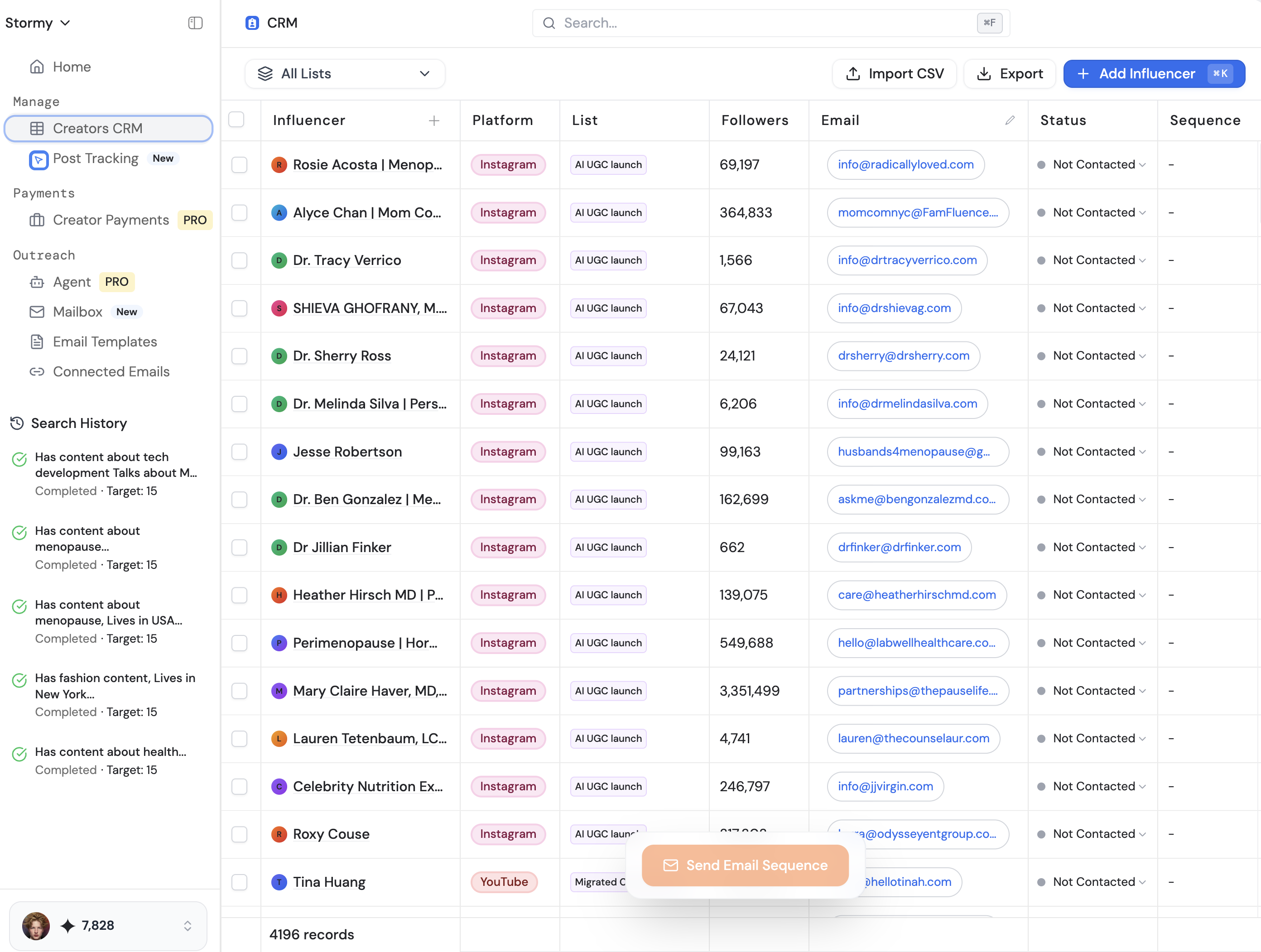
Managing these high-value relationships requires a centralized hub. Stormy's creator CRM allows you to track every interaction, deal stage, and negotiation history in one place. When combined with Stormy AI's personalized email outreach, which can automatically follow up with potential high-ticket leads using hyper-personalized messages generated for each contact, you create a self-sustaining growth engine. You can focus on delivering world-class results while the AI handles the discovery and initial outreach to the next $5,000 client.
Scaling Beyond Services: Build Once, Sell Forever
While a $5,000 retainer is excellent, the ultimate goal for any high-paid solopreneur is to diversify income into digital products. By documenting your process and the knowledge gained from thousands of reps, you can create info-products or templates that sell while you sleep. Whether it is a collection of UI assets or a course on high-ticket client acquisition, these products allow you to scale your revenue without scaling your time. This transition ensures that your business remains profitable even when you aren't actively working on client projects.
Ultimately, moving from $500 to $5,000 monthly retainers is about choosing to work with clients who respect your expertise and value your impact. By leveraging an autonomous Stormy AI agent to automate discovery, outreach, and creator payments, you can spend less time hunting for leads and more time delivering the high-value work that justifies your premium pricing. Success in the high-ticket world isn't about working harder; it's about working smarter for the right people.