Marketing teams today are drowning in data but starving for insight. We have spreadsheets full of conversion rates, Slack channels overflowing with creative ideas, and meeting transcripts that disappear into the digital void. The bottleneck in any modern Go-To-Market (GTM) strategy isn't a lack of information—it's the inability to recognize patterns across fragmented domains. We miss the connection between a specific customer complaint in a support ticket and a burgeoning trend on TikTok because those data points live in different universes.
Enter the combination of Obsidian and Claude Code. This isn't just another tech stack addition; it is a fundamental shift in how strategic marketing workflows are built. By using Obsidian as a "Market Intelligence Vault" and Claude Code as a terminal-based thinking partner, marketers can now perform advanced marketing pattern recognition that was previously impossible. This setup allows you to pass full project context—from Slack transcripts to Google Calendar data—into an AI agent that understands your brand's deep history.
Context Architecture: The Oxygen of AI
The biggest frustration with using standard AI interfaces like ChatGPT or the Claude web app is the "amnesia effect." Every time you start a new session, you have to re-explain your brand voice, your ICP (Ideal Customer Profile), and your 6-month goals. This repetitive task kills velocity. To solve this, sophisticated marketing teams are moving toward Context Architecture.
In this model, your marketing strategy isn't just a PDF; it’s a living repository of markdown files in an Obsidian vault. When you use Claude Code—a command-line interface (CLI) agent—you can reference these files instantly. Instead of a 500-word prompt, you use a single command to load your entire brand history. As noted in recent research on Anthropic's latest developer tools, the ability to feed "the beast" good context is the entire game. If the agent knows your history, it can make decisions that actually align with your vision.
"The quality of information that the agent has entirely determines what it can do for you. If it doesn't know a lot about you, it's not going to be able to do a lot for you."Building the Market Intelligence Vault
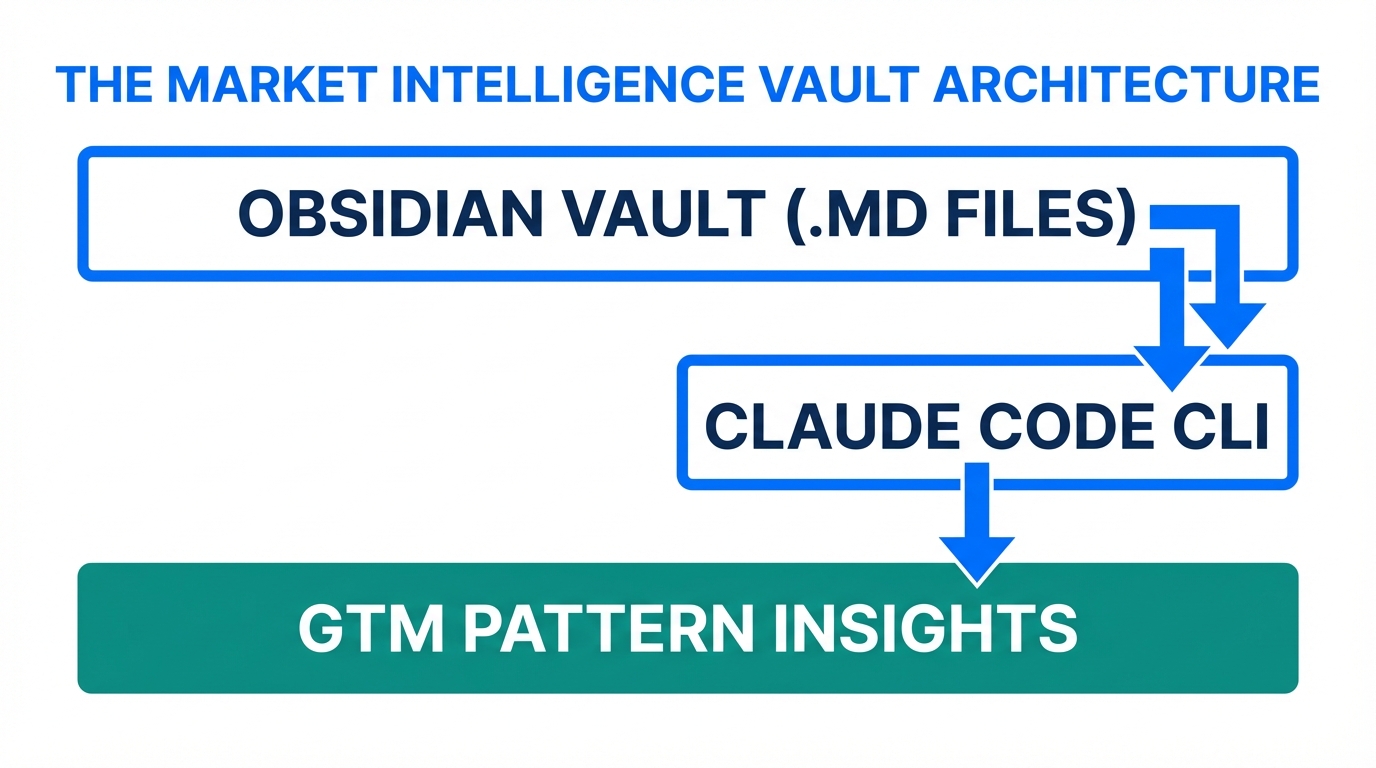
Obsidian is often described as a "second brain," but for a GTM team, it functions as a Market Intelligence Vault. Unlike a standard folder system, Obsidian allows for bidirectional linking. If you mention "UGC" in a note about TikTok Ads and also in a note about SEO, Obsidian creates a relationship between those two domains.
By pairing this with the Obsidian CLI, Claude Code can read the entire link graph of your vault. It doesn't just see individual files; it sees how your thoughts on influencer marketing connect to your churn rate data. This prevents duplicate research and helps identify where ad spend is being wasted on strategies that your internal notes already flagged as low-performing. Your vault becomes the source of truth that governs every automated decision.
The 'Connect' Command: Finding UGC and SEO Synergies
One of the most powerful applications of Claude Code in a marketing context is the /connect command. This custom command instructs the AI to look at two seemingly unrelated domains in your vault and find the "bridge" between them. For example, a marketer might run /connect "UGC Creators" "SEO Keyword Strategy".
Claude Code will scan your transcripts from creator calls, your Google Ads performance data, and your content calendar to surface non-obvious insights. It might discover that the specific vocabulary used by creators found via Stormy AI in high-performing videos actually matches long-tail keywords that your SEO team hasn't targeted yet. This type of AI market research turns anecdotal evidence into a scalable strategic marketing workflow.
| Strategy Component | Legacy GTM Workflow | AI Pattern Matching (Obsidian + Claude) |
|---|---|---|
| Context Loading | Copy-pasting prompts manually | /context-load command for instant history |
| Idea Discovery | Siloed brainstorming sessions | /emerge to find latent patterns in notes |
| Goal Tracking | Manual monthly reviews | /drift analysis of behavior vs. intention |
| Tooling | Fragmented SaaS platforms | Unified Vault as a centralized Marketing OS |
The 'Drift' Analysis: Strategy vs. Execution
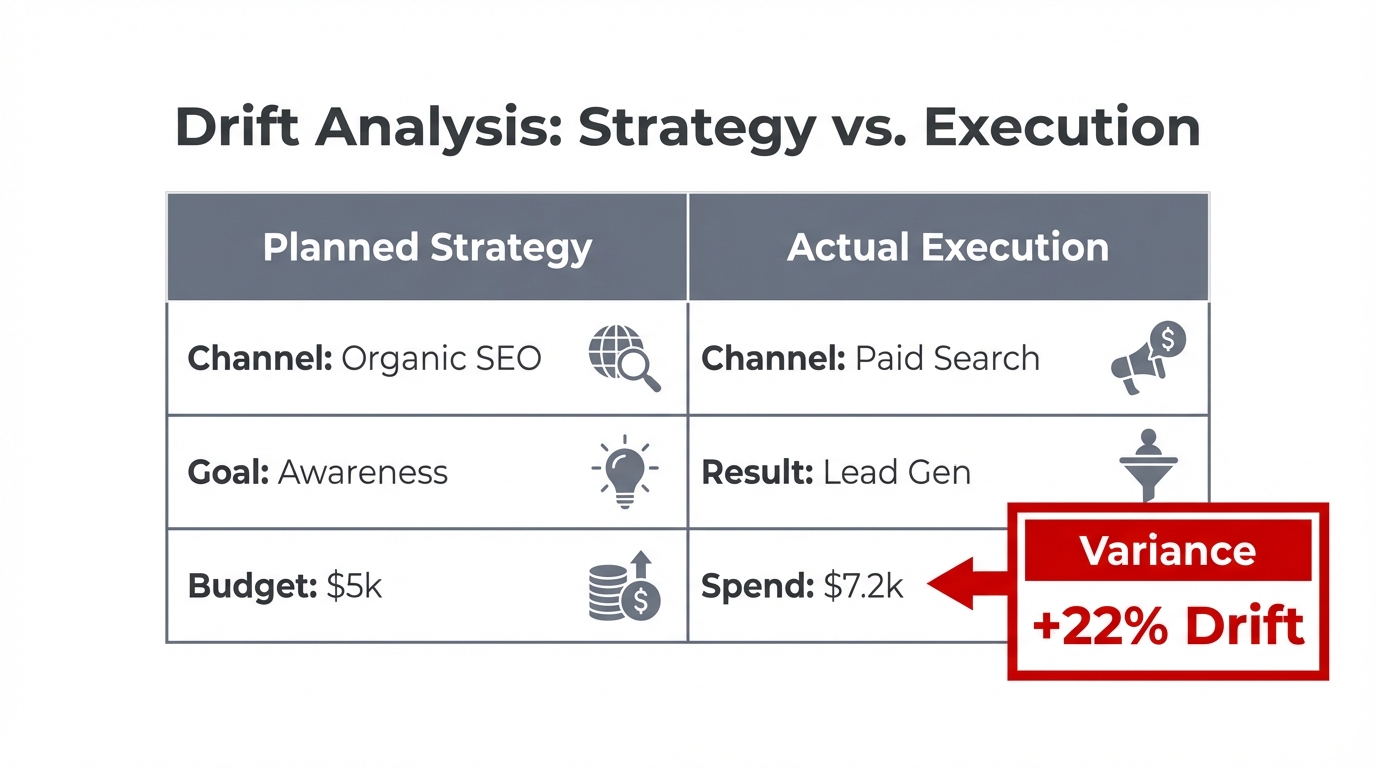
Most GTM strategies fail not because the plan was bad, but because the execution "drifted" away from the goal over 60 days. In a fast-paced environment, it’s easy to spend three weeks on a sub-project that doesn't move the needle. The /drift command is a diagnostic tool designed to fix this. It compares your stated intentions (from your 60-day strategy docs) against your actual behavior (from your daily notes, Google Calendar, and Slack transcripts).
By running a 30 to 60-day vault scan, Claude Code can surface what you are avoiding. It might tell you: "Your strategy says your #1 priority is App Store Optimization, but for the last 14 days, 80% of your activity has been focused on minor website UI tweaks." This radical transparency allows marketing leaders to course-correct in real-time before the quarterly budget is exhausted, often using data from Sensor Tower to validate the drift.
"The /drift command surfaces what you are avoiding. It identifies the gap between who you say you are and what you are actually doing."The Marketing Pattern Recognition Playbook
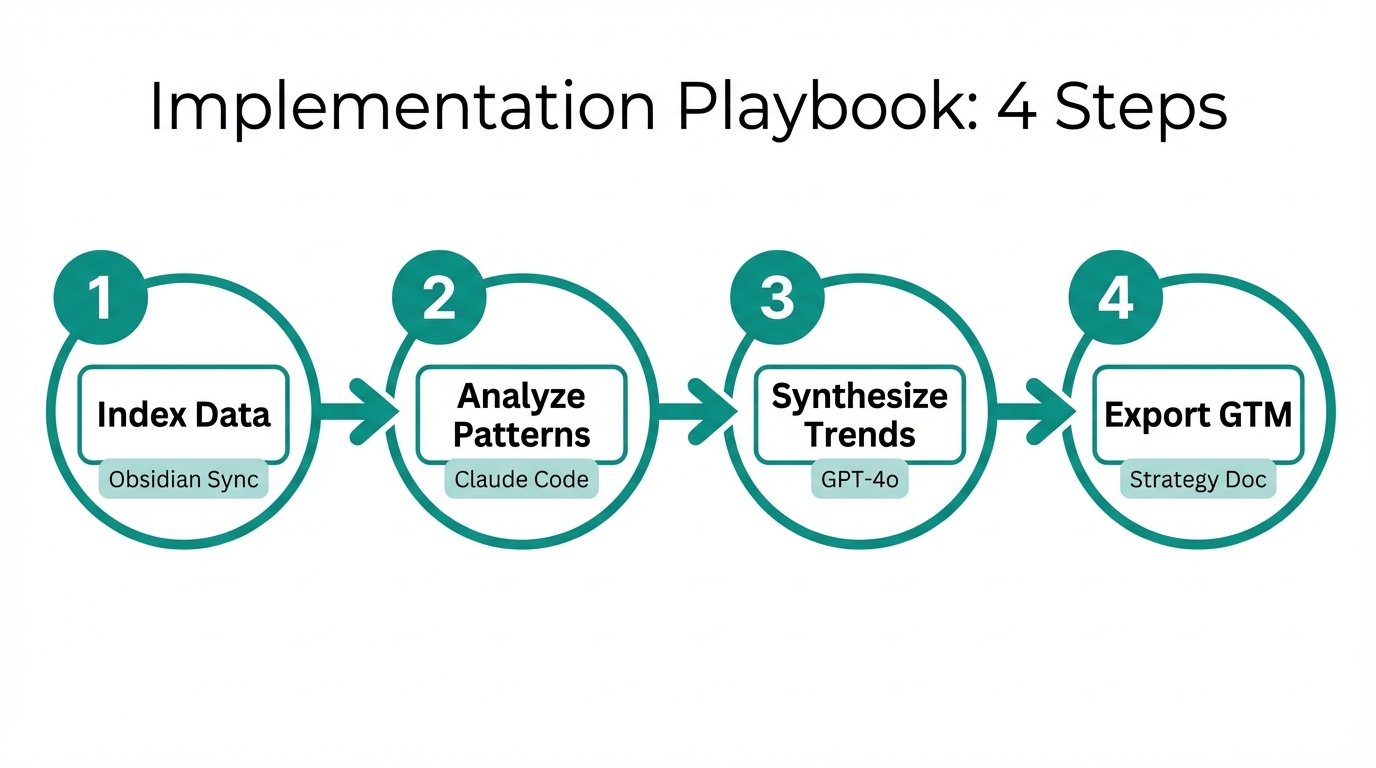
To set up this advanced GTM workflow, follow these sequential steps to ensure your AI agent has the proper context architecture.
Step 1: Centralize Your Markdown Files
Move all your strategy docs, meeting transcripts from tools like Otter.ai, and creative briefs into a single Obsidian vault. Ensure you use [[Backlinks]] to connect related concepts like #UGC, #Retention, and #PaidSocial.
Step 2: Install Claude Code CLI
Install the Claude Code agent on your terminal. This allows the AI to interact directly with your file system. Use the Obsidian CLI plugin to give Claude permission to read your vault's structure. This is the infrastructure for your Personal Marketing OS.
Step 3: Define Your Context Files
Create a /context folder in your vault. Inside, keep three files: Brand_Voice.md, Target_Audience.md, and Active_Projects.md. These will be the foundation for every prompt you run. When sourcing new growth opportunities or using platforms like Stormy AI to discover creators, having this context ready ensures your outreach and vetting are perfectly aligned with your brand identity.
Step 4: Run the 'Emerge' Command
Once your vault is populated, use the /emerge command once a week. Ask Claude: "What patterns are emerging in my marketing notes that I haven't explicitly named yet?" This is where the "alpha" is found—discovering that your best customers all mention the same specific pain point that you haven't yet addressed in your ad copy.
From Reflection to Actionable GTM Outputs
The transition from a "thinking partner" to a "doing partner" happens when you ask Claude Code to build based on the patterns it finds. If the vault scan reveals that your Meta Ads Manager performance is highly correlated with user-generated testimonials, you can immediately command the AI to: "Generate 5 new hook variations for our UGC creators based on the common feedback in the 'Customer_Interviews' folder."
This workflow effectively turns your past reflections into future revenue. Instead of starting from a blank page, you are iterating on a compounding asset. This is how marketing teams move from "guess and check" to a data-driven GTM strategy that evolves as fast as the market does.
The Future of the Marketing OS
We are entering an era where software will become fashion—fluid, personalized, and hyper-contextual. For marketers, the competitive advantage is no longer found in knowing how to use a specific ad platform, but in the ability to manage context at scale. The combination of Obsidian and Claude Code provides the first real glimpse into what a "Personal Marketing OS" looks like.
By building a robust Market Intelligence Vault and utilizing AI market research tools, you ensure that your agent—and your team—is always operating with a perfect memory. Whether you're tracking app installs via AppsFlyer or managing creator relationships in a CRM, your vault acts as the central nervous system for your entire growth stack. The most successful marketers of the next decade won't be the best writers or designers—they will be the best context architects.
Ready to start building? Download Obsidian today, set up your first vault, and begin the process of turning your fragmented marketing notes into a powerful GTM engine.