The landscape of Go-To-Market (GTM) execution has fundamentally shifted in 2026. We have officially moved beyond the era of manual spreadsheets and surface-level SWOT analyses into the age of Agentic Performance Marketing. Today, growth leaders aren't just using LLMs to draft emails; they are deploying autonomous agents to deconstruct competitor ecosystems in real-time. Organizations that have integrated specialized AI workflows into their market research are already seeing an average 30% higher ROI and a significant 27% improvement in campaign performance within just six months.
As we navigate this year’s aggressive market dynamics, the winner isn't the one with the biggest budget, but the one with the most refined AI competitive intelligence marketing stack. This playbook explores how to harness the unique cognitive strengths of Claude and OpenAI to identify untapped emotional triggers and crush your GTM strategy 2026 goals.
The AI Market Analysis Landscape: 2026 Benchmarks
In 2026, the "Ad Divide" has become clear. While OpenAI remains the volume leader with over 800 million weekly users, Anthropic’s Claude has surged to a 32% enterprise market share. This shift is largely due to Claude's massive context window and its reputation for brand consistency, which are critical for deep-dive competitive research.
| Feature | OpenAI (GPT-4o / GPT-5) | Claude (3.5 Sonnet / 4.5) |
|---|---|---|
| Primary Role | The Logical Architect | The Creative Strategist |
| Best For | Data analysis, automation scripts, high-volume ad variations. | Brand voice, long-form auditing, emotional trigger mapping. |
| Context Window | 128K - 400K tokens | 200K standard (Up to 1M in beta) |
| Core Integration | Zapier, Microsoft, Salesforce | AWS Bedrock, Claude Code, Vertex AI |
Performance marketers now view OpenAI as the superior choice for the "math" of growth—handling bid automation and complex Google Ads Python scripts—whereas Claude is the ultimate brand guardian that avoids the "robotic fluff" typical of 2024-era AI content. Leveraging both is no longer optional; it is the industry standard for AI market analysis tools.
"The 2026 GTM winner isn't the one with the most data, but the one who uses AI to find the 'belief friction' that competitors are too slow to see."Deep-Dive Research: Leveraging the Claude Context Window
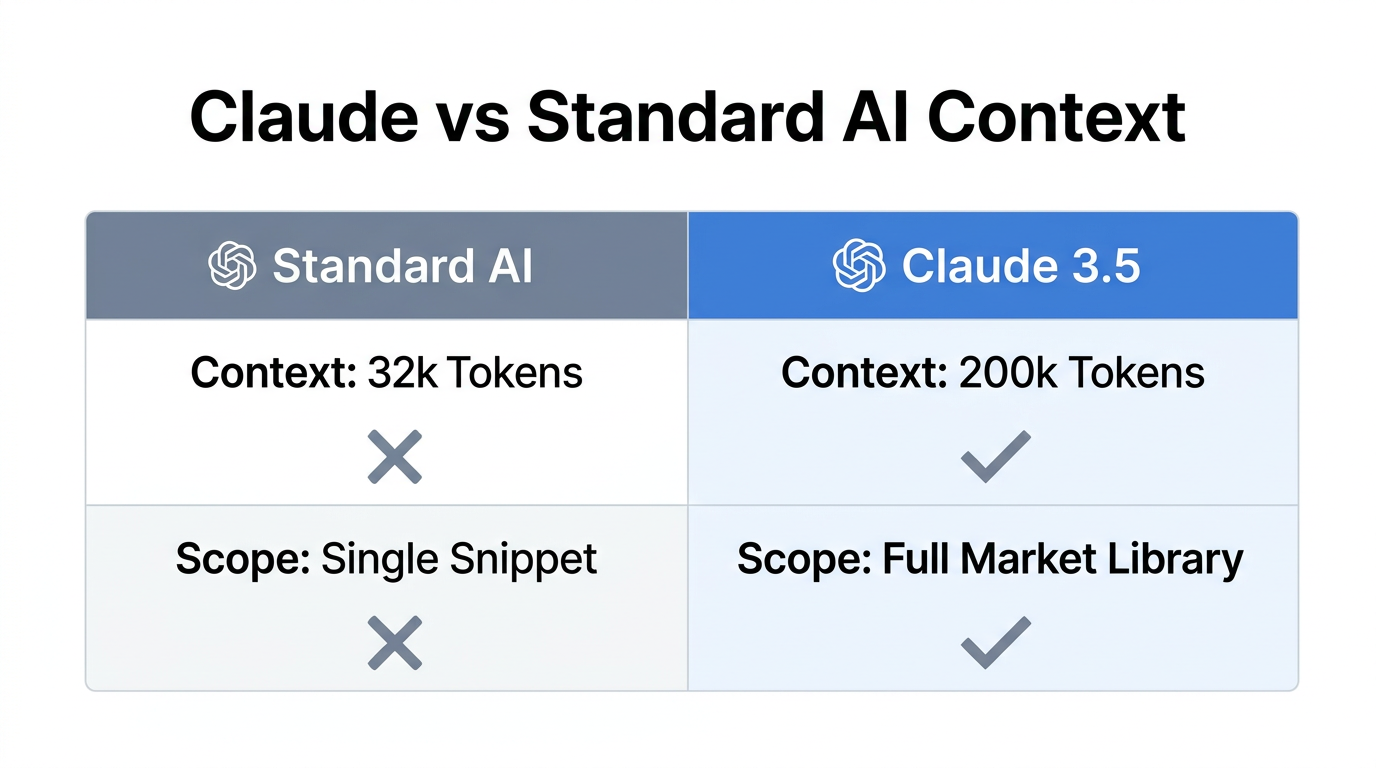
The most powerful weapon in a growth leader's arsenal this year is the Claude context window for research. While competitors are looking at surface-level headlines, you can ingest their entire digital footprint to find structural weaknesses. Here is the playbook for performing "humanly impossible" competitive audits.
Step 1: Document Ingestion
Export a competitor’s entire landing page structure, three months of their blog history, and their last 50 Meta Ads into a single, comprehensive PDF. Because Claude can handle up to 200,000 tokens (and significantly more in beta), you can feed it a 50+ page document without losing detail or coherence.
Step 2: Identifying Missing Emotional Triggers
Use a specific, role-based prompt to analyze the data. Instead of asking for a summary, ask for the gaps. Key Takeaway: High-performance teams use Role-Based Prompting to bypass generic outputs. For example: "You are a senior direct-response copywriter. Analyze this 50-page document. Identify the emotional triggers the competitor is ignoring and suggest three ad angles that position us as the specific solution."
Cleaning and Processing Intent Data with OpenAI
While Claude handles the creative strategy, OpenAI is your engine for AI competitive intelligence marketing at scale. The primary challenge in 2026 isn't a lack of data; it’s the "noise" created by fragmented customer intent signals across TikTok Ads, LinkedIn, and search queries.
Using OpenAI’s advanced data analysis tools, you can clean massive datasets of customer interactions to identify high-intent patterns. Neglecting data hygiene is one of the most common mistakes in modern GTM; feeding poor data into your AI leads to "hallucinated" spend patterns. High-growth startups now use GPT-4o to:
- Rebalance budgets across channels based on real-time ROAS data via Make.com or Zapier.
- Automate the cleaning of lead lists to ensure only high-intent targets enter the CRM.
- Build custom scripts that flag "creative fatigue" by monitoring CTR decay across Google Ads.
Creating Internal 'War Rooms' with Claude Projects
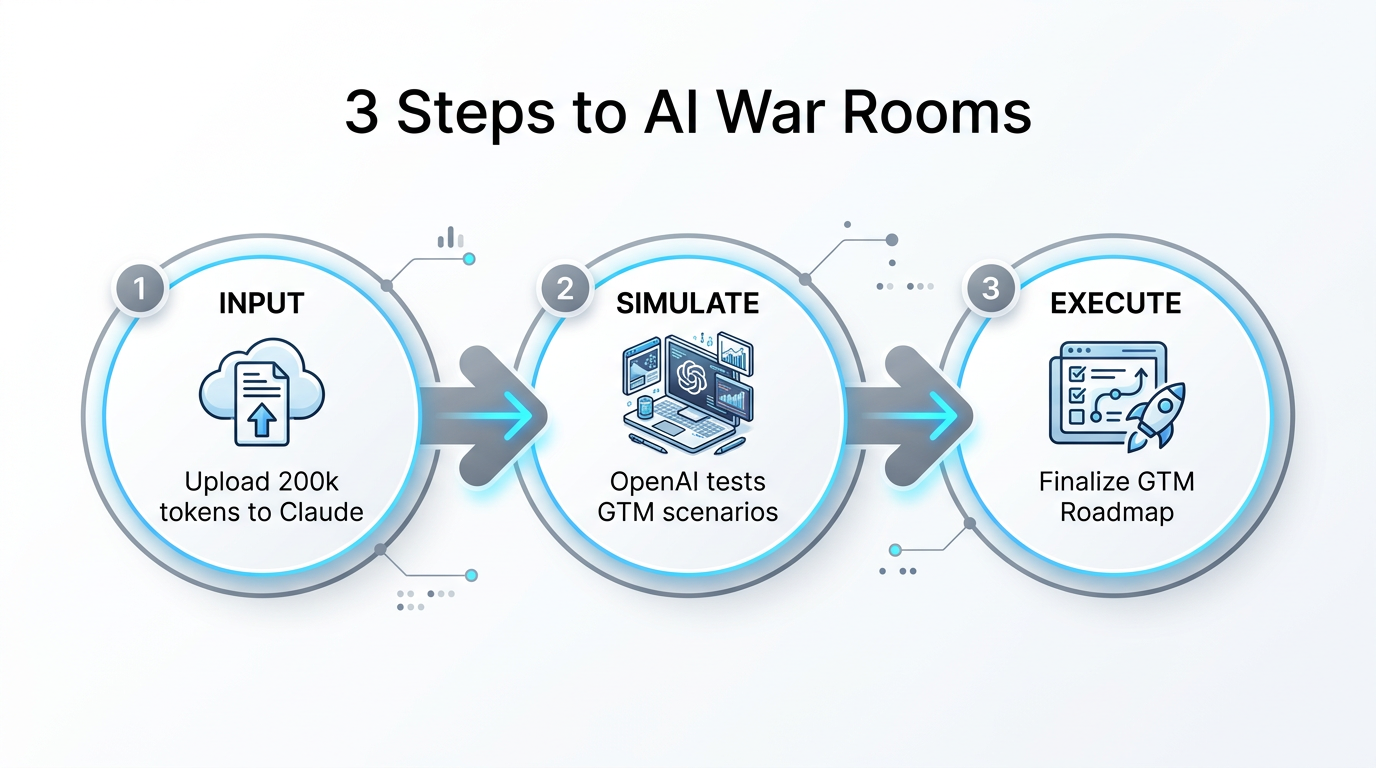
The concept of a "static" GTM plan is dead. In 2026, leading teams use Claude Projects and Custom GPTs to create living, breathing competitive "War Rooms." These are specialized AI instances pre-loaded with your brand’s style guide, target personas, and the latest competitive intelligence.
By maintaining a dedicated Claude Project for a specific product launch, your team can instantly vet any new creative idea against the competitor's known strategies. If a competitor drops a new pricing model at 9:00 AM, by 9:15 AM, your Claude War Room can have three counter-angles prepared for Meta Ads. This speed is why firms like TELUS have saved over 500,000 hours of manual labor by deploying internal AI tools.
"The War Room isn't a place; it's a persistent AI context that knows your competitor's moves better than their own CMO does."Integrating Intelligence into Amazon Bedrock and Zapier
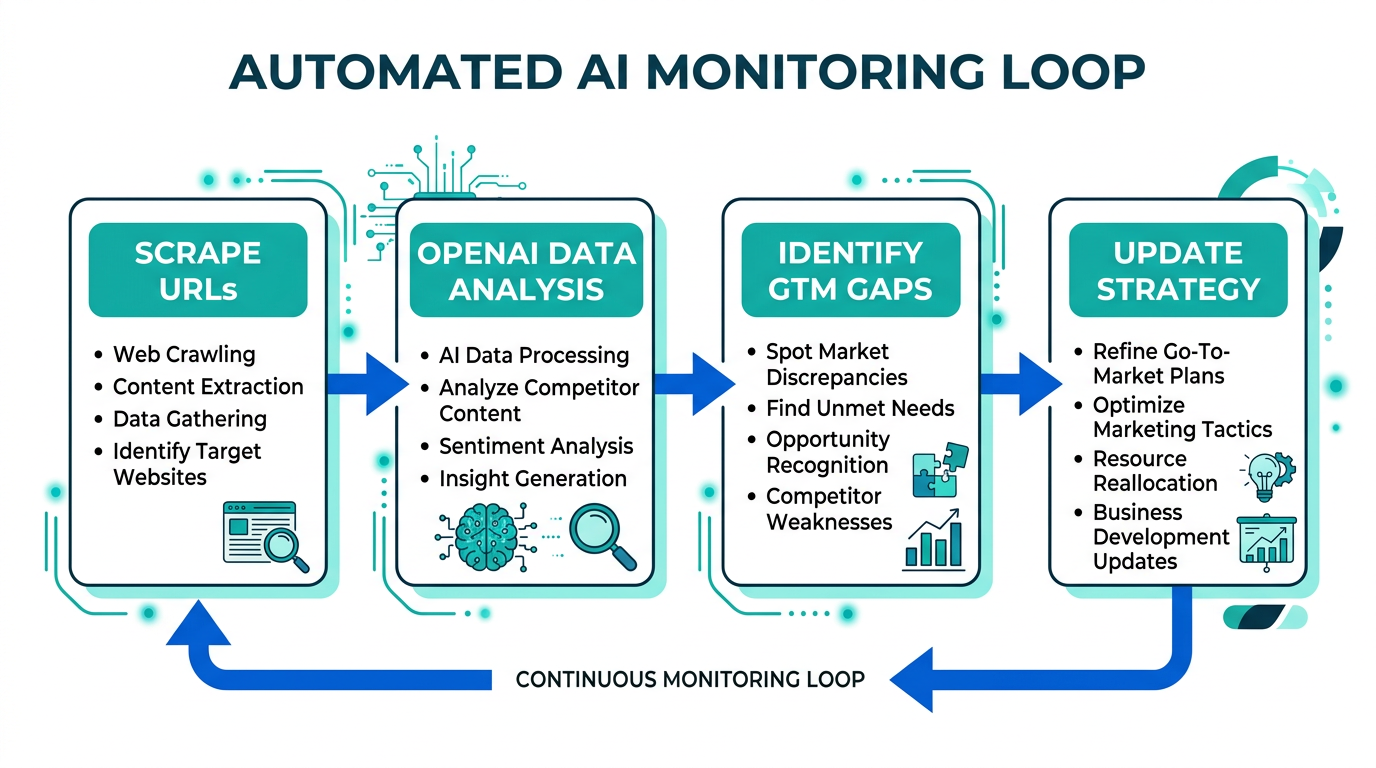
To truly crush your GTM strategy 2026, your competitive intelligence must be autonomous. You cannot rely on manual prompts every morning. The shift toward Agentic Performance Marketing involves connecting your AI stack to your operational tools. Organizations like Brex have integrated Claude via Amazon Bedrock to automate complex processing, freeing up massive budget for aggressive acquisition.
You can set up an automated market monitoring system by:
- Using Zapier to monitor competitor social mentions and website changes.
- Feeding those changes into a Claude 3.5 Sonnet instance via API to determine if the change is a "strategic threat."
- If a threat is detected, the AI automatically alerts the growth team in Linear or Slack with a suggested counter-move.
For those managing creator-heavy campaigns, platforms like Stormy AI complement this intelligence by automating the discovery and outreach to the very creators your competitors are trying to win over.
Common Mistakes: Why Generic Prompting Fails
Despite the power of these AI market analysis tools, many growth leaders fall into the "Set and Forget" trap. The quality of your competitive intelligence is directly proportional to the quality of your constraints. Generic prompting results in generic traffic, and in 2026, generic traffic is too expensive to sustain.
- Treating AI as a Strategy: AI is a tool, not a CMO. Using it to generate volume without a conversion-led strategy leads to wasted spend.
- Ignoring the 20% Human-in-the-Loop: Experts recommend a 20% human gap for strategic oversight to prevent "hallucinated" bidding patterns.
- Failing to Segment: Don't ask AI to "analyze the market." Ask it to analyze "Product-Led Growth startups in the fintech space with a focus on Gen Z emotional triggers."
Conclusion: Winning the GTM Race
Success in your GTM strategy 2026 requires a hybrid approach. Use the Claude context window for research to find the creative hooks that resonate on an emotional level, and use OpenAI’s data analysis to scale the math of your campaigns. By integrating these into automated workflows via Amazon Bedrock and Zapier, you move from reactive marketing to proactive market leadership.
As AI-influenced digital ad spend climbs toward $81.6 billion, the competitive edge goes to those who can synthesize data faster than the market can change. Start by building your internal War Room today, and leverage tools like Stormy AI to ensure your creator and influencer strategies are just as data-driven as your paid media.