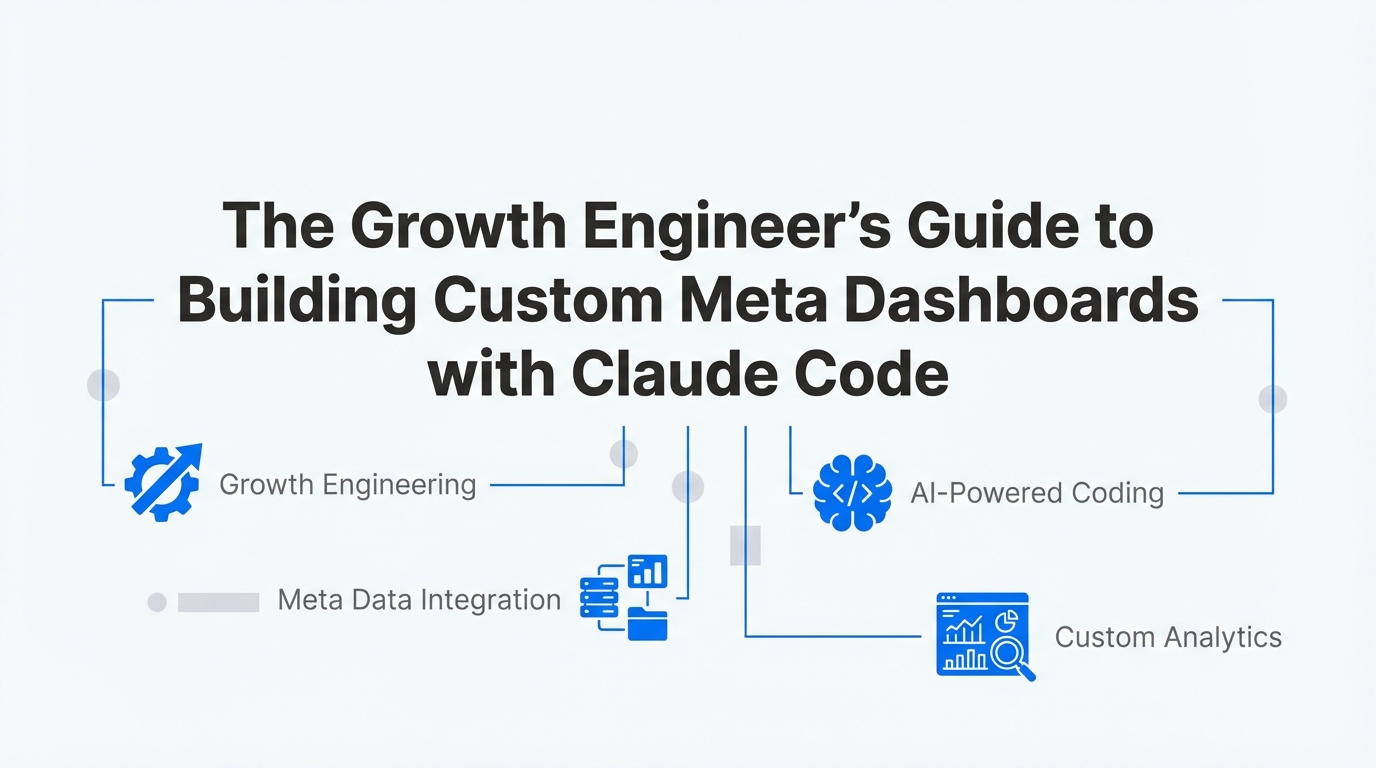
The era of "Chat AI" is officially over. In 2024 and 2025, we spent our time asking chatbots to write catchy headlines and email subject lines. But as we move into 2026, the industry has shifted toward "Action AI"—agentic systems that don't just suggest strategies but execute them directly within your marketing stack. For the modern growth engineer, this means moving beyond the limitations of Meta Ads Manager and into a world where you can "vibe code" your own proprietary analytics engines. By leveraging tools like the Claude Code CLI, marketers are now building custom recommendation tools that bridge the gap between Meta’s automation and high-level business goals.
Why Standard Meta Metrics are Failing the Modern Marketer
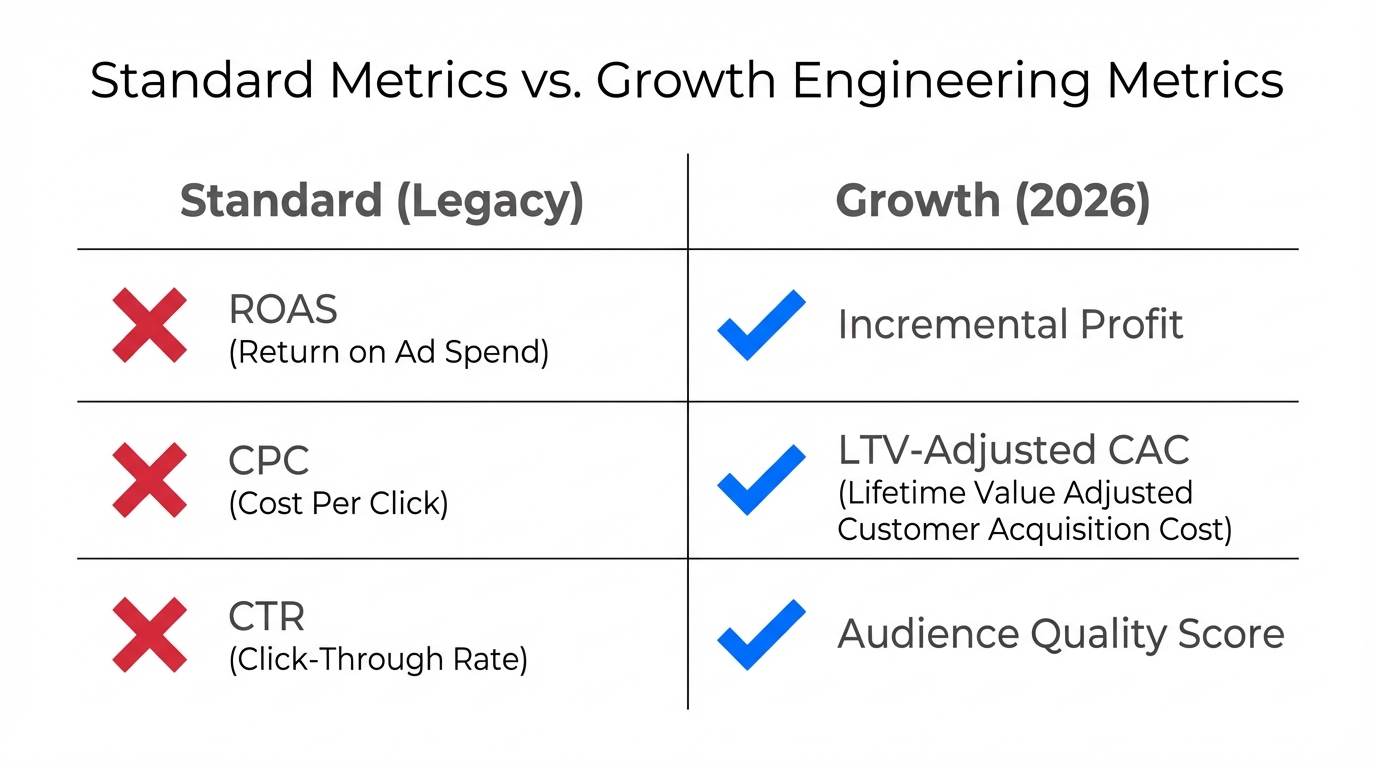
Meta’s Advantage+ suite has become incredibly powerful, but it has also turned the platform into a "black box." While internal Meta studies show a 32% drop in Cost Per Acquisition (CPA) when using these automation suites, as reported by Social Media Today, the lack of transparency is a growing concern for high-budget advertisers. Standard metrics like ROAS (Return on Ad Spend) are often laggy or misleading due to attribution windows, leading brands to scale "zombie" campaigns that don't actually contribute to the bottom line.
Growth engineers are now bypassing the standard UI to build custom "Kill/Scale" recommendation engines. These tools don't just look at ROAS; they calculate Hook Rates (3-second views / impressions) and Hold Rates (15-second views / impressions) to determine which creative assets are actually stopping the scroll. This level of granularity is essential for maintaining a competitive advantage in a crowded digital landscape, often requiring direct integration with the Meta Marketing API.
"The shift from 'Chat AI' to 'Action AI' is the single biggest catalyst for marketing efficiency we've seen this decade."
Vibe Coding: Building Internal Tools with Claude Code
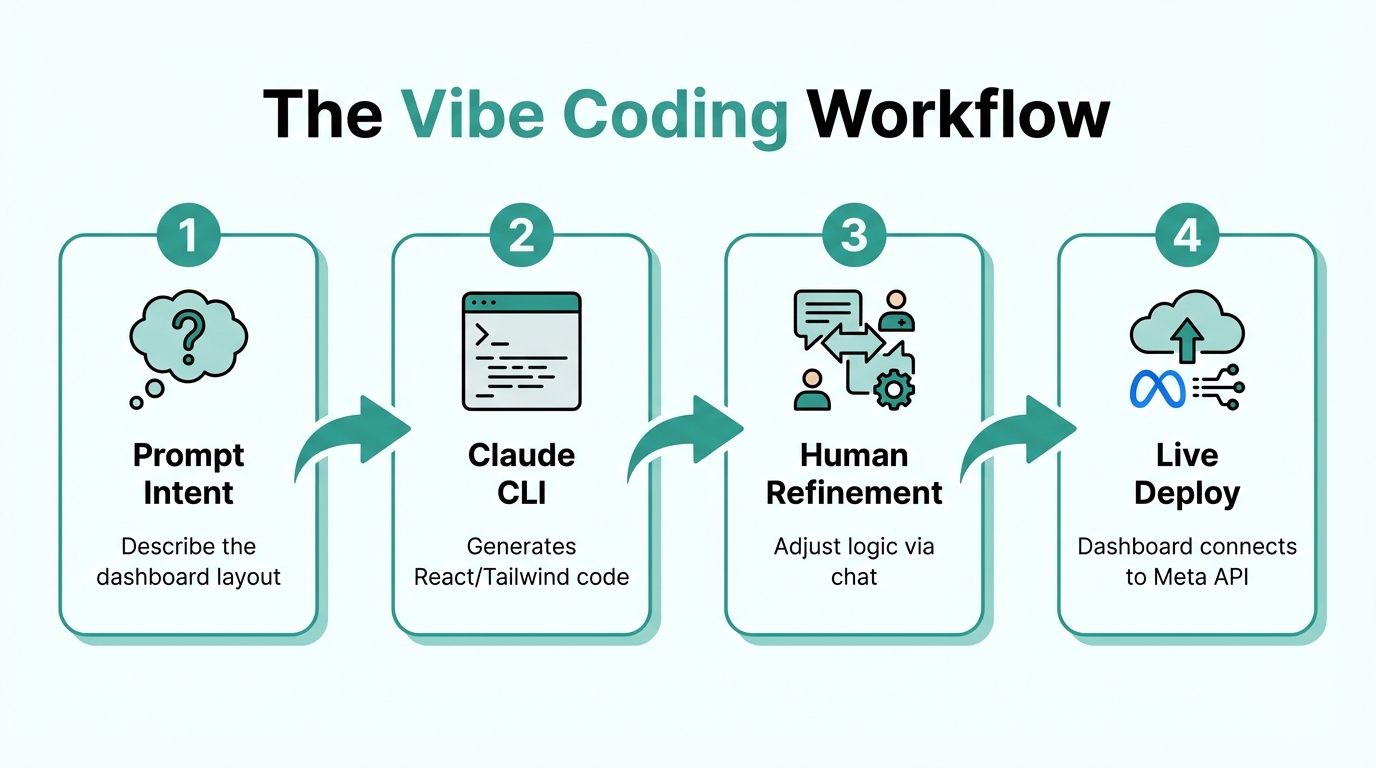
"Vibe coding" is the practice of using natural language to command an AI agent to build fully functional software. With Claude Code, you can interact directly with your terminal and your marketing data without needing a degree in computer science. This allows lean teams to build entire marketing ecosystems—from research to landing page deployment—in under an hour using modern development environments like VS Code.
| Feature | Standard Meta Manager | Custom AI Dashboard |
|---|---|---|
| Data Source | Native Meta Data | Multi-source (Meta + CRM + GA4) |
| Analysis Speed | Manual Export/Pivot | Instant / Agentic Analysis |
| Creative Insights | Basic CTR/CPM | Hook & Hold Rates via API |
| Automation | Rules-based | LLM-Reasoning based |
According to research into agentic workflows, we are seeing a deep integration where AI interacts directly with live APIs. This is made possible through the Model Context Protocol (MCP), which allows Claude to connect to live data sources in real-time. By using an MCP server for Meta Ads, your AI agent can literally "see" your account spend and performance data as it happens, eliminating the knowledge cutoff issues of previous AI models.
Step-by-Step: Building Your Proprietary Analytics Tool
Step 1: Environment Setup
Start by installing the Claude Code CLI and setting up your local environment. You will need access to your Meta Developer credentials to interact with the Marketing API. Tools like Python provide the foundational scripting capabilities needed to process complex data sets like LTV and blended CAC.
Step 2: Connect the Meta Ads MCP
Use the MCP repository to find and install the Meta Ads connector. This allows you to give Claude commands like: "Fetch the performance data for all active ad sets in the last 7 days and identify which ones have a Hook Rate below 20%."
Step 3: Scripting the 'Kill/Scale' Logic
Instead of manually toggling switches, ask Claude to build a script that implements your specific logic. For example, you might scale budget by 20% only if the ROAS is above 3.0 AND the creative has a Hold Rate above 40%. Platforms like Stormy AI can then be used to source new creators that match the aesthetic of your highest-performing assets, ensuring your creative pipeline remains full of high-quality content.
"Marketers using agentic workflows report being 300x faster at complex tasks like programmatic creative testing."
Bridging the 'Black Box': AI Agents as the Control Plane
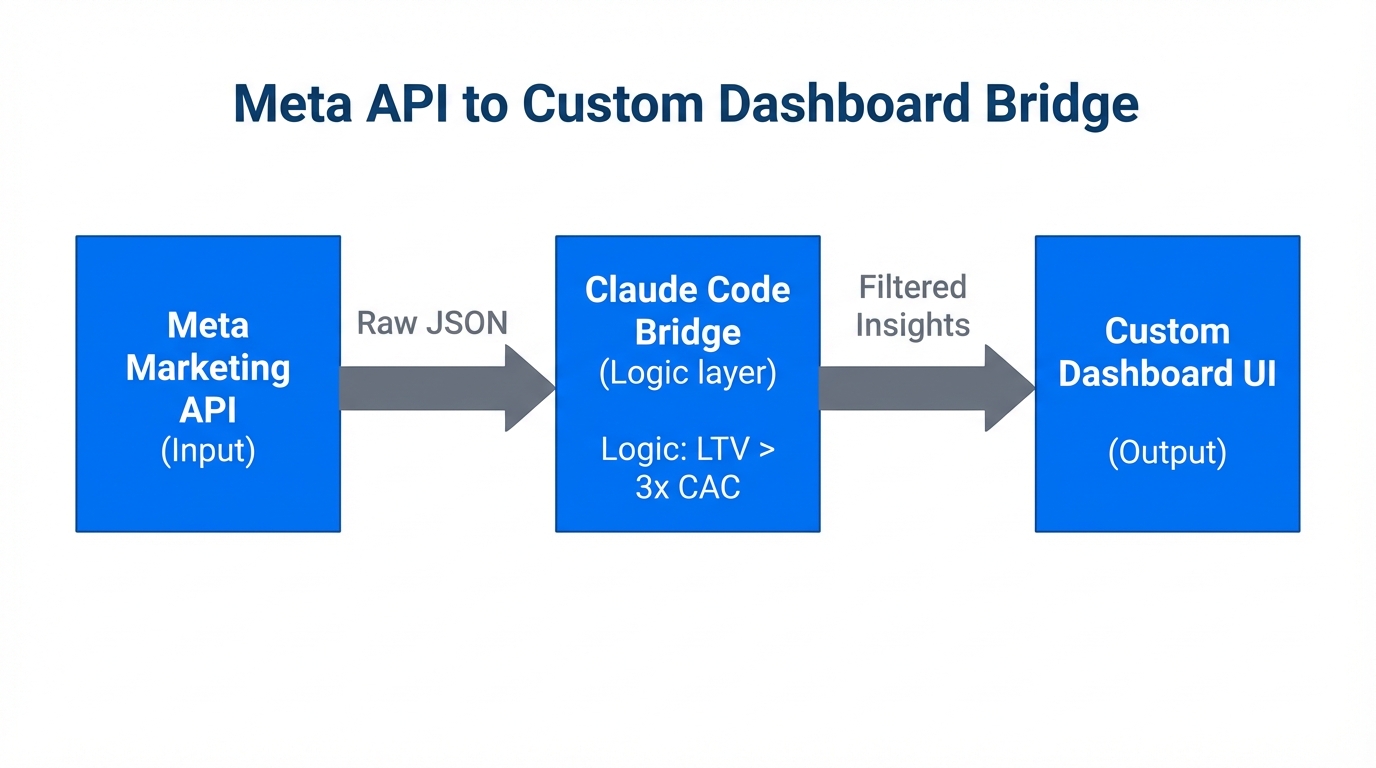
As Meta moves toward a world where you simply provide a budget and an objective, the human role is shifting to that of a "Control Plane" operator. The secret to success in 2026 is maintaining control over automation. Growth engineers are using Claude Code to audit their accounts for "vampire" ads—those that consume the majority of the budget without generating conversions. By connecting Claude to your code-base, it can even read your landing page files to ensure your ad copy perfectly matches your messaging using tools like TypeScript and React.
This "Context-First" strategy ensures that your messaging remains consistent even as the AI generates thousands of ad variations. If you are running app install campaigns, you can combine this with data from RevenueCat or mobile attribution platforms like AppsFlyer to optimize for long-term subscriber value rather than just initial top-of-funnel trials. As industry experts warn, over-optimizing for short-term signals can lead to a flood of low-quality traffic that never converts into profit.
Case Study: Autonomous Account Management
Consider the workflow of media buyers who have experimented with giving Claude AI full access to their Meta Ads ecosystems. By combining Claude with image generation APIs and creative analysis tools, they've built systems that handle ICP research, creative creation, and budget scaling with only one human command per day.
Others are using "vibe coding" to build dashboards that calculate metrics Meta doesn't provide natively. As seen in recent growth engineering tutorials on YouTube, media buyers are creating custom UIs that visualize the fatigue rate of specific creative hooks, allowing them to swap assets before performance drops. This level of proactive management is what separates the top 1% of growth engineers from those just using the default dashboard.
Common Mistakes and How to Avoid Them
While the speed of agentic workflows is intoxicating, there are critical pitfalls to avoid:
- Ignoring the Learning Phase: Meta’s algorithm requires 48–72 hours of stable data to optimize. Using Claude to make hourly budget changes will trap your campaign in "Learning Limited" forever.
- AI Slop: Don't rely on Claude’s first-draft copy. Feed it "Brand Voice" files and previous winning ad copy to ensure the output doesn't lose that "stop-the-scroll" quality.
- The "Set and Forget" Trap: Agentic workflows are not 100% error-proof. Human oversight is the final filter for brand safety and creative spirit.
Future-Proofing Your Growth Stack for 2026
The trend is clear: majority of Fortune 100 companies are already integrating AI into their development and marketing workflows to speed up execution, according to adoption data from Anthropic. To remain competitive, your tech stack must be modular and agent-ready. This means using platforms like Stormy AI for streamlined creator discovery and managing those relationships in a way that feeds your custom data engines.
As industry leaders have stated, the ultimate goal is for businesses to simply provide an objective. Tools like Claude Code are the bridge that allows you to customize and oversee that automation before the system becomes a total black box. By building your own dashboards and "Kill/Scale" engines today, you are securing your place as a growth leader in the autonomous marketing era.