Everyone is chasing the next "sexy" SaaS product, but the smartest entrepreneurs are looking at their own backyards. The most sustainable path to wealth in 2024 isn't found in a crowded Silicon Valley incubator; it is found in the local service markets that most people find uninteresting. By using google maps scraping for business and automated AI workflows, you can identify boring business ideas 2024 that generate significant cash flow with minimal competition. This guide provides a step-by-step playbook for using data, rather than intuition, to dominate underserved local markets.
The Shift from Sexy SaaS to Boring Businesses
There is a massive misconception that the only way to build a high-margin business is to develop a complex software platform. However, the reality is that the "sexy" spaces—like AI chatbots or project management tools—are hyper-competitive and dominated by deep-pocketed venture capital. In contrast, the local service sector is full of underserved opportunities with high order values. The Boring Marketer suggests that instead of fighting for the same three to five niches like plumbing or HVAC, entrepreneurs should go deeper into micro-niches.
Consider the Diesel Dudes model: a mobile diesel mechanic business that scaled to $30,000 a month in a very short time. The secret wasn't a complex algorithm; it was identifying a high-demand service with low provider quality. Other lucrative examples include hardscaping (building retaining walls), garage organization, and closet redesign. These are often $3,000 to $15,000 jobs that can be completed in a few days. The barrier to entry is high enough to keep out the uncommitted, but the technology to find these gaps is now more accessible than ever through AI market research tools.
The Tier 2 and Tier 3 City Strategy
When launching a local service business, location selection is half the battle. Many founders make the mistake of targeting massive hubs like New York City, Los Angeles, or Chicago. While these cities have volume, they also have crushing competition and high overhead costs. The winning strategy focuses on Tier 2 and Tier 3 cities—growing hubs like Charlotte, NC, Nashville, TN, Dallas, TX, and Denver, CO. These areas are seeing a massive influx of wealthy residents who need high-end services but find a shortage of quality providers.
By focusing on these mid-sized growing markets, you leverage a local market analysis software approach that identifies where demand is growing faster than the supply of labor. For example, if thousands of high-net-worth individuals are moving to Nashville, the demand for custom pool builders or luxury home security systems spikes. You don't need to be an expert in the service itself; you just need to be the expert in automated lead generation within that specific geographic pocket.
Scraping Google Maps for Market Intelligence
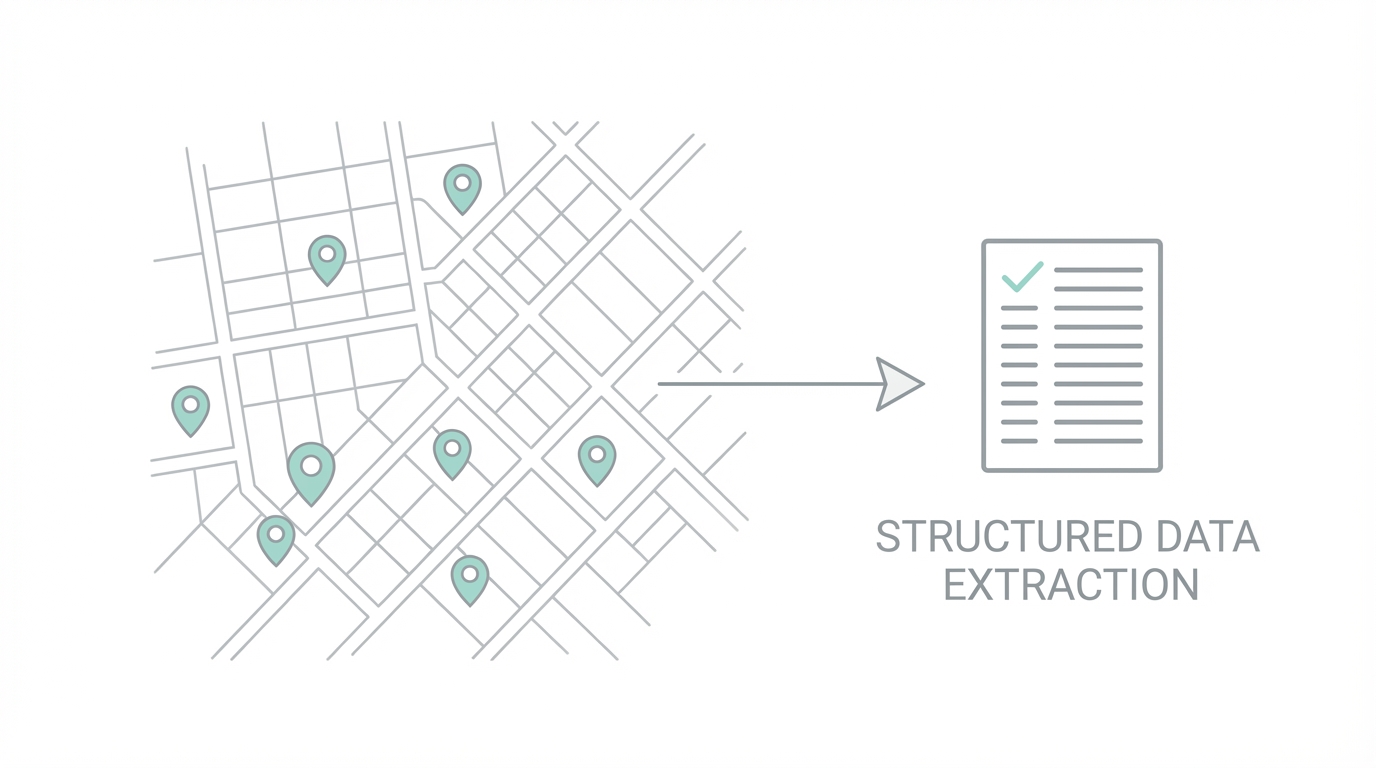
The most valuable treasure trove for local market data is Google Maps. It is where customers actually go to find services and leave their grievances. To turn this into a business strategy, you need a way to harvest this data at scale. Using an n8n workflow, you can create a scraper that pulls specific data points from Google Maps listings across multiple keywords and cities.
The workflow should capture more than just business names and phone numbers. You need to look at:
- Review Volume: How many reviews does the average provider have? High volume suggests high market demand.
- Review Velocity: How fast are new reviews coming in? This indicates current activity levels and growth.
- Contact Information: Extracting emails, Instagram handles, and Facebook pages for competitive analysis.
- Operational Gaps: Identifying businesses with limited hours or no online booking options.
Using AI for Sentiment Analysis and Market Gaps

Once you have scraped the data, the next step is automated market analysis. Raw reviews are messy, but an AI agent can synthesize hundreds of reviews in seconds to find "market arbitrage." This is the process of finding niches where there is high review volume (high demand) but poor review sentiment (low-quality service). If the top 10 players in a city all have 3.5-star ratings with complaints about communication or timeliness, that is your entry point.
You can feed your scraped data into a local market analysis software workflow that looks for patterns. For instance, in a city like Charlotte, you might find that "exotic car detailing" has high velocity but customers consistently complain about the lack of mobile service. This specific pain point becomes your entire business angle. AI helps you identify these boring business ideas 2024 by quantifying human frustration into actionable business hypotheses.
Step-by-Step Playbook for Validating Your Idea
To succeed, you must follow a rigid framework for validation. Don't spend a dollar on equipment or incorporation until you have cleared these steps:
Step 1: Define Your Hypothesis
Start with a prompt for your AI tool: "List 20 underserved local niches with high customer value, excluding common trades like plumbing." Focus on services like body contouring med spas, luxury tax advisory, or outdoor kitchen design. Pair these with a Tier 2 city.
Step 2: Scrape and Calculate Demand
Run your n8n scraper. Analyze the top 10 and bottom 10 players. If the market leaders have few reviews and haven't updated their social media in years, the market is stagnant and ready for a modern competitor.
Step 3: Analyze Review Velocity
A niche with 500 reviews from five years ago is a dead market. A niche with 50 reviews in the last three months is a exploding market. Use AI to calculate how many new customers are entering the space each month based on review frequency.
Step 4: Identify the Specific Angle
Use AI to summarize the 50 most recent negative reviews for the top competitors. If they all complain about "hidden fees," your business angle is "100% Transparent Pricing."
Optimizing Workflow Costs with VPS Hosting
Running high-volume scraping and AI analysis can become expensive if you use standard SaaS hosting. To keep your margins high, you should self-host your automated lead generation tools. Instead of paying for a premium n8n cloud account that limits your executions, you can use a Virtual Private Server (VPS). Services like Hostinger or DigitalOcean allow you to host n8n for as little as $5 to $7 a month.
This setup allows for unlimited workflow executions. You can have your scraper running 24/7, constantly monitoring review sentiment across dozens of cities and hundreds of niches. By reducing your software overhead, you can pivot between different business ideas until you find the one that "prints money." This cost-efficiency is essential for the early stages of market research where volume is key.
The Media and Lead Gen Play

You don't actually have to perform the manual labor to profit from these insights. One of the most effective ways to monetize this data is through a lead-generation media play. Instead of starting a car wrapping business, you can start a local newsletter or directory focused on car enthusiasts in Nashville. By creating a media asset that attracts the high-value end customer, you become the gatekeeper.
Once you have a list of car enthusiasts, you can sell those leads to existing car wrapping companies for $100 to $200 per lead. Since you know exactly what the customer pain points are (from your Google Maps sentiment analysis), your content will resonate far better than a generic agency's marketing. When managing these types of lead-gen partnerships, platforms like Stormy AI streamline creator sourcing and outreach, helping you find local influencers who can amplify your local newsletter's reach. Before partnering, you can use Stormy to vet their audience quality and ensure their followers are actually located in your target city. This allows you to scale your automated lead generation without ever picking up a wrench or a shovel.
Conclusion: Data-Driven Dominance
The age of starting a business based on a "hunch" is over. By leveraging google maps scraping for business, you can quantify demand, identify competitor weaknesses, and find boring business ideas 2024 that the rest of the world is ignoring. Whether you decide to build the operational infrastructure yourself—like the success of Diesel Dudes—or opt for a high-margin lead-gen media play, the data remains your unfair advantage. Start by setting up your n8n workflows, focus on growing Tier 2 cities, and let AI reveal the hidden opportunities in your local market. The riches are in the niches, and the niches are hidden in the data.