The 'First Try' Fallacy: Why Your Campaign Actually Failed
 4:42
4:42Most local founders approach Google Ads the same way: they claim a $200 free credit, throw up a few keywords like "smog check near me" or "plumber in Austin," point the traffic to a generic homepage, and wait. When the phone doesn't ring off the hook in 48 hours, they shut it down and pivot to something “shiny” like organic social or viral stunts.
When you dig into the data of these "failed" attempts, the reality is usually messy. Perhaps they didn't have ad conversion tracking set up properly. Maybe they didn't realize that while 10 people clicked, they were all looking for a different service. Or, most commonly, they were undervaluing the lead. If you are a business like Mobile Emissions, where you come to the customer for a smog check, your value prop is convenience. If your ad doesn't scream that in the headline, you’re paying for clicks from price-shoppers who will never convert.
"'It didn't work' is a sentence I'm very skeptical of. Most people who think they learned something from a failed campaign actually learned the wrong lesson."
The 100-Rep Rule: The Secret to High-Frequency Testing
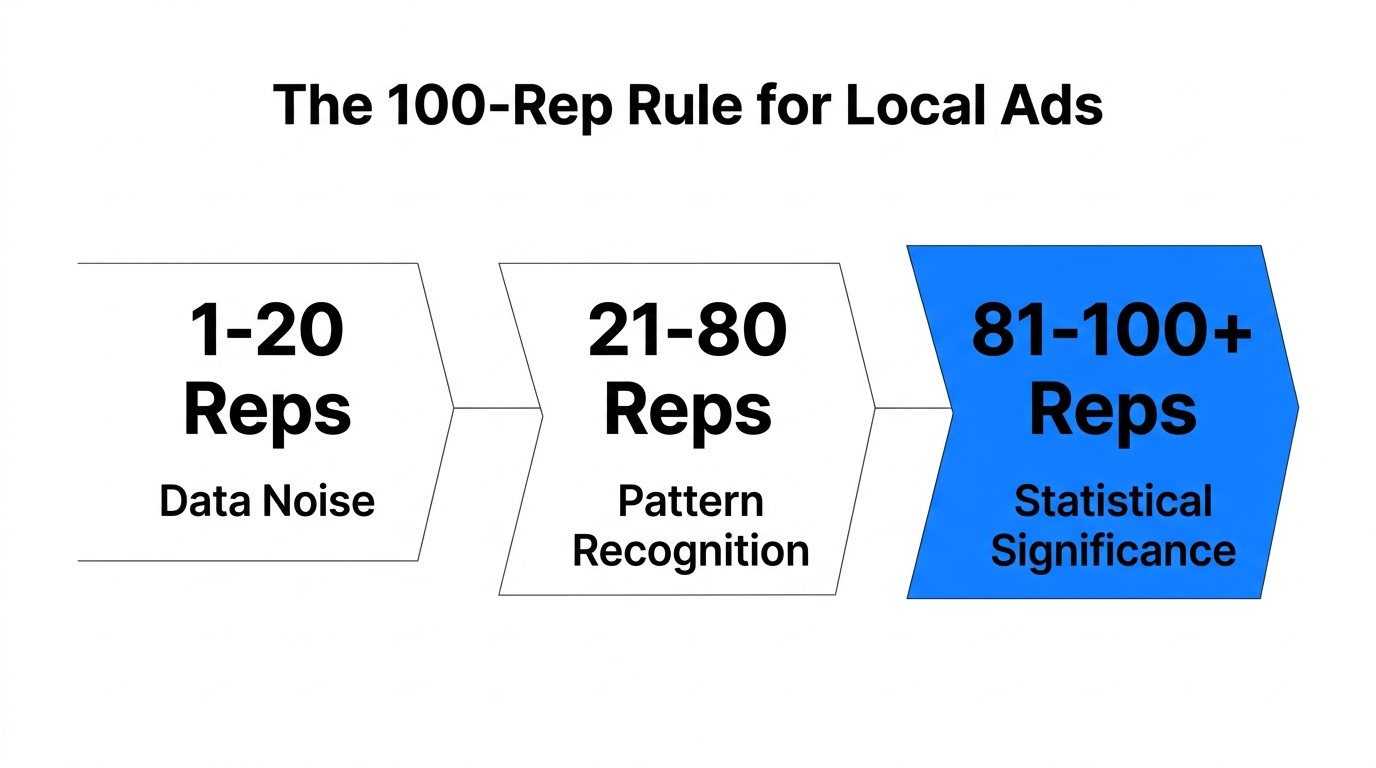
In 2026, winning at Google Search Ads optimization requires the mindset of an athlete, not a gambler. Success is rarely found in the first five ads. It’s found in the 100th. This is the 100-Rep Rule: you haven't truly tested a channel until you've iterated on your creative, your landing page, and your offer at least 100 times.
Think about the visual rhythm of your funnel. If you are running ads for a local service, your "rep" looks like this:
- Testing 10 different headlines focused on speed vs. price vs. reliability.
- Testing 5 different landing page layouts using tools like Framer or Webflow.
- Testing 20 different call-to-action (CTA) buttons (e.g., "Book in 60 Seconds" vs. "Get Your Instant Quote").
One single ad could have a 2x higher conversion rate than the others. If your acquisition cost drops from $3 to $1.50 because of one headline change, your entire business model changes. You can suddenly outspend your competitors 2-to-1 and still be more profitable. This is how you build a dominant customer acquisition strategy in 2026.
| Test Phase | Metric Focus | Founder Mindset |
|---|---|---|
| Rep 1-20 | Click-Through Rate (CTR) | Discovery: What hooks people? |
| Rep 21-60 | Cost Per Lead (CPL) | Optimization: What converts? |
| Rep 61-100 | ROI / LTV | Scaling: What generates profit? |
Socratic Growth: Diagnosing Your Marketing Failures
41:28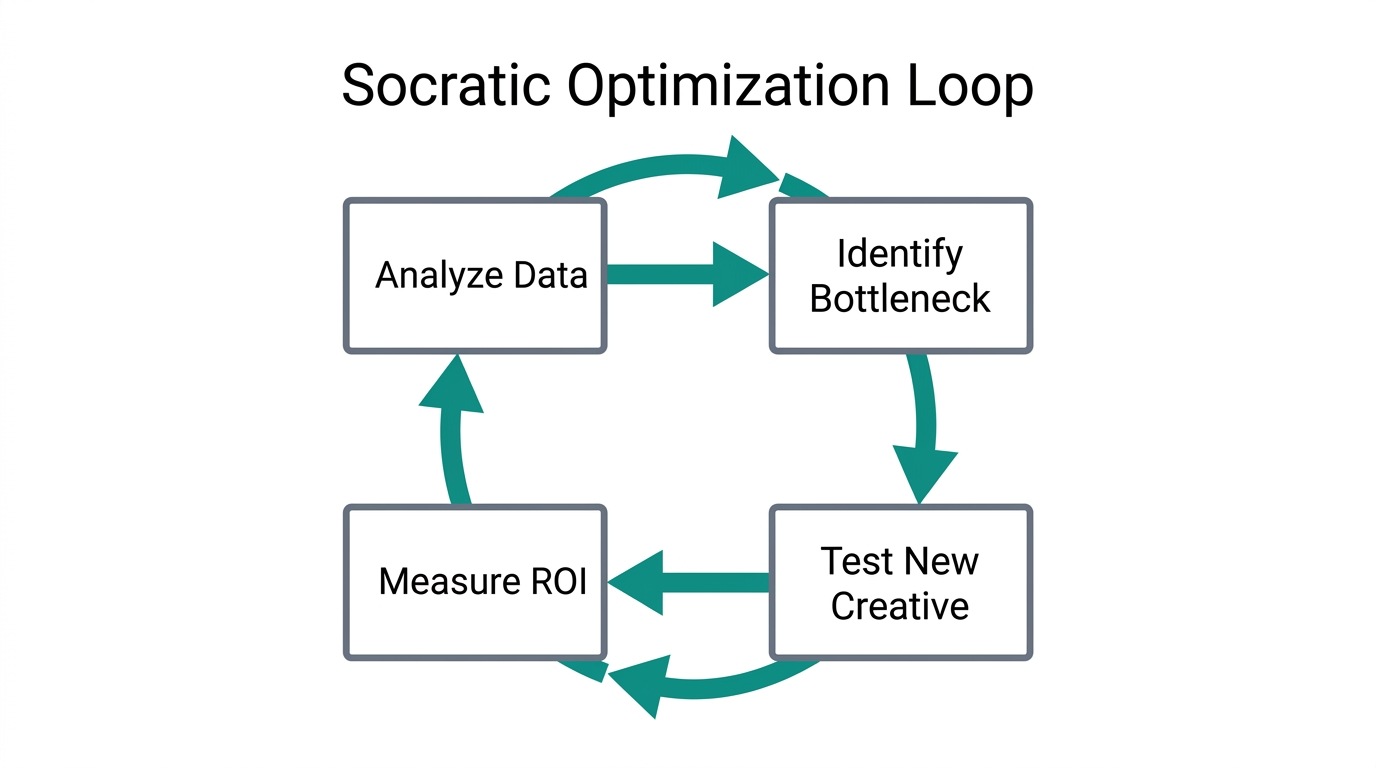
The best way to prevent sloppy thinking is through writing-as-thinking. If you feel like your marketing is stalling, open a Notion doc and perform the Socratic Growth method. This involves asking yourself a series of uncomfortable questions in bold and answering them honestly in plain text.
Ask yourself: "Was it a real try? What actually happened to the data?" If you can't fill in the gaps, your thinking is sloppy. Writing forces clarity. For example, if you claim Google Ads is too expensive, but you haven't looked at your competitors' landing pages or monitored your own user sessions using UserTesting, you don't actually know if the ads are expensive or if your website is simply broken.
"A smart man does first what a dumb man does last. He faces the pain of the data early so he can win easy later."
Setting Up the Feedback Loop: Tracking Local Service Leads
56:21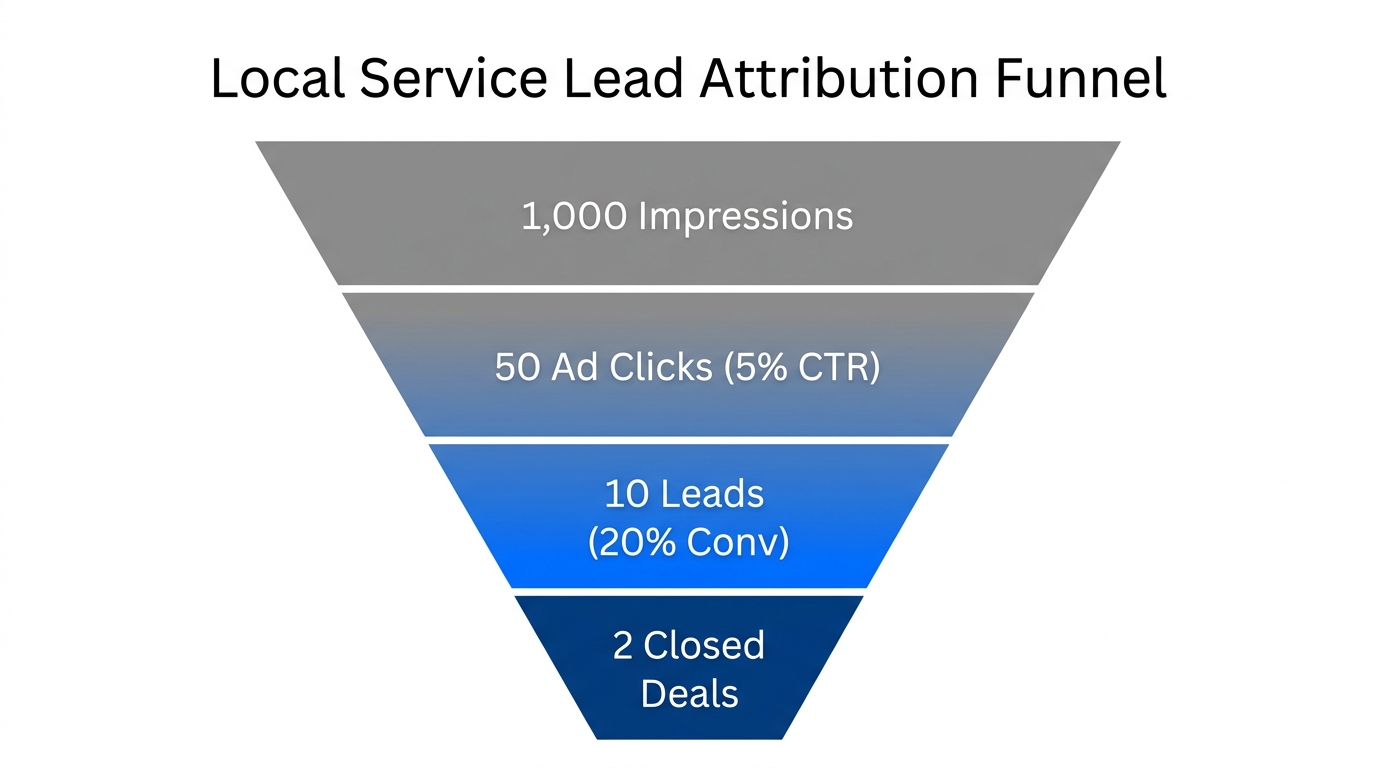
For local services like emissions testing, plumbing, or landscaping, ad conversion tracking is often the first point of failure. You cannot rely on "vibes" or asking customers "how did you hear about us?" Memory is a terrible database.
To master your local service marketing playbook, you must track every touchpoint. This includes:
- Dynamic Number Insertion (DNI): Using different phone numbers for different ad groups to see which one actually drives calls.
- UTM Parameters: Tagging every link so you know exactly which keyword generated the click.
- CRM Integration: Syncing your ad data with a CRM like Pipedrive or Stormy AI to track lead-to-close rates.
While managing these leads, many modern founders are turning to User-Generated Content (UGC) to make their ads feel more authentic. For instance, platforms like Stormy AI streamline the process of finding local creators who can record "mystery shop" style reviews or service demonstrations, which can significantly boost your Google Ads' Quality Score and trust levels.
The $1,000 Google Ads Pilot Checklist
Ready to stop lying to yourself about Google Ads? Follow this playbook for a 2026-ready pilot campaign with a $1,000 budget. Do not skip a single step.
Step 1: The Specificity Filter
Don't bid on broad terms. If you do mobile emissions, don't just bid on "car repair." Bid on "mobile smog check at home [City Name]". Your volume will be lower, but your intent will be 10x higher.
Step 2: Face the Pain of the Funnel
Before spending a dime, use UserTesting to watch 3-5 strangers try to book a service on your site. If they struggle for even 10 seconds, fix the UX before turning on the ads.
Step 3: Set Up Your 'Waste Meter'
Use tools like Hotjar or Microsoft Clarity to watch your ad traffic. If people click and leave in 2 seconds, your ad promised something your landing page didn't deliver.
Step 4: The 10-Variation Minimum
Create at least 10 different ad headlines. One should be Benefit-Led ("Get your smog check while you sleep"), one should be Price-Led ("Flat $60 Emissions Check"), and one should be Fear-Led ("Avoid the $200 late registration fine today").
"You don't need a million dollars to scale; you need a system that actually works and the discipline to let it run."
Conclusion: The Discipline of Growth
In 2026, the winners aren't necessarily the ones with the biggest budgets—they are the ones with the best decision-making functions. If you say something "didn't work," you are usually just saying you didn't have the stomach to iterate. Mastering Google Ads for local business is about moving past the first few reps and doing the hard work of tracking, writing, and testing that your competitors are too lazy to do.
Stop looking for the "fancy new thing" and start fixing the obvious thing. Whether you are scaling a mobile car service or a niche software tool, the principles of high-frequency testing and clear attribution remain the same. Train hard in your marketing lab, and you will win easy in the marketplace.