
By 2026, the ecommerce landscape has shifted from a "growth at all costs" mentality to a clinical focus on outcome engineering and intelligent commerce. With global ecommerce ad spend projected to reach $271 billion this year, the margin for error has evaporated. Advertisers no longer compete just on creative flair but on the technical precision of their data feeds and the efficiency of their SKU-level bidding. Today, the median ROAS across platforms sits at 3.2x, yet the top 10% of brands are achieving a staggering 8.4x ROAS by leveraging advanced AI orchestration.
Mastering the 4.2x ROAS Potential of Google Shopping and Performance Max
In 2026, Google Ads remains the bedrock of high-intent search. Google Shopping has maintained its dominance with an average ROAS of 4.2x and an average CPC of $1.16, according to recent benchmarks from Marketing LTB. However, the real story this year is the massive surge in Performance Max (PMax) adoption. A recent study of Swedish retailers during the last holiday cycle showed a 50% increase in PMax spend, which delivered a 4.57x ROAS—consistently outperforming traditional manual Shopping campaigns.
To capture this efficiency, brands are moving away from broad asset groups toward hyper-segmented PMax campaigns. This involves feeding Google's algorithms high-quality first-party data. With the total deprecation of third-party cookies, implementing server-side tracking via platforms like Elevar or Benly.ai is no longer an optional upgrade; it is a fundamental requirement. Brands failing to utilize server-side tracking are losing between 20% and 40% of their conversion data, which directly cripples the AI's ability to optimize bids.
"The era of 'tactical' PPC is over; 2026 is about Martech ROI and the maturity of your data ecosystem. If the AI doesn't see the conversion, the algorithm can't find the customer."
SKU-Level Optimization: Avoiding the 340% CAC Penalty
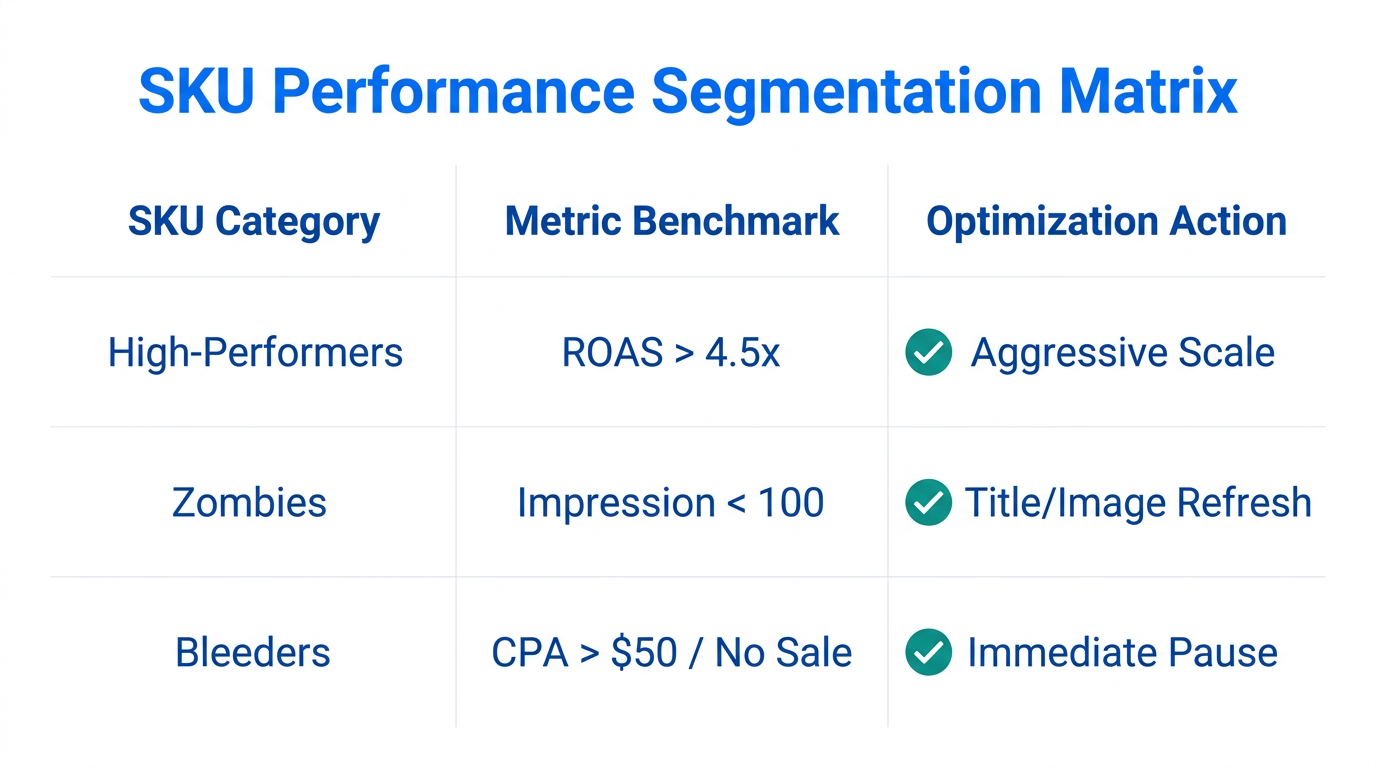
One of the most expensive mistakes an ecommerce brand can make in 2026 is "shotgun advertising"—the practice of applying uniform bids across an entire product catalog. Research from Digital 1010 reveals that advertising out-of-stock or low-stock items can increase your Customer Acquisition Cost (CAC) by a brutal 340%. High-performance brands now use tools like Feedonomics to dynamically pause ads for SKUs the moment inventory drops below a specific threshold.
To optimize ad spend at the SKU level, you must categorize your products into performance tiers:
- Heroes: High-margin, high-stock, high-conversion items. These get the aggressive bids.
- Zombies: SKUs with impressions but no clicks or conversions. These need a creative overhaul or to be excluded.
- Leaky Buckets: High-click but low-conversion items. These usually indicate a landing page or pricing issue.
Furthermore, it is vital to remember that 48% of users will abandon their carts due to high shipping costs. No amount of SKU-level ad optimization can fix a broken checkout experience or non-competitive shipping rates. You must audit your funnel before scaling your spend.
The Rise of Retail Media Networks (RMNs): Why Budgets are Shifting
The traditional dominance of social media ads is being challenged by the explosive growth of Retail Media Networks (RMNs). Brands are aggressively shifting budgets to Amazon Advertising, Walmart, and Instacart because these "closed-loop" systems offer 1.8x better results for purchase intent than social platforms like Meta or TikTok. RMNs are projected to become a $200 billion industry by the end of 2026.
| Platform | Average ROAS (2026) | Key Benefit | Average Metric |
|---|---|---|---|
| Amazon Sponsored Products | 5.2x | High Purchase Intent | 59% Spend Increase |
| Google Shopping | 4.2x | High Search Volume | $1.16 CPC |
| Meta (FB/IG) | 2.5x | Discovery & Retargeting | $11.54 CPM |
| TikTok Shop | 1.8x | Viral Social Commerce | $52.00 CPA |
Amazon Sponsored Products management now requires a sophisticated mix of automated bidding and manual keyword harvesting. Expert analysis from Skai.io indicates that 59% of top-tier brands have increased their Amazon spend this year. The advantage of Amazon is simple: the user is already at the point of sale. To maximize this, integrate your Amazon data with 3rd-party attribution tools like Northbeam or Triple Whale to see the true incrementality of your spend, rather than relying on Amazon's self-attributed dashboard metrics.
Auditing Google Ads for 'Budget Bleed' and Negative Keywords
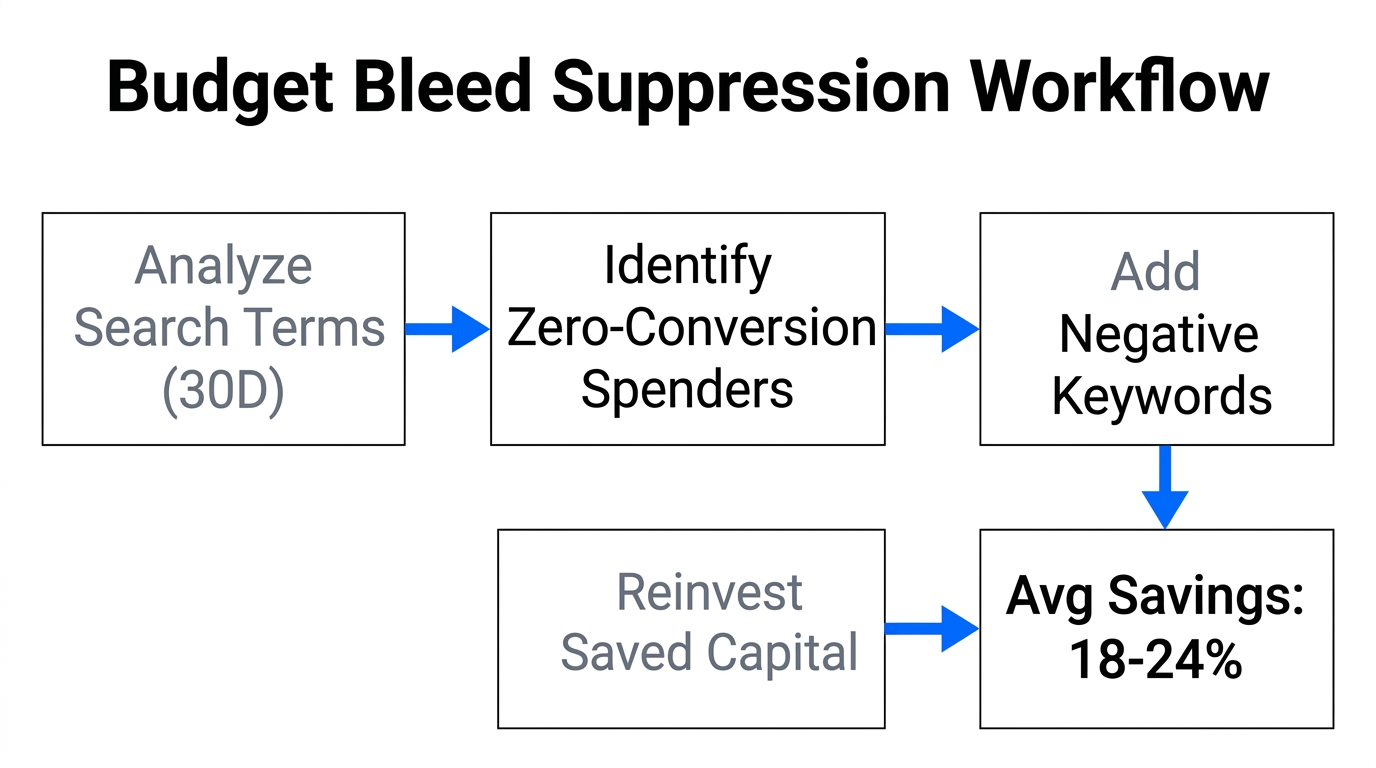
Even with advanced AI, human oversight is required to prevent "budget bleed." A primary cause of wasted spend is the failure to conduct regular search term audits. Without a rigorous negative keyword strategy, your ads may appear for irrelevant queries that consume your daily budget before your target audience even wakes up. Agencies like Zen Agency emphasize that filtering out non-converting intent (e.g., "free," "repair," "jobs") can instantly reclaim 15-20% of your wasted spend.
Additionally, modern optimization requires Omnichannel Retargeting. Don't just show another ad to someone who abandoned their cart. Synchronizing an ad retargeting campaign with an SMS or email flow via Klaviyo can boost revenue by 27%. The most efficient brands in 2026 are also leveraging User-Generated Content (UGC) sourced through platforms like Stormy AI for their retargeting ads, as unpolished video content has been shown to reduce CPA by 23% compared to high-production studio assets.
"Advertising is no longer a solo act. It's the synchronization of ads, email, and high-converting site speed that defines the winners of 2026."
Preparing for the Era of Agentic AI Commerce Agents
The biggest shift on the horizon is the move toward Agentic AI. By the end of 2026, 60% of ecommerce transactions are expected to involve AI agents—autonomous bots that browse the web, compare prices, and negotiate deals on behalf of the consumer. This means your advertising and product data must now be "machine-readable."
Optimizing for these bots requires clean, structured data in your product feeds. This includes detailed schema markup, clear technical specifications, and real-time inventory updates. If an AI agent cannot verify that your product is in stock or find its specific technical attributes, it will bypass your listing for a competitor's. Your 2026 strategy must cater to both human emotion and machine logic.
Building the 2026 Growth Stack

To execute these advanced strategies, you need a modern growth stack. Pair your Google Ads and Amazon efforts with specialized tools for attribution and creative sourcing. For example, brands often use Stormy AI to discover and manage the UGC creators who provide the raw footage for high-performing PMax and Spark Ad assets.
Key tools for your 2026 stack include:
- Feed Management: Feedonomics for SKU-level control.
- Attribution: Triple Whale or Northbeam for a single source of truth.
- PPC Automation: Optmyzr or Madgicx for automated bidding and creative testing.
- User Experience: Contentsquare to identify why users are dropping off your site.
Conclusion: The Path to 8.4x ROAS
Achieving elite-level performance in 2026 requires a departure from traditional "set and forget" advertising. By focusing on SKU-level profitability, embracing Retail Media Networks, and ensuring your data is server-side verified and machine-readable, you can navigate the complexities of this new era. Stop chasing vanity ROAS metrics and start focusing on contribution margin and incrementality. The brands that win this year will be those that treat their ad spend not as a cost of doing business, but as a precision-guided investment in high-intent customer acquisition.