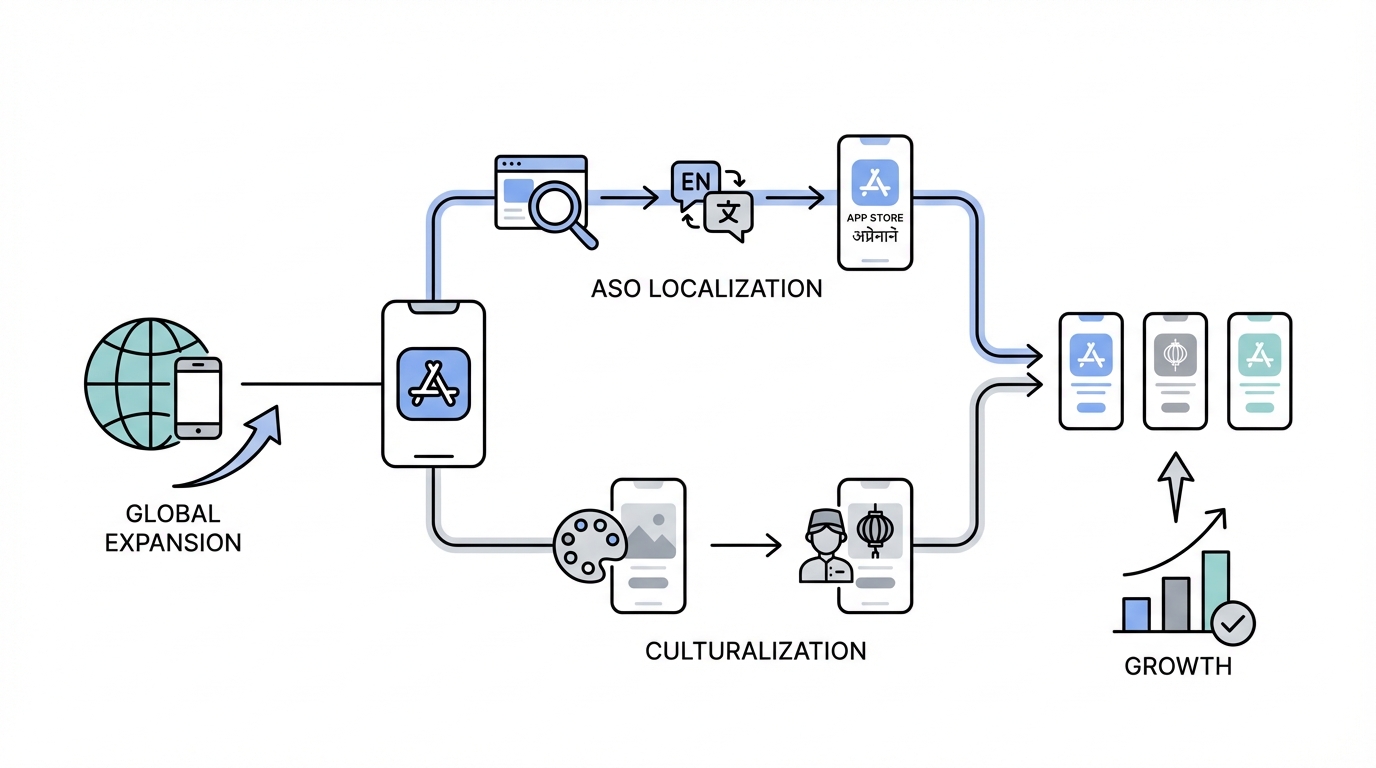
Expanding a mobile app into international markets is no longer just an option for ambitious developers; it is a necessity for sustainable revenue growth. However, many entrepreneurs fall into the trap of thinking that a simple translation of their store listing is enough to capture a global audience. The reality is far more complex. In a world where 65–70% of all app discoveries occur directly through search, according to data from Business of Apps, your visibility in local markets depends entirely on a sophisticated international ASO strategy.
To truly scale, you must move beyond literal translation and embrace culturalization—the process of adapting your app’s metadata, creative assets, and even its core value proposition to align with local search intent and cultural nuances. This guide explores the strategic framework for scaling mobile apps internationally by mastering the art and science of global App Store Optimization (ASO).
The Critical Difference: Translation vs. Culturalization

The most common mistake in global app growth is relying on automated translation tools like Google Translate to localize app metadata. While the words might be technically correct, they often miss the intent of the user. Translation is about language; culturalization is about behavior. For example, a "fitness tracker" might be searched for using technical terms in one region but referred to with local slang in another.
When you culturalize, you are researching how a local user naturally speaks. In Tier 1 markets like the US or UK, search terms might be highly competitive and branded. In Tier 2 markets, users might rely more on generic, utility-based terms. Research from DotcomInfoway suggests that failing to account for these nuances can lead to a disconnect between your app and its potential users, resulting in low conversion rates despite high visibility.
"Winning the 30% generic market through intent-driven ASO is the primary goal for apps looking to break away from their domestic borders."Researching Regional Slang and Local Search Intent
Effective multilingual keyword research requires a deep dive into the specific vocabulary of your target territory. You cannot assume that a top-performing keyword in the United States will have a direct equivalent in Germany or Brazil. Start by identifying "seed keywords" using tools like the Google Keyword Planner to understand broad web search intent in that region.
Tier 1 Markets: High Competition, Branded Focus
In mature markets, 70% of searches are branded. This means users are looking for specific names like "TikTok" or "Calm." To compete here, your international ASO strategy must focus on long-tail, high-intent keywords that offer a specific solution. As suggested by AppTweak, targeting phrases like "meditation for anxiety" rather than just "meditation" allows you to bypass the giants and capture users with immediate needs.
Tier 2 Markets: High Growth, Generic Focus
In emerging markets, users are often more open to discovering new solutions through generic terms like "free photo editor" or "offline maps." This is where app store localization pays the highest dividends. By identifying the specific ways these users describe their problems, you can achieve a high Download Velocity, which Sensor Tower identifies as the single biggest temporary booster for keyword rankings.
- Analyze Competitors: See which keywords your local competitors are ranking for using tools like ASOMobile.
- User Reviews: Scrape local reviews to find the exact language users use to describe your app’s features.
- Seasonal Trends: Adapt metadata for local holidays (e.g., Carnival in Brazil vs. Diwali in India).
How Localization Influences Ranking Signals and CVR

Modern app store algorithms from both Apple and Google have shifted toward Natural Language Processing (NLP). They no longer just look for exact character matches; they understand the context of the user’s query. This makes app store localization even more critical. If your metadata is poorly localized, the algorithm may fail to associate your app with the correct semantic cluster in that language.
Furthermore, a high Conversion Rate (CVR) is now a direct ranking signal. If an app ranks #1 for a term but has a 1% CVR while the #2 app has a 5% CVR, the stores will eventually swap their positions to prioritize the app users actually want to download. Localization directly impacts this; a user who sees a listing in their native tongue with culturally relevant screenshots is significantly more likely to click "Install."
According to ConsultMyApp, the synergy between keyword relevancy and visual localization is what drives sustainable growth. Without culturalized visuals, your keyword efforts will result in high impressions but low installs, eventually killing your organic ranking.
"The algorithm is no longer a simple machine; it is a sophisticated judge of human relevance and cultural alignment."Platform-Specific Nuances: iOS vs. Google Play
When scaling mobile apps internationally, you must navigate the distinct technical requirements of each store. Apple and Google treat localized metadata differently, and failing to adjust your strategy for each will lead to wasted effort.
Apple App Store (iOS)
Apple uses a specific 100-character Keyword Field that is hidden from users but vital for ranking. When localizing for iOS, do not repeat keywords that are already in your Title or Subtitle. Use this space for your primary localized terms. Research from ASO Guru highlights that Apple ignores duplicates, so every character in this field is precious real estate for your international ASO strategy.
Google Play Store (Android)
Google Play indexes the Full Description (4,000 characters). This requires a content-heavy approach where your core localized keywords should appear with a density of 1–2%. Over-optimizing here can lead to a "shadow ban," as warned by Practical Logix. Google’s algorithm is highly sensitive to keyword stuffing, so the localization must feel natural and helpful to the user.
The Localization Playbook: Launching in a New Territory
To successfully launch and scale, follow this structured workflow for every new market you enter.
Step 1: Market Prioritization
Use competitive intelligence from SearchAds.com to identify which regions have the highest demand and lowest competition for your app category. Don't try to launch everywhere at once; pick 2-3 key territories to master first.
Step 2: Deep Keyword Discovery
Identify localized synonyms and long-tail phrases. Ensure you are looking at what local users actually type, not just what a dictionary says. Tools like App Radar can help streamline this process by providing quick metadata updates and performance tracking.
Step 3: Creative Culturalization
Adapt your screenshots and videos. This includes changing the language of the text, but also potentially changing the people, backgrounds, and even the UI shown in the screenshots to better match local demographics. Testing these creatives via A/B testing platforms like SplitMetrics is essential for maximizing CVR.
Step 4: Leveraging Local UGC and Influencers
One of the most effective ways to boost conversion rates in a new market is by showing potential users that people just like them are using the app. User-Generated Content (UGC) from local creators acts as powerful social proof. Tools like Stormy AI can help you source and manage local UGC creators at scale, allowing you to find influencers in specific regions like Brazil or Japan who can create authentic content for your localized ads and store listings.

Monitoring International Visibility and Scaling
Once you have launched, the work is not over. ASO is a cycle of **Research → Test → Analyze → Repeat**. You should monitor your international visibility every 4–6 weeks to adjust to changing trends. The AI surge of 2024, which saw AI-related search volume increase by over 300%, is a perfect example of how quickly the landscape can change.
Use a combination of tools to maintain your global edge:
- Visibility Scores: Use Mobile Action to track your global visibility score across multiple countries simultaneously.
- Download Velocity: Monitor your install spikes using Sensor Tower to understand which keywords are driving the most actual growth.
- Conversion Analytics: Regularly check your CVR per keyword in different languages to ensure your culturalization is hitting the mark.
By treating app store localization as a continuous growth lever rather than a one-time task, you position your app to capture the 30% of users searching for generic solutions worldwide. The combination of data-driven keyword research, culturalized creatives, and local social proof is the ultimate blueprint for global app growth in 2025 and beyond.
"Scaling internationally is not about being everywhere; it is about being relevant everywhere you choose to be."Conclusion: The Future of Global App Growth
Mastering an international ASO strategy is the most cost-effective way to scale your mobile app’s revenue. By moving past simple translation and diving deep into the culturalization of your metadata and creatives, you satisfy both the algorithms and the end-users. Remember that the goal is to drive not just impressions, but high-intent conversions that signal to the stores that your app is the best solution for local users.
Whether you are researching regional slang in Tier 2 markets or leveraging AI-powered discovery tools like Stormy AI to find local creators for UGC, the key to success is consistency and cultural empathy. Start by optimizing your primary international territories today, and watch your global rankings climb as you turn local search intent into a global revenue engine.