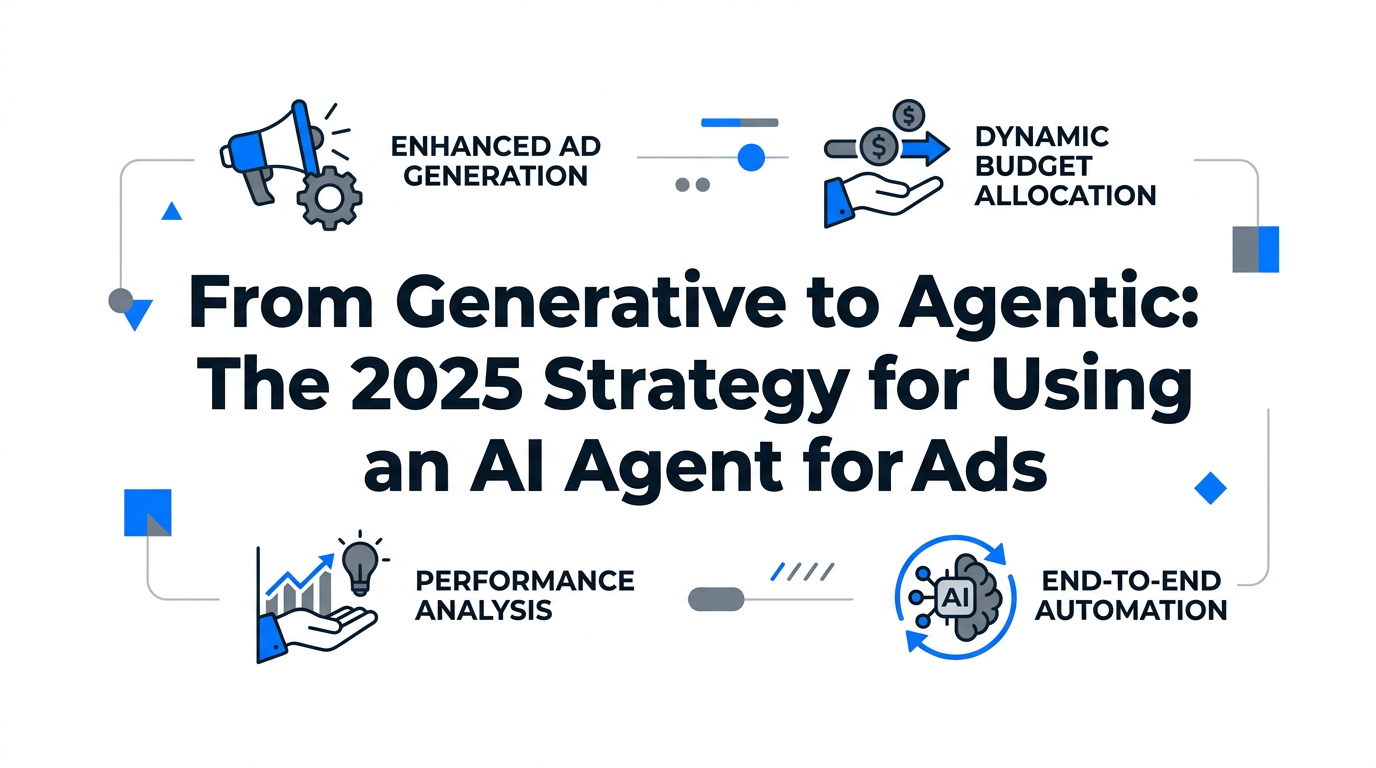
In 2024, the marketing world was captivated by the sheer novelty of generative AI. We marveled at its ability to draft a social media caption in seconds or generate a high-fidelity image from a single sentence. However, as we move toward 2025, the novelty is wearing off, and the focus is shifting toward utility and execution. Marketers are no longer satisfied with AI that simply 'assists'—they are demanding systems that 'act.' This marks the transition from generative AI to agentic AI. This shift represents the most significant evolution in digital marketing since the introduction of programmatic buying, moving us away from manual task management toward a world of autonomous ad management.
Defining the AI Agent Era: Beyond Simple Automation
To understand the 2025 AI advertising strategy, we must first define what an AI agent actually is. Unlike traditional AI marketing automation tools that follow rigid 'if-then' logic, an AI agent is a software entity capable of perceiving its environment, reasoning about how to achieve a specific objective, and taking autonomous actions. In the context of advertising, an AI agent doesn't just write a headline; it monitors the performance of that headline, compares it against 500 variations, and autonomously reallocates the budget to the top performer at 3:00 AM while your team is asleep.
This level of agentic AI for business is built on a feedback loop of 'Perceive, Reason, and Act.' By leveraging real-time data from sources like Relevance AI, these agents can adjust bids based on fluctuating stock levels, local weather patterns, or shifts in consumer sentiment. This isn't just efficiency; it is a fundamental restructuring of how marketing teams operate.
"AI agents are about to make the agile marketing debate irrelevant. They don't just plan; they ship in sprints, measure, and iterate constantly." — Deepak Gupta, Growth Expert
Market Forces: The $82 Billion Autonomous Shift
The numbers behind this shift are staggering. According to recent industry reports from MarketsandMarkets, the global AI in marketing market was valued at $20.44 billion in 2024 and is projected to skyrocket to $82.23 billion by 2030, growing at a robust CAGR of over 25%. This rapid growth is driven by a massive surge in adoption. As of late 2024, 69.1% of marketers have already integrated AI into their daily operations, a significant leap from the 61.4% recorded just a year prior.
Why is the adoption happening so fast? The answer lies in the bottom line. Organizations leveraging agentic workflows are reporting an average 20–30% higher campaign ROI compared to those relying on traditional manual methods. Furthermore, the efficiency gains are undeniable, with companies seeing a 30-50% faster time-to-market for new ad campaigns. In a competitive landscape where being first often means being the winner, the speed provided by autonomous agents is a critical advantage.
2025-2026 Trends: From Keywords to Intent Signals
As we look toward 2025, several key trends are emerging that will redefine the autonomous ad management landscape. The most notable is the end of the keyword. For decades, keywords have been the primary lever for search advertising. However, experts predict that by 2026, manual keyword targeting will be largely deprecated in favor of 'Search Themes' and 'Intent Signals' managed entirely by autonomous agents like Google’s 'AI Max' or Meta’s Advantage+ shopping campaigns.
Another major trend is the rise of Multi-Agent Systems. Instead of one large, clunky AI tool, brands are moving toward 'multi-agent nodes.' In this setup, a dedicated 'Research Agent' analyzes competitor data and market trends, which then feeds into a 'Creative Agent' responsible for generating visual assets using tools like Leonardo AI. Finally, an 'Optimization Agent' manages the deployment and budget pacing across channels like TikTok Ads Manager and Meta Ads Manager.
Expert Perspectives: The Executive View on Agentic AI
The push toward agentic AI isn't just coming from the marketing department; it’s a C-suite priority. A Google Cloud study released in 2025 found that 52% of executives have already deployed AI agents in some capacity. Perhaps more tellingly, early adopters are now dedicating 50% of their future AI budgets specifically to agentic capabilities rather than basic generative tools.
This investment is driven by the need for multi-agent nodes that can handle complex, cross-functional tasks. For example, in high-volume global workflows, brands like Adore Me use a network of specialized AI agents for everything from product descriptions to multi-language translations. This allows them to maintain a lean team while scaling their output exponentially. The goal is no longer just to 'do more with less' but to 'do everything at scale' without losing the human touch in strategy.
"The global AI in marketing market is projected to reach $82.23 billion by 2030, marking a permanent shift from assistive tools to autonomous teammates."
Choosing the Right Tech: AI Agent Comparison
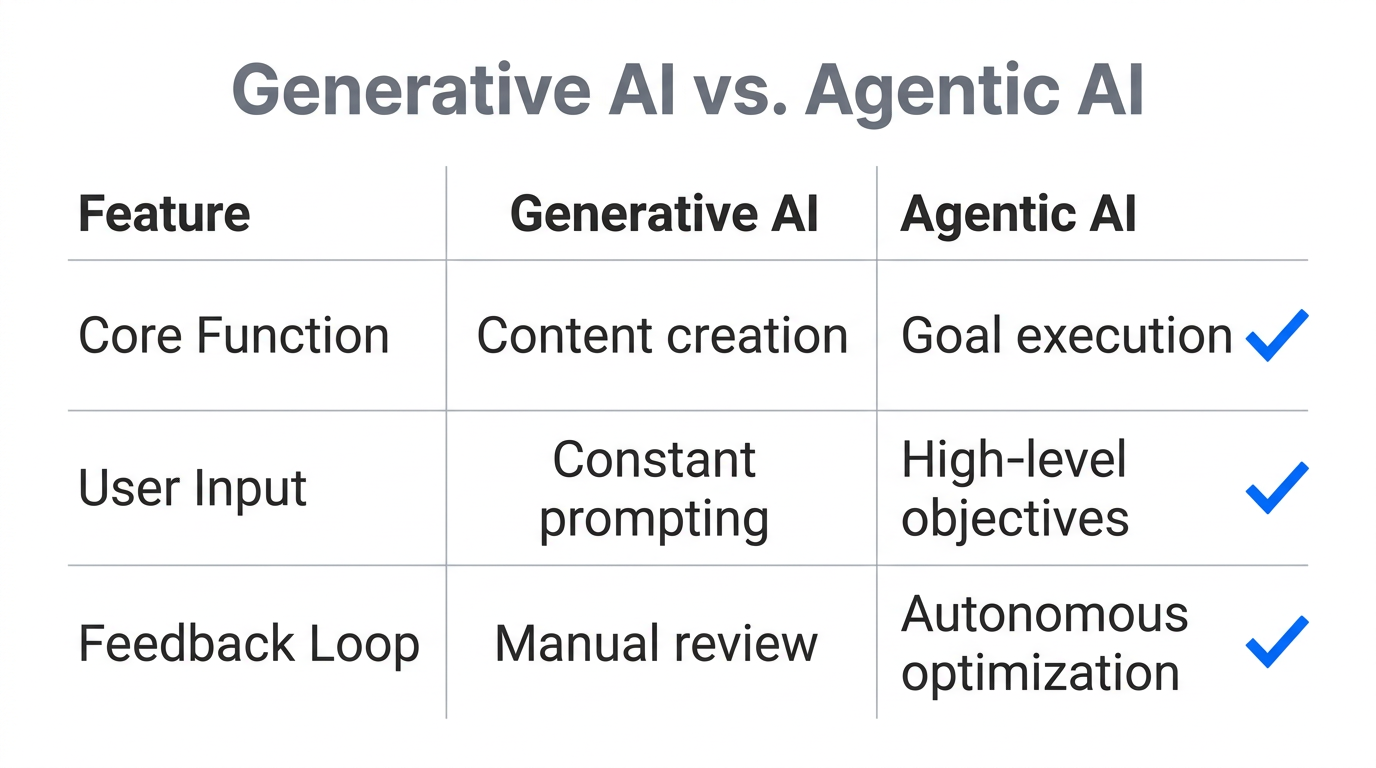
Not all AI tools are created equal. When building your 2025 stack, it is essential to distinguish between tools that offer simple generative features and those that provide true agentic AI for business capabilities. The following table highlights some of the leading platforms currently shaping the autonomous landscape.
| Tool | Core Function | Best For |
|---|---|---|
| Jasper AI | End-to-end strategy & copy | Multi-channel campaign consistency |
| Albert AI | Autonomous media buying | Cross-channel bid optimization |
| Salesforce Einstein | CRM-driven agent | Lead scoring & personalized ads |
| Adzooma | PPC Optimization | One-click Google/Meta improvements |
| Pixis AI | Creative & Targeting | High-volume performance marketing |
The 2025 Playbook: Transitioning to Outcome-Based Goals
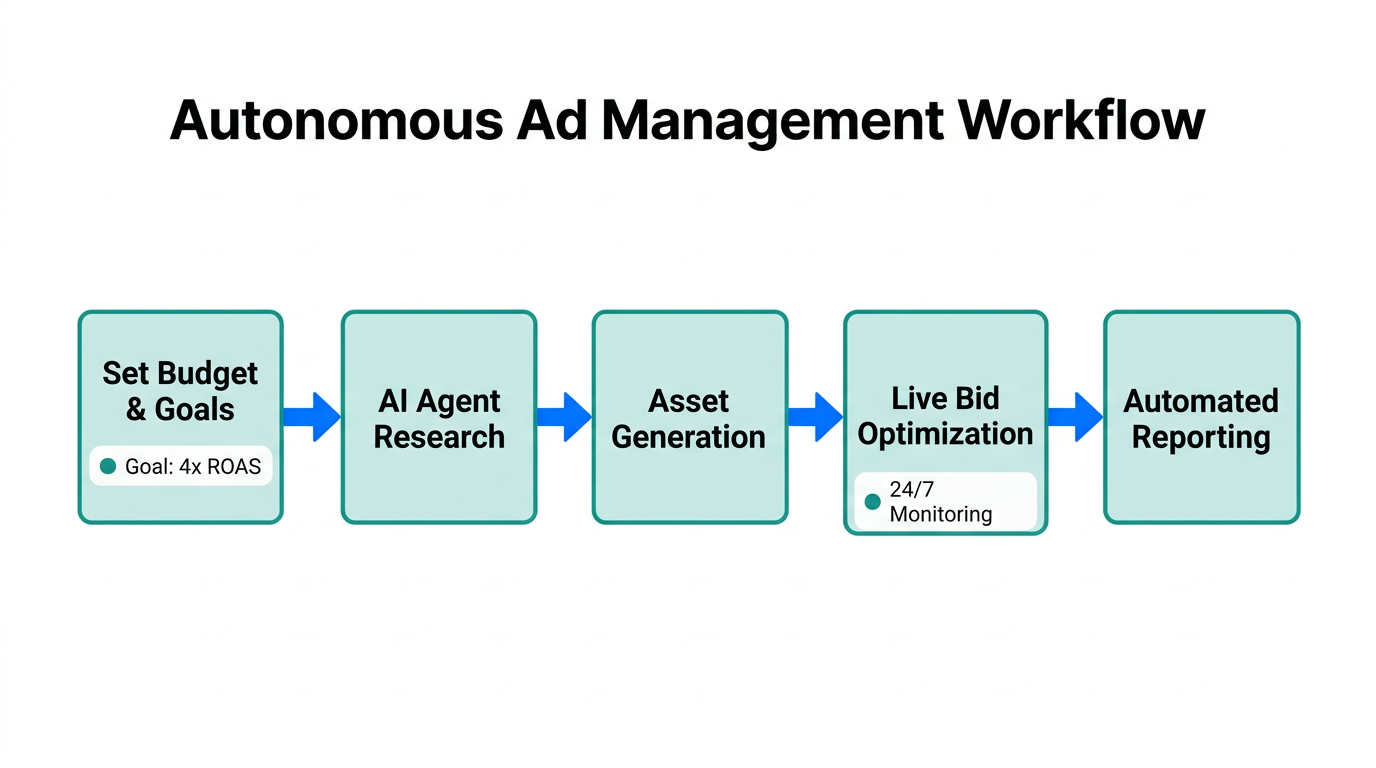
To succeed with an AI agent for ads, marketers must change how they interact with technology. The era of the 'perfect prompt' is ending; the era of 'objective setting' is beginning. Use this four-step playbook to transition your team toward agentic workflows.
Step 1: Define Outcomes, Not Tasks
Stop telling your AI to "write five headlines for a summer sale." Instead, set a goal-based objective: "Optimize ad creative to achieve a Cost Per Click (CPC) of under $2.00 while maintaining brand guidelines." This allows the agent to use its reasoning capabilities to test hundreds of variations, rather than just executing a single, static task.
Step 2: Connect Structured Data
An AI agent is only as good as the data it can access. For the agent to understand the full customer journey, you must integrate your CRM data from platforms like Salesforce or Close with your ad platform pixels. When agents have access to lower-funnel data, they can optimize for Lifetime Value (LTV) rather than just vanity metrics like clicks or impressions.
Step 3: Source High-Quality Inputs
Even the most advanced AI agent needs high-quality raw material to work with. For brands running social-first campaigns, this often means sourcing authentic User-Generated Content (UGC). Platforms like Stormy AI can help you discover the right creators and manage those relationships, providing the high-quality video and image assets that your AI optimization agents can then deploy and test at scale.
Step 4: Implement a "Human-in-the-Loop" Framework
Autonomy does not mean abdication. While you should let agents handle the 'grunt work' of bidding, variant testing, and budget reallocation, humans must remain the architects of strategy. Use your time to elevate the brand's creative direction and ensure all AI-generated output passes quality checks using tools like GPTZero to maintain a sense of authenticity.
Real-World Success: Agentic AI in Action
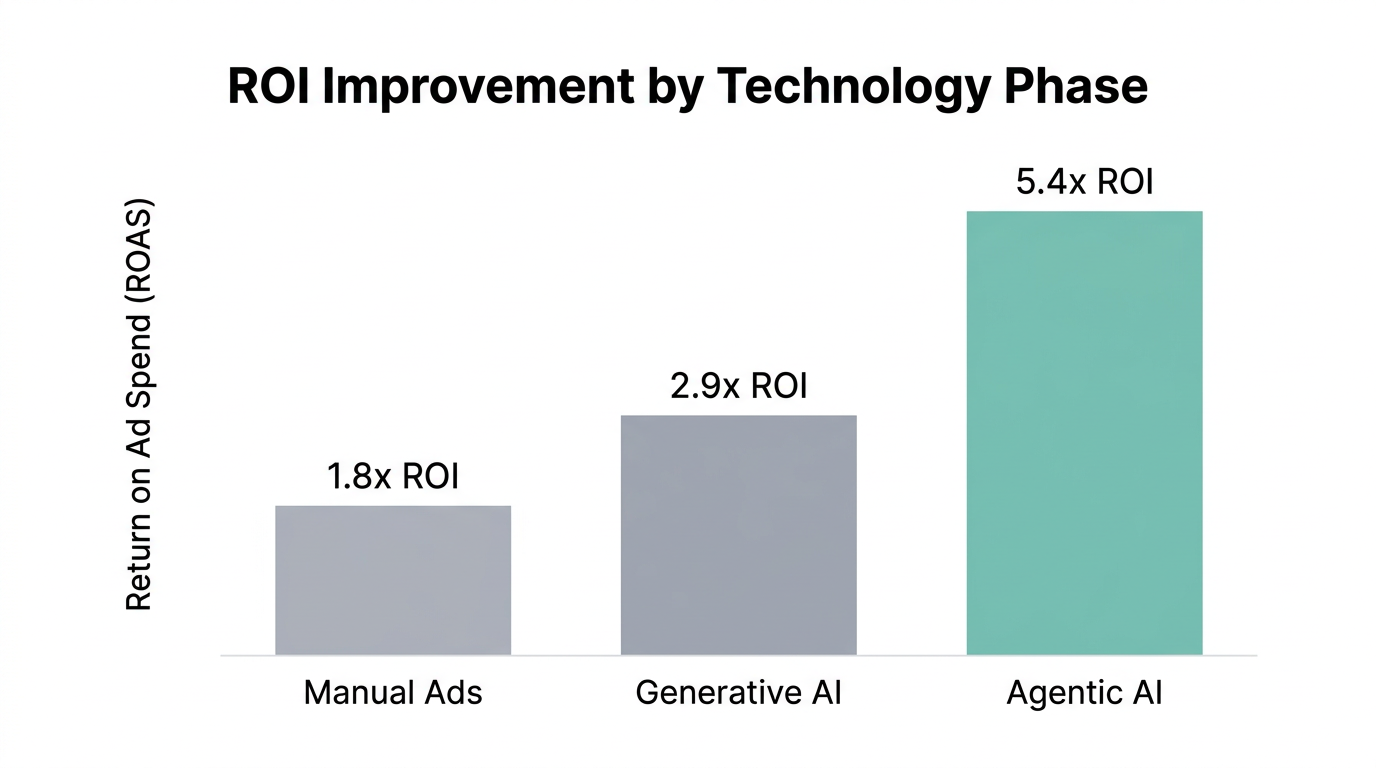
The impact of autonomous budget pacing and real-time optimization is best seen in real-world applications. For instance, the implementation of agentic AI for Google Ads has led to massive gains for early adopters. JB Impact reported a 30% reduction in CPA and a 41% increase in CTR after moving to an agent-driven strategy. By allowing the system to handle the granular adjustments of bidding and placement, the team was able to focus on high-level creative strategy.
Similarly, the success of Meta's Advantage+ tool—which functions as a specialized shopping agent—demonstrates the power of transition from generative to agentic. This tool has reached a $20 billion annual run rate according to Meta's recent earnings reports, with users seeing an average 17% improvement in their cost-per-acquisition. These results aren't just incremental; they represent a fundamental shift in campaign performance potential.
Avoiding the "Set and Forget" Trap
While the goal of an AI agent for ads is autonomy, total detachment is a recipe for disaster. One of the most common mistakes is the "set and forget" mentality. Without a monitoring framework, agents can suffer from 'data creep,' where they optimize for the wrong signals or cause budget spikes during anomalous market events. Monitoring the outcome-based goal setting results weekly is essential to ensure alignment with broader business objectives.
Furthermore, generic agents produce generic ads. If you fail to train your agents on your unique brand voice and guidelines, your ads will quickly become indistinguishable from the competition. For mobile app developers and e-commerce brands, pairing an AI optimization agent with a creator discovery tool like Stormy AI ensures that the 'seed' content used by the AI is grounded in real human experience and brand-specific aesthetics, preventing the 'uncanny valley' of purely AI-generated marketing.
Conclusion: The Future is Agentic
As we head into 2025, the competitive gap between companies using agentic AI for business and those stuck in the generative 'prompt-and-paste' era will widen. The ability to manage autonomous ad management at scale is no longer a luxury for big-budget enterprises; it is a necessity for any brand that wants to remain relevant in a signal-based advertising world. By shifting from task-based workflows to multi-agent nodes focused on high-level outcomes, marketers can finally reclaim their time for what matters most: strategy, creativity, and building genuine connections with their audience. The tools are ready—the question is, are you ready to delegate?