In 2026, the digital marketing landscape has reached a point of no return. The era of "content-for-clicks" is officially dead, replaced by a "content-for-answers" paradigm that prioritizes direct information delivery over website visits. As AI-integrated search engines like Google’s SGE (Search Generative Experience) and OpenAI’s SearchGPT become the primary interface for users, marketers are facing a brutal reality: the Zero-Click Crisis. If your growth strategy still relies solely on traditional CTR (Click-Through Rate), you are fighting a losing battle. To survive, brands must master Generative Engine Optimization (GEO)—the strategic art of becoming the primary source cited by Large Language Models (LLMs).
The 2026 Zero-Click Crisis: By the Numbers
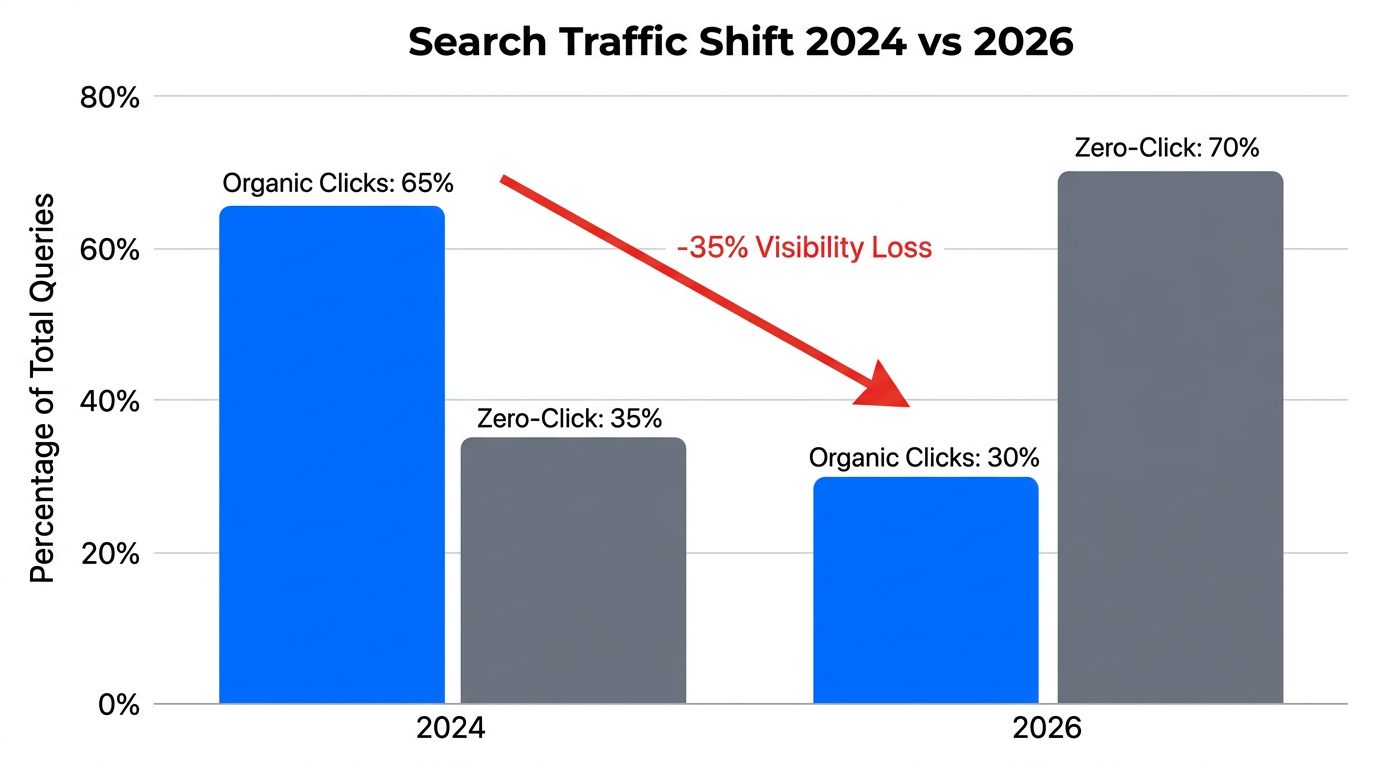
The numbers are startling. As of early 2026, the way users interact with search results has fundamentally shifted. According to data from Inner Spark Creative, a staggering 83% of AI-integrated searches result in no website visit. This means that for four out of five queries, the AI provides a comprehensive enough answer that the user never needs to click a link.
Despite this drop in clicks, organic search remains the single most important driver of global web traffic, accounting for 53.3% of all traffic. The paradox of 2026 is that while you are getting fewer direct clicks, your brand visibility in the search ecosystem has never been more influential. If an AI engine cites your brand as the expert, your authority and brand recall skyrocket, leading to high-intent direct searches later on.
What is Generative Engine Optimization (GEO)?
Generative Engine Optimization (GEO) is the evolution of SEO. While traditional SEO focuses on ranking #1 for specific keywords, a GEO strategy 2026 focuses on information density and topical authority. AI engines don't just look for keywords; they look for the most comprehensive, trustworthy, and "citeable" answer to a user's intent.
The goal is no longer just to "be on the first page." The goal is to be the primary source that the LLM uses to build its response. This requires a shift in content production. Instead of writing broad, fluffy articles, brands must produce high-density content that answers "why" and "how" with precision. This is particularly critical for SaaS and B2B brands where decision-makers use AI tools like Claude or ChatGPT to compare features and workflows.
"If your traffic is down but impressions are up, AI is citing you without sending clicks. Your strategy must pivot to building 'brand recall' so users search for you by name." — MarTech Editorial Panel
Using Ahrefs for Information Density Gap Analysis
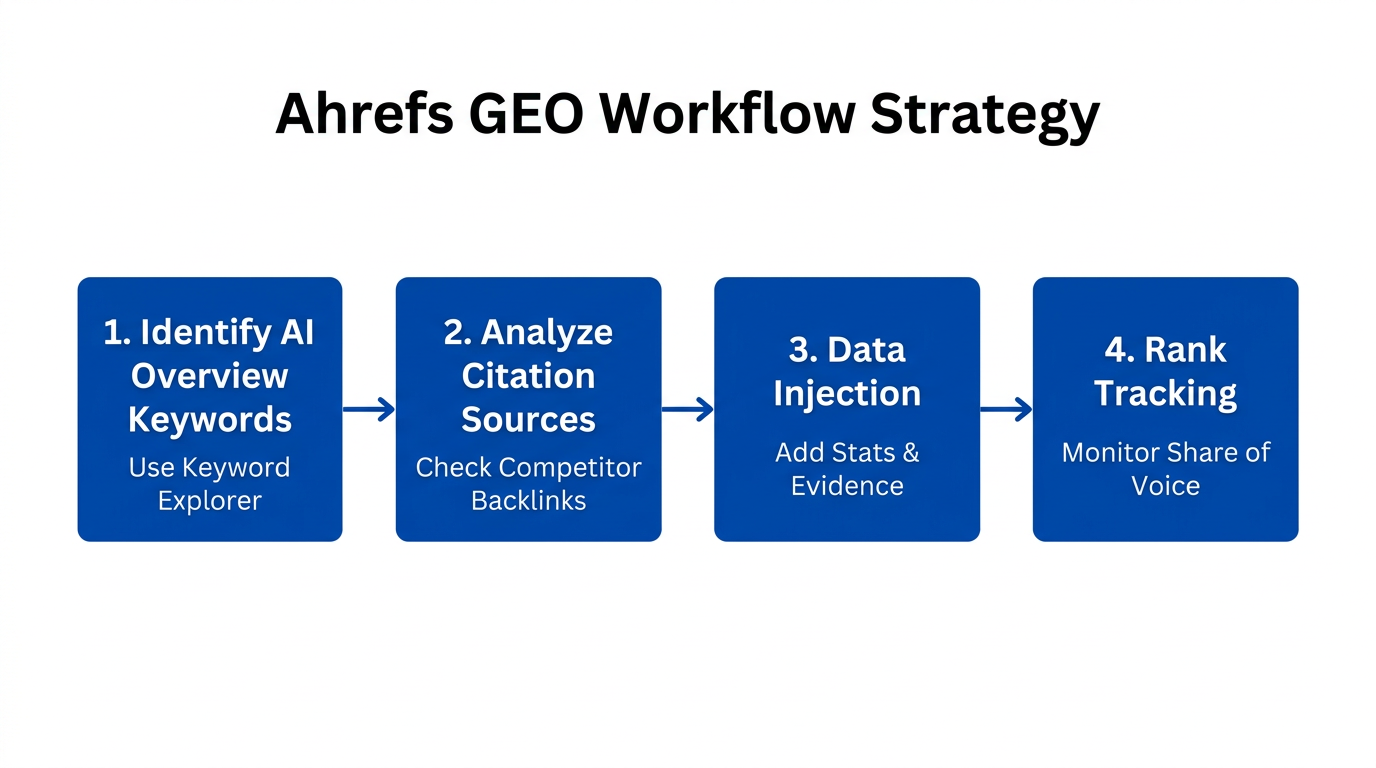
To win at GEO, you need to know what the AI knows—and more importantly, what it’s missing. Ahrefs remains the gold standard for this, but the workflow has changed for 2026. You are no longer just looking for high-volume keywords; you are performing Information Density Gap Analysis.
- Identify "Answer Engine" Keywords: Use the Keywords Explorer in Ahrefs to find terms that trigger AI Overviews (AIO). Look for queries with high informational intent.
- Analyze Top-Cited Sources: Look at the websites currently being cited in the AI summaries. Use Ahrefs’ Site Explorer to see the backlink profile and E-E-A-T (Experience, Expertise, Authoritativeness, Trustworthiness) markers of those sources.
- Find the "Density Gap": Compare your content against the AI’s summary. Is the AI missing a crucial step in a tutorial? Is it using outdated statistics? By providing more dense, accurate, and structured data, you become the more attractive source for the next model training or real-time web crawl.
The Pillar-Cluster Model: Establishing Topical Moats
In 2026, AI engines favor topical authority over individual page strength. To be recognized as an authority, you must implement a robust Pillar-Cluster model. This involves creating a comprehensive "Pillar" page (the ultimate guide) and surrounding it with "Cluster" pages that dive deep into specific sub-niches.
This structure helps LLMs understand the relationship between your content pieces. When an AI crawls a site that has 50 interconnected articles on "B2B referral marketing," it is far more likely to cite that site than a competitor with one single high-ranking post. For example, brands like Canva have built organic empires by creating an educational ecosystem that covers every possible design-related query, making them the default authority for AI design summaries.
| Metric | Traditional SEO (Pre-2025) | GEO (2026 & Beyond) |
|---|---|---|
| Primary Goal | Rank #1 on SERP | Be the Primary Citation in AI Summary |
| Content Focus | Keyword Density | Information Density & Schema Accuracy |
| Success KPI | Click-Through Rate (CTR) | Brand Recall & Unclicked Authority |
| Structure | Linear blog feed | Pillar-Cluster Topical Moats |
Shifting KPIs: From CTR to Brand Recall
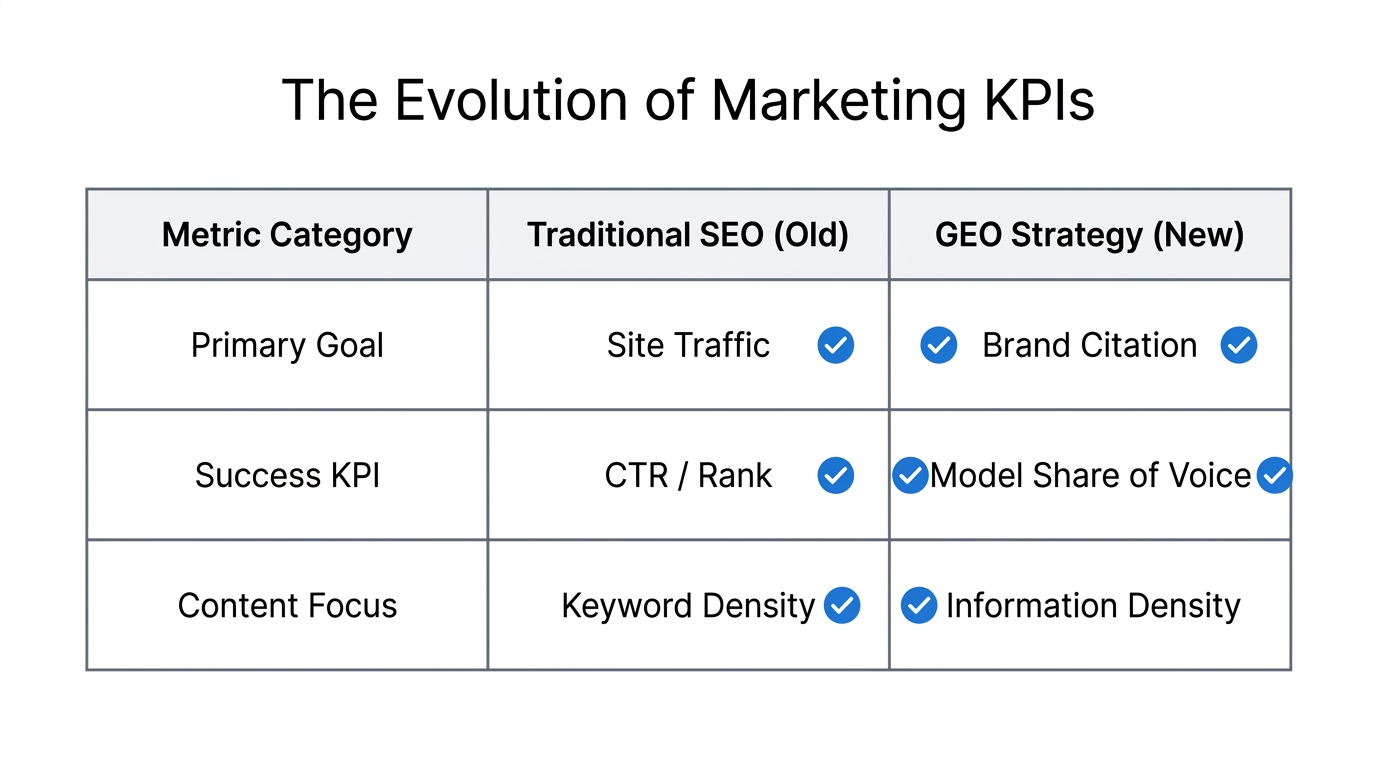
One of the hardest transitions for marketing teams in 2026 is moving away from the "click" as the primary unit of value. When 83% of searches are zero-click, your traditional Google Analytics dashboard might look bleak. However, the value is shifting to unclicked authority.
If a user sees your brand name cited in a ChatGPT response or a Google AI Overview five times in a week, you have achieved something more valuable than a click: Brand Recall. The next time that user needs a tool, they won't search for a generic category—they will search for your brand specifically. This is why referral marketing is booming; it capitalizes on the trust established by these authoritative mentions. Referral leads in 2026 convert 30% better and have a 16% higher LTV because they enter the funnel with pre-established trust.
"Community is the new moat. You don't 'acquire' users anymore; you 'invite' them into an ecosystem." — Jonathan Reich, CEO of Zedge
Step-by-Step GEO Playbook for SaaS & B2B
If you are managing a SaaS or B2B brand, follow this 2026 playbook to secure your AI search engine visibility:
Step 1: Audit for LLM Readability
Ensure your website is easily crawlable by AI bots. Use clear headers, bulleted lists, and extensive Schema Markup. If the AI can't parse your data instantly, it won't cite you. Use tools like VWO to test how different content layouts impact your appearance in AI snapshots.
Step 2: Optimize for "How" and "Why"
AI engines are excellent at summarizing "what" something is. To beat them (and be cited by them), you must provide the Experience and Expertise (the first two Es in E-E-A-T). Write about real-world workflows, specific case studies, and unique data insights that an AI cannot hallucinate or pull from a generic Wikipedia entry.
Step 3: Build a Social & UGC Signal
LLMs in 2026 are increasingly trained on real-time social data. Platforms like Stormy AI are essential here, as they allow you to discover and manage UGC creators who can generate authentic brand mentions across TikTok, LinkedIn, and YouTube. When your brand is being discussed by influencers and experts across the web, AI engines perceive you as a high-authority entity worthy of a search citation.
Measuring Success: Privacy-First Attribution
With the death of cookies and the rise of Google’s Privacy Sandbox, tracking the journey from an "unclicked" AI citation to a conversion is difficult. In 2026, growth teams are shifting to last-mile surveys and MMP (Mobile Measurement Partners) like AppsFlyer or Adjust.
By asking users "How did you hear about us?", brands are finding that "I saw you cited in an AI search" is becoming a top-three response. Furthermore, tracking branded search volume in Ahrefs is a better indicator of GEO success than tracking organic clicks for generic terms. If your branded search is up, your GEO strategy is working.
Conclusion: The Future of Organic User Acquisition
The zero-click crisis isn't the end of SEO; it’s the beginning of a more sophisticated era of Generative Engine Optimization. By shifting your focus from volume-heavy keywords to information-dense authority, you can ensure that your brand remains at the center of the AI-driven search experience.
To win in 2026, you must:
- Stop chasing clicks and start chasing citations.
- Use Ahrefs to find density gaps that AI engines need to fill.
- Leverage UGC and influencer signals via Stormy AI to build social proof.
- Invest in double-sided referral loops using tools like Cello to capture users who search for you by name.
The brands that embrace the "unclicked" reality today will be the household names cited by every AI engine tomorrow. Don't wait for your traffic to hit zero—start your GEO transition now.