In 2026, the search landscape has undergone its most radical transformation since the invention of the crawler. We have officially moved past the era of the "blue link." As the global AI marketing market swells to $128 billion, marketers are no longer fighting for the top spot on a SERP; they are fighting to be the definitive citation in an AI-generated answer. Welcome to the era of Generative Engine Optimization (GEO), where tools like Gemini 3.1 and SearchGPT have turned traditional SEO playbooks into ancient history. If you aren't optimizing for mentions in AI Overviews, your brand effectively doesn't exist to 78.4% of marketers who now use AI tools daily to find information according to recent State of AI reports.
The Death of Traditional SEO: The 60% Conversational Shift
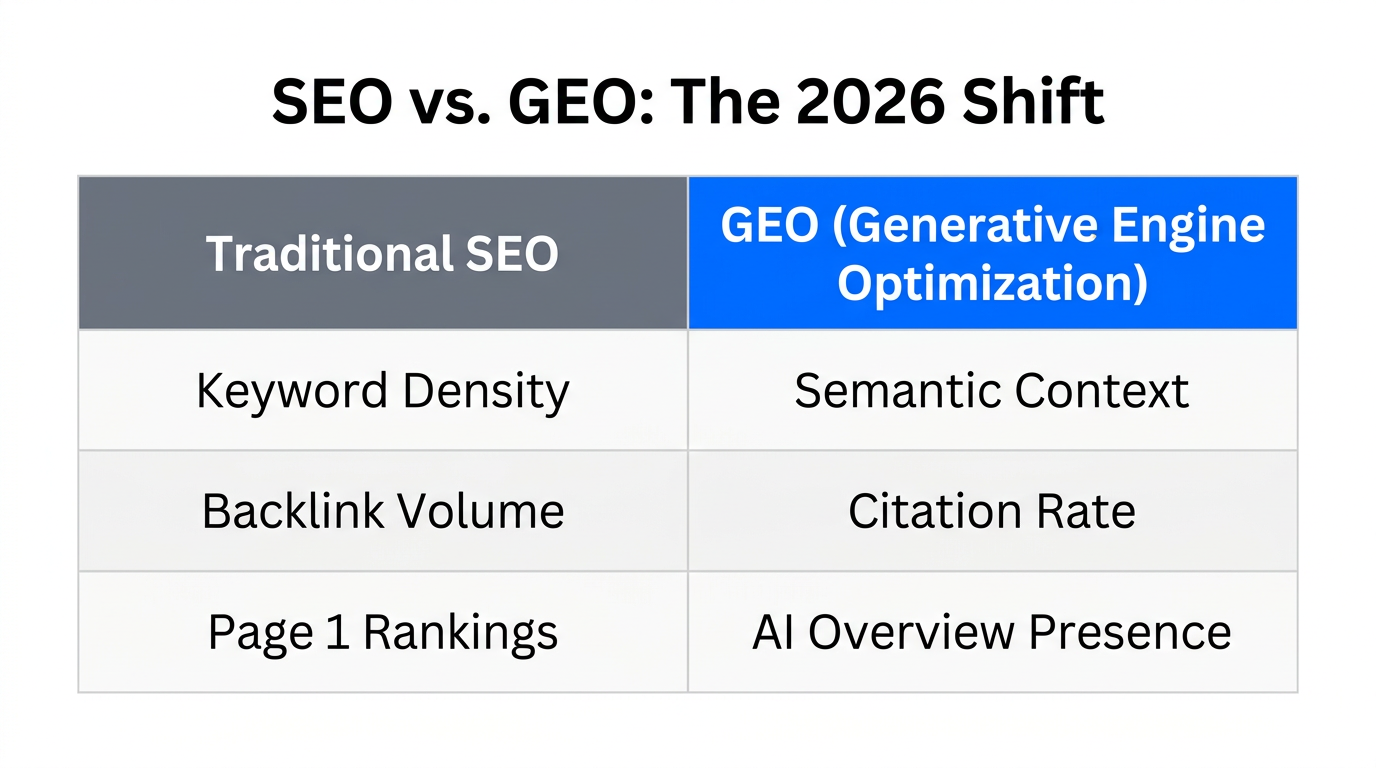
By mid-2026, the data is undeniable: 60% of all searches are now conversational long-tails. Users aren't typing "best CRM 2026" anymore; they are asking, "Which CRM integrates with my specific agentic workflow and offers the best ROI for a mid-sized agency?" This shift has rendered keyword density obsolete. Modern search engines are powered by semantic intent, and Gartner research suggests that teams failing to adapt to this conversational shift are seeing a massive drop in organic visibility.
"By 2026, 60% of searches have bypassed the blue link entirely in favor of conversational long-tails that demand deep, cited answers."
The transition from SEO to GEO means moving from static keywords to automated content clusters. Traditional ranking factors like backlinks still matter, but they now serve as "trust signals" for AI models rather than direct ranking boosters. In this new world, visibility is binary: you are either the cited source in the AI box, or you are buried in the 'see more' links that no one clicks.
Optimizing for 'Mentions': How Gemini 3.1 and SearchGPT Prioritize Citations
In the 2026 GEO game, the most valuable currency is a Brand Citation. Gemini 3.1 Pro, which boasts a staggering 94.3% reasoning score on GPQA benchmarks according to Google DeepMind technical reports, prioritizes sources that provide high-utility, structured data that it can easily parse and present to the user. To get mentioned, your content must satisfy the AI’s need for unambiguous accuracy.
Gemini 3.1’s real-time Google ecosystem integration means it is constantly scanning Google Ads, Search Console, and Merchant Center to verify brand claims. If your onsite content contradicts your structured data or your ad copy, the AI will likely skip you in favor of a more consistent competitor. This is why Gemini real-time data marketing has become a core pillar of modern digital strategy.
| Feature | Gemini 3.1 Pro | Claude 4.6 Opus | SearchGPT (GPT-5) |
|---|---|---|---|
| Best For | Real-time Search & Google Ads | Strategic Logic & Nuance | Real-time Web Buying |
| Context Window | 1M+ Tokens | 128K+ Tokens | Multi-modal Action |
| GEO Advantage | Native Google Integration | High Reasoning Accuracy | Strong Web Connectivity |
| Integration | Google Workspace/Ads | MCP (Independent) | Microsoft Ecosystem |
Unlike traditional search, where you might rank for a broad term, GEO success often depends on being the answer to ultra-niche queries. For example, platforms like Stormy AI streamline creator sourcing and outreach by identifying micro-influencers with high topical authority who are more likely to be cited in AI search summaries than generic celebrity accounts. This is because AI models prioritize contextual relevance over raw follower counts.
Technical GEO: Structuring First-Party Data and Value Exchanges
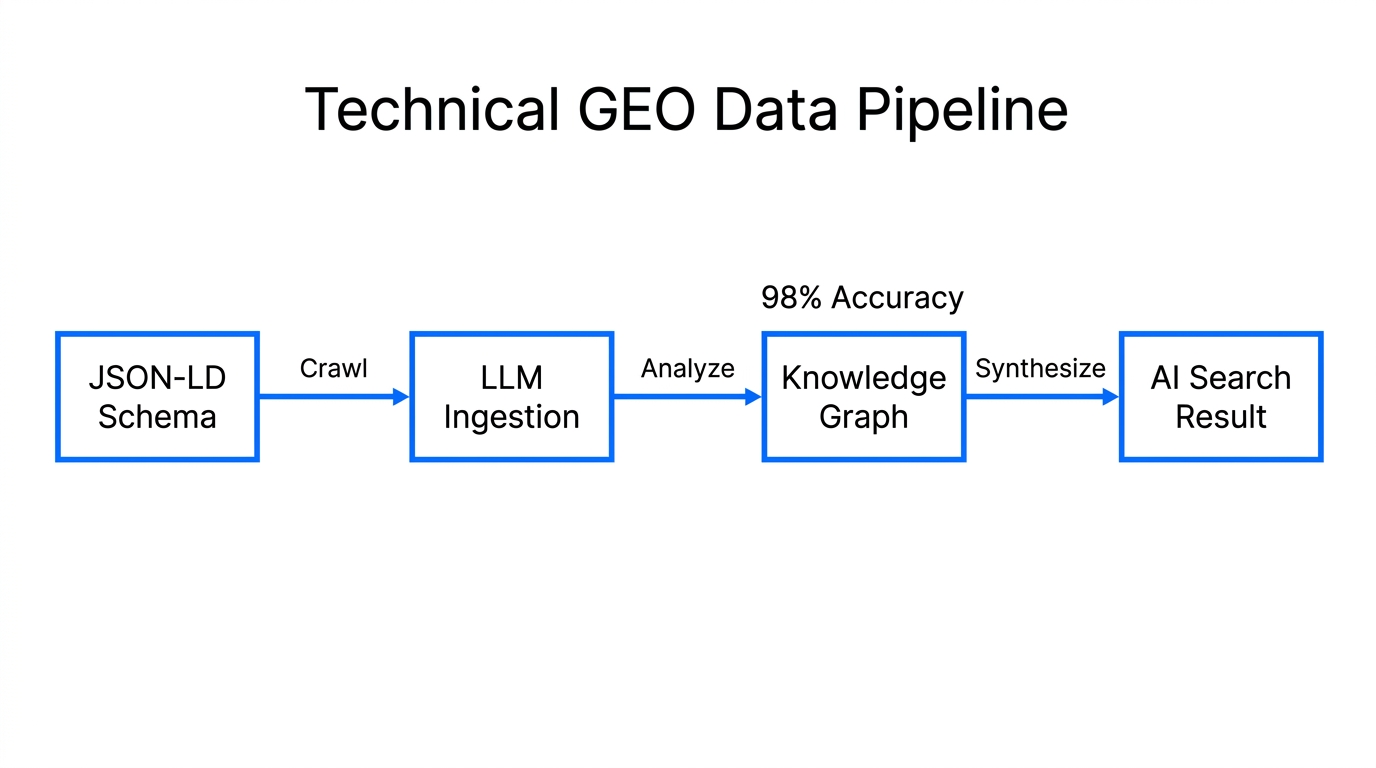
The technical side of GEO involves making your data as "edible" for AI models as possible. With the death of third-party cookies, Google's privacy frameworks highlight that AI models now rely on first-party data value exchanges to predict attribution and user intent. This means building interactive tools, gated calculators, or AI-powered advisors that collect high-intent data while providing immediate value to the user.
Consider the case of A.S. Watson, which deployed an AI skincare advisor. By structuring their product data to be used by an AI agent, they saw a 29% increase in average order value and a massive conversion rate boost. They didn't just write blog posts about skincare; they created a structured utility that AI engines could verify and recommend.
The MCP Protocol: The "USB-C for AI"
One of the biggest technical breakthroughs of 2026 is the Model Context Protocol (MCP). This allows non-technical marketers to connect their site directly to AI models like Claude or Gemini without complex API builds. By using a WordPress or Shopify MCP, you can allow agentic tools to "see" your content in real-time, identify gaps, and update metadata to align with current AI search trends via Zapier or Make integrations.
"GEO is no longer about being #1 on a list; it is about being the 'trusted partner' that the generative engine uses to construct its answer."
The Gemini 3.1 Playbook: Auditing Your AI Visibility
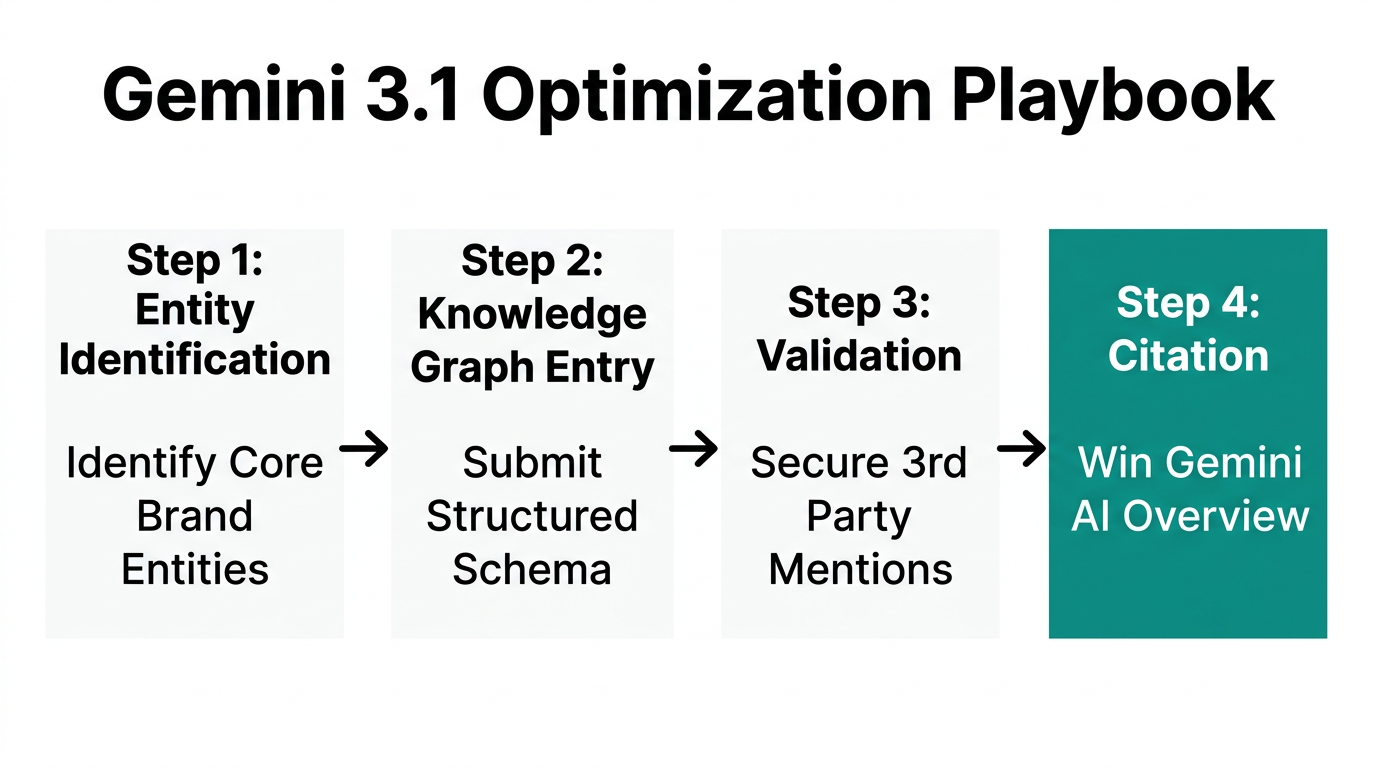
To win at Gemini 3.1 SEO strategy, you must move beyond the browser. High-maturity marketing teams use a "terminal-first" approach to audit their visibility, ensuring they capture every bit of semantic search equity available.
Step 1: The AI Audit
Use Gemini 3.1 Pro or Claude Code to run a deep analysis of how your brand is currently perceived. Use a prompt like: "Analyze the top 20 AI-generated answers for [Your Product Category]. Identify which brands are cited and what specific data points they provide that I am missing."
Step 2: Close Semantic Gaps
Gemini 3.1 is excellent at analyzing huge datasets. Feed it your existing content and your competitors' top-cited articles. Use its 1M+ context window to find "semantic white space"—topics or questions that users are asking but no one has answered with authority yet, utilizing tools like Notion to organize these insights.
Step 3: Deploy Real-Time Agents
Set up an autonomous agent that monitors Google Trends every 24 hours. When a new conversational query spikes, have the agent draft a high-authority response and publish it to your site via an MCP connection. This ensures you are always the first mover for new AI-driven search patterns.
The 'Trust Crisis' Workaround: Balancing AI Visibility with Human Authority
While 77% of advertisers view AI positively, only 38% of consumers share that sentiment, according to reports from MarTech.org. This "trust crisis" is the biggest threat to GEO. If an AI engine cites your brand but your content looks like "AI slop"—soulless, uncanny, and generic—you will lose the customer the moment they click through.
The workaround is Human-in-the-Loop (HITL) editing. Use Gemini 3.1 to handle the heavy lifting of data analysis and structuring, but ensure that your final brand voice is injected with unique human perspectives and first-hand experience. This is what prevents the "Recognition Problem" where AI makes average effortless, leading to a sea of identical content. Brands that win in 2026 are those that use AI for scale but humans for soul.
"AI platforms can recirculate negative coverage indefinitely... Unprepared brands risk losing control of their narrative to third-party AI interpretations." — Shannon Reedy, Terakeet
To combat this, you must proactively manage your brand's "AI reputation." This means monitoring not just your rankings, but how AI models describe your brand. If Gemini 3.1 is hallucinating or citing outdated negative coverage, you must update your first-party data value exchanges and schema markups to provide the model with more accurate, up-to-date information via Schema.org protocols.
Conclusion: The 2026 GEO Mandate
Winning the GEO game isn't about gaming the algorithm; it’s about becoming the most authoritative, accessible, and structured source of truth in your niche. By leveraging Gemini 3.1 for real-time data integration and Claude Code for agentic orchestration, you can build a marketing engine that doesn't just rank—it dominates the conversation.
As you move forward into 2026, remember that AI search engine visibility is a marathon, not a sprint. Start by auditing your semantic gaps, structuring your first-party data, and maintaining a human-centric brand voice. If you need help identifying the right creators to boost your topical authority in these AI models, platforms like Stormy AI can help you find and manage the influencers who are already winning the GEO game through hyper-personalized outreach and advanced analysis.
The blue links are gone. The conversational future is here. Is your brand ready to be the answer?