The traditional marketing funnel is undergoing a tectonic shift. In 2025, the way consumers find information has moved from a "click-to-site" model to an answer-first experience. As zero-click searches rose to 69% in early 2025, brands are no longer just competing for the first page of Google; they are competing to be the primary citation in an AI's response. This is the era of generative engine optimization (GEO), a discipline that requires more than just high-quality writing—it requires a fundamental restructuring of how brand data is presented to Large Language Models (LLMs). To survive this transition, marketing teams are moving away from manual content creation and toward agentic tools like Claude Code to build future-proof brand visibility.
The New Frontier: Generative Engine Optimization (GEO)
Generative engine optimization, or GEO marketing strategy, is the practice of optimizing content specifically to be crawled, indexed, and cited by generative AI engines like SearchGPT, Perplexity, and Claude. Unlike traditional SEO, which focuses on keywords and backlinks to drive traffic to a website, GEO focuses on information density and structured authority. The goal is to ensure that when an AI agent researches a topic, your brand is the source it trusts to answer the user's query directly within the chat interface.
This shift is driven by the reality of zero-click search marketing. If an AI can provide the answer without the user ever clicking a link, your only way to maintain brand relevance is to be the entity that the AI "credits" for that information. Research from Whitehat SEO suggests that social content must now be structured to match the data ingestion patterns of LLMs, favoring clear hierarchies, semantic richness, and verified data points over traditional "clickbait" headlines.
The Role of Claude Code in Agentic Marketing
If GEO is the destination, agentic AI is the vehicle. We are moving from "Chat AI" (where humans ask questions) to "Action AI" (where agents execute workflows). The social media management market is projected to explode from $27.03 billion in 2024 to $124.63 billion by 2032, a CAGR of 21.2%, according to Fortune Business Insights. At the heart of this growth is the integration of tools like Claude Code—Anthropic's command-line interface (CLI) that allows developers and marketers to run complex, multi-step tasks autonomously.
"The shift from 'Chat AI' to 'Action AI' represents the most significant change in digital strategy since the mobile revolution—it is no longer about talking to the machine, but letting the machine work for you."
Using Claude Code brand building techniques, teams can ensure their automated social content aligns with the specific technical data structures favored by generative engines. Because Claude 3.5 and 3.7 Sonnet are consistently rated higher than competitors for bug-free code generation on platforms like Reddit /r/ClaudeAI, they are the preferred engine for building the custom API connectors required for modern distribution.
| Feature | Traditional Automation | Agentic AI (Claude Code) |
|---|---|---|
| Input Method | Manual scheduling & forms | Natural language & CLI commands |
| Context Awareness | Static (reposts same content) | Dynamic (reads brand guidelines) |
| Execution | Linear (If X, then Y) | Reasoning (Plans before acting) |
| GEO Alignment | Low (Focuses on humans only) | High (Structures data for LLMs) |
From Prompting to Context Engineering
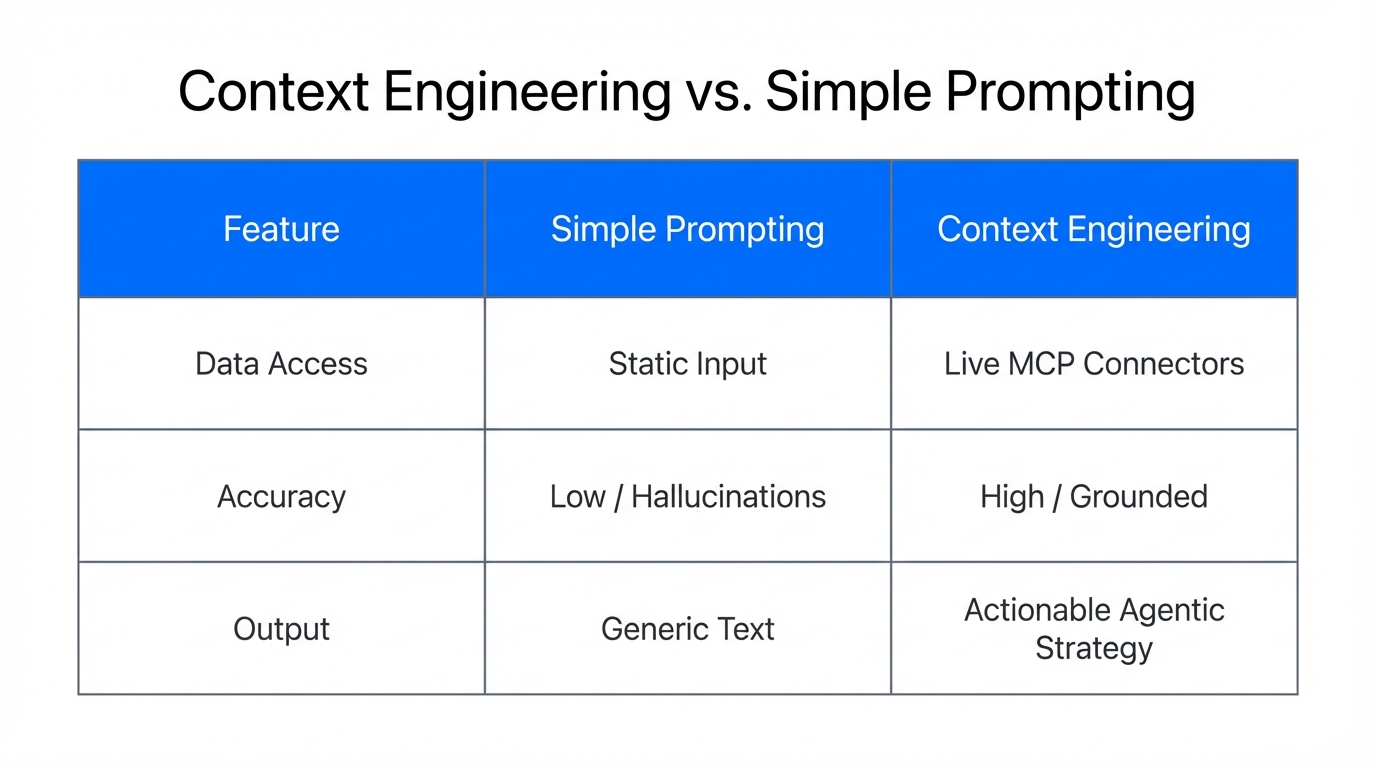
The marketing role is evolving. We are shifting away from manual writing toward Context Engineering—the process of guiding an AI's logic rather than just giving it one-off instructions. Experts at the Digital Marketing Institute argue that while AI handles the busywork of formatting, humans must manage the underlying logic and "cooldown" periods of automated agents.
A key strategy in AI brand strategy is the use of a CLAUDE.md file. By placing this documentation in your project root, you define your brand voice, content pillars, and post constraints. When Claude Code executes a task, it reads this file automatically, ensuring every generated post is perfectly on-brand. This replaces the need for repetitive prompting and allows for programmatic brand consistency at scale.
Managing the Logic Gate
One of the biggest mistakes in automation is the "set it and forget it" fallacy. To maintain a human touch, successful marketers follow the 80/20 Rule: 80% automated distribution and 20% manual engagement. Tools like Mixpost and n8n.io can be used to create "review gates" where an agent drafts content, but a human must click "approve" in Slack before it goes live. This ensures that your GEO marketing strategy remains authentic and avoids the dreaded "bot look" on social platforms.
The Tech Stack: Monitoring Trends with Puppeteer MCP
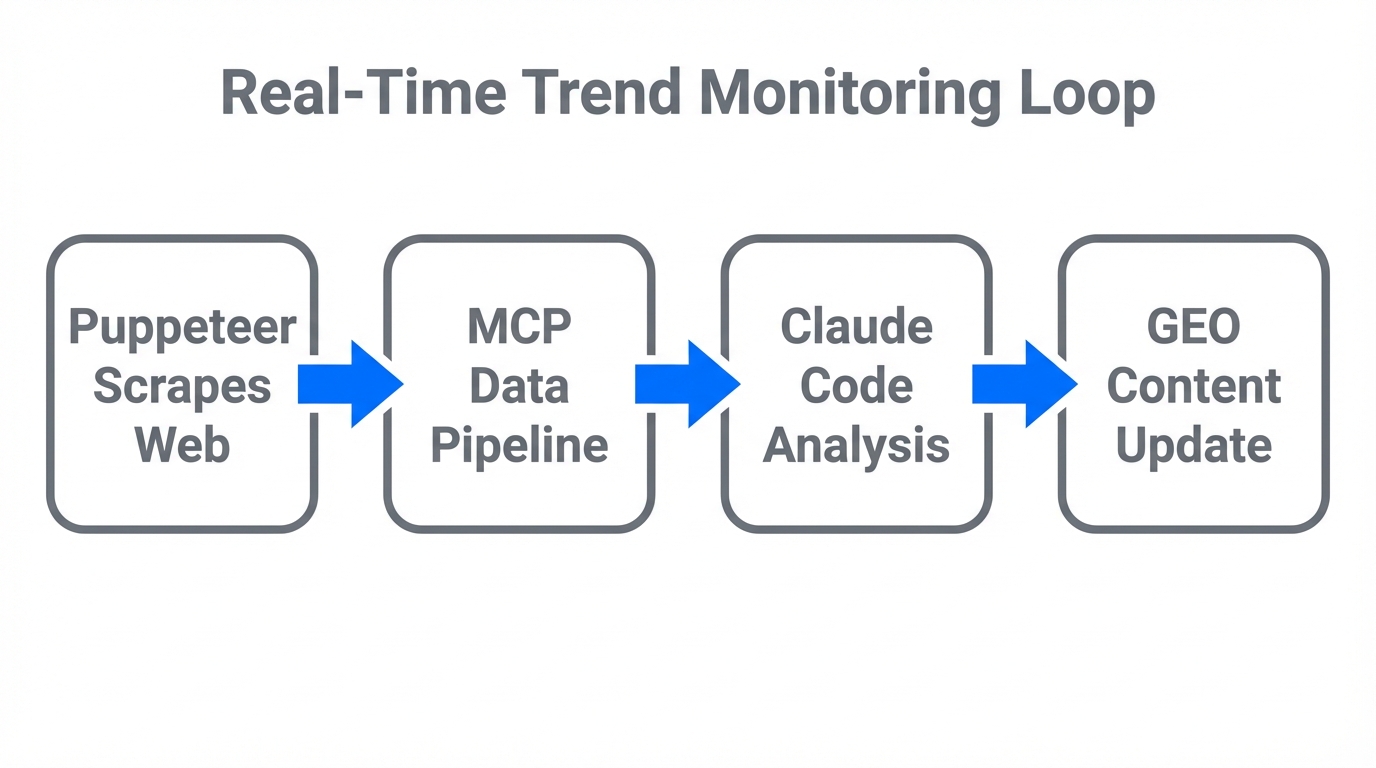
To win at GEO, your brand must be responsive to live data. Through the Model Context Protocol (MCP), Claude Code can now "talk" directly to external software. By using the Puppeteer MCP, an AI agent can browse live trends on X or LinkedIn, analyze market gaps, and generate "response content" in real-time. For example, if a competitor's product is trending due to a specific flaw, your agent can detect this via Apify scraping and immediately draft a social thread or blog post positioning your brand as the solution.
"The future of search isn't just about being found; it's about being the most relevant answer at the exact moment the AI asks the question."
When you combine this level of discovery with an AI-powered creator platform, the results are exponential. For instance, platforms like Stormy AI can help source and manage UGC creators who can then produce the video content your agents need to distribute. By pairing Stormy AI's creator discovery with Claude Code's distribution logic, brands can create a self-sustaining content loop that dominates both human feeds and AI search results.
The Long-Term ROI: Why Automation Pays Off
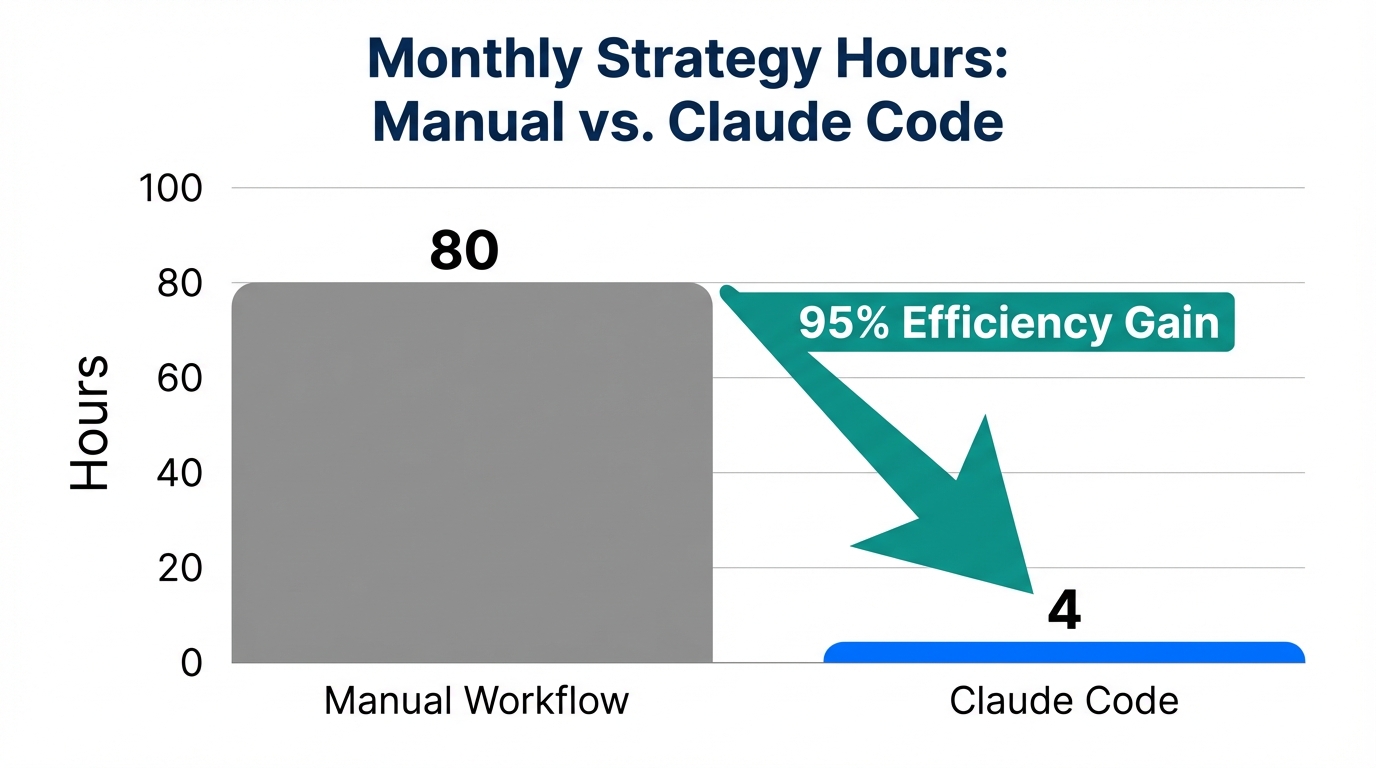
The financial argument for moving to an agentic workflow is undeniable. Marketing automation tools yield an average ROI of $5.44 for every $1 invested, according to data from Templated. Furthermore, teams using agentic AI workflows report a 300x increase in output for complex tasks compared to manual content creation. This productivity gain allows small teams to compete with enterprise-level agencies by automating the "middle-ware" of marketing.
Playbook: Future-Proofing with Claude Code
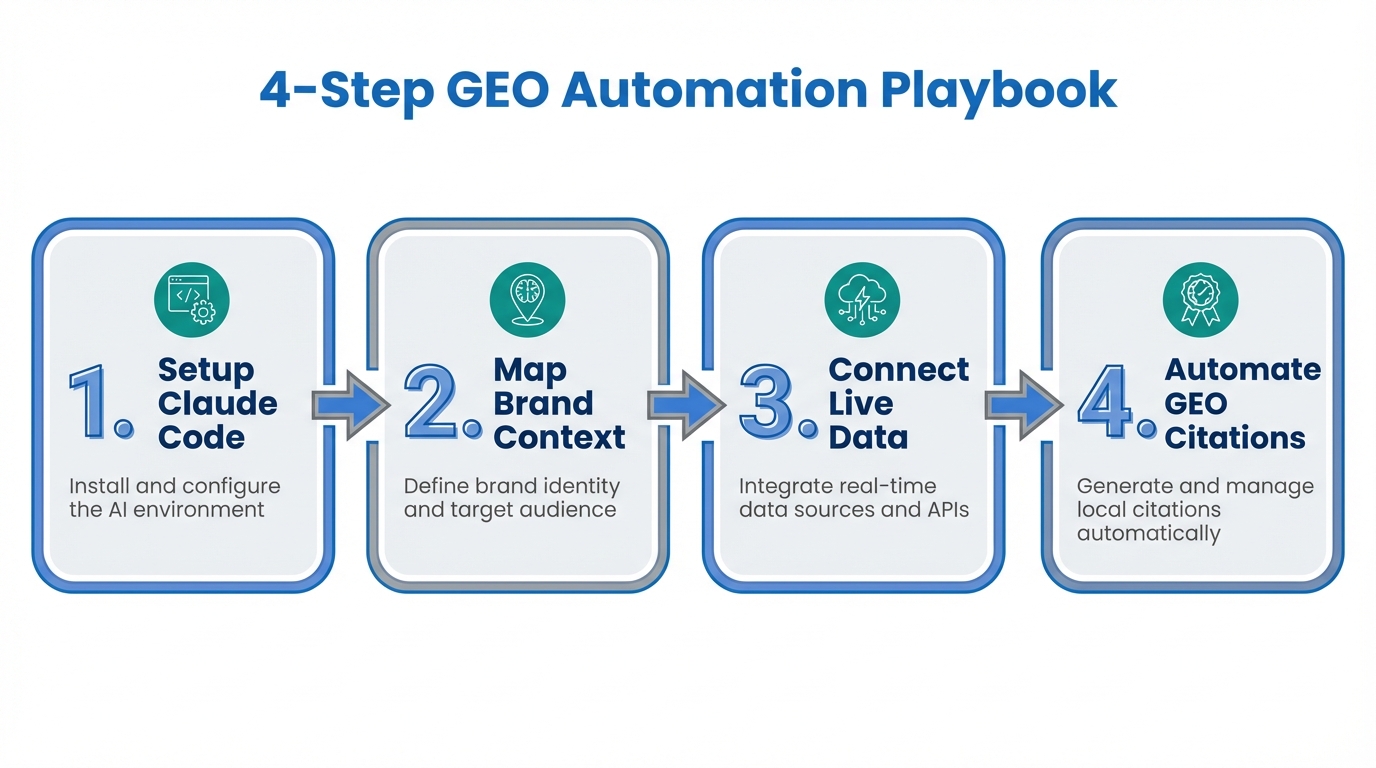
Ready to move from manual posting to agentic GEO? Follow this sequence to build a robust, automated brand presence.
Step 1: Define Your Brand via CLAUDE.md
Create a CLAUDE.md file in your repository. Include your target audience, tone of voice (e.g., "professional but accessible"), and prohibited topics. This serves as the "brain" for your agent.
Step 2: Set Up MCP Connections
Connect Claude Code to the Puppeteer MCP for web browsing and the Late MCP via the Late API to handle the actual scheduling of posts. This gives the AI both "eyes" to see trends and "hands" to take action.
Step 3: Implement Topic Cooldowns
Instruct your agent to check a local database or a tool like Zapier to ensure you aren't over-posting on a single topic. This maintains content variety and avoids platform shadowbans caused by repetitive posting.
Step 4: Execute Plan Mode
Before any major campaign, use Claude's "Plan Mode" to design a multi-platform distribution strategy. Have it analyze a single YouTube transcript or blog post and generate platform-specific hooks—punchy for X, professional for LinkedIn, and visual for TikTok scripts.
Common Pitfalls in GEO & Automation
While the potential of AI brand strategy is high, there are several traps that can damage your brand's reputation if ignored:
- Platform Blindness: Posting identical copy across all platforms. Claude Code should be instructed to adapt the structure for each network (e.g., no hashtags on LinkedIn, thread format on X).
- Ignoring Rate Limits: When using agents to scrape or post, failing to include delays can lead to account bans. Always instruct Claude to include rate-limiting logic in its scripts.
- Missing QA: Never let an agent post without a human review gate for sensitive topics. Use a system like SocialBee or a custom Slack notification to provide the final sign-off.
Conclusion: The Future is Agentic
Generative Engine Optimization is not just a trend—it is the logical conclusion of the AI-first web. As consumers move toward zero-click environments, the brands that thrive will be those that use agentic tools like Claude Code to structure their data for AI and their stories for humans. By shifting from manual prompting to Context Engineering, and leveraging high-ROI tools for automation, you ensure your brand is not just found, but cited as the ultimate authority. Start by building your first agentic workflow today, and secure your place in the next generation of digital search.