In the lightning-fast world of digital marketing, the difference between a viral campaign and a forgotten post is often just a few hours. For social media managers and influencer agencies, the struggle has always been the lag: by the time a trend is visible on the charts, the early-mover advantage is gone. Traditional Large Language Models (LLMs) haven't helped much either, as their training data usually has a 'cutoff date,' making them historians rather than fortune tellers. However, the release of Gemini 3.0 and its revolutionary Google Search grounding capabilities has fundamentally changed the rules of social media market research. By connecting world-class intelligence directly to live search data, marketers can now build 'trend engines' that spot emerging shifts in real-time.
The Shift: From Static LLMs to Real-Time Google Search Grounding


To understand why this matters, we have to look at how AI has traditionally worked. Most AI models are like a library of books; they are incredibly smart about everything written up until the day the doors were locked. If you asked a standard LLM about a trending TikTok sound from this morning, it would likely hallucinate or admit it doesn't know. Gemini 3.0 grounding breaks those library walls down. It allows the model to query the live web via Google Search, verify its facts, and pull in data that is only minutes old.
This is not just about 'searching the web.' It is about AI trend analysis that synthesizes thousands of search signals into actionable insights. When Gemini uses grounding, it isn't just giving you a list of links; it is reading the current landscape to tell you why something is trending and how it relates to your specific niche. For a modern influencer marketing strategy, this means moving away from reactive posting and toward predictive content creation.
Step-by-Step: Building a 'Trend Engine' Without Writing Code
One of the most powerful aspects of Gemini 3.0 is what experts call vibe coding. This is the process of building fully functional applications simply by describing them or providing screenshots, a concept popularized by developers using Cursor and other AI-native IDEs. You can build a custom 'Trend Engine' app in Google AI Studio that monitors specific industries and generates content ideas daily.
Step 1: Access AI Studio
Navigate to ai.studio/build. This is Google’s playground for developers and 'vibe coders' alike. It provides a clean interface where you can prompt the model to build software, generate creative assets, or analyze data. The best part? Currently, you can start building and testing these experiences for free through the Google Cloud ecosystem.
Step 2: Define Your App's Core Logic
Instead of just asking for a trend, you are going to build a tool that lives on your dashboard. Start with a prompt like this: "Build me a web app that pulls daily business and social media trends through Google Search grounding. Create a button that generates 'Tomorrow's Viral Niche' based on these live signals."
Step 3: Refine the UI with Screenshots
If you see a layout you like on a site like Idea Browser, you can simply screenshot it and upload it to the model. Tell Gemini, "Clone this UI exactly, but make it work for my social media trend engine." The model will generate the HTML, CSS, and JavaScript required to bring that interface to life, complete with interactive buttons and live data feeds.
The Art of the Prompt: Predicting 'Tomorrow’s Viral Niche'
To get the most out of Google Search grounding AI, your prompts need to be ambitious. Most users under-utilize the model by asking simple questions. To stay ahead of the curve, you need to ask the model to synthesize disparate data points. A high-level influencer marketing strategy requires more than just knowing what is popular; it requires knowing what is about to be popular.
Consider this advanced prompting structure: "Analyze the last 24 hours of search volume for 'AI productivity tools' and 'remote work ethics.' Identify the intersection where conversation is peaking but content is scarce. Propose a content series for a TikTok creator in this niche."
By using grounding, Gemini might notice a spike in searches regarding the EU AI Act and how it affects small businesses. It might then suggest a niche like 'AI Governance for Creators'—a topic that is currently exploding in professional circles but hasn't yet been simplified for the general social media audience. This allows your agency to be the first to market with high-value, informative content.
Case Study: Identifying the 'Ethos AI' Opportunity
During a recent demonstration of Gemini 3.0, a 'vibe-coded' version of a trend browser identified a burgeoning market: Ethos AI. The model used real-time grounding to see that businesses were struggling with the operational boundaries of AI agents. It didn't just report on the news; it conceptualized a solution called Ethos AI—a central control plane for defining ethical guidelines for AI deployments.
For a marketing agency, this insight is gold. Instead of waiting for a client to ask about 'AI ethics,' the agency could proactively reach out to software-as-a-service (SaaS) clients with a pre-built strategy around AI governance readiness. This predictive capability is what separates AI trend analysis from simple social listening. You aren't just watching the waves; you are predicting the tide.
Bridging the Gap: From Insight to Influencer Execution
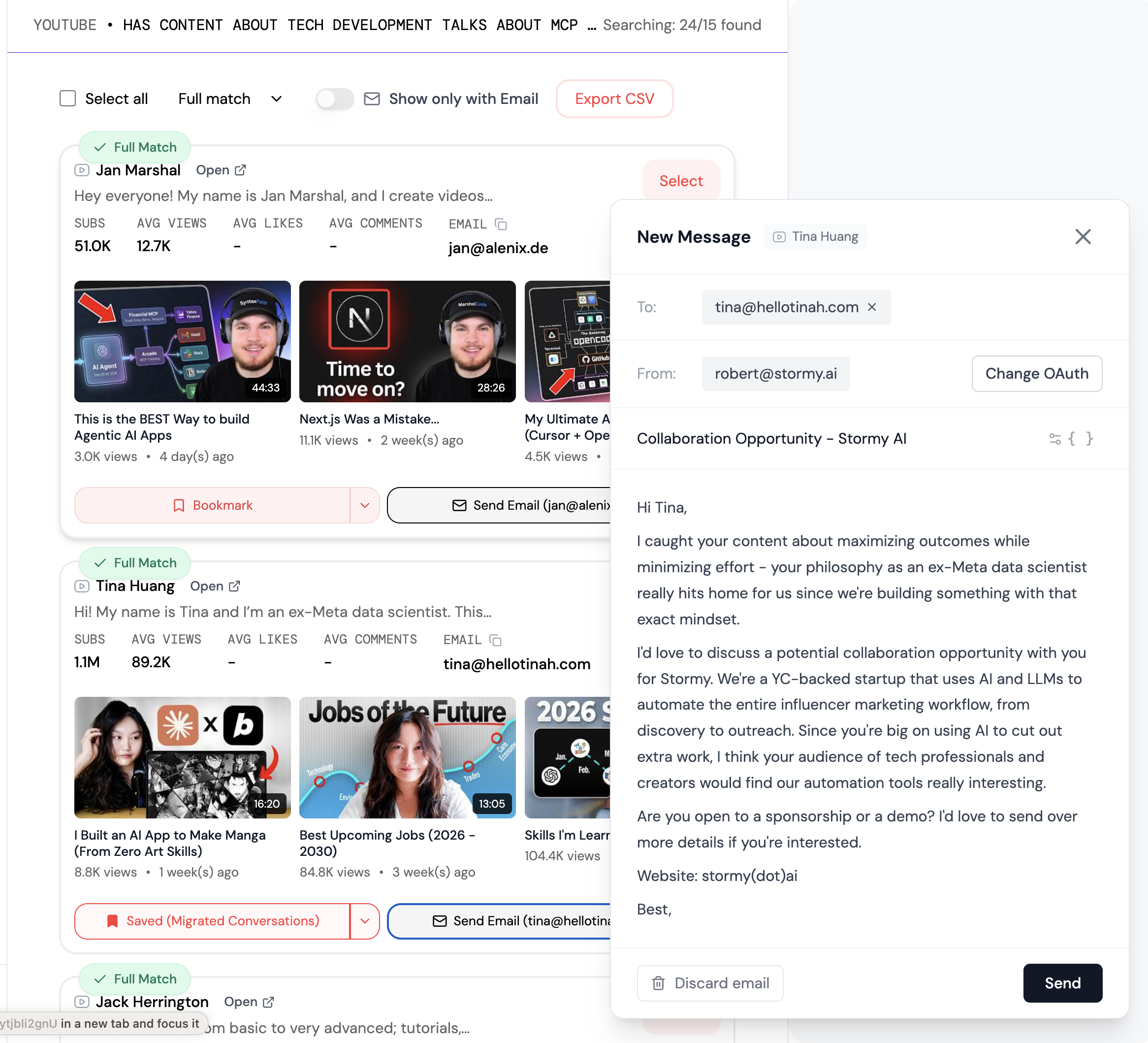
Once Gemini 3.0 has identified an emerging niche—like 'Generational Talent Fusion' or 'AI-Enabled Mood Boarding'—the next step is finding the right people to deliver that message. This is where tools like Stormy AI become indispensable for execution. While Gemini identifies the what and the why, you need a platform to handle the who.
Using the Search & Discovery features of Stormy AI, you can instantly find creators who are already experimenting with these 'grounded' trends. If Gemini suggests that 3D VR games are the next big marketing asset, you can jump into Stormy, search for creators with high engagement in 3D modeling and VR, and vet their audience quality in seconds. This prevents the common mistake of hiring a massive influencer who has no actual authority in the specific emerging niche you've identified.
The Economics: Why Gemini 3.0 is a Competitive Advantage
Staying ahead of the market usually comes with a high price tag, but the Gemini 3.0 Pro model is disrupting the pricing tiers of the industry. According to Google Cloud pricing data, the model is priced at approximately $2 per million input tokens and $12 per million output tokens. This is notably more affordable than legacy or competing models like GPT-5.1 or the latest versions of Claude.
For an agency, this low cost of entry means you can run continuous, high-volume social media market research without blowing your budget. You can have an AI agent constantly querying search trends, drafting outreach emails, and analyzing creator fit 24/7. When combined with the automated outreach capabilities of a CRM like Stormy AI, you create a 'flywheel' where the AI finds the trend, identifies the creator, and initiates the partnership while your team focuses on the high-level creative strategy.
Conclusion: The Future is Grounded
The era of guessing which hashtags will trend next week is over. By leveraging Gemini 3.0 grounding, social media professionals can move from a state of constant reaction to one of strategic proactivity. Whether you are vibe-coding a custom trend dashboard or using AI to find 'tomorrow's viral niche,' the goal remains the same: capture attention before the market becomes saturated.
To succeed, start by experimenting with the free tools available in AI Studio. Don't be afraid to ask for ambitious features or to screenshot your favorite marketing tools to use as templates. Once you have your insights, use a dedicated creator platform like Stormy AI to source, vet, and manage the talent that will bring those trends to life. In a world of static data, the winner is whoever has the best connection to the real-time truth.