The digital marketing landscape is currently undergoing its most significant paradigm shift since the invention of the social feed. For the last decade, brands have relied on passive databases to manage their creator relationships—software that acted as a digital Rolodex, requiring constant human prompting and manual data entry. However, the future of influencer marketing is no longer about better databases; it is about autonomous AI agents. We are moving away from a world of manual 'tools' and entering the era of 'agentic models'—software entities that don't just help you work, but actually do the work for you. By 2025, the ability to deploy influencer marketing AI agents will be the primary differentiator between brands that scale and those that stagnate.
Defining the Shift: AI Tools vs. AI Agents
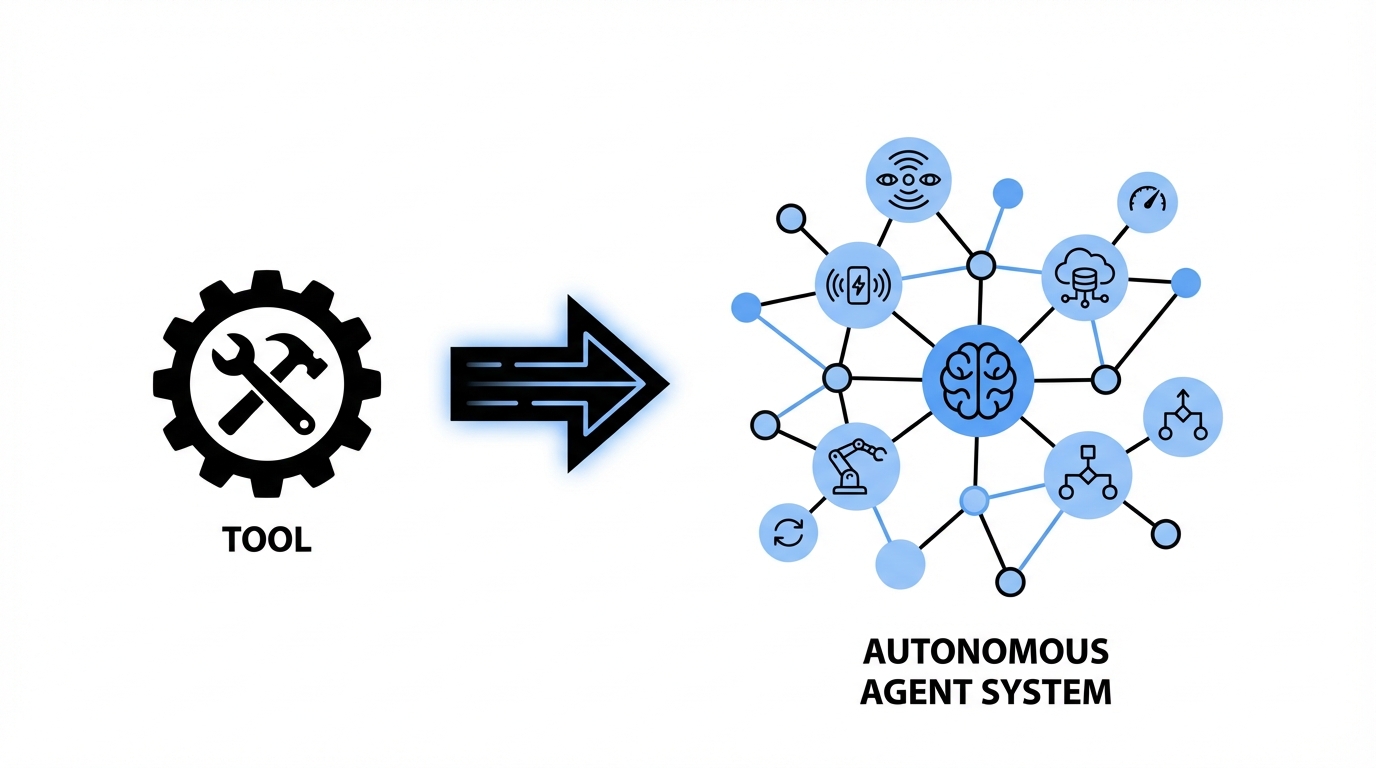
To understand where the industry is heading, we must first distinguish between traditional AI-enabled tools and the new wave of AI agentic models. For years, marketers have used AI 'tools'—features designed to perform a single, narrow task when prompted by a human. For instance, a fake follower checker or a caption generator is a tool. It is reactive, requiring a human to click a button, interpret the result, and decide the next move.
In contrast, an AI agent is an autonomous software entity capable of independent planning and executing multi-step workflows. According to recent research from Exei.ai, agents can independently discover 50 creators, draft hyper-personalized outreach, negotiate rates based on a preset budget, and flag contract violations without human intervention. The core difference lies in the transition from passive SaaS databases to autonomous agentic models that function as full-time, digital team members.
The 2025 Market Landscape: A $32 Billion Industry
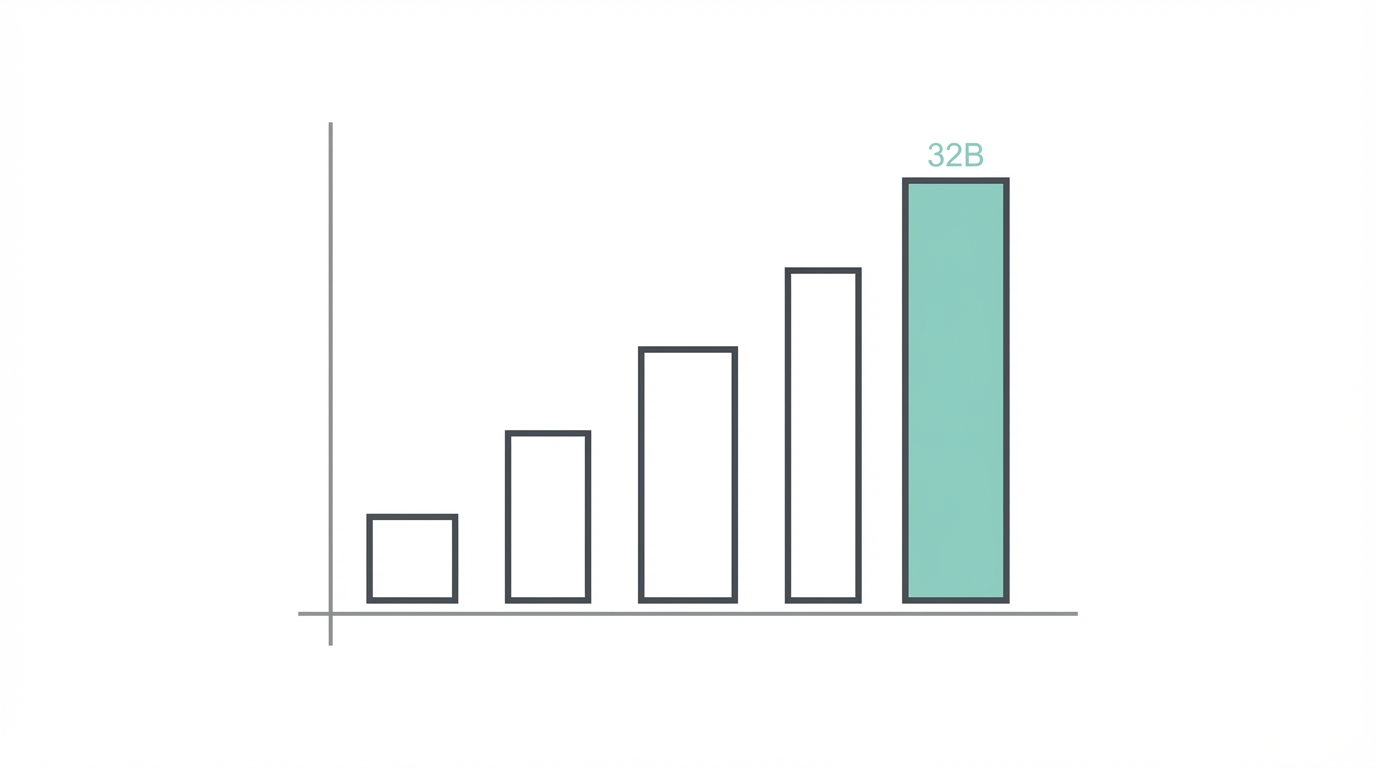
The financial implications of this shift are staggering. The global influencer marketing industry is projected to reach $32.55 billion by the end of 2025, according to data from IZEA. This represents a massive 33% CAGR, driven largely by the integration of automation and AI. Specifically, the market for AI-driven influence—which includes virtual creators and autonomous management platforms—is estimated to hit $6.95 billion in early 2025.
The adoption rate is equally impressive. Currently, 60.2% of brands already use some form of AI in their influencer strategy, and AI Align Agency reports that 79% of companies are actively moving toward adopting autonomous agents. This isn't just about following a trend; it's about measurable performance. Brands utilizing AI-driven analytics are seeing 2.3x higher conversion rates, with an average ROI of $5.78 for every $1 spent. For top-tier performers, that return can skyrocket to $18 or $20.
"The influencer marketing industry is projected to hit $32.55 billion by 2025, with AI-driven influence accounting for nearly $7 billion of that total."
Agentic Orchestration: Reducing Launch Times by 65%
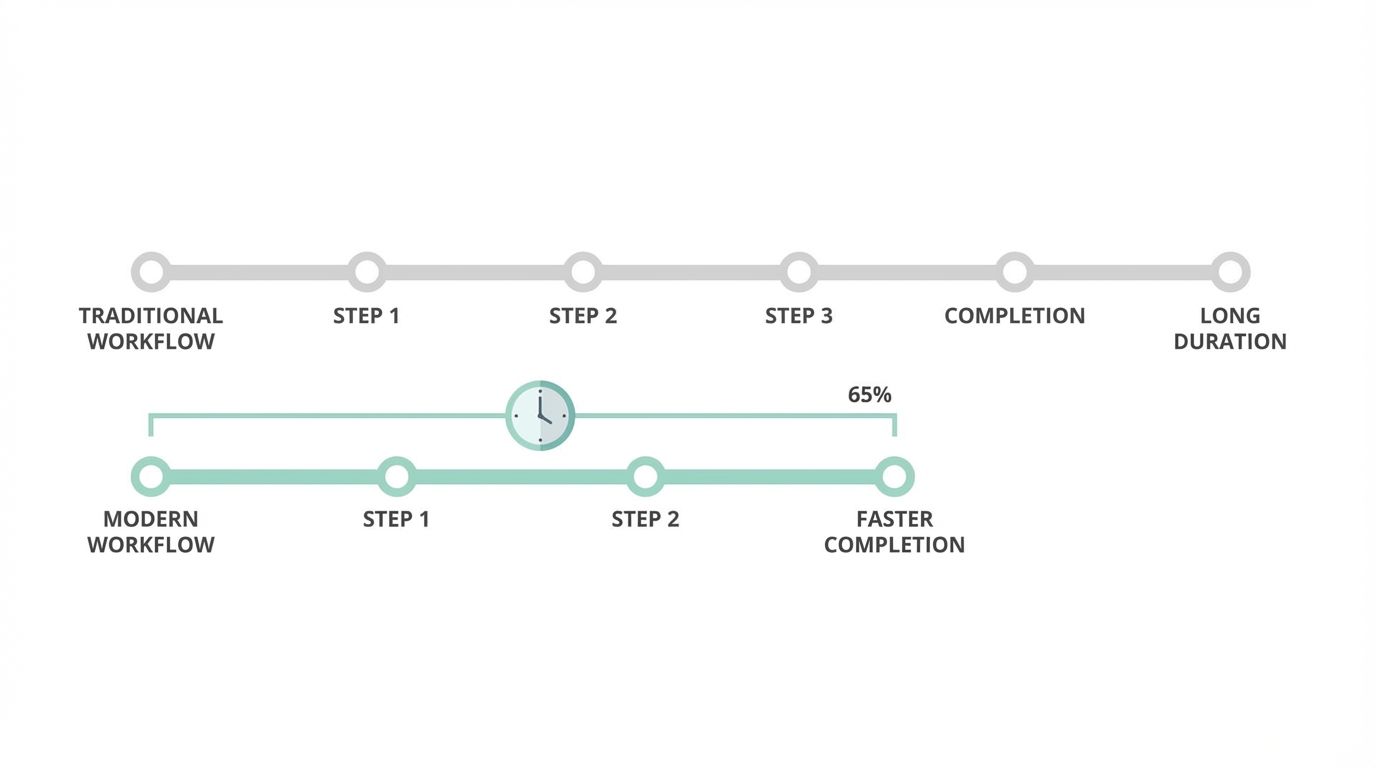
The most immediate benefit of moving toward influencer marketing automation is the radical increase in operational efficiency. In the traditional model, launching a campaign involved weeks of manual searching, vetting, and emailing. Agentic Orchestration changes this by unifying the entire lifecycle—from discovery to payment—into a single, autonomous flow.
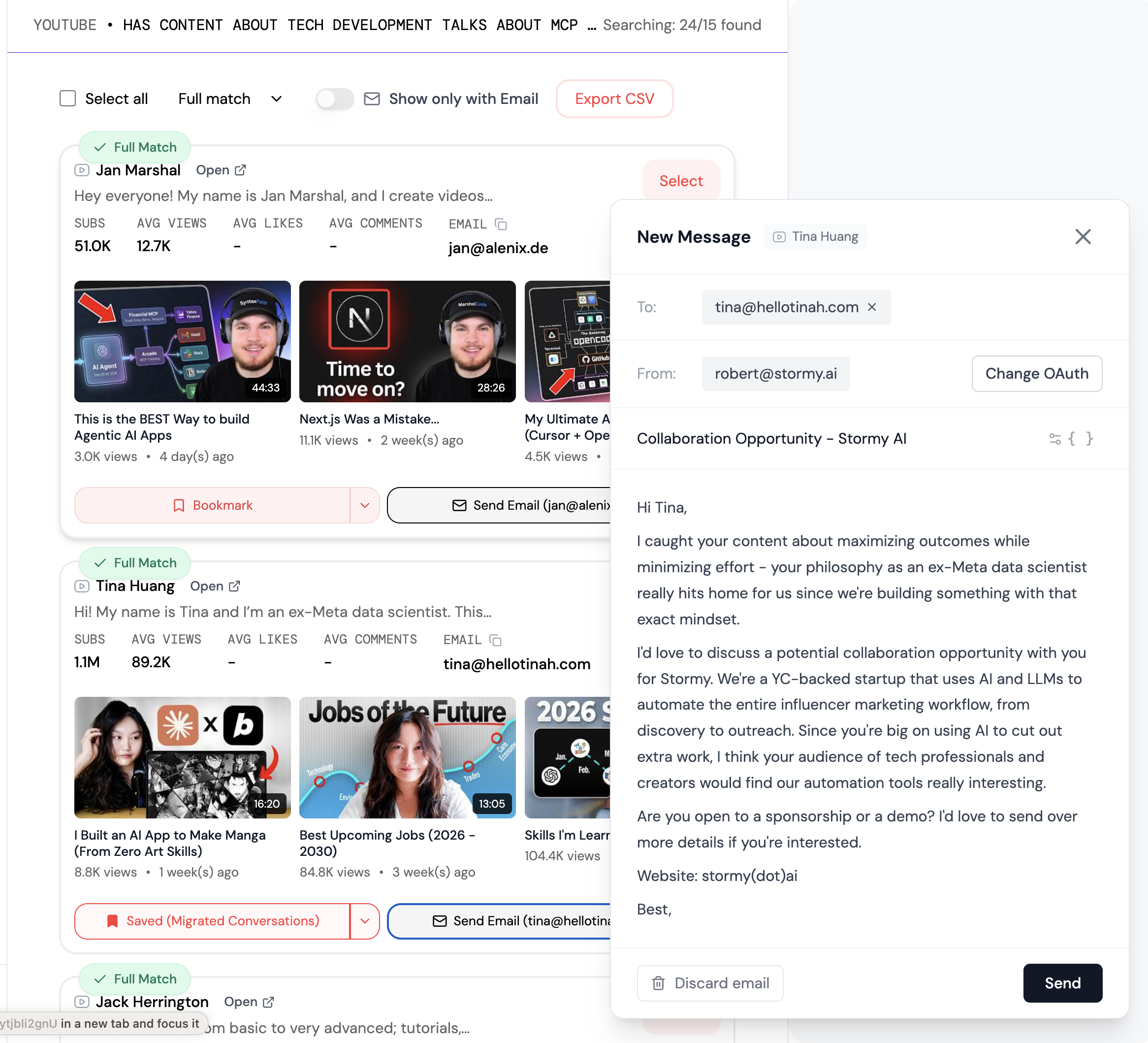
Early adopters of these agentic systems have documented a 65% reduction in campaign launch times. By automating the 'grunt work' of influencer marketing, teams can scale their efforts without increasing headcount. This is particularly vital for mobile app developers and e-commerce brands that need to maintain a high volume of User-Generated Content (UGC) to keep acquisition costs low. Modern platforms, such as Stormy AI, allow marketers to set up autonomous agents that discover, outreach to, and follow up with creators on a daily schedule, essentially running the discovery engine while the team sleeps.
Content-Matched Discovery: Analyzing Hooks and Scripts
For years, 'discovery' meant filtering a database by follower count and niche. This approach is increasingly obsolete. The future of influencer marketing relies on Content-Matched Discovery, where AI agents analyze the actual substance of a creator's videos rather than just their metadata. This involves analyzing actual video content scripts and hooks to ensure a perfect brand alignment.
AI agents now use Emotion AI to detect sentiment in video frames, identifying creators who evoke specific feelings like trust, curiosity, or excitement. As highlighted by Snaplama, this allows for a level of precision that was previously impossible. Instead of finding a 'beauty influencer,' an agent can find 'a creator in Chicago whose last five videos used high-energy hooks and resulted in a 4% higher-than-average save rate.' This ensures that the creators you partner with are already 'speaking your brand's language' before the first email is even sent.
"Discovery is no longer about who the creator is, but what they say—AI agents now analyze scripts and emotional sentiment to match brands with the perfect voice."
The Rise of Algorithmic Trust and AIO
A fascinating development in the realm of AI marketing agents is the concept of AI Search Optimization (AIO). Influencer marketing is no longer just about reaching human audiences; it’s about influencing the AI models that those humans use. When users ask Google Gemini or ChatGPT for product recommendations, those AI assistants pull data from 'social proof' found across the web.
By deploying creators to discuss a brand, marketers are seeding the training data that AI assistants use to generate recommendations. This creates a cycle of Algorithmic Trust. Brands are now using Metricool and other analytics platforms to track how social mentions translate into AI recommendation frequency. It is a new frontier where influencer content serves as the bridge between human desire and AI-powered answers.
The Co-Pilot Philosophy: Integrating AI into Teams
Despite the power of autonomous agents, the industry consensus remains that humans are not being replaced—they are being upgraded. HubSpot CMO Kipp Bodnar frequently promotes the 'Co-Pilot Philosophy,' where AI handles the heavy machine logistics while humans drive the creative strategy. This Human-in-the-Loop (HITL) approach ensures that while an agent might handle the data mining and outreach, a human still oversees cultural nuances and final contract approvals.
As noted by experts at Landrum Talent Solutions, the goal is to create a unified team where the AI agent acts as a high-speed engine and the marketer acts as the navigator. This prevents 'robotic' or tone-deaf responses in sensitive negotiations while maintaining the massive scale that only AI can provide. Companies like Archive are already showing how storing and managing this AI-generated content can streamline the creative feedback loop.
The Faceless Economy and Virtual Influencers
We cannot discuss the future of influencer marketing without mentioning the 'Faceless Economy.' Virtual influencers like Lil Miquela are no longer novelties; they are high-performing assets. According to Indahash, virtual influencers often see engagement rates of 2.84%, significantly higher than the human average of 1.72%.
Major brands are already leading the way:
- Samsung: Integrated Lil Miquela into their #TeamGalaxy campaign, generating 126 million organic views.
- Lenovo: Paired the virtual influencer Imma with human creators to blend futuristic aesthetics with inclusive messaging.
- H&M: Utilized AI-generated 'digital twins' to scale their e-commerce imagery without the logistical hurdles of physical shoots.
These virtual entities are managed by AI agentic models that can respond to trends in real-time, ensuring the brand is always at the center of the cultural conversation.
"Virtual influencers are achieving engagement rates 65% higher than their human counterparts, signaling a massive shift toward the 'faceless economy'."
Common Mistakes to Avoid in the AI Era
As you transition to influencer marketing automation, it is critical to avoid several common pitfalls that can undermine your ROI:
- Over-Automating Sensitivity: Never let an AI agent handle a PR crisis or sensitive brand-safety negotiation without human oversight.
- Obsession with Vanity Metrics: While AI can find high-follower accounts, ensure your agents are programmed to filter for Engagement Quality—detecting genuine comments versus bot activity. Platforms like Eesel help teams manage the massive amounts of data generated here to keep things organized.
- Fragmented Tech Stacks: Avoid using multiple tools that don't communicate. Data silos lead to missed opportunities and doubled work.
- Ignoring Data Privacy: Always use enterprise-grade AI subscriptions to process creator and customer data to prevent leaks.
By following these guidelines and leveraging platforms like AdParlor for integrated media buying, brands can build a robust, AI-forward marketing engine.
Conclusion: The Baseline for Survival
The shift from AI tools to autonomous AI agents is not just a technological upgrade; it is a fundamental change in how marketing teams operate. By 2026, AI agents are becoming the baseline for survival in a fragmented digital economy. Brands that embrace agentic orchestration through platforms like Stormy AI will enjoy 2.3x higher conversions and a 65% faster time-to-market, while those stuck in manual SaaS databases will struggle to keep up with the sheer volume of the creator economy.
The playbook is clear: start by defining your goals, move toward content-matched discovery, and implement a co-pilot philosophy that empowers your team with autonomous technology. The future is agentic—and it is already here.