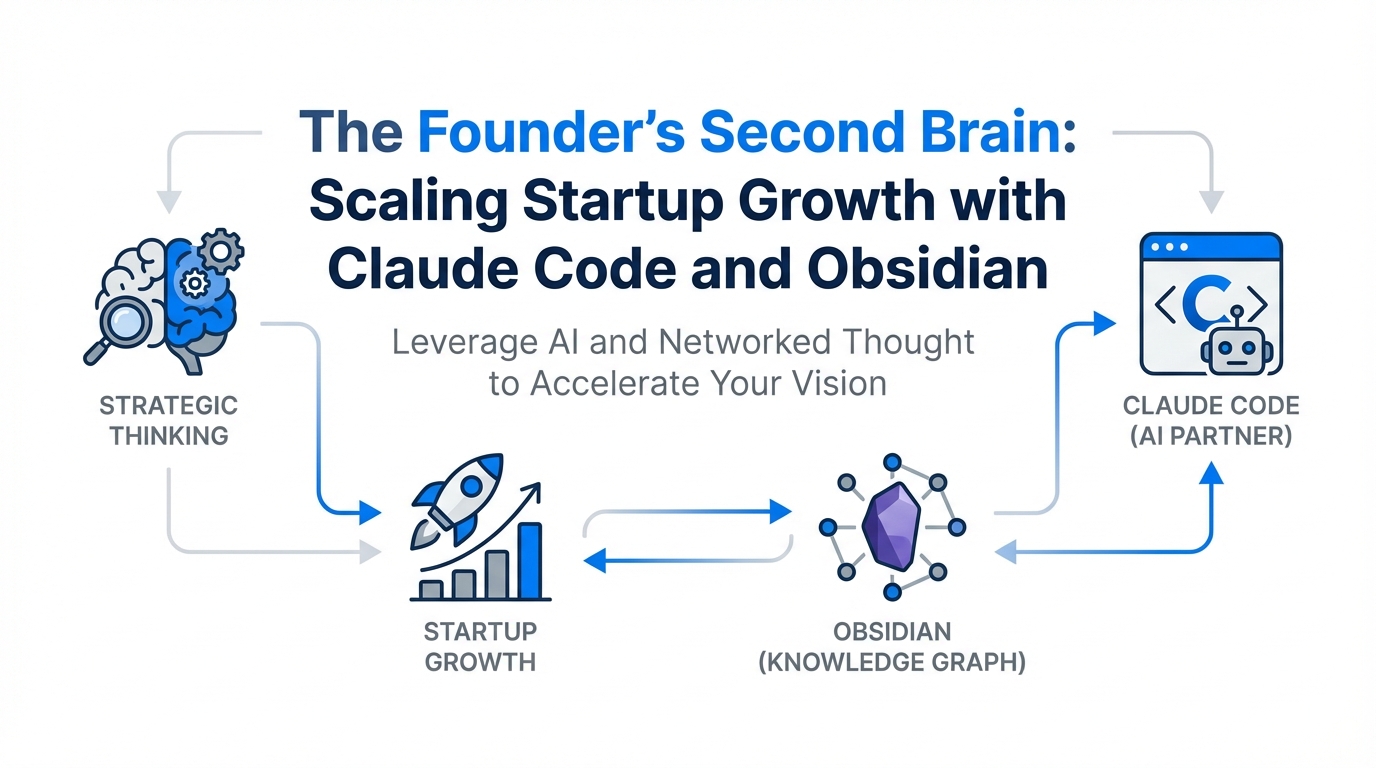
For most startup founders, the greatest bottleneck isn’t a lack of ideas—it’s the leakage of context. We live in a constant stream of Zoom meetings, Slack pings, and late-night voice memos. We have thousands of data points about our market, but they remain trapped in unstructured silos. This is where Claude Code and Obsidian enter the fray. By pairing a local-first "Second Brain" with a high-reasoning CLI agent, entrepreneurs can stop just managing tasks and start managing context.
This combination is a literal game-changer for those looking to scale. As Internet Vin discussed in a recent deep dive, the goal is to create a thinking partner that understands your business as deeply as you do. When your startup growth strategy is backed by a perfectly indexed vault of your own logic, you stop explaining things to AI and start executing on them. In this guide, we will explore how to build a GTM Vault, use the 'Emerge' command to find product-market fit, and automate the graduation of raw ideas into full-scale marketing campaigns.
The Context Crisis: Why Standard AI Fails Founders
Most business owners use Claude or ChatGPT through a web interface. While powerful, these tools suffer from a "cold start" problem. Every time you start a new session to discuss your Go-To-Market (GTM) plan, you have to re-upload PDFs, re-paste personas, and re-explain your distribution hypotheses. Even with "memory" features, you don't truly know what the agent knows.
Claude Code solves this by operating as a Command Line Interface (CLI) agent that lives directly on your computer. It can read your files, understand your directory structure, and—most importantly—interact with your Obsidian vault. Obsidian is essentially a folder of markdown files that uses bi-directional linking to mirror the way the human brain works. When you give an AI agent access to this vault, you aren't just giving it text; you are giving it the interrelationships between your ideas.
"The whole game is feeding the beast good context. The better and faster the information you can give the agent, the faster you can delegate to it."Building the 'GTM Vault' in Obsidian
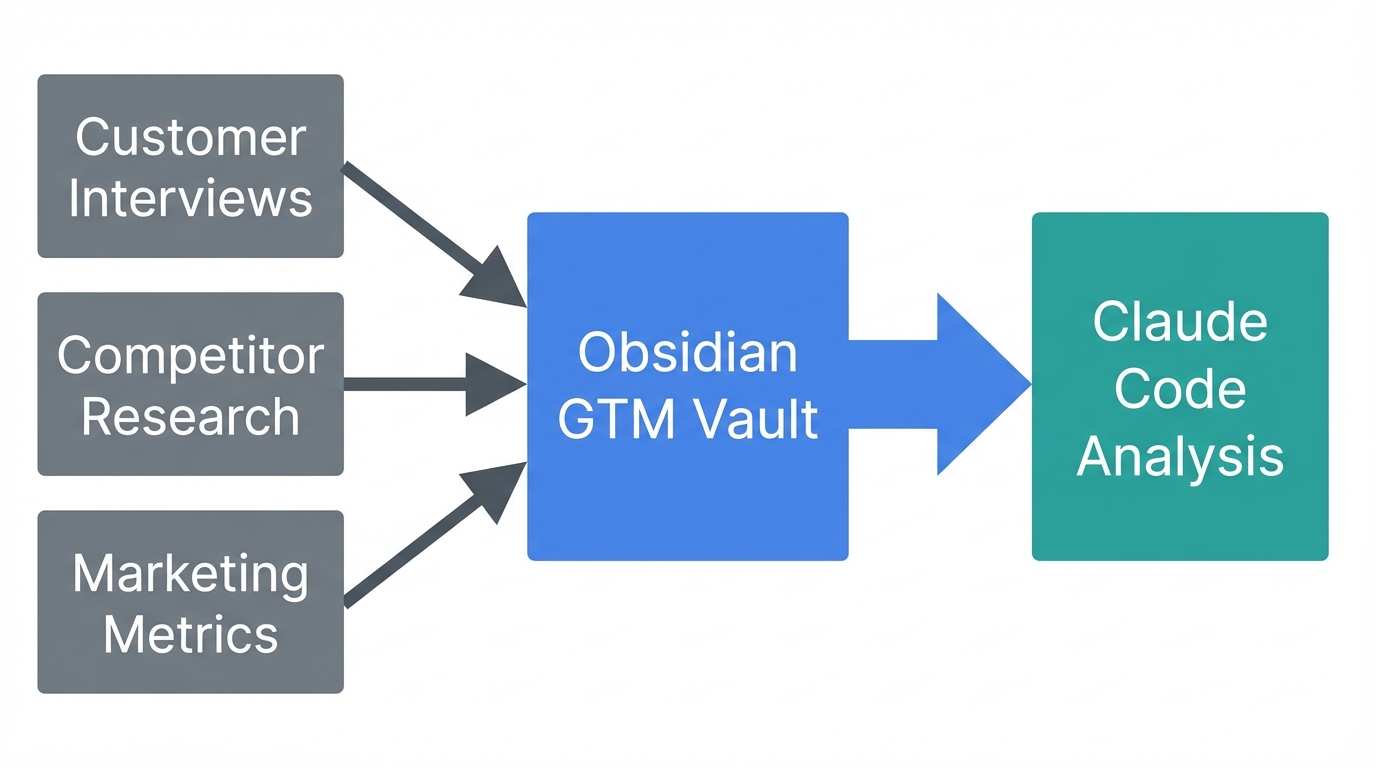
To scale a startup, you need a centralized source of truth. A "GTM Vault" in Obsidian is not just a collection of notes; it is a relational database of your business logic. Unlike Notion or Asana, which are often structured around rigid databases, Obsidian allows you to link a competitor research note directly to a distribution hypothesis or a customer interview transcript.
The Three Pillars of Your Growth Vault
- Competitor Intelligence: Create a note for every competitor. Link them to "Pattern" notes (e.g., [[Pricing Strategies]] or [[UGC Ad Hooks]]).
- Customer Personas: Store your customer discovery transcripts. Use the [[Persona Name]] tag to link specific pain points back to your product roadmap.
- Distribution Hypotheses: Every marketing experiment should be a note. "If we run TikTok ads targeting founders, we expect a 3% CTR because [[Pain Point X]]."
When you use GTM planning tools like this, you create a "graph" of your business. If you’re planning a campaign on Meta Ads Manager, you can ask Claude Code to "scan my vault for every mention of 'ad fatigue' and suggest three new creative angles based on my recent customer interviews."
| Asset Type | Obsidian Structure | Claude Code Utility |
|---|---|---|
| Market Research | Bi-directional links between competitors | Surfaces market gaps you haven't explicitly named. |
| Meeting Notes | Daily notes with [[Project]] tags | Extracts action items and updates project status. |
| GTM Strategy | Hypothesis-led markdown files | Pressure tests beliefs against vault history. |
The 'Emerge' Command: Finding Latent Growth Ideas
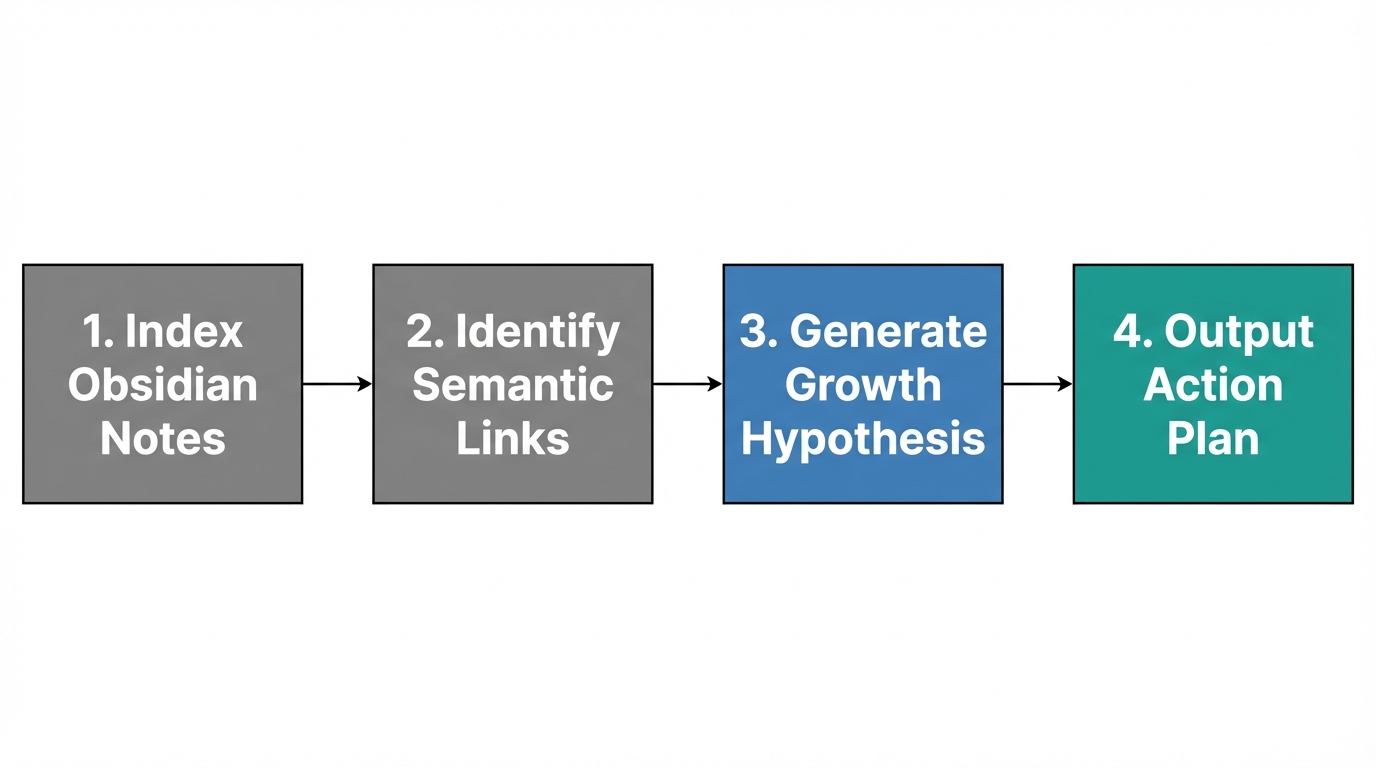
One of the most powerful ways to use AI for business owners is to find the "unnamed patterns" in your thinking. Vin describes a custom command called /emerge. This command instructs Claude Code to perform a deep scan of the vault to find conclusions from scattered premises—ideas the vault implies but the founder hasn't actually stated yet.
For example, you might have mentioned "high churn in the first 7 days" in a meeting note in January, a "difficult onboarding UI" in a personal reflection in February, and "competitor X has a great setup wizard" in March. Individually, these are just notes. Together, they are a critical product-market fit signal. Claude Code can connect these dots instantly.
Step-by-Step: Using 'Emerge' for Growth
- Initialize the CLI: Open your terminal in your Obsidian vault folder and start Claude Code.
- Run the Scan: Use a prompt like: "Scan my daily notes from the last 60 days. Identify patterns in customer objections that I haven't addressed in my GTM strategy yet."
- Analyze the Output: Claude will list "Latent Interests" or "Orphaned Ideas"—concepts you've written about but haven't linked to a project.
"Emerge surfaces ideas the vault implies but never states. It finds unnamed patterns and unarticulated directions that can lead to huge breakthroughs."This is particularly useful when managing complex creator relationships. If you are sourcing influencers for a mobile app campaign, platforms like Stormy AI streamline creator sourcing and outreach at scale, but you still need the internal logic to know why a certain creator type is working. By scanning your vault, you might realize that every high-performing creator you’ve worked with shares a specific narrative style you hadn't consciously noticed.
Transitioning from 'Managing Agents' to 'Managing Context'
A major shift in the entrepreneurial workflow happens when you stop telling the AI what to do and start showing it how you think. In a traditional setup, you act as the manager, constantly correcting the AI's output because it lacks your "flavor" or specific business context.
In the Founder’s Second Brain model, your vault is the "source code" of your brand. If an agent makes a poor decision or writes a campaign that feels "off," you don't just fix the prompt. You update the vault. You might create a note called [[Brand Voice Principles]] or [[What I Believe About AI]] and link it to your current projects. The next time you run a command, the agent pulls from this updated context.
This allows you to automate repetitive tasks like:
- Morning Review: A
/todaycommand that pulls your calendar from Google Workspace, cross-references it with your [[Top Priorities]] note, and builds a prioritized plan. - Outreach Automation: Taking a raw list of prospects and having Claude Code draft personalized emails using the specific [[Value Proposition]] links in your vault.
- Follow-ups: If you use a standard sales CRM for general lead management, you can export your notes into markdown and let Claude find the "stale" relationships that need a personal touch.
The 'Graduate' Protocol: From Brainstorming to Campaign
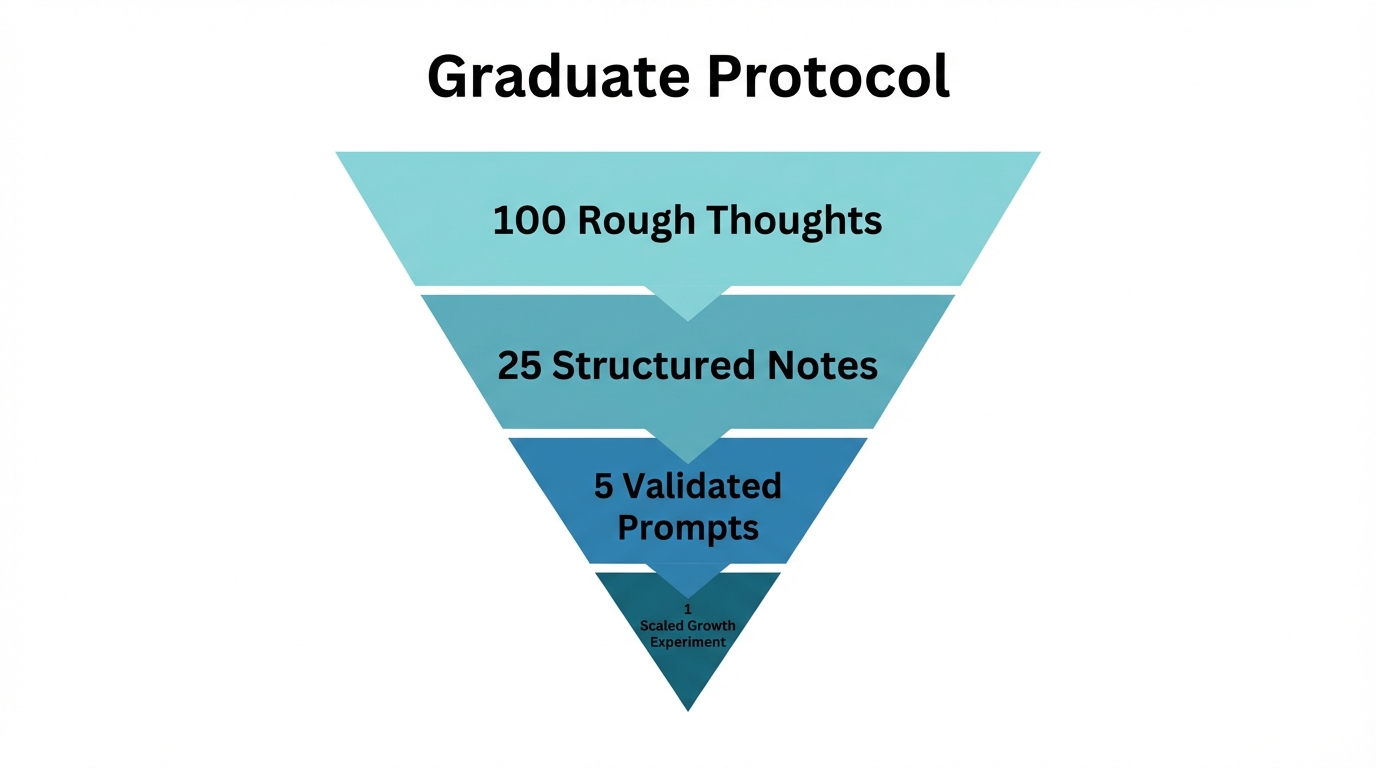
The biggest waste in most startups is the "Daily Note Graveyard." We have brilliant ideas during a morning walk, type them into a note, and then they are never seen again. The Graduate Protocol is a workflow designed to move an idea from a raw fragment to a structured asset.
Step 1: Capture the Fragment
Write your idea in your Obsidian Daily Note. Use a specific tag like #idea or #hypothesis. For example: "Idea: We should partner with niche LinkedIn creators for our B2B SaaS launch. [[LinkedIn Strategy]]."
Step 2: Run the Graduate Command
Using Claude Code, run a command to "Scan for all #idea tags in the last 7 days that haven't been promoted to standalone notes." The AI will present a list and ask which ones you want to "graduate."
Step 3: Asset Creation
When you graduate an idea, Claude Code doesn't just copy the text. It uses its access to your vault to:
- Draft a mini-essay or working document based on the core claim.
- Link it to related notes (e.g., your [[Competitor Analysis]] or [[Pricing Models]]).
- Create a task in Linear or Monday.com to execute on it.
Step 4: Execute at Scale
Once the idea is graduated, it becomes a project. If the project requires external talent, you can use Stormy AI to discover creators who match the specific persona you developed in your vault. You can then use Claude Code to write the campaign briefs by pulling directly from the newly graduated [[Campaign Strategy]] note.
"The graduate command turns a daily note stream into a structured idea pipeline. It ensures that your best thinking actually compounds over time instead of sitting in isolation."The Future of the Automated Founder
Building a "Second Brain" with Claude Code and Obsidian is not about being a power user; it is about sovereignty over your own data. In an era where AI tokens are the oxygen of business, your markdown files are the memories that give those tokens life. By investing the time to set up this infrastructure, you are creating a competitive advantage that cannot be easily replicated by a competitor using generic prompts.
As you scale, your role as a founder shifts from being the "doer" to being the "context architect." You provide the vision, the reflections, and the raw data. The AI provides the synthesis, the pattern recognition, and the execution. Scaling startup growth in 2025 requires this harmony. Start by downloading Obsidian, initializing Claude Code, and writing your first 10 daily notes. The patterns are already there—you just need the tools to see them.