The 2026 Founder’s Guide to the 10-Minute AI Playbook and Claude Code: Launching SaaS for $1k
Learn the 10-minute AI playbook to launch a production-ready SaaS for under $1k. Master Claude Code and the 7-step sequence to bypass $50k agency fees in 2026.
In 2026, the barrier to entry for building a software-as-a-service (SaaS) company has not just been lowered—it has been obliterated. The days of non-technical founders raising a seed round just to hand $50,000 over to a development agency are over. We have entered the era of the "conductor," where the primary skill of a founder is no longer writing code, but orchestrating autonomous agents. With tools like Claude Code and a framework known as the 10-minute AI playbook, entrepreneurs are now shipping full-stack, production-ready applications in the time it used to take to write a single project brief.
The New Economy of Software: AI App Builder ROI 2026
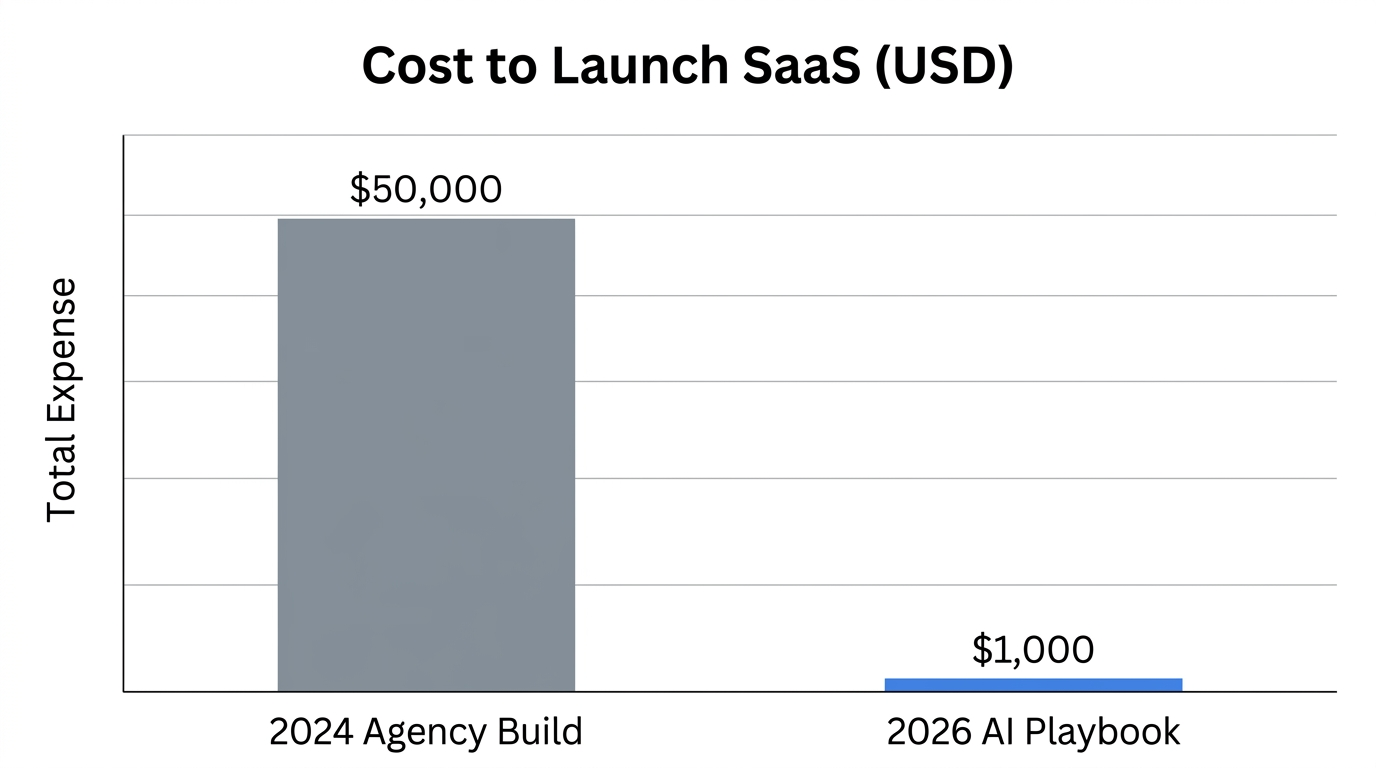
The economic shift in software development is staggering. According to Gartner, worldwide AI spending is forecasted to hit $2.52 trillion in 2026, a massive 44% increase year-over-year. This capital isn't just going into enterprise infrastructure; it's fueling a democratization of creation. For the modern founder, the AI app builder ROI 2026 is calculated not in years, but in days. When a founder can bypass a 12-month development cycle for a 4-week AI-driven sprint, the capital efficiency of the business changes fundamentally.
As of early this year, data from Y Combinator indicates that 25% of startups in their latest batch have codebases that are 95% or more AI-generated. This isn't just a trend for small side projects; it's the standard for the next generation of unicorns. Even at the highest levels of tech, Alphabet’s Sundar Pichai noted that over 30% of new code at Google is now produced by AI. For a solo founder, the cost to build an app with AI 2026 has plummeted to approximately $1,000, covering subscriptions, initial hosting, and API credits.
"You don't need to become a developer... you just need AI. This is a 10-minute playbook to replace $50k app builds." — Greg Kowalczyk
Case Study: Rebuilding a $50k App in 5 Hours with Claude Code
To understand the power of the 10-minute AI playbook, one only needs to look at the work of founder Matt Shields. In March 2026, Shields documented a project where he rebuilt a social habit-tracking application from scratch. The original version of the app, built using traditional methods, had cost $50,000 and taken 15 months to complete. Using Claude Code, an agentic evolution of the Claude model that lives directly in the terminal, Shields was able to replicate the entire feature set, database architecture, and UI in just 5 hours.
This wasn't just "vibe coding"—blindly pasting prompts and hoping for the best. Shields utilized Claude Code as an autonomous agent that could plan the file structure, write the logic, and test its own output. By using Claude Code, he bypassed the manual "copy-paste" loop that hindered early 2024 AI workflows. The agent understood the entire context of the project, allowing it to refactor code and fix bugs in real-time without Shields having to write a single line of TypeScript himself.
Success stories like this are becoming the norm. Whether it is Caio Moretti using Lovable to generate $3 million in revenue within 48 hours of launch, or non-engineers building complex sponsor portals for SaaStr in under two days, the data is clear: the barrier to software creation is dead.
The 7-Step Sequence: Executing the 10-Minute AI Playbook
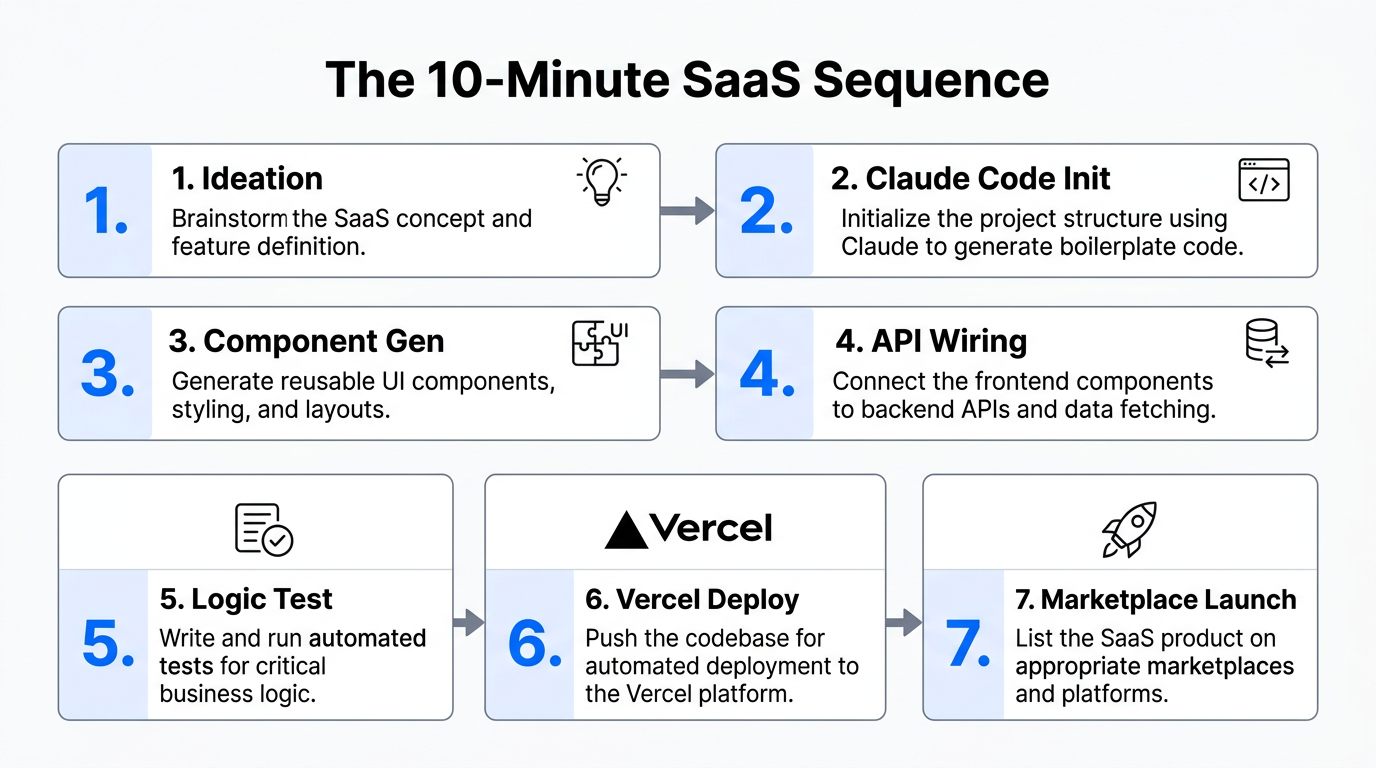
If you want to launch a SaaS with AI this year, you must follow a structured approach. Random prompting leads to "Zombie Code"—software that runs but is impossible to maintain. Successful founders follow the 7-step sequence to ensure their product is production-ready.
- PRD with AI: Before opening an IDE, use Claude or ChatGPT to draft a Product Requirements Document (PRD). This serves as the source of truth for your AI agents.
- Modular Prototyping: Don't try to build the whole app at once. Build in "tiny modules" using rapid builders like Bolt.new or Lovable. These tools excel at generating frontends and basic logic in minutes.
- Active Debugging: When the AI makes a mistake, don't try to fix it manually if you aren't a coder. Copy the error logs back into the agent and let it perform a self-healing deployment.
- Context Management: As your codebase grows, the AI can become confused (hallucinations). You must "clear context" aggressively, feeding the AI only the specific files or logic it needs for the current task.
- Environment Migration: Move your prototype from the browser-based builder to a professional AI-native IDE like Cursor. This gives you deep control over the file system and complex backend logic.
- AI Documentation: Use your agent to document every function and database table. This is critical for future maintenance and scaling.
- Early Submission: Submit to the App Store or Product Hunt early. Use the AI to handle the rejection/fix cycles iteratively.
"The speed is real... but founders who never learned to manage context are screwed when the AI generates 15,000 lines of code they don't understand." — r/SaaS Practitioner
| Feature | Traditional Custom Build ($50k+) | AI Playbook Build (~$1k) |
|---|---|---|
| Speed to Market | 3–12 Months | 2–4 Weeks |
| Ownership | Agency-managed / Fees | 100% Code Ownership |
| Flexibility | High (Manual Code) | Medium (AI-Stack Optimized) |
| Validation Risk | High Financial Outlay | Low Cost; Rapid Pivot |
Standardizing Your Tech Stack: The 'Boring Stack' (AI Edition)
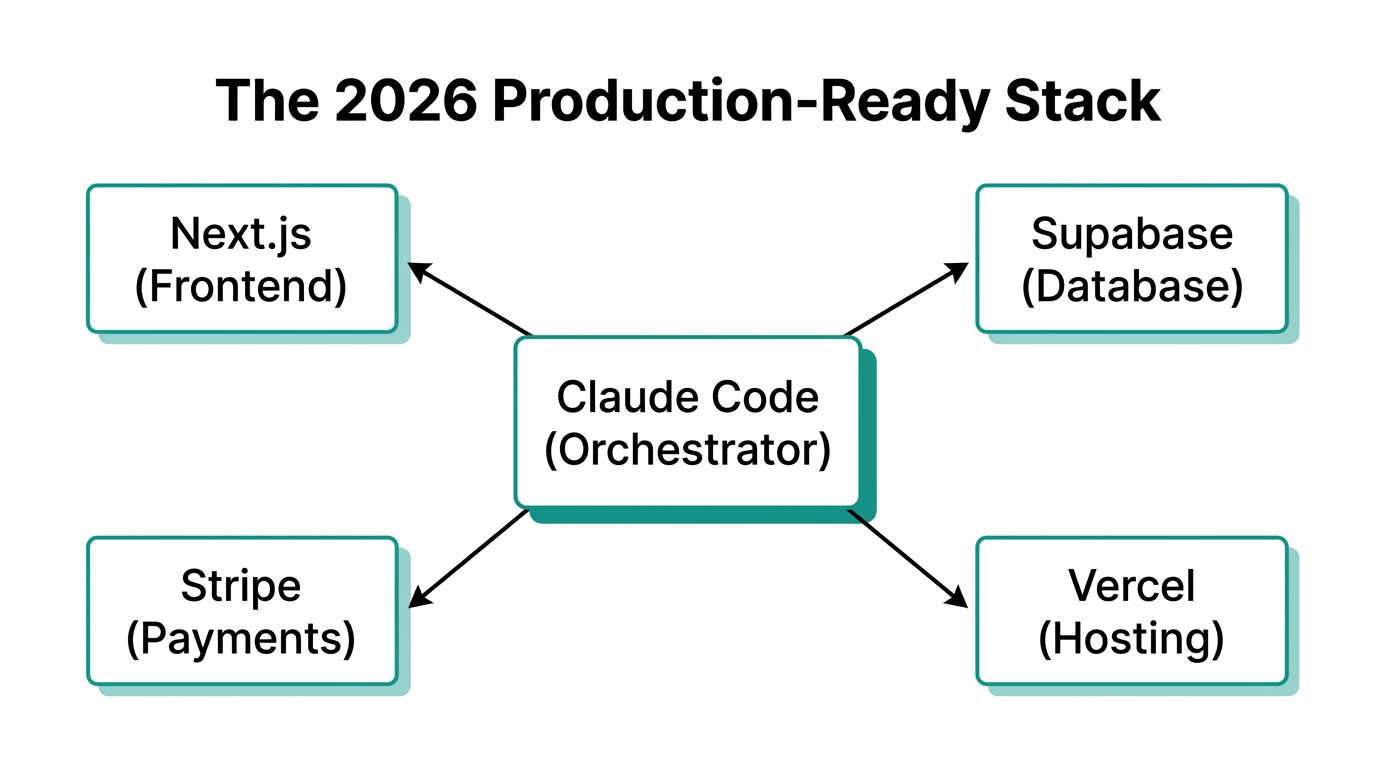
To maximize the efficiency of Claude Code and other agents, you should avoid "clever" architectures. In 2026, practitioners have standardized on the "Boring Stack." These tools are chosen because their syntax is extremely well-represented in AI training data, meaning the AI is less likely to hallucinate when writing code for them.
- The Frontend: Next.js with Tailwind CSS and Shadcn UI. This is the global standard for AI builders like v0.dev and Lovable.
- The Backend: Supabase. Because it uses a schema-first PostgreSQL approach, AI agents can read and write to your database with near-perfect accuracy.
- Authentication: Clerk. Managed auth services save the AI from writing thousands of lines of security-sensitive logic that could contain vulnerabilities.
By using the Boring Stack, you ensure that your code is maintainable. If you ever need to hire a human developer later, they will be familiar with these industry-standard tools. Furthermore, using a platform like Stormy AI for your subsequent marketing launch allows you to find creators who specifically talk about these technologies, helping you reach other builders or relevant audiences for your SaaS.
Mindset Shift: From 'Vibe Coding' to 'Vibe Engineering'
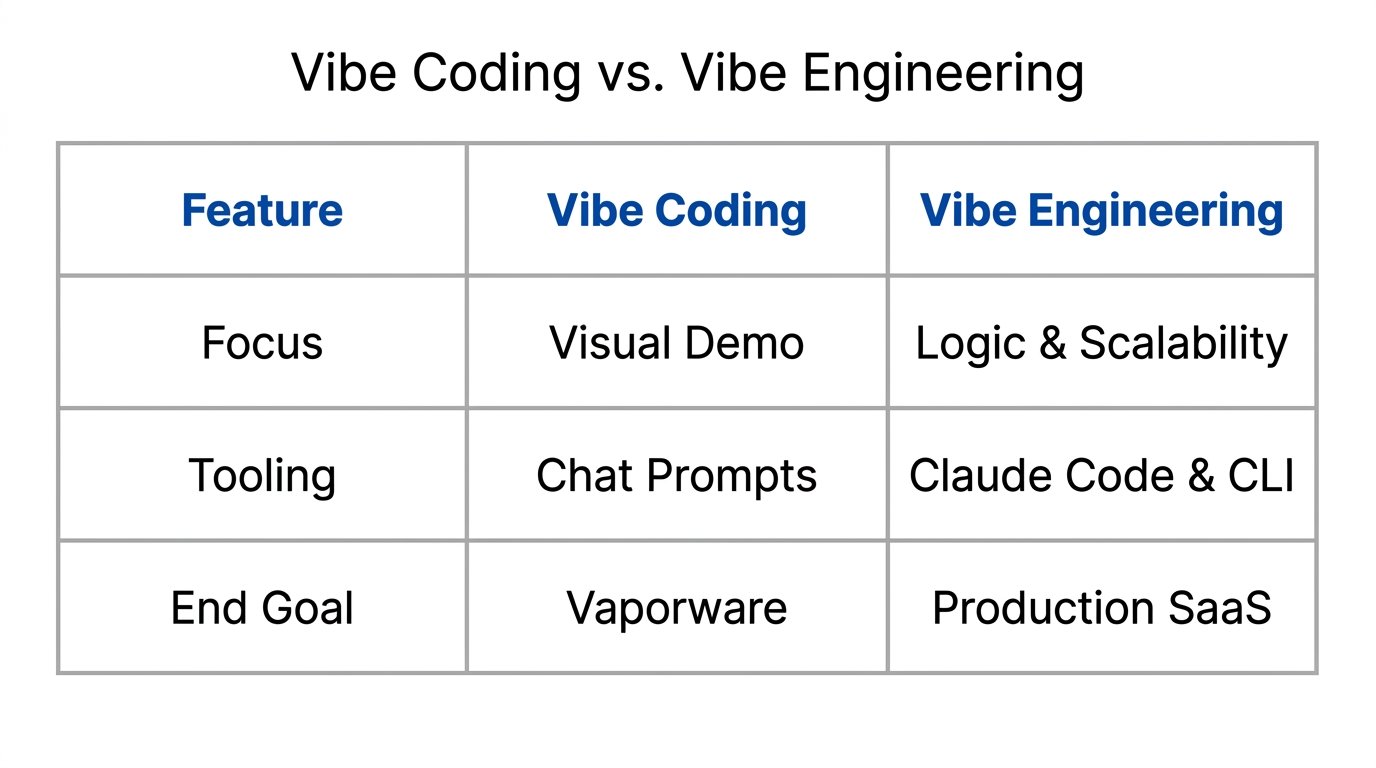
Early 2024 was the year of "vibe coding"—blindly accepting whatever the AI spit out. In 2026, the successful founders are "vibe engineers." The difference is systematic context management. A vibe engineer treats the AI's context window like an infrastructure asset. They understand that the quality of the app is directly proportional to the clarity of the instructions and the "state" they provide to the agent.
Tools like Windsurf (the next-gen agentic IDE) and Cursor now allow for agentic workflows. These agents don't just complete lines of code; they plan the entire software development life cycle (SDLC). However, this power comes with the "Final 20% Problem."
The AI Coding Hangover: Technical Debt and Security
As we launch SaaS with AI at record speeds, we must address the "AI Coding Hangover." Research indicates that a significant percentage of AI-generated code contains potential security weaknesses. Furthermore, code review services like CodeRabbit report that 90% of AI-written codebases have significantly high technical debt.
The danger is that a founder might ship an app they cannot fix. If the AI generates 15,000 lines of complex logic and a bug occurs three months later, a non-technical founder may be forced to "delete and restart" if they haven't maintained clear documentation. This is why the 10-minute playbook emphasizes AI Documentation and Modular Prototyping. Small, well-documented modules are easier for an AI to debug later than one giant, monolithic block of code.
"The role of the developer is shifting from a 'writer' of code to a 'conductor' of multiple specialized AI agents." — Forrester Analyst
Conclusion: The Conductor's Era
The 10-minute AI playbook is not a magic wand, but it is the most powerful leverage an entrepreneur has ever had. By combining Claude Code with the Boring Stack and a modular approach to building, you can bypass the traditional $50,000 entry fee to the SaaS world. Your goal in 2026 is to validate quickly, fail cheaply, and scale what works.
Once your technical foundation is built, the focus shifts to growth. Just as you used AI to build your product, you should use AI to market it. Platforms like Stormy AI streamline the process of finding and outreaching to the right influencers to drive traffic to your newly minted app. In the modern world, the winner isn't the person who can write the most code—it's the person who can most effectively orchestrate the AI agents to build, launch, and grow.