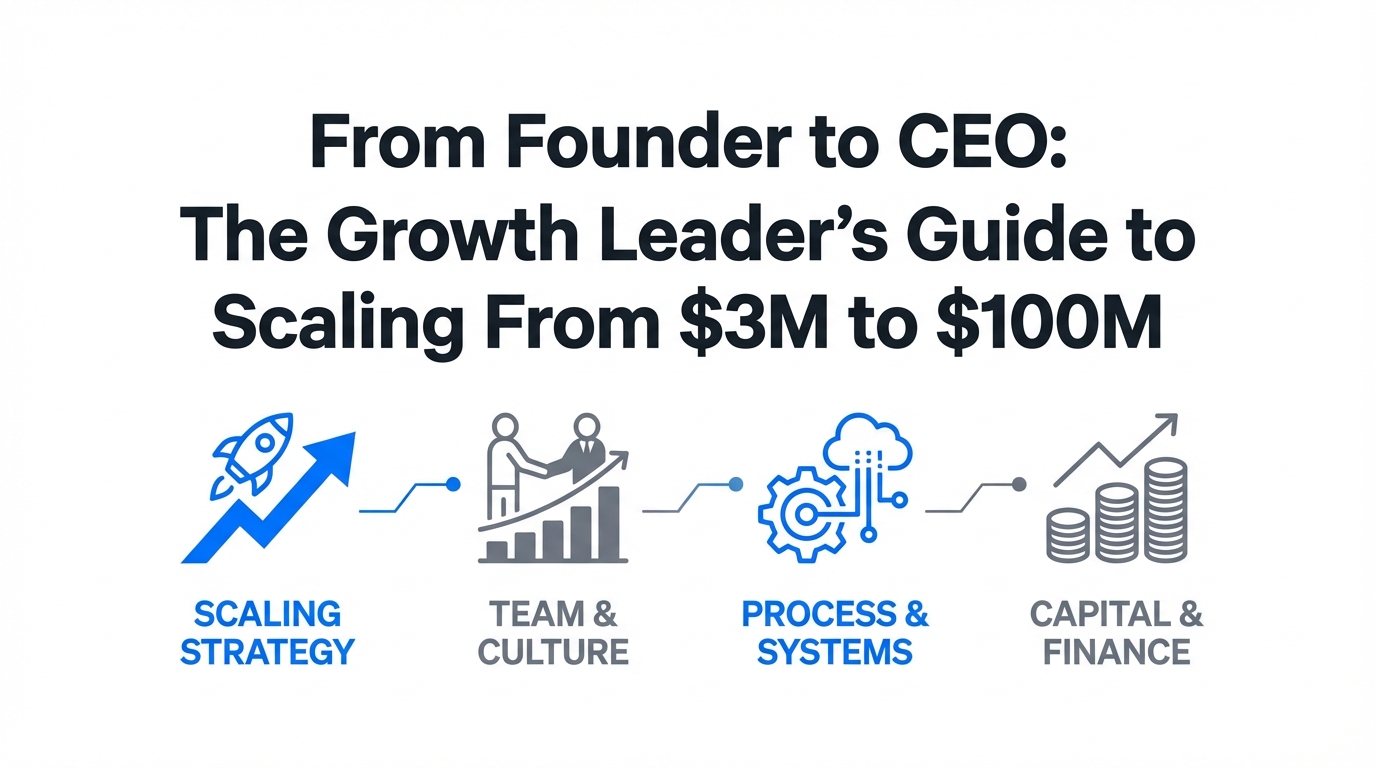
Every founder eventually hits a wall where brute force no longer works. In the early days—from zero to $1 million, perhaps even up to $3 million in revenue—you can power through obstacles with sheer willpower and 80-hour workweeks. But as you cross the eight-figure threshold and eye the journey toward $100 million, the bottleneck changes. It is no longer your product, your market, or your capital. The bottleneck is you. As many successful entrepreneurs realize, a company’s growth is strictly limited by the personal growth of its leader. To scale further, you must undergo the fundamental founder to CEO transition, shifting from a 'doer' who executes to a 'leader' who builds systems and psychology.
The Brute Force Wall: Why $3M Changes Everything
There is a specific kind of magic in the early stages of a startup. You are lean, mean, and agile. You handle the sales, you manage the Google Ads, and you might even be the one answering support tickets. This 'brute force' stage is necessary to find product-market fit. However, once you hit roughly $3 million in revenue, the complexity of the organization begins to outpace your individual capacity. This is where the psychology of the founder becomes the limiting factor. If you continue to micro-manage every decision, you don’t just slow down the team—you paralyze them.
Scaling a business to 100 million requires a total mindset shift. You have to move away from being the smartest person in the room and toward being the person who creates the environment where other smart people can thrive. This involves moving from high-frequency intervention to high-leverage systems. You aren't just 'working'; you are architecting a machine that generates growth without your constant manual input. This is the stage where you might use Notion to document every process or Pipedrive to automate your sales pipeline, but the software is only as good as the leadership frameworks behind it.
Delegation vs. Abdication: The Framework for Growth
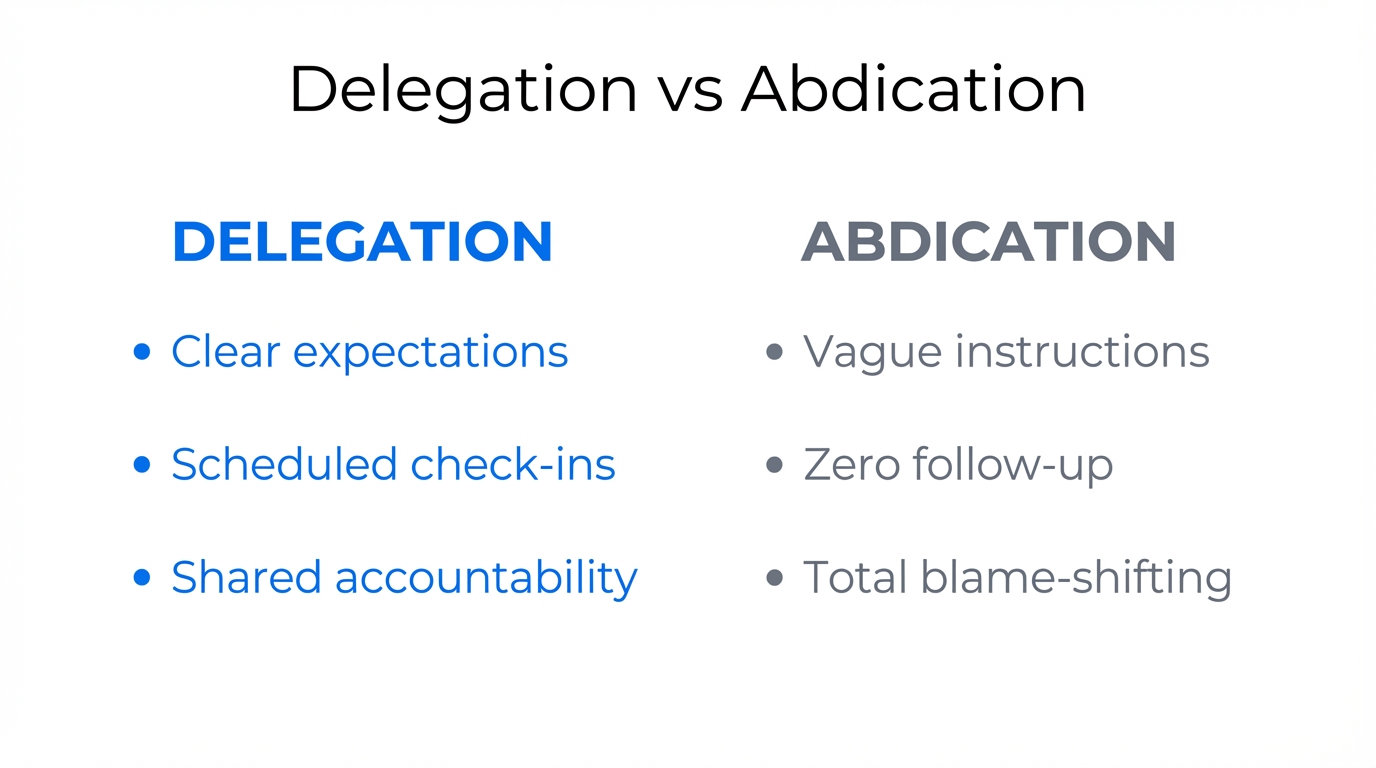
One of the most common mistakes in the leadership for startup founders is the confusion between delegation and abdication. Abdication is when you hire a freelancer or a new manager, give them a vague objective, and say, "You got this, right?" You then mentally relieve yourself of duty and walk away. When they inevitably fail or deliver sub-par results, you feel resentful. This isn't their failure; it's yours. You didn't delegate; you abdicated.
"Abdication is throwing the ball and hoping they catch it; delegation is coaching the catch until it becomes second nature."
True delegation requires a structured framework. To ensure your team is set up for success, use the What, How, When, and Motivation framework:
- What: Clearly define the expected outcome. What does 'done' look like?
- How: Provide the necessary training. Show them the process, provide the scripts, and let them shadow you before they take the reins.
- When: Set hard deadlines and scheduled follow-ups. Do not leave the timeline open-ended.
- Motivation: Explain the 'why' behind the task to ensure they are bought into the vision.
- Accountability: Use tools like Asana or Monday.com to track progress transparently.
For example, if you are training a new sales hire, you shouldn't just hand them a phone. You should spend two hours a week reviewing their calls, correcting their scripts, and demonstrating the 'how' until their performance matches or exceeds your own. This process can take months, but it is the only way to build a high-performance organization.
The RACI Model: Eliminating Organizational Bottlenecks
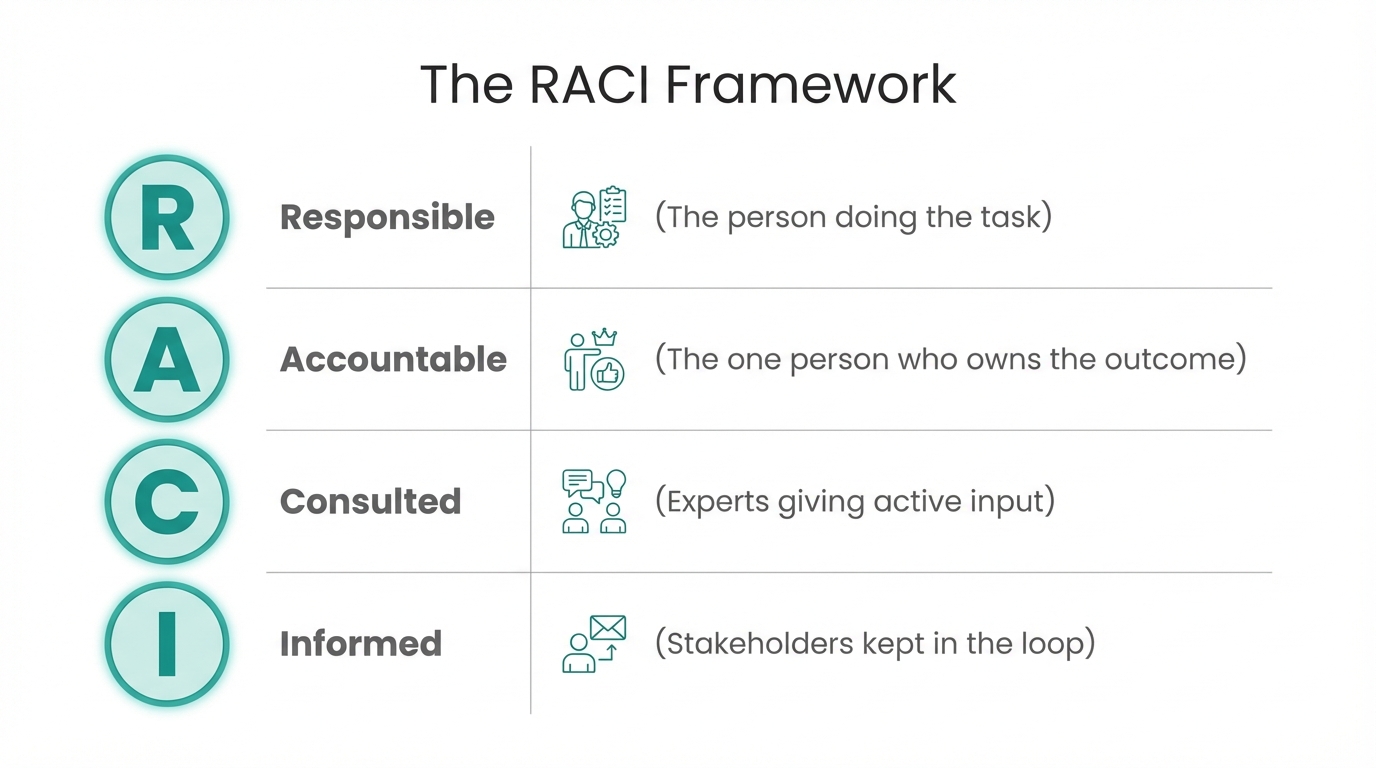
As your team grows from three people to seven and then to twenty, communication begins to break down. When a ball is thrown into a crowd, the more people there are, the more likely it is to hit the floor. Everyone assumes someone else has it. This is where the RACI model for startups becomes an essential tool for scaling a business to 100 million. It defines roles for every major project or decision to ensure total clarity.
| Role | Description | Responsibility Level |
|---|---|---|
| Responsible (R) | The person who actually does the work to complete the task. | High (The Doer) |
| Accountable (A) | The person who owns the outcome and signs off on the work. Only one person per task. | Ultimate (The Owner) |
| Consulted (C) | People whose opinions are sought; they have a two-way communication channel. | Medium (Expertise) |
| Informed (I) | People who are kept up-to-date on progress but don't need to provide input. | Low (Visibility) |
Implementing RACI prevents the 'sharp elbows' dynamic where people fight over tasks, as well as the resentment that builds when stakeholders aren't consulted. For instance, when launching a new marketing campaign via TikTok Ads Manager, the Growth Manager might be Responsible, while the Head of Marketing is Accountable. The Creative Director must be Consulted to ensure brand alignment, and the Sales team should be Informed so they can prepare for the incoming lead flow.
The One Minute Manager: Aligning Employee Goals with CEO Vision
Communication at scale is about marginal gains. You don't need a three-hour meeting to align a team member; you need a consistent system. Inspired by the classic 'One Minute Manager' approach, the goal is to create one-page plans that synchronize the employee’s focus with the company’s vision. Instead of a top-down mandate where you tell people exactly what to do, or a bottom-up approach where they guess what you want, you use a collaborative revision process.
"The best management isn't about giving orders; it's about agreeing on a plan that the employee owns but you endorse."
The employee writes a one-page plan for their quarter or month. You review it, provide feedback, and they revise it. By the end of the process, they have full ownership because they wrote it, and you have full confidence because you approved it. This prevents the common founder frustration of being disappointed by execution that didn't match the 'vision in your head.' While you manage these relationships, platforms like Stormy AI can help source and manage the external talent—like UGC creators—needed to fuel the growth plans your managers have designed.
Mastering the Feedback Loop: PICS and NICS
One of the hardest parts of the founder to CEO transition is learning how to have difficult conversations and provide effective feedback. Many founders fall into the trap of the 'feedback sandwich' (positive-negative-positive), which often leaves the employee confused about the actual priority. To build a culture of excellence, you should adopt the PICS and NICS framework.
PICS (Positive, Immediate, Certain): When someone does something great, praise them immediately. Be specific about the behavior and certain about its value. Don't wait for a quarterly review to tell a high-performer they are doing well.
NICS (Negative, Immediate, Certain): This is where most leaders fail. If an employee is on their phone during a meeting or misses a deadline, you must correct it immediately. If you let it slide four times and then explode on the fifth, you are the problem. Correct small things fast so they never become big things. Be immediate so the behavior is fresh, and be certain so there is no ambiguity about why the behavior was unacceptable.
To keep the momentum of these feedback loops, modern CEOs often use communication platforms like Slack or specialized coaching tools. However, the software only facilitates the speed; the leader must provide the 'certainty.'
The 'Baby Naming' Approach to Company Values
Most companies get their values wrong by picking aspirational words like 'Integrity' or 'Innovation' before they even have a team. A more effective strategy—the 'Baby Naming' approach—is to wait until the company has some history before codifying its values. Just as you get to know a baby’s personality before naming them, you should observe the attributes that lead to success in your specific culture.
For example, if you value 'Speed,' it shouldn't just be a word on the wall. It should be uncomfortably fast. It means asking, "How can we do in two weeks what normally takes a quarter?" If you value 'Pride,' it means caring about the details of a boilerplate email or paying a vendor the day they submit an invoice because it's the right thing to do. Once these values are identified, they must be productized through rituals. At scale, platforms like Stormy AI can assist in vetting creators who align with your specific brand values, ensuring your external marketing remains as 'high-pride' as your internal culture.
"Your values aren't what you say; they are what you reward, punish, and do when no one is looking."
The Speedrun Mindset: Stacking Marginal Gains
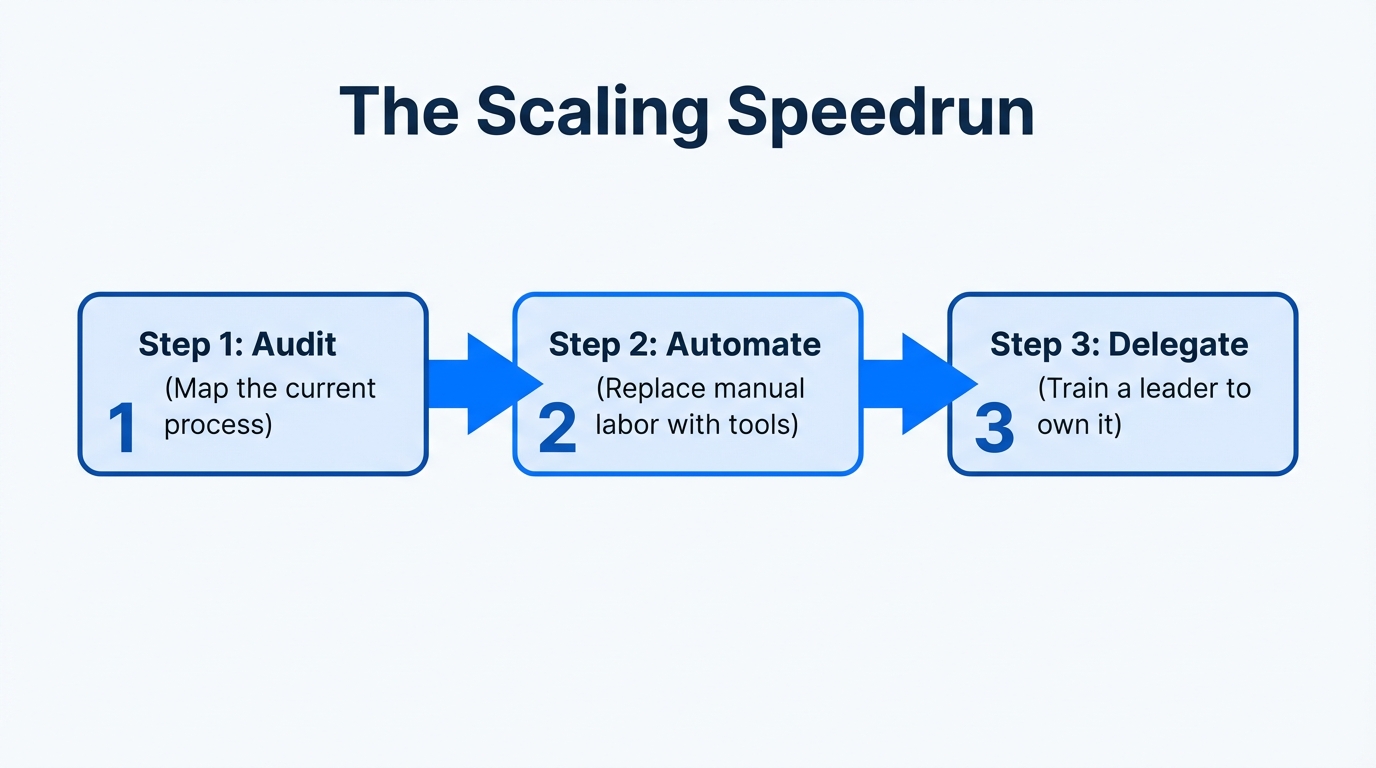
Scaling from $3M to $100M is often about 'speedrunning' the level. Much like the British cycling team that won the Tour de France by focusing on 1% improvements in bike seat thickness and tire grease, a CEO wins by stacking marginal gains across the organization. This 'lead bullets' approach—as opposed to searching for a single silver bullet—creates a moat that is impossible for competitors to cross.
Whether it's optimizing your checkout flow on Shopify, improving your email open rates in Klaviyo, or refining your creator outreach scripts, these 1% wins accumulate. The most successful second-time founders often use the exact same 'playbook' from their previous ventures because they have already identified where the marginal gains live. They aren't inventing new wheels; they are spinning the existing ones faster and with more precision.
Conclusion: Becoming the CEO Your Company Needs
The transition from founder to CEO is a journey of letting go. It requires the humility to realize that you are the root cause of the problems in your company, but also the root cause of the solutions. By implementing the RACI model, mastering the PICS/NICS feedback loop, and moving from abdication to true delegation, you build an organization that can thrive without your constant presence. To get the results of a $100 million company, you must become the type of leader for whom those results are inevitable. Start by auditing your calendar: are you doing the work, or are you building the systems? The answer to that question will determine the ceiling of your success.